Thursday, 28 February 2019

What Still Remains

This article first appeared in the very early days of this blog back in November 2011. I thought it worthwhile to update it slightly, correct some of the grammar and to post a few additional images. As always, the photographs used in this piece are my property and MAY NOT be reproduced anywhere without my express written permission.


Shelter Sign in Frankham Street, Deptford (author's photo)

As someone who frequently guides walks around the bombed areas of our capital city and who frequently studies this aspect of our wartime past, I'm often asked what clues of London’s wartime past remain visible. The answer is that perhaps surprisingly, there is still evidence to be seen - not exactly plentiful but certainly still out there if one uses one’s eyes, knows where to look or has the occasional piece of luck. Sometimes, it can be it a tip-off from a friend or occasionally one can blunder across a little gem by accident

Finding these pieces of our wartime heritage using one’s own detective skills is half of the fun, so it would not be right to spill the beans about everything that remains and unlike some of the so-called experts out there, I certainly does not profess to know about everything that still remains. For those that wish to make their walk to work or school, around their local neighbourhood or simply a stroll around a much loved area, a little more interesting, here is a guide to the sort of thing that can still be spotted by the discerning eye.

Splinter damage at St Clement Danes Church (Author's photo)

Probably the most striking evidence of London’s bomb strewn past are the “honourable scars” worn by many buildings in the capital caused by bomb splinters. Sometimes and incorrectly referred to as shrapnel, this now generic term comes from the name of Colonel Henry Shrapnel. Whilst he was still a Lieutenant in the Royal Artillery in 1784, he invented on his own initiative, a hollow cannon ball, filled with shot that after firing, burst in mid air, thus spreading the shot over the unfortunate soldiers beneath. This first crude form of anti-personnel weapon, when formally adopted by the British Army in 1803 was immediately christened the Shrapnel Shell and whilst during the Second World War, neither side used this sort of weapon against either civilians or military, any sort of bomb or shell fragments were also given the Colonel’s name.

So it is that many buildings in London still bear scars caused by this terrifying by-product of bombing. Some of the better known examples can be found at St Clement Danes Church in the Strand, the General Wolfe Statue in Greenwich Park, Waterloo Place in Westminster and perhaps best known, the Victoria & Albert Museum in Exhibition Road, which even has a helpful commemorative plaque explaining what the damage is, how it was caused and why it has been left unrepaired. There are many other examples of this sort of damage to be found right across London and it is probably the most vivid reminder to be seen of our wartime past. It also provides ample food for thought. If pieces of white hot steel, flying through the air at massive speed can cause the sort of damage to solid masonry that can be seen today, what it could do to the vulnerable human frame does not bear thinking about. If one does think about it, the bravery of the Air Raid Wardens, the Fire Brigade personnel, Police, Ambulance and other Civil Defence workers, both men and women exposed to this lethal barrage, defies belief.

Shelter sign on St John's Estate, Bermondsey (Author's photo)

Whilst out walking, look for the tacit signs of damage; the replacement brickwork around windows, the lighter coloured masonry that even after almost eighty years, still hasn’t quite blended back in with the original, or the most tell-tale sign of all, a terrace of Victorian or Edwardian houses that is abruptly interrupted with a more recent building before resuming its original progression. These are all sure signs of bomb damage, not a dramatic memorial to the Blitz, but a memorial nevertheless. A closer examination of Civil Defence Incident Logs for the area concerned will usually prove one’s suspicions correct and will often reveal that on the site in question, people perished in the own homes. Each piece of repaired damage or replacement building is often therefore a mute memorial to times gone by.

Less widespread, but still visible in places are the painted Air Raid Shelter Signs. The Wartime lead-based paint was surprisingly durable, although with the passage of seventy-odd years, even the hardiest of these signs are starting to look their age now. In some cases, it is the paint used to obliterate the sign which has worn off, thus re-exposing them to public view long after they became obsolete. For some reason, there is a plethora of these Shelter signs in southeast London, with Deptford in particular, being the Shelter Sign Capital of London. Quite why London SE8 has so many of these surviving signs is a bit of a mystery; perhaps it is because (with all due respect to the area) it has escaped serious redevelopment until recently, perhaps it is just good luck. Whatever the reason, we can only hope that with the rediscovered interest in our Wartime past, some or all of these signs can be preserved. Already, one of these southeast London signs, in Jerningham Road, has been lost forever after the wall it was on was recently demolished as part of a housing scheme. Let us hope it is the last to be lost in this way, for these signs deserve to survive and act as a reminder of more troubled times. Apart from Deptford, there are Shelter signs to be found in Westminster, in Poplar and opposite the Oval Tube Station, although this sign has recently been partially covered with a street sign.

Shelter with intact blast wall at Croydon Cemetery (Author's photo)

From Shelter Signs, we go to the Air Raid Shelters themselves. As has been discussed on this blog in the past, Shelters came in many shapes and sizes, from the corrugated Anderson Shelter in the back garden to the communal ‘Morrison Sandwich’ shelter via the Deep Level Shelters in Central London. Examples of all these and more remain; most Anderson Shelters have long since been uprooted from their original back garden locations but some remain as sheds on allotments in odd parts of the capital. The communal brick and concrete shelters were christened ‘Morrison Sandwiches’ by some laconic Londoners, when some of the early examples of these structures showed a propensity to collapse at the merest hint of a nearby blast. The concrete slab base and roof of these shelters provided the bread and when the poorly keyed in and frankly Jerry-built brickwork was blown out by the blast of a near-miss bomb, the unfortunate occupants of these buildings provided the meat in the sandwich – enough said. Some of these shelters still survive; Fawe Street in Poplar, Battersea Park, Raynes Park and Norbury all possess surviving examples as does a splendid example complete with intact blast walls at Croydon Cemetery. The Deep Level Shelters were built from 1941 based on the experiences of the London Underground stations used as shelters; eight were built in total, four north of the Thames at Chancery Lane, Belsize Park, Camden Town and Goodge Street and four south of the River at Clapham North, South and Common as well as at Stockwell. Designed to take 8,000 people each in relative comfort and unrivalled safety, these shelters all survive and the ungainly concrete entrance structures can all still be seen at these locations.

EWS sign at the site of St Paul's School, Hammersmith (Author's photo)

Altogether a rarer specimen of wartime signage is that which signifies the “EWS” or Emergency Water Supply. This usually takes the form of a white or sometimes yellow rectangle with diagonal black stripes painted across it with the letters E W S in the lateral and lower quadrants, with the water capacity shown in the upper. These Emergency Water Supplies were large static water tanks, originally formed from the sealed basements of bombed out building, but later often purpose built tanks designed to augment the Fire Brigades’ supply of water should the regular water mains be damaged by bombing. A few of these signs still survive - there are two faded examples at the site of the former Wilson's Grammar School in Camberwell, another in Copperfield Street in Southwark, on Albert Embankment, at Boston Manor and at the former site of St Paul's School in Hammersmith.

Other sundry structures remain; Wardens’ Posts, Pillboxes, Anti-Tank defences, Anti-Aircraft Gun emplacements, rifle loopholes and the like remain across our capital. Putney Bridge Station is the home to a highly visible pillbox, Blackheath is the home to a set of Home Guard rifle loopholes and Epsom Downs is the home to a set of Tank Traps. These defences all formed part of the ‘Stop Lines’ formed to slow down and delay the advance of the advancing Germans in order to buy time for the British defenders to call up reserves. Fortunately, these defences were never put to the test but this fascinating and untried part of our wartime history can still be seen gently crumbling away in many parts of suburban London. Mudchute Park on the Isle of Dogs is the home to an almost complete Anti-Aircraft emplacement. Wardens’ Posts are rarer creatures although one or two others are still extant, with extant examples still to be found in Blackheath, Blackfen and Barnes amongst other places.

Putney Bridge Station pillbox (Author's photo)

Another evocative piece of wartime London still visible, albeit not being used for its original purpose and in declining numbers, is the once ubiquitous stretcher fencing. Mass produced in steel and wire mesh for the expected vast numbers of civilian casualties caused by German bombing, the ‘ARP’ stretcher was designed to be easily cleaned and re-used in clearing the dead and wounded. Many of these were never used and the end of the war saw hundreds of thousands of these simple pieces of equipment suddenly made redundant. In an early piece of recycling, an ingenious use was made of these stretchers in order to replace the wrought iron railings sacrificed for the war effort. There were also many new estates being built to replace the vast swathes of local authority housing destroyed in the Blitz. The stretchers provided a simple and effective solution and can still be seen in several locations across the London suburbs; Watergate Street in Deptford, Amherst Road in Hackney, the Springfield Estate in Stockwell are but three of the places that these can found.

Stretcher Fences in Marlborough Lane, Charlton (Author's photo)

Apart from these physical reminders, there are of course, an abundance of monuments which commemorate events, people and places connected with the wartime past, not only of this country’s wartime achievements but the Allied cause as a whole. So, across London we find plaques and statues galore commemorating such diverse personalities as the Polish General Sikorski, the Supreme Allied Commander of the Allied invasion at Normandy, Dwight D Eisenhower, the Chief of the Imperial General Staff Viscount Alanbrooke and General De Gaulle as well as many others. Plaques mark the spot of the first V-1 Doodlebug falling in Bow, the V-2 Long Range Rocket in Chiswick as well as the location of the Special Operations Executive, the Headquarters of the Norwegian Merchant Marine. There are also memorials to the fallen; across London there are still new plaques being erected by the charity Firemen Remembered marking the locations where members of the Fire Services fell in the course of performing their duties whilst under fire.


English Heritage Blue Plaque in Bow (Author's photo)

The reminders of our wartime past referred to above merely scratch the surface of what is still out there to be seen. As mentioned earlier, there is much enjoyment to be found in discovery and as always, any comments from the readership are welcomed. If you know of some aspect of London’s wartime heritage that can still be seen, then please feel free to share the information with us.

Thursday, 31 January 2019

Tales behind the graves in Carshalton

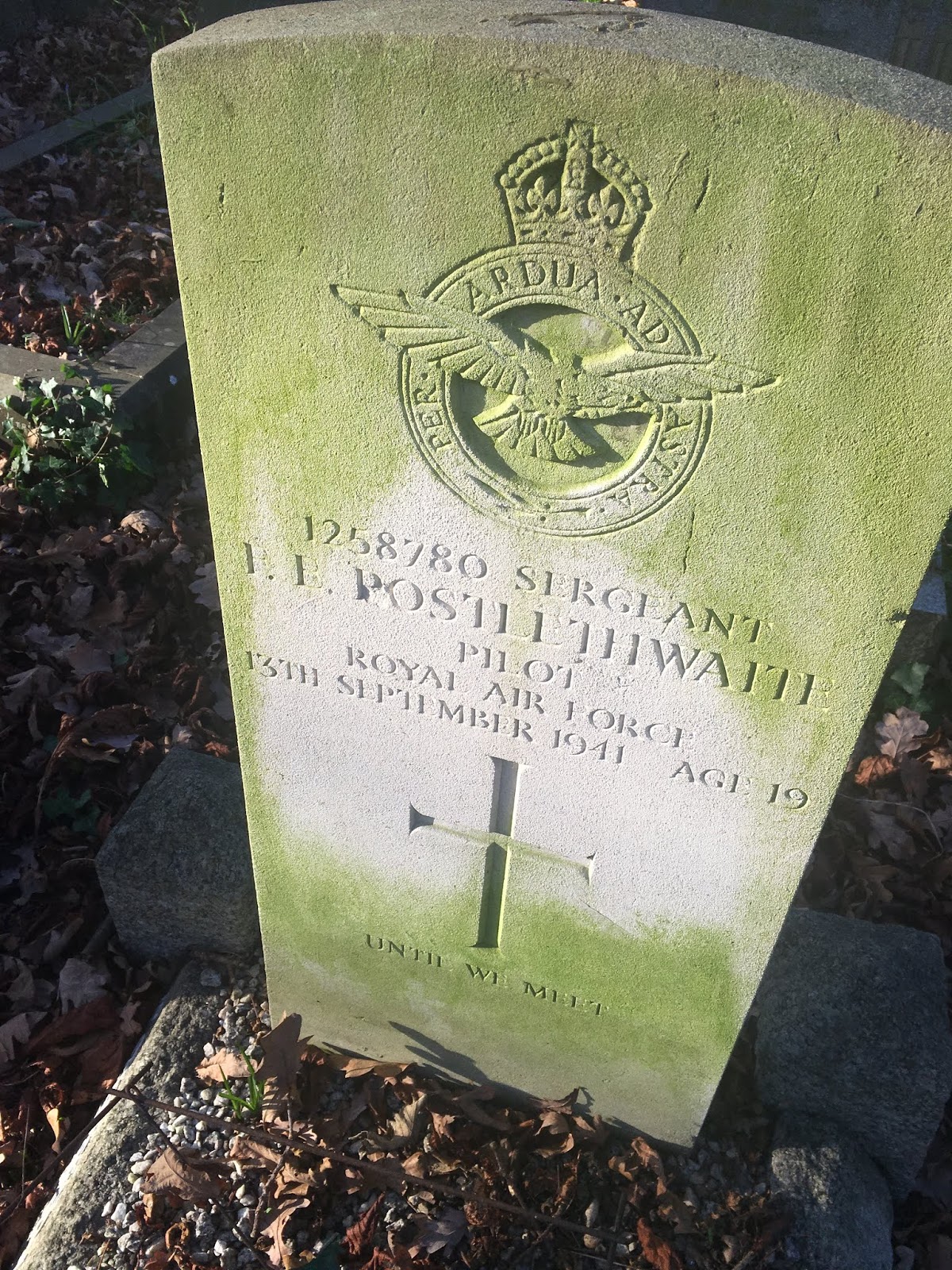
The grave of Sgt. Frederick Postlethwaite at All Saints Churchyard, Carshalton (Sam Dorrington)

One of the more satisfying aspects about my enthusiasm for history (or obsession depending on who you talk to) is how this tends to rub off on to my friends. This is partially because many of them have always shared this fascination in the subject but because we're never far from our wartime past in this country, they do all seem to notice points of interest much more easily these days!

Whatever the reasons, they all seem to have caught the history bug and are always quick to let me know about their finds. Sam Dorrington is one of my longest standing friends and has always shown a particular interest in the subject but in his case, this has perhaps been more a rekindling of a dormant fascination. Back in November 2016 I was proud to tell the story of his grandfather, Able Seaman Jack Dorrington and since then Sam, who is a talented professional photographer, has frequently accompanied me in searching out old wartime structures, visiting wartime airfields and often sends me photographs of various memorials and other wartime points of interest that he has discovered on his travels.

One such photograph he sent to me recently recalled memories of my own 'accidental researching' in Charlton which I reported on in January 2017 and which incidentally, had a connection with Sam's own local neighbourhood of Carshalton in suburban Surrey. Whilst taking a shortcut to the shops through his local churchyard, he came across a Commonwealth War Graves Commission headstone and upon closer inspection, discovered many more located around All Saints' Churchyard.

Despite being familiar with the area, Sam doesn't often use the churchyard as a short cut and had thus never previously noticed the distinctive CWGC headstones and as a result, decided to send me a photograph of the RAF airman's grave that had caught his eye. As always, I needed to know more and so set about trying to find something of the story of Sergeant FE Postlethwaite and the circumstances of his death, at the tragically young age of 19.

Frederick Postlethwaite and a letter from the King (Kelvin Youngs, Aircrew Remembered/Michael Taylor)

Frederick Edgar Postlethwaite was the son of Frederick William and Alice Marion Postlethwaite and had been born in Southwark in 1922. However, his mother and father both appear to have both died at a relatively young age in 1928 and 1932 respectively and so by the time of the 1939 Register being taken, the 17 year old Frederick had become the ward of one Elsie May Cogger of 2 Queen Mary's Avenue, Carshalton Beeches. In August 1941, having volunteered to serve as RAF aircrew and having qualified as a Sergeant Pilot, he was posted to the famous 92 Squadron, flying the Spitfire Mk. Vb based at Biggin Hill in Kent and on the 31st of that month, flew his first two operational patrols, a fighter sweep over the Channel, followed by a convoy patrol off the North Foreland. The beginning of September saw further fighter sweeps over France, interspersed with convoy patrols. On 8 September 1941, the Operations Record Book reports a "big party in the mess" to celebrate the anniversary of the squadron's arrival at Biggin Hill, which fortunately coincided with a day of non-flying due to bad weather!

The 92 Squadron Operations Record Book dispassionately records Sgt. Postlethwaite's death (author's photo)

The bad weather continued to play a part in the squadron's fortunes, with only one day of suitable flying weather on 11 September, which saw 'Rhubarb' fighter sweeps over France. The 13th saw another day of poor weather over France, which precluded any operational flying but which did allow the squadron to take part in training exercises. At 19:00 hours, whilst taking part in formation flying exercises, Postlethwaite's Spitfire, serial number W3562 was seen to go into an uncontrolled dive from about 2,500 feet from which the pilot did not bale out. The aircraft plunged into a house near Biggin Hill airfield, killing Sgt. Postlethwaite instantly. No explanation was ever discovered as to the cause of the accident.

This tragic incident caused us both to reflect upon this accidental death and as a result, we chose five more RAF headstones at random in the churchyard to try and discover more about these War Graves that were almost on our doorsteps.

Sgt. Frederick Jones at All Saints Churchyard, Carshalton (Sam Dorrington)

The first of these additional names we looked at concerned Sergeant Frederick Jones, who was aged 34 and at the time of his death, married to Violet Ellen Jones. Unfortunately, due to the sheer number of people bearing the name Jones, we have been so far unable to discover anything further regarding their family life, other than that they were living somewhere in North Cheam at the time of his death on 14 September 1943. Closer examination of the excellent CWGC website reveals that Frederick was serving in Bomber Command as a mid-upper gunner with 115 Squadron.

A look at the squadron's Operations Record Book for the date in question shows that as with our first casualty, he died as a result of a tragic accident.

At this stage of the war, 115 Squadron was one of the relatively few squadrons that flew the Avro Lancaster Mk II which was powered by four Bristol Hercules engines instead of the more usual Merlin power plant used for other marks of the iconic heavy bomber. The Bristol-powered variant was never as successful as the Merlin-powered Lancaster, being restricted to a smaller bomb load and having a lower ceiling, so when the expected shortage of the Rolls Royce and licence-built Packard Merlin engines failed to materialise, production of the Mk II was curtailed after just three hundred had been built. The Hercules engines were then used to power the Mk III version of the Halifax bomber, which ironically became a far more successful aircraft with this choice of engine than the original Merlin powered variants of this Handley Page aircraft!

On 14 September, the crew had been allocated a new aircraft, serial DS780 and at 10:53 took off from their base at RAF Little Snoring in Norfolk to carry out air tests on their new charge. In addition to the regular crew of seven, the Lancaster was carrying an additional crew member, Sgt. Harold Ashwin, a Flight Engineer who was on detachment from 1678 Conversion Flight but serving as a member of 115 Squadron. All seemed to have been going well until the operation of levelling and calibrating the bomb sight, at which point the Air Bomber, Sgt. M Read, requested the pilot, F/Sgt. Bradford RNZAF to maintain a height of 2,000 feet to ensure that the bomb sight would not jam but it soon became apparent that something was wrong and the pilot advised that he was unable to maintain height. F/Sgt. Bradford ordered the crew to their crash stations but shortly afterwards, the aircraft ploughed into a railway embankment at Magdalan, about four miles north of the RAF airfield at Downham Market. There were only two survivors, the Wireless Operator, Flight Sergeant Williamson and the Air Bomber, Sgt. Read. The investigation revealed that the two starboard engines had been feathered as part of the air test but could not be restarted due to the master fuel cock having been closed.

The cold facts of the loss of DS780 in the 115 Squadron O.R.B. (author's photo)

With the exception of Sgt. Ashwin, who was not a regular member, this was an experienced crew which had completed thirteen operational missions, with Flight Sergeant Bradford having logged a total of 743 flying hours, since he joined the squadron on 14 July 1943 from 1678 Conversion Flight. Of the survivors, the Wireless Operator, F/Sgt. Ivan Williamson RNZAF went on to complete two operational tours with 115 and 75 Squadrons, and left the service in 1946 as a Flying Officer. He died in his native New Zealand, aged 69 in 1981.

Incidentally, 115 Squadron was one of the 'original' Bomber Command squadrons, active at the outbreak of war and apart from a very short spell where they were attached to Coastal Command, served continuously with Bomber Command right through to the end of the war in Europe. They dropped the second greatest tonnage of bombs - approximately 23,000 tons - of any RAF Squadron during the war as well as participating in the third highest number of raids. As a counterpoint to these fine achievements and undoubtedly as a direct result of their almost continuous availability, 115 Squadron suffered the highest losses of any squadron within Bomber Command and were indeed, the only squadron to lose more than 200 aircraft in the war.

The grave of Sgt. Reginald Sharp at All Saints Churchyard, Carshalton (author's photo)

The next casualty that we selected at random was Sergeant Reginald James Sharp who died on 19 May 1942, aged just 22. Like the previous two individuals, he was a local boy and was an only child who lived with his parents George and Ethel Sharp at 196 Thornton Road, Carshalton.

After enlisting in the RAF and completing his aircrew training, Reginald was posted in November 1941 to Bomber Command as an Observer (the early-war phrase for Navigator) with 15 Squadron, based at RAF Wyton in Cambridgeshire, from where the squadron flew the Short Stirling, the RAF's first four engine heavy bomber. The Stirling was an unsatisfactory design which had had it's wingspan reduced whilst still on the drawing board for reasons of expediency concerning hangar accommodation. As a result, its operational ceiling suffered and it became the least popular and worst performing of the three types of heavy bomber ordered by Bomber Command, with most crews preferring the Lancaster or Halifax types. However, in the early stages of the war, squadrons had to make do with what was available and wait for the other types to become available in quantity.

Reginald does not appear to have been part of a regular crew but despite this, by May 1942 had flown sixteen missions with the usual mixture of night bombing over Germany and occupied Europe and 'gardening' or minelaying missions over the North Sea and Baltic. Closer inspection of the Operations Record Books reveals that four of these missions were aborted at various stages into the flight due to various technical issues typical of the Stirling.

On 19 May 1942, Reginald formed part of an expanded crew of nine, including Charles Evans Woodhouse, a USAAF civilian contractor electrician attached to Bomber Command and a member of RAF ground crew, Aircraftman 2nd Class Thomas Edwards of North Sheen. The reason for the latter's presence is not known but was perhaps a flight as a favour from his south west London neighbour, Reginald Sharp. Whatever the now unknown reasons, the crew took off shortly after midday from RAF Wyton in Stirling Mk I serial W7523 under the command of Sergeant Albert Douglass. The reason for the flight was an air test and the presence of the USAAF Electrician perhaps indicated that the aircraft had been suffering from some sort of electrical problem and was being tested following repairs. However, shortly after taking off, the bomber crashed into trees just north east of Gravely, with the Operations Record Book for RAF Wyton suggesting that the aircraft had caught fire whilst in the air. The aircraft rolled onto its back soon after hitting the ground and seven of the nine on board were killed outright, including Reginald Sharp.

There were two survivors from the initial crash, the Air Bomber, Pilot Officer Lionel Hack, who survived and the American Charles Woodhouse, who sadly succumbed to his injuries in hospital the following day.

The grave of Kenneth Snuggs at All Saints Churchyard, Carshalton (author's photo)

Our next casualty was Sergeant Kenneth Snuggs, born on 12 May 1910 in Humberstone, Leicestershire but who by the time of the 1939 Register being taken was living in Carshalton, where his civilian occupation was described as a 'Master Hairdresser' who prior to joining the RAF, also had a wartime job as an Ambulance Driver with the Cheam & District Auxiliary Ambulance Service.

Following his enlistment into the RAF and on completion of his aircrew training, Kenneth served with Bomber Command, in his case as a Wireless Operator/Gunner in 44 (Rhodesia) Squadron based at RAF Waddington, another 'original' Bomber Command squadron which served without a break for the entire war and whose squadron badge carried the splendidly appropriate motto for a bomber squadron of "Fulmina Regis Iusta", which translates to "The King's Thunderbolts are Righteous".

Sergeant Snuggs appears not to have been part of a regular crew, as the 44 Squadron Operations Record Book shows him flying eight missions with three different crews during June and July 1941. However, on his second mission, a raid on the Marshalling Yards at Hamm on 12 June 1941, he was credited with having shot down a Bf110 night fighter over Enschede. On 6 July 1941, he flew on a mission to attack German cruisers at Brest under the command of a Flight Commander (and future Squadron Commander) of 44 Squadron, Squadron Leader Kenneth Smales DFC. Smales was a colourful character who had managed to escape from under the noses of the advancing Germans in 1940, when he and a colleague were able to reach the port of Brest by motorcycle (having previously been shot down and then having commandeered another aircraft) in time to catch one of the last ships to leave the port on 17 June 1940, just before the Fall of France. Smales had a very individual style of low flying when attacking such naval targets, often flying so low that his aircraft would return caked in mud and salt splashes. Despite this bold approach, Smales survived the war and served in the peacetime RAF during the 1950s.

Having survived this mission, Snuggs was then posted to the Central Gunnery School, located at RAF Castle Kennedy near Stranraer. On 27 July 1941, he took off in Hampden serial number P1162 piloted by Sergeant HG Turner as part of a crew of four Wireless Operator/Gunners for the purpose of Gun Camera trials but shortly after taking off, the aircraft stalled whilst turning and crashed at 10:32, about one mile southeast of the airfield, killing all five on board.

The grave of Sgt. Horace James Cox at All Saints Churchyard, Carshalton (Sam Dorrington)

Horace James Cox was yet another local boy, the eldest of two sons of Horace Walter and Edith Cox who in the 1939 Register, were recorded as living at 100 Westmead Road, Carshalton. In 1942, Horace junior had married his wife Jose and lived at 217 Gander Green Lane, Sutton. Having volunteered to serve as aircrew with the RAF, Horace had completed his initial training and had been posted as an Air Bomber to 11 Operational Training Unit Bomber Command, based at RAF Westcott in Buckinghamshire and was a member of Course 69. Here, Horace would have been found himself as part of a bomber crew via the time honoured Bomber Command process known as 'Crewing Up' in which the men were placed inside a hangar or similar large space and left to sort themselves into the required number of crews. Once this was achieved, the newly formed crews would complete their training for night bombing operations on Wellington bombers which had been retired from front line service and which could often justifiably described as 'tired'. Just occasionally, the fledgling crews would be sent out on ops themselves but this became a less common occurrence as the war progressed and the front line Bomber Command squadrons became more numerous.

Course 69 at 11 OTU - infuriatingly, the photographed is not captioned, so the names remain unknown (Author's collection)

An important part of the training regime at an OTU was in the continual practice of night time bombing, as this formed the major part of Bomber Command's work. This meant replicating as far as possible the conditions in which crews would be expected to bomb a target and so in the early hours of 2 May 1943, the newly-formed crew took off from RAF Oakley, a satellite station of Westcott with the intention of dropping bombs on the range at Warpsgrove. Their charge was Vickers Wellington Ic serial Z8866, a twin engined medium bomber, once the mainstay of Bomber Command but now being increasingly relegated to training duties upon replacement by the four engined 'heavies' in the form of the Halifax and Lancaster.  At 02:45, observers on the ground witnessed that the aircraft dropped two bombs but then flew away to the south west. Shortly afterwards, an aircraft was seen to be on fire and it was soon reported that a Wellington had crashed at Belcher's Farm, close to Stadhampton. The nearby base at RAF Mount Farm sent two crash tenders and an ambulance but on arrival reported that the crew had all been killed.

The grave of F/O George Wigley at All Saints Churchyard, Carshalton (Sam Dorrington)

Our final casualty was the only officer in the group that we selected but whose story is perhaps the most heartbreaking of all those recounted previously. Flying Officer George Alexander Wigley was 22 years old when he died and like the others whose stories we have examined, was another local lad who lived with his parents and siblings at 41 St Albans Grove, Carshalton. As with many of his RAF colleagues buried at All Saints Churchyard, George was serving with Bomber Command, in his case as an Air Bomber with 97 Squadron of the Pathfinder Force based at RAF Bourn but unlike the others we chose, had received a commission as a Flying Officer.

George formed part of the seven-strong crew of Lancaster Mk III, JB219 under the command of Pilot Officer J Kirkwood DFC and at 16:50 on 16 December 1943, the aircraft lifted off from the Cambridgeshire airfield, heavily laden with five 2,000 lb 'High Capacity' or HC bombs, popularly known as 'Blockbusters' to be delivered to the "Big City" as Berlin was universally referred to in Bomber Command. These were bombs with a very thin casing, so as to maximise the blast effect and by 1943, formed a standard part of the RAF's armoury, along with the larger 4,000 lb HC bombs, known as 'Cookies'.

Kirkwood and his crew were highly experienced, having flown 23 missions with 207 Squadron since June 1943, before transferring to the Pathfinder Force (or PFF) on 29 November 1943. The PFF were viewed as something of an elite force within Bomber Command, being a specialist target finding and marking force. They were also viewed with some resentment amongst the senior echelons of the "Main Force" squadrons as the PFF tended to "cream off" the best crews to serve with them but the crews themselves were often keen to be selected. Partially, this was down to the professional pride at being seen to be part of an elite but was also due to more pragmatic reasons - a PFF tour of duty consisted of one single tour of 45 missions before being posted away from combat flying, whereas Main Force crews were expected to perform a first tour of 30 missions, then being rested as an O.T.U. Instructor for example, before undertaking a second tour of 20 missions.

Following their posting to 97 Squadron, this raid on Berlin was their first mission as part of the Pathfinder Force and according to the squadron's Operations Record Book, it went largely without incident, with only one aircraft from the squadron lost to enemy action over the target but this particular raid was to be tinged with tragedy upon the return to England.

George Alexander Wigley (Kelvin Youngs, Aircrew Remembered)

On the morning of the raid, low cloud and poor visibility had been forecast, so much so that the Met. Officer at RAF Bourn had been convinced that ops for the day would be cancelled by Bomber Command HQ at High Wycombe. No such order was received and the mission went ahead as scheduled, with 483 Lancasters from across Bomber Command being dispatched. During the raid itself, some 25 Lancasters were lost to enemy action but upon the return, the promised low visibility had indeed materialised and particularly affected the airfields of 1, 6 and 8 Groups (the latter of which 97 Squadron was a part). As a result, a further seven aircraft from the squadron were lost when attempting to land at their home airfields. Two of these crews managed to bale out safely, abandoning their aircraft, whilst of the remainder who attempted to land, none survived unscathed, ranging from one or two survivors from an aircraft, to entire crews being killed. Across the whole of Bomber Command, a total of 29 Lancasters were lost on returning to England as a result of the bad weather.

Lancaster JB219, of which George Wigley formed part of the crew, was one of those lost when attempting to land at RAF Gransden Lodge, a satellite airfield of RAF Bourn, when at 00:10 the bomber crashed killing all on board at nearby Hayley Wood. The aircraft immediately caught fire but the wreckage containing the bodies of the crewmen was not discovered until the following morning. This raid saw the worst bad-weather crashes incurred during the entire war and escalated the attrition rate for this mission to an unacceptably high 12.2 percent. No small wonder that Bomber Command crews dubbed this raid as "Black Thursday."

The 97 Squadron O.R.B. tells the sad story of JB219's end (author's photo)

It is a sobering thought indeed to consider that of the 55,573 killed in Bomber Command (out of an approximate aircrew strength of 125,000), some 8,195 of these lost their lives in flying or ground accidents such as we have examined above.

When all of the individuals whose cases we have examined joined the RAF, they must have had at least the occasional thought, quickly suppressed, that they may well be killed on active service and no doubt, the natural assumption would have been that it would always be someone else that would "buy it" but it somehow seems far worse that these men should have died by accidental causes, especially in the case of Flying Officer George Wigley, who with his crew-mates, had seemingly survived the worst dangers of a raid to Berlin, only to fall at the final hurdle when home and safety was so tantalisingly close at hand.

If any readers are in possession of any further photographs of those airmen mentioned above, or know members of their families who are prepared to share images, then please contact me using the 'comments' facility and I will be happy to add them to this article. My thanks are due to Sam Dorrington for alerting me to his latest find and for sharing his photos of the headstones with me.

In the meantime, the information garnered thus far will be shared to the excellent Aircrew Remembered website and linked to the relevant aircraft listed below, in order to ensure that these men and their crew mates are never forgotten.

This sort of history is on all of our doorsteps and the sort of research seen above is the type of service that we specialise in, so if you have a relative whose service you would like to explore further, then please contact us using the form on our main website.

As always, all of the photographs used in this article are copyright to me, or of the person credited in the caption and may not be used without my express written permission.

In Memoriam:

92 Squadron Spitfire Vb serial W3562

Sergeant FE Postlethwaite RAFVR (Pilot) of Carshalton Beeches

115 Squadron Lancaster II serial DS780

Flight Sergeant EAJ Bradford RNZAF (Pilot & Captain) of Hawke's Bay, New Zealand
Pilot Officer CR Morse RNZAF (Navigator) of Hanmer Springs, Canterbury, New Zealand
Sergeant F Jones RAF (A) (Mid Upper Gunner) of North Cheam
Sergeant M Fearn RAFVR (Flight Engineer) of Inverness
Flight Sergeant RV Griffiths RNZAF (Rear Gunner) of Penrose, Auckland, New Zealand
Sergeant HJB Ashwin RAFVR (Flight Engineer) of Kilburn

15 Squadron Stirling I serial W7523

Sergeant A Douglass RAFVF (Pilot & Captain) of Nottingham
Sergeant RJ Sharp RAF (Observer) of Carshalton
Sergeant DW Lewis RAF (Flight Engineer) 
Flight Sergeant NF Payne RAFVR (Wireless Operator/Gunner) of Southampton
Sergeant HV Edmonds RAFVR (Air Gunner) of Exeter
Sergeant N Cash RAFVR (Air Gunner) of Broughton
Aircraftman 2nd Class TA Edwards RAFVR (Air Gunner) of North Sheen
EL2C CE Woodhouse USAAF (Electrician) of Oklahoma, USA

Central Gunnery School Hampden I serial P1162

Sergeant HG Turner RAFVR (Pilot)
Sergeant K Snuggs RAFVR (Wireless Operator/Gunner of 44 Squadron) of Carshalton
Flight Sergeant GE Appleton DFM RAF (Wireless Operator/Gunner of 49 Squadron) of Newcastle-upon-Tyne
Flight Sergeant AHD Batty DFM RAF (Wireless Operator/Gunner of 226 Squadron) of Walsall
Flying Officer A Paterson DFC RAFVR (Wireless Operator/Gunner of 49 Squadron) of Clapham Common

11 OTU Wellington Ic serial Z8866

Sergeant JR Richmond RAF (Pilot & Captain) of Epsom
Sergeant LR Crouch RAFVR (Navigator) of West Ealing
Sergeant HJ Cox RAFVR (Air Bomber) of Sutton
Sergeant ED Scott RAFVR (Wireless Operator/Gunner) of Beckenham
Sergeant JA Cheetham RAFVR (Air Gunner) of Liverpool
Sergeant TN Harker RAFVR (Air Gunner) of Darlington 

97 Squadron Lancaster III serial JB219

Flying Officer J Kirkwood RAFVR (Pilot & Captain) of Kilwinning
Flight Sergeant EG Hubbard RAFVR (Flight Engineer) of Croxton
Sergeant RC Stewart RAFVR (Navigator) of Braemar
Flying Officer GA Wigley RAFVR (Air Bomber) of Carshalton
Sergeant RG Cleeve RAFVR (Wireless Operator) of Wyke Green
Sergeant L Madeley RAFVR (Mid Upper Gunner) of Manchester
Sergeant J Killen RAFVR (Rear Gunner) of Hollinfare


Published Sources:

The Berlin Raids - Martin Middlebrook, Viking 1988
Black Night for Bomber Command - Richard Knott, Pen & Sword 2014
The Bomber Command War Diaries: An Operational Reference Book 1939-1945 - Martin Middlebrook & Chris Everitt, Pen & Sword 2014


Internet Sources:

49 Squadron Association
Aircrew Remembered


Unpublished Sources:

92 Squadron Operations Record Books - National Archives Kew, AIR 27/744/8 - 10
115 Squadron Operations Record Books - National Archives Kew. AIR 27/892/4 - 18
15 Squadron Operations Record Books - National Archives Kew, AIR 27/203/20 - 34
RAF Wyton Operations Record Books - National Archives Kew, AIR 28/963
44 Squadron Operations Record Books - National Archives Kew, AIR 27/448/10 - 18
RAF Castle Kennedy Operations Record Book - National Archives Kew, AIR 28/125
Central Gunnery School Operations Record Book - National Archives Kew, AIR 29/605
11 O.T.U. Operations Record Book - National Archives Kew, AIR 29/942
11 O.T.U. Appendices - National Archives Kew, AIR 29/645
97 Squadron Operations Record Books - National Archives Kew, AIR 27/767/22 - 24
Casualty Information - Sgt K Snuggs - National Archives Kew, AIR 81/7957


Sunday, 16 December 2018

The Auxiliary Fire Service: From Army Dodgers to Heroes with Grimy Faces

A group of AFS firemen (and cab) at Gordonbrock Road School (author's collection)

The Auxiliary Fire Service or AFS was formed in 1938 at the time of the Munich Crisis and on its formation, there were many who doubted the motives of those who volunteered for firefighting duties. An explanation for this early hostility could perhaps have been due to the fact that volunteers for the Fire Service were automatically exempted from the call-up to military service. As a result, a fair number of conscientious objectors were attracted to the AFS and although attitudes towards these principled individuals were more enlightened than during the Great War, there were still many small-minded citizens who could not bring themselves to show any sympathy towards this attitude.

As a result of this, aided and abetted by some of the more hysterical sections of the press, both local and national, there was still some lingering hostility towards the AFS during the dying days of peace and during the so-called "Phoney War" period immediately after the declaration of war in September 1939. "£3 a week Army Dodgers"  and "£3 a week to play darts" were just two of the insults directed towards these volunteers. There was also some hostility towards the Auxiliaries from the regular firemen themselves; some of this was aimed at the conscientious objectors from a minority of firemen who had previously served in the armed forces themselves and harboured outdated views. Sadly though, some was racially motivated, especially towards the considerable Jewish contingent who volunteered for service in the AFS. Some of this was the casual anti-Semitism which pervaded (and which sadly sometimes still pervades) society, whilst some of the more overt hostility came from members of Mosley's British Union of Fascists, some of whom served within the Fire Services.

Firemen in Cheapside on the morning of 30 December 1940 (author's collection)

Fortunately, once the bombs began to fall, it was clear to the public at large that the firemen (and women) were not "Army Dodgers" at all and had in fact, volunteered for the most dangerous role within the Civil Defence and the prejudice aimed at them rapidly evaporated. The truth of the matter was that the newly formed Civil Defence service, of which the Auxiliary Fire Service was a major part, was essentially a citizen army of local people and tended to reflect the ethnicity of the local recruits. For example, in the Aldgate and Whitechapel areas of East London, some 85-90 per cent of the Civil Defence was Jewish - simply local people playing their part in helping to defend their own neighbourhood.

The London Fire Brigade in 1939 was under the control of the London County Council and across the whole of the United Kingdom, the Auxiliaries were similarly held under municipal control. Such a vast expansion of the Fire Services required a similar increase in the number of accommodation and equipment. The former was easily solved by invariably using school premises, newly vacated as a result of the evacuation of school children and which with their catering facilities and ample space for parking, were ideal for use as makeshift fire stations. More of a problem was the provision of sufficient vehicles to act as fire engines. In the capital, the London Taxi came to the fore, towing a trailer pump and with a ladder strapped to the roof rack. Their drivers also went to war and their encyclopedic knowledge of the streets made them an invaluable weapon in the fight against the fires lit by Hitler's bombs.

A London Taxi in attendance at All Hallows-by-the-Tower on 30 December 1940 (author's collection via LMA)

As the word 'auxiliary' suggests, the AFS provided additional or extra capacity to the regular fire brigades and was designed to supplement them by acting as a sort of mobile reserve which could be deployed from city to city in times of great need. The fragility of this plan became evident on the first day of the Blitz, when AFS units arrived from outside the capital only to find that their equipment was not always compatible. For example, hydrant connections were of differing gauges and the standards of training often differed from region to region, so whilst the provincial volunteers were certainly willing, they were not always able to assist. There were also sometimes petty arguments between the various local authorities who controlled the country's fire services. which sometimes prevented the rapid movement of the AFS volunteers from one municipality to another.

Notwithstanding these difficulties, the men and women of the AFS performed heroically during the Blitz. Despite their intensive training, most of the firemen of the AFS had never tackled a 'normal' fire prior to the commencement of the Blitz on 7 September 1940, let alone the sort of fires caused by incendiary and high explosive bombs but during the first twenty two days of the bombing of London, they had fought almost 10,000 fires across London. The Firewomen (the use of the word 'Firefighter' didn't begin until the 1980s) didn't actually tackle fires during the Second World War but instead performed equally vital duties such as Fire Watchers, Drivers and managing the communications network and by 1943, over 70,000 women had volunteered for the Fire Service across the United Kingdom. As a result of their work during the Blitz, the firefighters found themselves feted as "Heroes with grimy faces" a phrase originally coined by Winston Churchill but one which caught the imagination of a grateful public.

Firemen Remembered plaque at Invicta Road School (author's photograph)

However, as a result of the experience gained during the Blitz, it was clear that coordinated action was required, not only to ensure commonality of equipment and training but also to ensure that the petty regional jealousies were overcome. Therefore, on 18 August 1941 the 1,400 separate fire services in Britain were nationalised and a new body, the National Fire Service or NFS was formed in their place. This new service quickly set about tackling the problems caused by the differences in organisation and equipment thrown up by the huge number of former municipal brigades. There were some frictions at first as old habits died hard but it was quickly realised that the nationalisation was for the greater good and the new NFS under the command of the former head of the London Fire Brigade, Sir Aylmer Firebrace, was soon to prove itself more than equal to the challenges thrown up by the Baedeker Raids of 1942-3 and the Little Blitz of 1943-4 as well as the greater problems caused by the V-1s and V-2s of 1944 and 1945.

After the War, the NFS was eventually disbanded in 1948 and the regional fire brigades were taken back under municipal control. However, the standardised procedures and equipment remained in place and thus it is fair to say that the National Fire Service formed the template for today's modern fire services that we all take for granted in their efficiency and dedication to duty.

The National Firefighters' Memorial (author's photograph)

In London alone, 327 firefighters - male and female - were killed during the war but thanks to the work of the charity Firemen Remembered, many memorial plaques have been places at locations where firefighters lost their lives. The National Firefighters Memorial, opposite St Paul's Cathedral was originally commissioned in 1991 following a campaign led by Cyril Demarne OBE, a former senior officer in the NFS and later the London Fire Brigade. Originally designed solely as a tribute to those London firefighters who gave their lives during the Blitz, in 2003 the monument was expanded into a national memorial with the names of a further 1,192 firefighters from across the country who have died in both peace and war being added. Today, this memorial with its evocative image of three firefighters tackling the fires of the City of London and also protecting the Cathedral serves as a lasting and fitting memorial to those men and women of the country's fire brigades who have made the ultimate sacrifice.

Published Sources:

Jewish Participation in the Fire Service in the Second World War - Stephanie Maltman & Martin Sugarman, Valentine Mitchell 2016
London at War - Philip Ziegler, Sinclair Stevenson 1995
The London Blitz, A Fireman's Tale - Cyril Demarne OBE, After The Battle 1991

Friday, 9 November 2018

Forgotten no longer: The Alan Adams story

Alan Adams (Luuk Buist)
Regular readers of this blog will know that I am a supporter of non-league football and of Dulwich Hamlet FC in particular. I was honoured to be asked to write the history of the club's four players who feature on our Second World War Roll of Honour and in November 2017, we released For Freedom at the time of our annual Remembrance ceremony in the club's boardroom at our Champion Hill ground, little knowing that we were on the brink of an enforced and potentially permanent exile from our spiritual home.

As the author of the booklet, I was acutely aware that there were some gaps in the stories, particularly in the case of Eric Pierce, whose senior playing career for the club had ended almost as soon as it had begun. However, we made the best of the information that was available to us, starting with the Roll of Honour itself and had no reason to doubt the accuracy of this primary source of information.

Doubts began to arise shortly after publication, when I was contacted by one of our older supporters who had come across some old programmes on an internet auction site, one of which mentioned two players who had fallen during the Second World War, neither of whom featured on the club's War Memorial. Wartime football programmes, particularly for the non-league game can be rare beasts and many clubs, including Dulwich Hamlet, did not produce programmes for large periods of the war due to the lack of raw materials. As a result of this, information about wartime players and matches can often sneak 'under the radar' and such was the case with the two players mentioned in the programmes that came to light here.

The DHFC War Memorial at Champion Hill (Duncan Palmer Photography)

What was harder to explain was the absence of the two players from the Roll of Honour. One of them, Charles Ede, was a former player who had left the club for pastures new at Kingstonian in 1934 and so perhaps had been deliberately omitted for that reason; but the other player, Alan Adams, was by the admission of the club itself in the programme in question, very much a current player at the time of his death and this makes his omission from the Roll of Honour all the more inexplicable.

We shall probably never know the reasoning behind this oversight but we can at least put things right, albeit a little late in the day. Hopefully, in the future, we will be able to produce a revised and updated version of For Freedom and pay tribute not only to the original four men whose stories we had already told but also to the two hitherto forgotten players and perhaps to also recall the wider history of the club during the Second World War. In the meantime, at this time of remembrance, it is now appropriate to share the story of Dulwich Hamlet's youngest wartime casualty.

Alan Adams was a first generation Londoner, as his parents Richard James and Pyarea Victoria Adams (nee Rhind) had both originally hailed from West Derby on Merseyside. Alan had an elder sister, Patricia, who was born on 13 August 1923 at the former family home at 18 Oban Road in the Walton district of Liverpool but sometime after this event, the family had moved to London and were established at 22 Bushey Hill Road, Camberwell by the time of Alan’s birth on 22 May 1925. The reason for the move south is unknown but could possibly be connected with Richard’s job as an accountant with a steamship company or was perhaps indicative of a general lack of work on Merseyside at that time.

By the time of the 1939 Register being taken shortly after the outbreak of war, the family had moved to 58 Sunray Avenue in Herne Hill but the then 14 year old Alan does not appear in the census. He had become a pupil of Archbishop Tenison’s Grammar School at Kennington in 1936 and had been evacuated out of London with his school to the relative safety of Reading. Alan served with the school’s Officer Cadet Corps but later transferred to their Air Training Corps when this was established in 1940 and so appears to have taken a keen interest in the military from a young age, as well as perhaps having an eye on a future career as a flyer. Alan was also an accomplished sportsman who represented his school at athletics, cricket and football – the latter two at First Eleven level.

Alan Adams on the Roll of Honour at Archbishop Tenison's School (Laurence Weeks)

Alan left school in mid-1941 and returned to live at the family home in Herne Hill, from whence he took up a job as a junior insurance clerk for the Liverpool Victoria Insurance Company. Alan’s military life continued after leaving school, as he served in his local Home Guard Unit, the 18th County of London Battalion which was based at Lordship Lane, from 1942 pending his enlistment into the Army proper.

It was whilst serving with the Home Guard that the then 17 year old made his senior debut for the Hamlet on Saturday 7 November 1942 at Champion Hill in a 4-4 draw against the London Fire Force. Ironically, despite the match being played at Dulwich, this was in fact an away fixture for the Hamlet as the Fire Force also used the ground for their home matches – such oddities were not entirely uncommon in wartime football. Alan didn’t feature on the original team sheet but the following week’s programme explained that he had been a late call-up due to the regular left back Roger Bishop being detained at work and unable to reach Champion Hill in time for kick-off. Dulwich fielded a youthful team and in addition to Alan, there was another debutant on display, a young centre forward by the name of Charles Birdseye, himself a late replacement for Stan Smith who was suffering with influenza. Birdseye made an instant impression by scoring one of the goals during the Hamlet’s spirited fightback from 1-2 down at half time. Arthur Phebey with two and Gillespie were the other scorers in a match which the following week’s programme described as “…reminiscent of the peace time days when it was a bye-word that Dulwich Hamlet always played their hardest when up against it.” This same programme, which was for a match against the RAF on 14 November 1942, went on to say that “….the youngsters mentioned will be heard of again.” so we can only assume that Alan and his youthful team-mate performed well on their senior debut.

Alan Adams' first mention in a Hamlet programme - 14 November 1942 (author's photo)

Alan was attested into the Army and duly swore allegiance to the Crown on 19 March 1943 but his actual enlistment date did not come until the following 6 May. It would appear that previous experience with the school Air Training Corps had hardened Alan’s ambition to become an airman, as after completing his basic training with the Gordon Highlanders, he transferred to the Army Air Corps on 14 January 1944 having volunteered to train as a Pilot with the Glider Pilot Regiment. At this point, Alan was promoted to the rank of Corporal, with a further promotion to Serjeant following on 15 June 1944.  He was awarded his Army Flying Badge to signify qualification as a glider pilot on 27 July 1944 and was then posted to E Squadron, No. 2 Wing, Army Air Corps, where he would fly the Airspeed Horsa glider. These large wooden aircraft could either carry 30 fully equipped soldiers, or a freight load of three tons on airborne operations.

The role of a glider pilot was an extremely hazardous one, for not only were they expected to fly the heavily laden gliders into their landing zones through invariably hostile skies but upon landing, they were then expected to fight as infantrymen alongside the airborne troops they had just transported, until such time as they could be evacuated out of the landing zone back to friendly territory. The photograph that illustrates this article shows a young pilot wearing civilian clothes rather than Army uniform – this type of photograph was taken in case a false identity was required to smuggle the glider pilots from behind enemy lines following airborne operations and further demonstrates the precarious nature of the glider pilot’s life. Whilst we are not absolutely certain that the photograph (which was kindly supplied by Dutch military historian Luuk Buist) definitely depicts Alan, we see a hitherto unidentified pilot of E Squadron who is simply described as “Boy”. Given Alan’s extreme youth, coupled with his position as the youngest pilot in his squadron, it must be a fair assumption that this is him, especially as the physical description given on his Army service record “fair complexion, grey eyes and brown hair” matches that of the person in the photograph.

Airspeed Horsa glider as flown by Alan Adams (IWM)

In September 1944, Alan’s Squadron was required to take part in Operation Market Garden, Field Marshal Bernard Montgomery’s bold plan to seize the bridges over the River Rhine and thrust directly into Germany. Had everything gone according to plan, the war could perhaps have been considerably shortened but for a variety of reasons too complex to go into in an article of this nature – a mixture of over-optimistic planning, poor weather, missed opportunities and intelligence failures – the operation went down in history as one of the “glorious failures” of the war which is still hotly debated amongst military historians to this day.

On 18 September 1944, as part of the Second Wave of landings, the Horsa glider piloted by Alan, which was chalked “837” left from RAF Down Ampney in Gloucestershire, towed by a Douglas Dakota transport aircraft of 271 Squadron RAF. Alan’s glider carried a heavy load of a Jeep plus two trailers full of ammunition as well as two passengers from Headquarters, 1 Airlanding Light Regiment, Royal Artillery. The Second Pilot on board was Serjeant Richard Ennis from Wallasey on Merseyside who thus had something in common with Alan, whose parents were both originally from that part of England.

"Handlebar Hank" aka Jimmy Edwards (with trombone) at a concert at RAF Down Ampney (author's collection)

Incidentally, one of the Dakota pilots of 271 Squadron was Flight Lieutenant JK Edwards, who became better known post-war as the handlebar-moustached trombonist and comedian “Professor” Jimmy Edwards of radio and television fame but who in wartime, appeared in RAF and service concerts under the stage name of "Handlebar Hank" in addition to his regular flying duties. Edwards was awarded the Distinguished Flying Cross for his bravery, when on 21 September 1944, the Dakota serial KG444 that he was piloting was shot down by FW190s over the Arnhem area. The aircraft caught fire and Edwards ordered his crew to bale out, an order which his Second Pilot and Navigator promptly obeyed. Edwards went aft to also bale out but discovered that three of his four Army Despatchers were injured and unable to jump. He promptly returned to the cockpit and despite having to stand with his head protruding from an escape hatch due to the smoke in the cockpit, he managed to crash land the Dakota in a lightly wooded area, at which point the aircraft went up in flames. Edwards had suffered severe burns to his face but was thrown clear by the impact. The unwounded Despatcher and his Wireless Operator, who had also remained on board to help, managed to escape the burning aircraft but the three wounded Despatchers were killed in the crash. In spite of his wounds and with some help from a Dutch civilian, Edwards was able to guide the other two men back to British lines.

Returning to our story, the operation initially went according to plan but shortly before 20:00 when approaching the Landing Zone at Wolfheze, Alan’s glider was taken under fire by German anti-aircraft guns and a flak shell burst close to the glider’s starboard wing. Alan was hit by shrapnel and slumped in his seat over the controls, at which point, the Second Pilot Serjeant Ennis took over. Unfortunately, he could not recover full control in time and as a result, the glider overshot the Landing Zone and ploughed into trees at over 100 mph. Ennis was catapulted through the Perspex windscreen whilst still strapped into his seat but amazingly survived more or less unscathed, as did the two Army passengers in the rear. Sadly, Alan was crushed by the load behind him which shifted forward with the impact of the crash. At first, he was given a field burial in a garden behind the Psychiatric Home at Wolfheze but on 24 August 1945, as part of the general peacetime consolidation of British and Allied war graves in the area, he was re-interred at Oosterbeek War Cemetery, which contains the graves of 1,691 British and Commonwealth servicemen as well as a further 79 Polish and three Dutch servicemen.

Alan’s death was reported in the match programme for the fixture against Pinner on 2 December 1944, which went on to describe him as “a promising left back for the Reserves, who had one or two games for the senior side before joining the Forces.”  The same article also hints at a wider family connection with the club as it mentions that “his father used to referee some of our games on the top pitch.” The report goes on to mention that Alan’s father had “some time ago suffered another great bereavement when his wife was killed by enemy action.”

Richard Ennis' story in the Liverpool Echo of 4 October 1944 (British Newspaper Archive)

Whilst the death of Pyarea Adams was undoubtedly a great tragedy for the family, the circumstances of her death as described in the Hamlet programme do not stand up to scrutiny. The 1939 Register recorded that Alan’s parents both served as Air Raid Wardens within the Metropolitan Borough of Camberwell, which could lend credence to the “enemy action” theory but inspection of Pyarea’s Death Certificate reveals that she died at the age of 43 on 19 February 1944 from “Cardiac Asthma” at home in Sunray Avenue. Although there was indeed an air raid on the day of her death, the family home was not bombed and neither were any fatalities or injuries recorded elsewhere in the immediate area. The mystery is further compounded because she is not recorded by the Commonwealth War Graves Commission as a Civilian War Death, which would have been the case had she been killed as a direct result of an air raid. Whilst the stress of working as an Air Raid Warden during the London Blitz would undoubtedly put a great strain on a weak heart, it would appear that Pyarea did, in fact, die of natural causes.

Alan Adams' grave at Oosterbeek War Cemetery (wargraves.nl)

There is also some confusion regarding Alan’s Christian names; his Birth Certificate records him as Richard Alexander Adams, whilst his Army service record and that of the Commonwealth War Graves Commission show him as Richard Allen Adams, although Archbishop Tenison’s Grammar School’s obituary in December 1944 gives his name as Ronald Alan Adams. To compound matters further, Dulwich Hamlet programmes and the “Tenisonian” yearbooks refer to him simply as Alan Adams.  However, the details concerning his Army records, parents, schooling and home address leave us in no doubt that despite the various permutations of his name, these all refer to 'our' man.

Towards the end of October 2018, came the momentous news that a deal had been reached that would enable Dulwich Hamlet to return home sometime in December, thus ending a near ten month exile. A bonus to this emotional homecoming will be the fact that we will once again be able to hold our traditional Remembrance Ceremony in the Boardroom and pay tribute to all of the club's fallen of two World Wars and this time, we will be able to belatedly remember these two hitherto forgotten men. Before too long, we shall hopefully add their names to the Roll of Honour, thus ensuring that they are forgotten no longer.


Published Sources:

Dulwich Hamlet FC - programmes for various matches referred to in text - courtesy of Ian Colley
Glider Pilots at Arnhem - Mike Peters & Luuk Buist - Pen & Sword, 2014

Unpublished Sources:

Record of Service for RA Adams - Army Personnel Centre Historical Disclosures
Airborne Operations, NW Europe Arnhem: 2 Wing Glider Pilot Regiment, Army Air Corps - Enquiries into Missing Personnel - National Archives WO 361/505 & 636
Metropolitan Borough of Camberwell, Civil Defence Incident Log - London Borough of Southwark Archives
271 Squadron RAF, Operations Record Book - National Archives AIR 27/1574-9
RAF Down Ampney, Operations Record Book - National Archives AIR 28/211
The 'Tenisonian' Yearbook (various) - Archbishop Tenison School Archives, courtesy of Laurence Weeks