Showing posts with label Bombers Moon. Show all posts

Wednesday, 15 January 2020

Books, Books and more Books!

A "shelfie" of one of my new alcove shelves (author's photo)

Regular readers of this blog, together with anyone who knows me well, will testify to the fact that I am something of a bookworm and have a house full of books, mainly covering military history but also with a sizeable number on transport history, film and a decent sized cricket library too!

This hobby/obsession (depending who you listen to) had threatened to get out of control, as towards the end of 2018, I had simply run out of space and as well as two overflowing and inadequate bookcases, books had begun to pile up on the floor, on chairs and tables. 

Some of those who clearly don't know me suggested that I either sell some of those "that you hardly read" or that I have an even bigger clear out and transfer the lot to electronic format!

I must confess that I have disposed of a few, a very few titles that were either duplicates, didn't fit in with my general theme of interest, or frankly weren't very good but any idea of a mass cull just wasn't going to happen and towards the end of last year, I finally got around to getting some larger capacity, heavier-duty shelves installed. The idea for them came from a Twitter friend of mine, David J.B. Smith, aka @NavalAuthor whose own shelves I had inspected when paying him a visit a couple of years back. These were re-purposed scaffold boards, easily sturdy enough to carry the weight of books, sanded and cut to size to fit the space available. In Dave's case, these were located along one wall of his office but in mine, they were to fit in two alcoves, either side of the chimney breast and each arranged in a run of six shelves. This would give me ample storage for everything I currently have and also provide room for expansion, if necessary. I am useless at anything remotely connected with DIY, so apart from purchasing and preparing the scaffold boards, the actual installation was entrusted to a good mate of mine who is a professional handyman.

Installation took slightly less than an afternoon and once this was done, I was able to start re-stocking the shelves, as well as having a general sort-out and placing the books in some sort of order. The photograph at the top of the page shows mostly the naval side of things, with a section devoted to Dunkirk, another to individual ship or action histories and a further one to the Battle of The Atlantic and submarine warfare, before moving into the subject of military high command, with a few "unclassifieds" thrown into the mix!

Shelfie two, showing the air war section (author's photo)

On the other side, the second alcove shown above contains all of my transport books, together with air war, Blitz and Home Front titles, plus once again a few that don't really fall into any of these categories. The books you see in these "shelfies" aren't always continually being read but they are important sources of reference when writing this blog, when planning new walks, preparing talks and when undertaking research, which is another important source of income for me.

LCC Bomb Damage Maps (author's photo)

The 'London County Council Bomb Damage Maps 1939 - 1945' was reviewed by me in October 2015 and although anything printed on paper has been disparaged by some who should know better, this work often provides a useful first insight into a question that has been posed to me by a customer who needs general information into the wartime history of a specific area in London. Obviously, the maps cannot help with bomb incidents in the parts of London that fall outside the then LCC area and neither can they give dates of incidents but they do provide valuable clues from which to start

Another invaluable source of reference is William Kent's 'The Lost Treasures of London', published in 1947 for 12/6 (about 63 pence in today's money), which I found at a car boot sale for 50 pence about ten years ago. This book proves that no idea is new and indeed, William Kent was giving us Blitz Walks some seventy three years ago and indeed, this work often accompanies me on my City walks, where some of the personal accounts prove invaluable and insightful.

Title paper of The Lost Treasures of London (author's photo)

Another fascinating book that is long out of print but which forms part of my collection, is Richard Collier's 'The City That Wouldn't Die', published in 1959 and which concentrates solely on one raid during the London Blitz, the night of 10/11 May 1941, the heaviest raid of the campaign and what proved to be last against the capital for some eighteen months. The book provides many eye-witness accounts and looks at the events of the night from many viewpoints - members of the public and Civil Defence workers on the British side and from airmen on the German side. I use some of the personal accounts from here in my "Thames on Fire" walk.

The City That Wouldn't Die (author's photo)

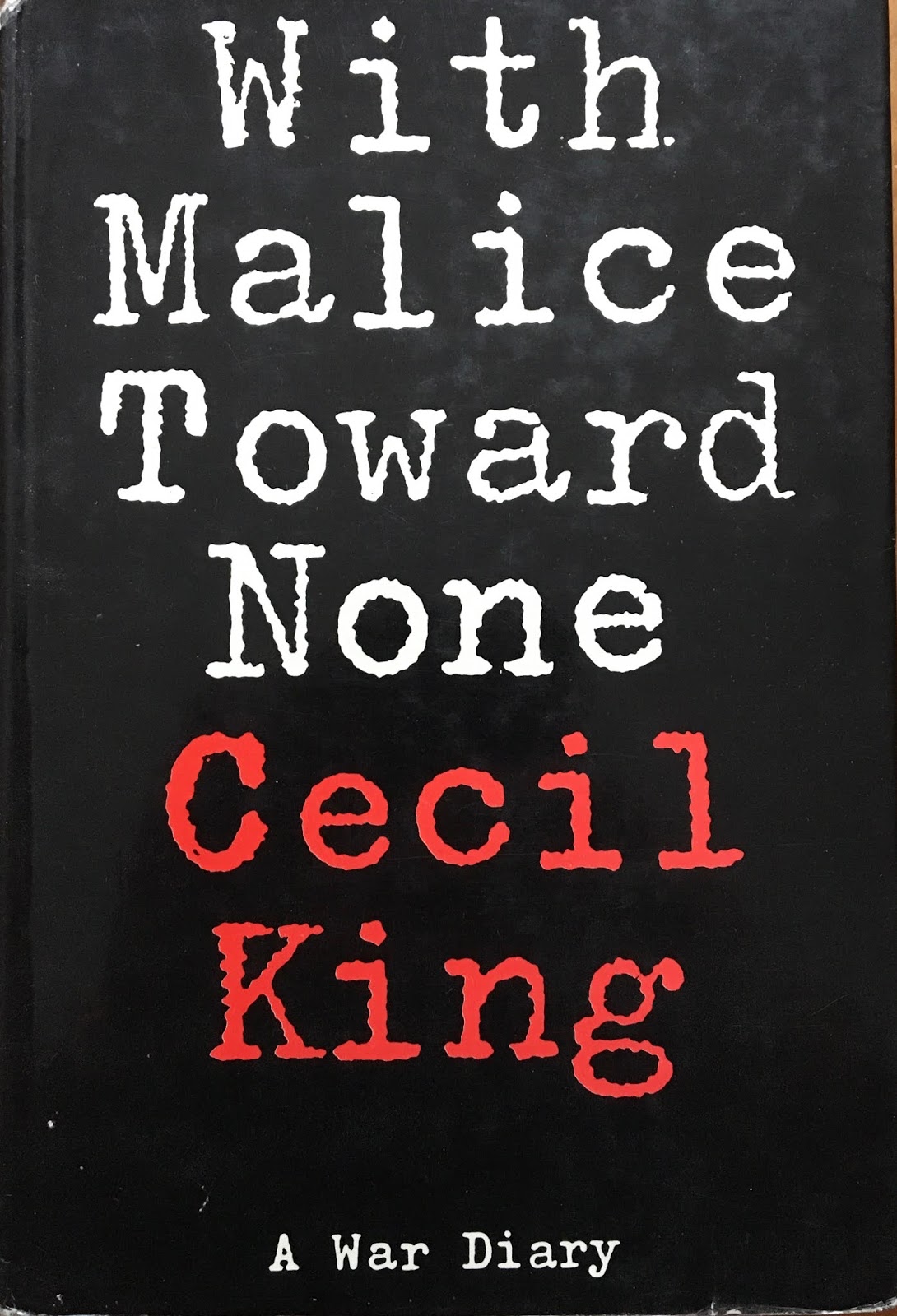
With Malice Toward None (author's photo)

Another work which contains an excellent account of the events of 10/11 May 1941, mainly in and around Fleet Street, is 'With Malice Toward None', written by Cecil King and published in 1970. The Fleet Street connection immediately falls into place when one understands that King was the proprietor of the Daily Mirror and Sunday Pictorial newspapers and the book is written in the journalistic style that would be expected of the author.

Westminster in War (author's photo)

William Sansom was an author and travel writer in peacetime but during the Blitz, was a member of the Auxiliary Fire Service and so his book, 'Westminster in War' published in 1947, must have contained at least some of his own personal experiences. Once again, it has proved an invaluable source of reference over the years and has often accompanied me on my travels around the streets of the present-day City of Westminster. I was lucky enough to pick up this copy, signed by the author, for the princely sum of £5, from a Chelsea antiquarian bookshop some years ago.

Bomber Command War Diaries (author's photo)

Apart from guiding walks, another important source of my income these days is researching family history enquiries, often from the descendants of Allied airmen. This usually entails at least one visit to the National Archives at Kew to examine operational record books from the relevant squadrons but for those who served with RAF Bomber Command, a useful first point of reference can be to check out 'The Bomber Command War Diaries; An Operational Reference Book 1939 - 1945' compiled by Martin Middlebrook and Chris Everitt, which was first published in 1985. Putting this work together must have required many visits indeed to the then Public Records Office to go through the various squadron records and RAF archives. Obviously, this book doesn't provide a squadron-by-squadron guide as to who bombed where and when but it does provide details of every single operation mounted throughout the war by Bomber Command on a daily (or nightly) basis. From this information and from the service histories of the individual airmen, it can then usually be ascertained from a follow-up visit to Kew, exactly how many missions a particular airman flew, to which targets and even in which individual aircraft.

The Blitz (author's photo)

Bomber's Moon title paper (author's photo)

Returning to the Blitz, two of my earliest second-hand purchases remain amongst my most prized possessions, partially because of the illustrations contained therein. These are 'The Blitz' by Constantine FitzGibbon, published in 1957 and 'Bomber's Moon' by the journalist James Negley Farson. These wonderful books contain illustrations by no less than Henry Moore in FitzGibbon's book and some beautiful, evocative pencil drawings by Tom Purvis in 'Bomber's Moon'. The book is themed on Purvis and Farson's travels through London in the Blitz, including various nights spent in air raid shelters and a trip down river to Greenwich. One of the drawings relating to the Thames trip is shown below - 'Old Ron' the Billingsgate Fish Market porter - '45 years in the market' and one of those London faces instantly recognisable to one who grew up in the capital when it was a working city, rather than the somewhat bland place that it has increasingly become.

'Old Ron' the Billingsgate Porter by Tom Purvis (author's collection)

Both Negley Farson and Constantine FitzGibbon were Americans, although both spent much of their time on this side of the Atlantic and indeed, in FitzGibbon's case, served in the British Army until 1942, when he was commissioned into the US Army. The American contribution to the literature of London at War cannot be overstated and I am fortunate enough to possess several of them, including 'Ernie Pyle in England' a 1941 work by the eponymous author, 'I Saw England', another 1941 publication, this time by Ben Robertson, 'A London Diary', also from 1941, written by Quentin Reynolds and finally 'Hell Came to London', a 1940 work by Basil Woon which concentrates on the author's experiences of two weeks living in London starting on 7 September 1940, the first day of the Blitz, which became known to Londoners as 'Black Saturday'. Woon's personal accounts have been much-quoted by other authors and still make remarkable reading to this day.

Title paper from 'Hell Came to London' (author's photo)

It is fair to say that all of the books mentioned above and indeed all of those that you see in the 'shelfies' shown at the beginning of this article, are much-loved by me and have become very much part of the furniture here at Blitzwalker Towers, whether they be old or new publications. I couldn't possibly write about all of them here but will perhaps return to the subject in the future and look at some of the other subjects covered in my library.

All of the photographs used to illustrate this piece are copyright to the author and may not be reproduced without my express written permission.


Books referred to in this piece:

The Blitz - Constantine FitzGibbon, with illustrations by Henry Moore, published in 1957 by MacDonald.
The Bomber Command War Diaries: An Operational Reference Book 1939-1945 - Martin Middlebrook & Chris Everitt, published (paperback) in 2014 by Pen & Sword.
Bomber's Moon - Negley Farson, with illustrations by Tom Purvis, published in 1941 by Victor Gollancz.
The City That Wouldn't Die - Richard Collier, published in 1959 by Collins.
Ernie Pyle in England - Ernie Pyle, published in 1941 by Barnes & Noble.
Hell Came to London - Basil Woon, published in 1940 by Peter Davies.
I Saw England - Ben Robertson, published in 1941 by Jarrolds Limited.
The London County Council Bomb Damage Maps 1939-1945 - editor Lawrence Ward, published in 2015 by Thames & Hudson.
A London Diary - Quentin Reynolds, published in 1941 by Random House.
The Lost Treasures of London - William Kent, published in 1947 by Phoenix House.
Westminster in War - William Sansom, published in 1947 by Faber & Faber.
With Malice Toward None - Cecil King, published in 1970 by Sidgwick & Jackson.

Sunday, 6 May 2018

The Aldwych Tube, Bomber's Moon and Negley Farson

Negley Farson (Wikipedia)

Blitz aficionados will be aware of the name of James Negley Farson, the American author, adventurer and fisherman, who wrote one of the best accounts of the London Blitz, Bomber's Moon, published in 1941 and which apart from Farson's vivid descriptions of life in London during 1940, contains some beautiful pencil illustrations from his friend and commercial artist Tom Purvis.

Almost an entire chapter of the book is devoted to shelter life, more specifically to the experiences of those sheltering in the London Underground. The small branch line station at Aldwych - actually located in the Strand - features prominently in this chapter and was the subject of some of the most famous photographs taken of Tube shelterers. This station has been closed to the public since 1994, when the little-used Aldwych branch was finally discontinued. This was partially due to the prohibitive cost of replacing the original 1907 lifts, which although still in perfectly good working order at the time, could not continue to be used for Health & Safety reasons owing to the exposed moving parts in the lift machinery. The station is still in situ and although different schemes have been floated over the years for its re-opening and incorporation into various Tube extensions, it remains as a mute reminder of London's wartime past. The site is occasionally opened to the public in conjunction with the London Transport Museum's Hidden London initiative but tickets are expensive and sell out quickly, so I have never actually been able to visit the station since closure 24 years ago. My memories of the place were those of a vague air of decay but also of a station that would have been instantly recognisable to a wartime shelterer.

Setting the scene outside Aldwych Station (Tom Day)

In addition to these rare public openings, the station is often used for filming and is also utilised by TfL and various Government Departments for training purposes. It was in connection with this latter use that I was recently able to pay a visit, as part of my guiding duties for a British Army group's Battlefield Study tour looking at the London Blitz, amongst other subjects. 

Mother & Baby drawn by Tom Purvis (author's collection - from 'Bomber's Moon')

To try and give the reader some background to the notion of spending the night in an Underground Station whilst bombs are falling "up top", I can do no better than quote directly from Farson himself:

"One night, about six o'clock, I stood in the Strand with the long line of shelterers waiting to go down the famous Aldwych Tube. It was very much in the newspapers at the time. Nearly everyone (except those who were occupying it) believed it had just been opened as a public shelter. The Press, unwittingly, was giving the impression that great things were being done.

As a matter of fact, when the Authorities were complacently accepting all the ballyhoo about throwing it open as a shelter, it had been packed to capacity for over three weeks.

The first person in line was a girl, twenty years old, holding an eighteen-months-old baby in her arms. She told me later, that she was "expecting" again in January. She had been standing there and hour and a half. The next seventy people in line had, of course, been standing there for slightly shorter periods. And there were more people piling up behind them while I was waiting to go down with them. She bared her gums and laughed saying:

'Maybe I'll faint. I did yesterday. Then there was an air raid and they had to let us all down.'

The collapsible steel gates of the tube were locked. They were not supposed to be open until 6:15. But this evening an Underground worker came along and let the crowd down shortly before six. We descended 132 steps. 

The people scampered about the deserted tube platform below to find their favourite places. This girl carried her baby to the far end, spread out a blanket. Then, from somewhere, she produced two sheets of corrugated cardboard - the thick packing case stuff. She placed her baby on top of it:

'So that he won't get damp,' she said simply."

At this stage of the war, there were no facilities at the station and as Negley Farson alluded to in his narrative, it had only been available as a shelter for around three weeks at the time he wrote his piece. He goes on to confirm the lack of basic facilities thus:

"Well, it was quite a scene for a dark, damp, smelly tube - with an open "Gent's" latrine staring you straight in the face. Lest I be accused of painting the picture, this was the Aldwych Tube; the position of the bucket latrine, used by the men, was some ten feet from the stone steps at the end of the platform - and I'll take a chance on it that there will be plenty of witnesses to come forward and swear that the only veil that covered it from public view at that date were two torn strips of burlap - with a jagged unclosable gap between them of at least eighteen inches from top to bottom.  

As one woman put it:

'We have a free public view - stalls. Ha ha!'"


An elderly lady shelterer drawn by Tom Purvis (author's collection from 'Bomber's Moon')

On the outbreak of war, the Chamberlain government had decreed that unlike the 1914-18 War, the London Underground would not be made available for Air Raid Shelter purposes. The vaguely ridiculous reasoning behind this was that allowing the public to shelter in the Tubes would "encourage a troglodyte mentality" - in other words, they were afraid that people would enter the Tubes, never to emerge again, with the resulting catastrophic effect on war production, followed by a general collapse of society. 

When the bombs did start to fall on London, the population used their common sense, ignored the Government's edicts and simply invaded the Tube Stations, invariably by simply buying a ticket to the next station and then refusing to board a train. The Authorities quickly relented and allowed the Tube stations to be used but as Farson mentions in his book, the complacent attitude that had previously been demonstrated took some time to put right and it took some time, running into months, before steel bunk beds, chemical toilets and first aid posts, amongst other facilities began to appear on those stations selected for use as shelters.

Recreated station signage (author's photo)

Aldwych Station had opened in 1907 as part of the Great Northern & Strand Railway and was originally named Strand. It was intended to be the terminus of a line running from Wood Green (now Alexandra Palace) via Finsbury Park and Kings Cross. Whilst under construction, the line was taken over by the Brompton and Piccadilly Circus Railway (the modern day Piccadilly Line) and permission was granted to link the two lines via a new tunnel running between Piccadilly Circus and Holborn to connect the two routes. This left the line running down to the Strand as a somewhat superfluous spur that eventually became the Aldwych Branch. The station was renamed Aldwych in 1915 to avoid confusion with the station of the same name (now Charing Cross) owned by the Charing Cross, Euston and Hampstead Railway (now the Charing Cross Branch of the Northern Line).

The Aldwych Branch settled down to life as basically a shuttle service that ran to-and-fro between Aldwych and Holborn Kingsway Stations. It is possible to walk between these two points in less than ten minutes, so it was never a particularly well used service. Probably because of this relative lack of use, the entire branch was selected for use as a shelter and closed to the public on 22 September 1940, shortly after the beginning of the London Blitz. The station had originally been named consisted of two platforms serving a double track line in two tunnels to Holborn but one platform had been closed in 1917, as just one platform and a single track was more than sufficient to cater for the shuttle service. For shelter purposes, the disused platform was also opened up to the public and the train running tunnels (including the disused tunnel) were used by the British Museum to store some of their collection, including the Elgin Marbles. The electric current was switched off and eventually, the platform was built out over the tracks so as to create a much wider area for the shelterers than was normally found on a working station but initially, some of the shelterers had to sleep on the tracks, as the accompanying photo shows.

Aldwych Station - then and now (author's photograph)

My entry into the station was through similar "collapsible steel gates", perhaps the very same that Negley Farson and his fellow shelterers had used nearly 78 years previously. I then walked through one of the original 1907 Otis lifts - both of which are now held statically by large steel beams beneath them - into the Booking Office area, part of which is original and the remainder an elaborate film set which has been retained in situ. Following a safety briefing, our group descended the spiral staircase towards platform level. It was whilst walking down the stairs that my memories of this station began to be rekindled; a somewhat musty, damp smell pervaded the staircase and the passageways leading to the platform. There was also a strange, unaccountable feeling of melancholy - as if the old station was trying to tell us that it was lonely and missed the sound of commuters footsteps.

The beginning of the 132 steps (author's photo)

Walking through the original 1907 Otis elevator (author's photo)

A now lonely passageway echoes to the sound of footsteps once again (author's photo)

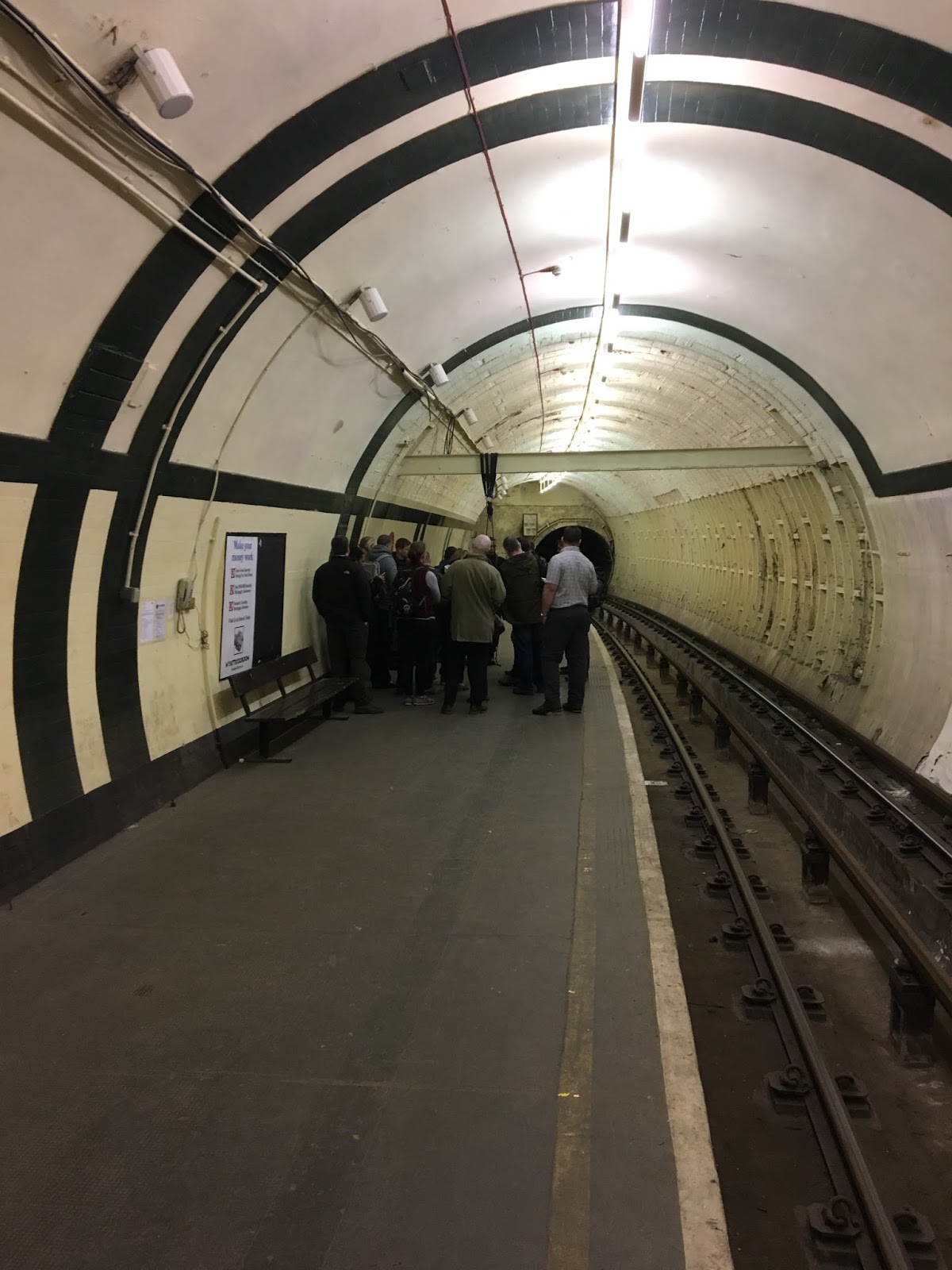
Once on platform level, I explained a little of the station's wartime history as well as hearing a interesting briefing as to the history of tunnels and tunnellers in warfare through the ages, a fascination which continues to this day. Whilst listening to this talk, we were disturbed by various distant rumbling sounds and periodical bursts of cool breezes, all of which reminded us that not far away, up the line at Holborn, the Underground network was still operating. The area we had been visiting was Platform "A" which had been the working platform when the line closed to the public in 1994 and which, we had been warned at the Safety Briefing, still contained energised live rails and which was still frequently used for filming. The station has featured in numerous movies, ranging from Battle of Britain, Patriot Games, V for Vendetta and Atonement, to pop videos, perhaps most famously The Prodigy's "Firestarter" in 1996.

Looking south towards the buffers (author's photo)

Looking north towards Holborn (author's photo)

We then moved across to the other platform, disused since 1917, which although bricked off from the main running tunnels, still contained a stretch of the original one hundred year old track, which lay flat on ballast as with surface railway lines and did not contain the now familiar "Anti-Suicide Pit" which we see today at Tube stations. Unfortunately, the sensitive nature of some of the equipment being demonstrated in this area meant that it was not possible to take photographs here on this occasion but the platform presented a strange mixture of old and new, due to the fact that London Underground sometimes use this area to trial new systems of lighting, tunnel panels and other equipment.

The footbridge leading across to the 1917 platform (author's photo)

"Way Out" sign, together with the 'A N' from STRAND which was the station's original name (author's photo)

After about 90 minutes below ground, it was now time to return to the surface and it was at some point during the ascent of the 132 steps that I became painfully aware of how much we took lifts and escalators for granted. Some of my Army colleagues sprinted up the steps, leaving the oldest man in the group to bring up the rear somewhat wearily!

The Leslie Green designed Ticket Hall (author's photo)

Back at surface level, I made a brief inspection of the original Leslie Green designed Ticket Hall, with an elaborate "BOOK HERE" sign, as well as discovering an original 1930s direction sign pointing would-be interchange passengers in the direction of the nearby Temple Station.

1930s signage still extant (author's photo)

The way out to Surrey Street (author's photo)

As mentioned earlier, many proposals have been mooted to incorporate the Aldwych Branch into various other underground extensions and new lines but personally, I rather hope that the line remains preserved as a time capsule looking back into Underground history.

Blinking as we emerged back out into the bright spring sunshine, it was time for me to start earning my keep again as a guide but thanks are due to Major Christopher Garrard of 29 EOD & Search Group HQ for arranging the visit and for allowing me to add an unusual extra dimension to our Battlefield Study Tour.


Printed Source:

Bomber's Moon by Negley Farson, illustrated by Tom Purvis - Victor Gollanz Ltd, 1941