|
| Per Ardua Ad Astra (author's photo) |
As has been mentioned on this blog on numerous occasions, a major part of my job - if it can be described as such - is research. Sometimes, this is part of the process of developing a new walk, or on other occasions, it can be part of a larger project such as a family history commission or for a forthcoming publication.
It was for the latter reason - details of which will be forthcoming nearer to the time of publication - that I recently made a visit to the Air Forces Memorial at Runnymede, administered by the Commonwealth War Graves Commission and which commemorates some 20,456 airmen and women from the Royal and Commonwealth Air Forces who made the ultimate sacrifice during the Second World War in the skies over North and Western Europe but who have no known grave.
This impressive memorial, which is a place of tranquility and great beauty, is situated on Coopers Hill and overlooks Runnymede Meadow, where Magna Carta was signed and is also close to the Kennedy Memorial. It was designed by the architect Sir Edward Maufe and was formally unveiled by Her Majesty the Queen in her Coronation year of 1953 on 17 October. It features sculptures by Vernon Hill and has impressive ceilings and engraved glass designed by John Hutton. Interestingly, it was the first post-war structure in the United Kingdom to be listed for architectural merit and from having now inspected the memorial myself, this is an eminently justifiable award.
 |
| The impressive first view of the memorial (author's photo) |
I had previously made a note of the airmen whose panels I wished to see from the information recorded on the excellent CWGC website and the memorial is laid out with correspondingly numbered panels that makes the process of finding a specific person an extremely easy one.
The first name that I was seeking out was Sergeant Ronald William Ebsworth of 214 Squadron in Bomber Command. In peacetime, Ron had been an accomplished amateur footballer, firstly for his local club Ilford FC, before he signed for Dulwich Hamlet FC in the summer of 1936. By the time of the declaration of war in September 1939, Ron was 33 years of age and perhaps having thoughts about retiring from football but despite his relatively advanced years (for a footballer and for aircrew), he volunteered to serve as aircrew and enlisted into the RAF on 13 July 1940. Upon completion of his training, Ron had qualified as a Wireless Operator/Gunner and was posted on 17 September 1941 to 214 Squadron, flying Vickers Wellingtons, based at Stradishall in Suffolk. Ron and his all-Sergeant crew had flown four operational sorties by 30 November 1941, when they departed for their fifth - a mission to Germany's second city of Hamburg. It was a mission from which they were destined not to return, as the squadron's Operational Record Book simply records "Failed to return" alongside his crew's aircraft. The circumstances of the bomber's disappearance are shrouded in mystery; no German night-fighters were operating in the area that the aircraft was flying and in any case, no claims were ever made by German pilots that could not be matched against other losses. A couple of weeks later, the body of the Second Pilot, Sergeant John Boland was washed up on the coast of the German occupied Dutch island of Texel and was buried with due honours by the occupying forces there. Of the remaining crew members, including Ron, there was no trace and today he is commemorated on Panel 42 at Runnymede, with his similarly missing crew mates all remembered in alphabetical order on adjacent panels.
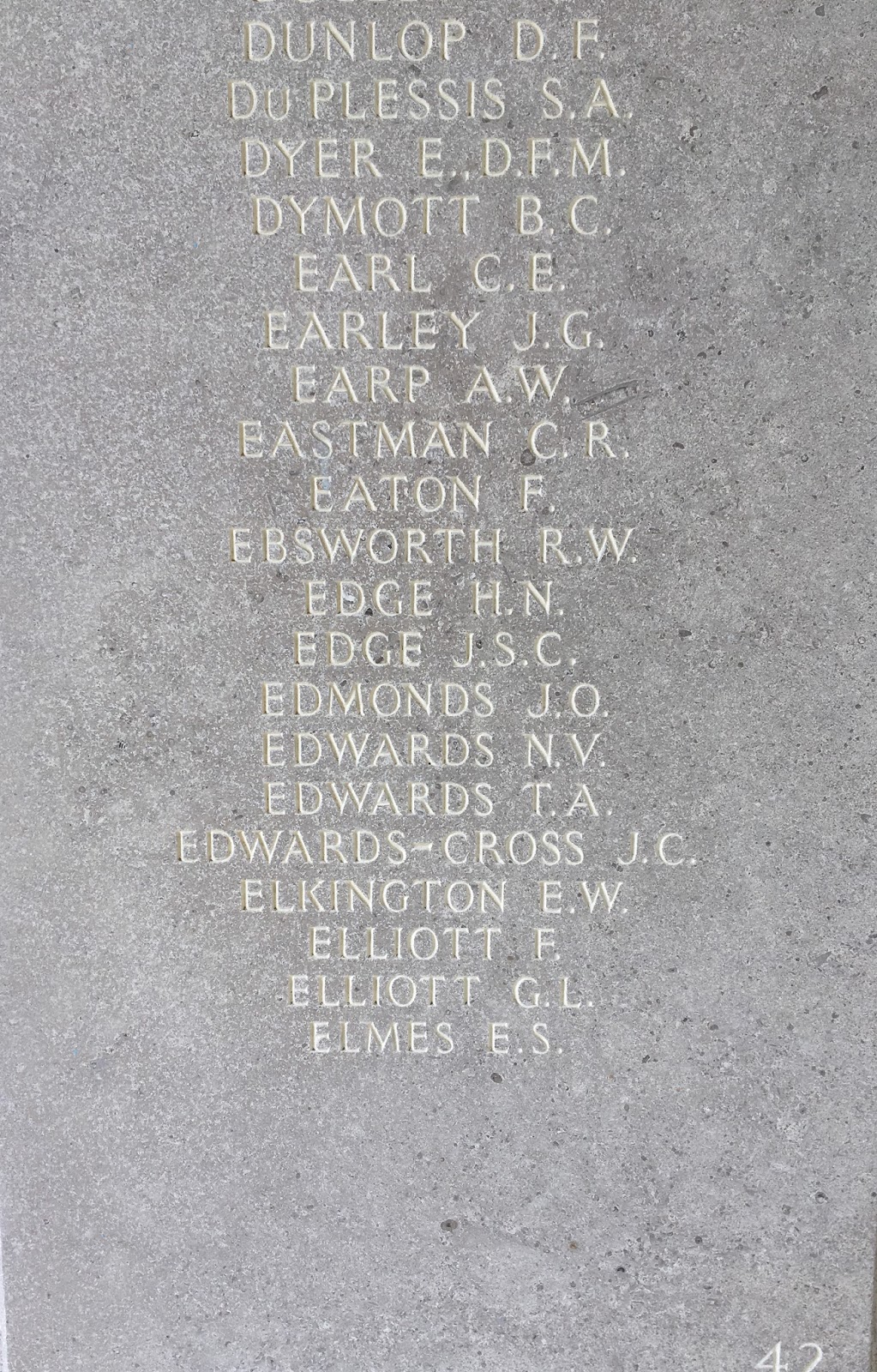 |
| Sgt Ron Ebsworth commemorated on Panel 42 (author's photo) |
Before seeking out the other names for whom I was searching, I decided to explore the memorial more fully and decided to climb the steps, culminating in quite a tight spiral staircase, up to the viewing platform on the roof. The day of my visit had dawned with some pretty heavy spring downpours but by the time I reached the memorial, the weather had moderated somewhat and even though the sky was still angry in places, visibility was pretty good. The Thames stretched out below me and away to the east could be seen Heathrow Airport and whilst looking at the steady stream of modern airliners taking off, I speculated as to what the airmen commemorated here would have made of the sleek jet aircraft passing overhead every few minutes that were so different to the piston engined machines of war that they had flown. Further away still, landmarks such as Wembley Stadium and the London Eye could be clearly seen - a rebuilt London vastly different from the Blitz-scarred capital that these airmen would have known. Looking to the west, the view would have been more familiar with Windsor Castle still dominating the skyline.
 |
| The scene from Viewing Platform on the roof (author's photo) |
Descending the steps once again, I next studied the words on the Great North Window and subsequently discovered that they were the words to the 139th Psalm, apparently sometimes known as the Airman's Psalm, which even to someone like me who is not particularly religious, could have been written for an airman.
If I climb up into heaven, Thou art there;
If I go down to hell, Thou are there also.
If I take the wings of the morning
And remain in the uttermost parts of the sea,
Even there also shall Thy hand lead me;
And Thy right hand shall hold me.
I then paid a visit to the central courtyard at which many wreathes and more personal tributes to loved ones were on display. Some of these tributes were official and had been laid by representatives of the various Commonwealth nations, whilst some were from bodies representing different sections of the RAF, such as Bomber Command and Air Sea Rescue. There were also poignant tributes from the Association of Jewish Ex-Servicemen and the War Widows' Association. One particularly moving tribute was a personal one, left by the family of one Sgt Edward Buckingham and I hope that they do not object to my having photographed it, as the words at the beginning of the tribute eloquently summed up the essence of the work that I do, stating as it did "It is not just a name on a memorial, it is the story behind the name..."
 |
| "It is not just a name on a memorial..." (author's photo) |
 |
| Looking through to the Central Courtyard (author's photo) |
 |
| Tributes from far and wide (author's photo) |
I then set out to find the other names I had been seeking out, two of whom I have previously written about on this blog. The first of whom was Warrant Officer Peter Leopold Godfrey, whose story I had told November 2012. Pete had been a member of Ickenham Cricket Club, of which I am a member and whose name features on the Club's Roll of Honour. He had been shot down into the sea whilst piloting a Hawker Tempest on flak-suppression duties on 17 September 1944 as part of the air operations connected with Operation Market-Garden. Having written about him and seen a photo of the impossibly young looking pilot, it was nice now to see his memorial.
 |
| Pete Godfrey's memorial panel (author's photo) |
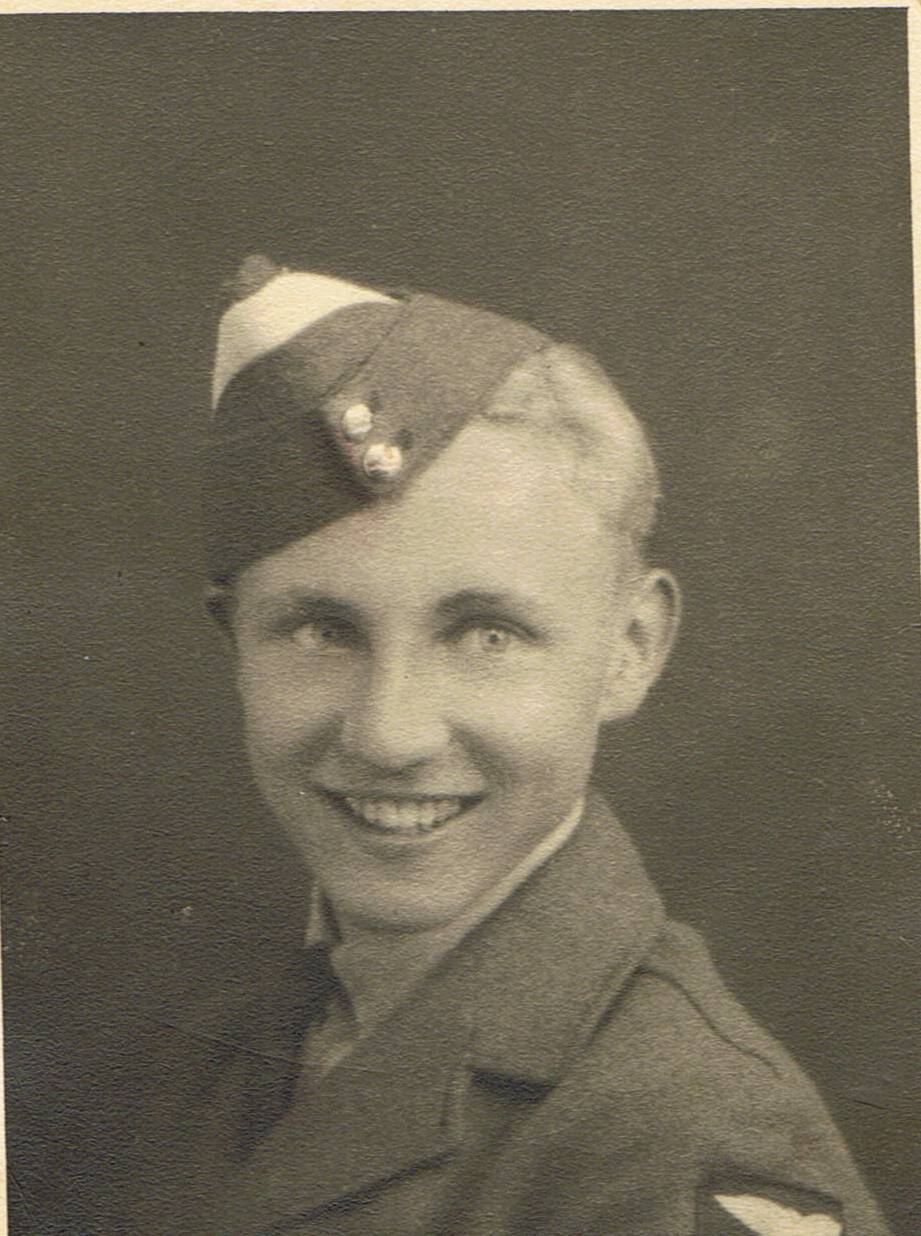 |
| W/O Pete Godfrey (author's photo) |
The other airman for whom I was searching was the subject of a much more recent post, as I had written about Flying Officer James Farrar as recently as January of this year. James had been a Navigator with 68 Squadron based at Castle Camps in Cambridgeshire, where they flew the De Havilland Mosquito. James was also a poet and would surely have become better known had he survived to see peace in 1945. Sadly, whilst his aircraft was on 'anti-diver' patrols, in other words attempting to shoot down V-1 Flying Bombs, his aircraft disappeared over the Thames Estuary. The body of his pilot was washed up in the Thames soon afterwards but Farrar was never found.
 |
| Flying Officer James Farrar (author's collection) |
 |
| James Farrar's memorial tablet (author's photo) |
Obviously, the vast majority of the aircrew recorded within the memorial are those of airmen but there are also women commemorated as well, both from the Women's Auxiliary Air Force and the Air Transport Auxiliary. I have not yet had the chance to research any of the female names on display but will hopefully get around to this at some point in the future.
 |
| Women are remembered too (author's photo) |
Before leaving this memorial which is a place of great beauty and also incredibly moving, I took a final walk through the cloisters which were lined with names and recalled the tribute I had read earlier "It is not just a name on a memorial...." Name after name, each one a son, a husband, a brother, a father and as I had learned, in some cases a daughter, a wife, a sister or a mother. Some of the panels had photographs, individual poppy crosses and personal messages beneath. Incredibly moving and proof that these men and women are still honoured by family and friends.
 |
| Just some of the 20,456 names (author's photo) |
As I left the memorial to return to my car, I remembered the words engraved on the gallery window, written by a student, Paul H Scott shortly after the memorial was unveiled:
Shall touch its pillars,
And as the day advances
And the light grows stronger,
You shall read the names
Engraved on the stone of those who sailed on the angry sky
And saw harbour no more.
No gravestone in yew-dark churchyard
Shall mark their resting place;
Their bones lie in the forgotten corners of earth and sea.
But, that we may not lose their memory
With fading years, their monuments stand here,
Here, where the trees troop down to Runnymede.
Meadow of Magna Carta, field of freedom,
Never saw you so fitting a memorial,
Proof that the principles established here
Are still dear to the hearts of men.
Here now they stand, contrasted and alike,
The field of freedom's birth, and the memorial
To freedom's winning.
And mists, like quiet ghosts, rise from the river bed,
And climb the hill to wander through the cloisters,
We shall not forget them. Above the mist
We shall see the memorial still, and over it
The crown and single star. And we shall pray
As the mists rise up and the air grows dark
That we may wear
As brave a heart as they.
If you haven't previously visited this memorial, I would strongly recommend doing so. It is open during the hours of daylight every day of the year except on Christmas Day and New Year's Day.
Source for background information: Commonwealth War Graves Commission
All photos in this article © Steve Hunnisett unless stated otherwise