Showing posts with label Second World War. Show all posts

Tuesday, 20 June 2023

Old Palace School - the largest Fire Service tragedy on British soil

The order of service for the ceremony (author's photograph)

Towards the end of last month, I was honoured to be invited to the dedication and unveiling of the latest commemorative plaque placed by the charity Firemen Remembered, at the Old Palace Primary School in Bow, in London's East End.

In many ways, this represents a full circle for the charity as the first commemorative plaque ever placed by the charity was at Old Palace School in 1997. Whilst this plaque is still in situ, it is no longer visible to the public and although the names were known at the time, they were not listed on original blue plaque and so it was right that the story was brought up to date.

The original plaque, now obscured from public view (author's photograph)

In common with many London schools, whose pupils had largely been evacuated out of the capital, Old Palace School, in St Leonard's Road was taken over by the Auxiliary Fire Service to serve as Sub-Station 24U, under the control of the erstwhile Brunswick Road Fire Station. It had served throughout the Blitz, including the dark days of "Black Saturday" on 7 September 1940, the great fire raid of 29 December 1940 and countless other raids affecting the East End of London. 

Old Palace School before the war (Firemen Remembered)

By April 1941, although Londoners didn't know it at the time, the Blitz was drawing to an end. Hitler was about to strike east at the Soviet Union and despite the misgivings of senior figures within the Luftwaffe such as Hugo Sperrle, the majority of the Luftwaffe's bomber forces were redeployed east. 

Despite the impending changes, bombing on London continued for the time being, with another particularly heavy raid being mounted on the night of 16/17 April 1941, a raid which became known to Londoners simply as "The Wednesday".

Three days later, on the night of 19/20 April came another heavy raid, said by some to coincide with Hitler's 53rd birthday and again, it was a sufficiently heavy and devastating raid to be given the simple label "The Saturday" by those that experienced it.

One of the purposes of the Auxiliary Fire Service was for the various units to act as a mobile reserve to be deployed wherever the need was greatest and on this night, as all of the local crews had been called out to fires in the local area, the call went out to Beckenham Fire Station for reinforcements. The twenty one Beckenham Firefighters arrived at 01.30 on Sunday 20th April and were mustering for orders alongside fellow crews from Homerton and Bow, when at 01:53 a high explosive bomb scored a direct hit on the school, demolishing a large part of it and setting the remainder on fire.

The results were catastrophic; all thirty two Firemen at the school as well as two Firewomen (1941 ranks used) were killed outright. It was - and remains - the largest loss of Fire Service personnel in a single incident in British history.

The grim task of recovery (Firemen Remembered)

The ceremony was presided over by Stephanie Maltman of the charity Firemen Remembered and the Rev'd Cathy Wyles; it was attended by Steve Dudeney, the former London Fire Brigade Borough Commander for the area when the original plaque was unveiled, as well as members of the present day Beckenham and Bow Fire Stations. As always, it was an extremely moving ceremony, especially as the names of the fallen were read.

Stephanie Maltman and the Rev'd Cathy Wyles (author's photo)

Fire Brigade guests, past and present (author's photo)

After the ceremony, we repaired to the school for tea and cakes but before we did, the School Caretaker invited us to the rear of the school buildings, where he showed us the splinter-strewn car park walls, the only part of the original school still standing, mute witnesses to an appalling horror. The walls had been slated for demolition a few years ago, he told us but the-then Head Teacher had mounted a campaign to save them, which ensured that they are now listed and saved for future generations to see.

Splinter strewn wall at Old Palace School (author's photo)

Splinter strewn walls (author's photo)

Thanks are due, as always to Stephanie Maltman and Bill Hickin of Firemen Remembered for organising the ceremony and for inviting yours truly to attend.

The new plaque in situ (author's photo)


Friday, 9 November 2018

Forgotten no longer: The Alan Adams story

Alan Adams (Luuk Buist)
Regular readers of this blog will know that I am a supporter of non-league football and of Dulwich Hamlet FC in particular. I was honoured to be asked to write the history of the club's four players who feature on our Second World War Roll of Honour and in November 2017, we released For Freedom at the time of our annual Remembrance ceremony in the club's boardroom at our Champion Hill ground, little knowing that we were on the brink of an enforced and potentially permanent exile from our spiritual home.

As the author of the booklet, I was acutely aware that there were some gaps in the stories, particularly in the case of Eric Pierce, whose senior playing career for the club had ended almost as soon as it had begun. However, we made the best of the information that was available to us, starting with the Roll of Honour itself and had no reason to doubt the accuracy of this primary source of information.

Doubts began to arise shortly after publication, when I was contacted by one of our older supporters who had come across some old programmes on an internet auction site, one of which mentioned two players who had fallen during the Second World War, neither of whom featured on the club's War Memorial. Wartime football programmes, particularly for the non-league game can be rare beasts and many clubs, including Dulwich Hamlet, did not produce programmes for large periods of the war due to the lack of raw materials. As a result of this, information about wartime players and matches can often sneak 'under the radar' and such was the case with the two players mentioned in the programmes that came to light here.

The DHFC War Memorial at Champion Hill (Duncan Palmer Photography)

What was harder to explain was the absence of the two players from the Roll of Honour. One of them, Charles Ede, was a former player who had left the club for pastures new at Kingstonian in 1934 and so perhaps had been deliberately omitted for that reason; but the other player, Alan Adams, was by the admission of the club itself in the programme in question, very much a current player at the time of his death and this makes his omission from the Roll of Honour all the more inexplicable.

We shall probably never know the reasoning behind this oversight but we can at least put things right, albeit a little late in the day. Hopefully, in the future, we will be able to produce a revised and updated version of For Freedom and pay tribute not only to the original four men whose stories we had already told but also to the two hitherto forgotten players and perhaps to also recall the wider history of the club during the Second World War. In the meantime, at this time of remembrance, it is now appropriate to share the story of Dulwich Hamlet's youngest wartime casualty.

Alan Adams was a first generation Londoner, as his parents Richard James and Pyarea Victoria Adams (nee Rhind) had both originally hailed from West Derby on Merseyside. Alan had an elder sister, Patricia, who was born on 13 August 1923 at the former family home at 18 Oban Road in the Walton district of Liverpool but sometime after this event, the family had moved to London and were established at 22 Bushey Hill Road, Camberwell by the time of Alan’s birth on 22 May 1925. The reason for the move south is unknown but could possibly be connected with Richard’s job as an accountant with a steamship company or was perhaps indicative of a general lack of work on Merseyside at that time.

By the time of the 1939 Register being taken shortly after the outbreak of war, the family had moved to 58 Sunray Avenue in Herne Hill but the then 14 year old Alan does not appear in the census. He had become a pupil of Archbishop Tenison’s Grammar School at Kennington in 1936 and had been evacuated out of London with his school to the relative safety of Reading. Alan served with the school’s Officer Cadet Corps but later transferred to their Air Training Corps when this was established in 1940 and so appears to have taken a keen interest in the military from a young age, as well as perhaps having an eye on a future career as a flyer. Alan was also an accomplished sportsman who represented his school at athletics, cricket and football – the latter two at First Eleven level.

Alan Adams on the Roll of Honour at Archbishop Tenison's School (Laurence Weeks)

Alan left school in mid-1941 and returned to live at the family home in Herne Hill, from whence he took up a job as a junior insurance clerk for the Liverpool Victoria Insurance Company. Alan’s military life continued after leaving school, as he served in his local Home Guard Unit, the 18th County of London Battalion which was based at Lordship Lane, from 1942 pending his enlistment into the Army proper.

It was whilst serving with the Home Guard that the then 17 year old made his senior debut for the Hamlet on Saturday 7 November 1942 at Champion Hill in a 4-4 draw against the London Fire Force. Ironically, despite the match being played at Dulwich, this was in fact an away fixture for the Hamlet as the Fire Force also used the ground for their home matches – such oddities were not entirely uncommon in wartime football. Alan didn’t feature on the original team sheet but the following week’s programme explained that he had been a late call-up due to the regular left back Roger Bishop being detained at work and unable to reach Champion Hill in time for kick-off. Dulwich fielded a youthful team and in addition to Alan, there was another debutant on display, a young centre forward by the name of Charles Birdseye, himself a late replacement for Stan Smith who was suffering with influenza. Birdseye made an instant impression by scoring one of the goals during the Hamlet’s spirited fightback from 1-2 down at half time. Arthur Phebey with two and Gillespie were the other scorers in a match which the following week’s programme described as “…reminiscent of the peace time days when it was a bye-word that Dulwich Hamlet always played their hardest when up against it.” This same programme, which was for a match against the RAF on 14 November 1942, went on to say that “….the youngsters mentioned will be heard of again.” so we can only assume that Alan and his youthful team-mate performed well on their senior debut.

Alan Adams' first mention in a Hamlet programme - 14 November 1942 (author's photo)

Alan was attested into the Army and duly swore allegiance to the Crown on 19 March 1943 but his actual enlistment date did not come until the following 6 May. It would appear that previous experience with the school Air Training Corps had hardened Alan’s ambition to become an airman, as after completing his basic training with the Gordon Highlanders, he transferred to the Army Air Corps on 14 January 1944 having volunteered to train as a Pilot with the Glider Pilot Regiment. At this point, Alan was promoted to the rank of Corporal, with a further promotion to Serjeant following on 15 June 1944.  He was awarded his Army Flying Badge to signify qualification as a glider pilot on 27 July 1944 and was then posted to E Squadron, No. 2 Wing, Army Air Corps, where he would fly the Airspeed Horsa glider. These large wooden aircraft could either carry 30 fully equipped soldiers, or a freight load of three tons on airborne operations.

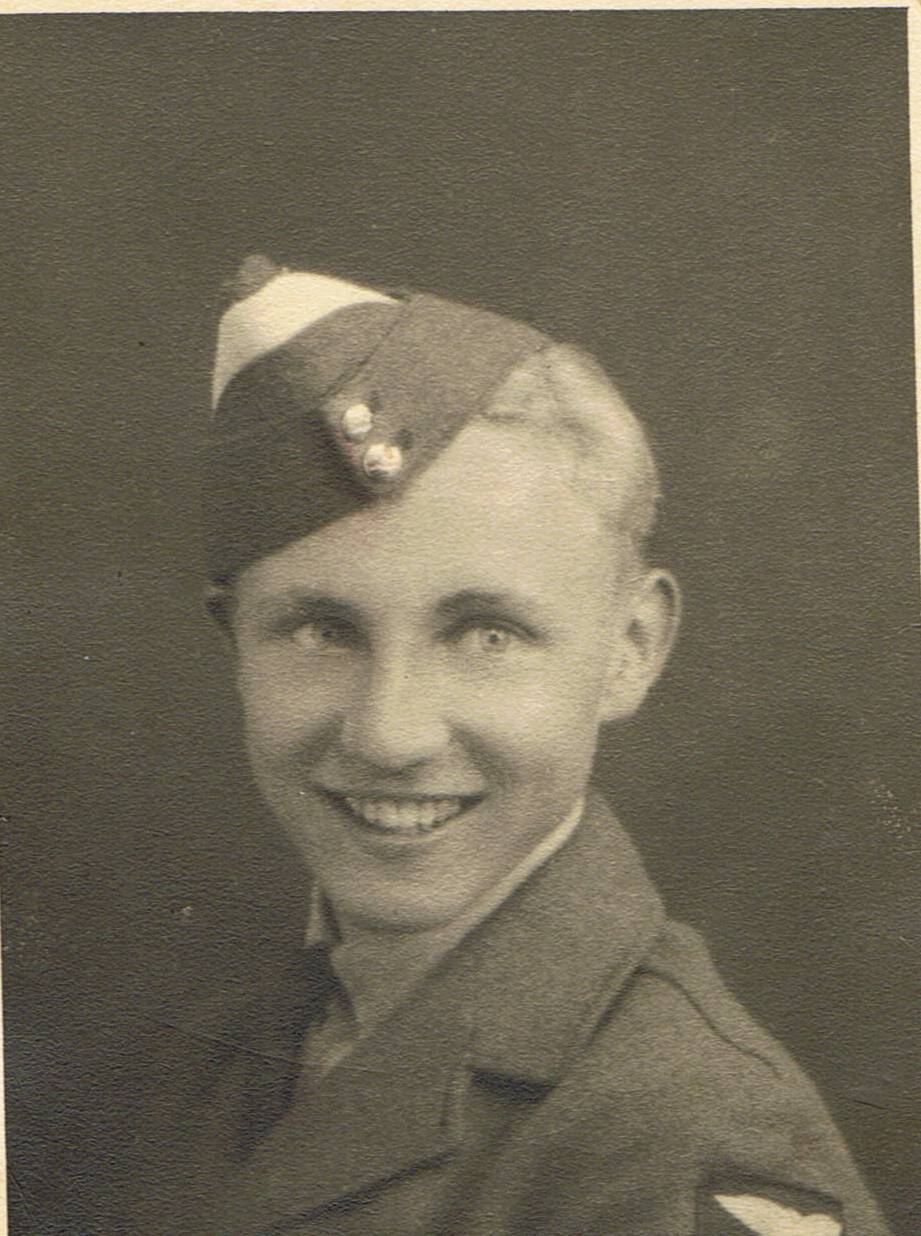
The role of a glider pilot was an extremely hazardous one, for not only were they expected to fly the heavily laden gliders into their landing zones through invariably hostile skies but upon landing, they were then expected to fight as infantrymen alongside the airborne troops they had just transported, until such time as they could be evacuated out of the landing zone back to friendly territory. The photograph that illustrates this article shows a young pilot wearing civilian clothes rather than Army uniform – this type of photograph was taken in case a false identity was required to smuggle the glider pilots from behind enemy lines following airborne operations and further demonstrates the precarious nature of the glider pilot’s life. Whilst we are not absolutely certain that the photograph (which was kindly supplied by Dutch military historian Luuk Buist) definitely depicts Alan, we see a hitherto unidentified pilot of E Squadron who is simply described as “Boy”. Given Alan’s extreme youth, coupled with his position as the youngest pilot in his squadron, it must be a fair assumption that this is him, especially as the physical description given on his Army service record “fair complexion, grey eyes and brown hair” matches that of the person in the photograph.

Airspeed Horsa glider as flown by Alan Adams (IWM)

In September 1944, Alan’s Squadron was required to take part in Operation Market Garden, Field Marshal Bernard Montgomery’s bold plan to seize the bridges over the River Rhine and thrust directly into Germany. Had everything gone according to plan, the war could perhaps have been considerably shortened but for a variety of reasons too complex to go into in an article of this nature – a mixture of over-optimistic planning, poor weather, missed opportunities and intelligence failures – the operation went down in history as one of the “glorious failures” of the war which is still hotly debated amongst military historians to this day.

On 18 September 1944, as part of the Second Wave of landings, the Horsa glider piloted by Alan, which was chalked “837” left from RAF Down Ampney in Gloucestershire, towed by a Douglas Dakota transport aircraft of 271 Squadron RAF. Alan’s glider carried a heavy load of a Jeep plus two trailers full of ammunition as well as two passengers from Headquarters, 1 Airlanding Light Regiment, Royal Artillery. The Second Pilot on board was Serjeant Richard Ennis from Wallasey on Merseyside who thus had something in common with Alan, whose parents were both originally from that part of England.

"Handlebar Hank" aka Jimmy Edwards (with trombone) at a concert at RAF Down Ampney (author's collection)

Incidentally, one of the Dakota pilots of 271 Squadron was Flight Lieutenant JK Edwards, who became better known post-war as the handlebar-moustached trombonist and comedian “Professor” Jimmy Edwards of radio and television fame but who in wartime, appeared in RAF and service concerts under the stage name of "Handlebar Hank" in addition to his regular flying duties. Edwards was awarded the Distinguished Flying Cross for his bravery, when on 21 September 1944, the Dakota serial KG444 that he was piloting was shot down by FW190s over the Arnhem area. The aircraft caught fire and Edwards ordered his crew to bale out, an order which his Second Pilot and Navigator promptly obeyed. Edwards went aft to also bale out but discovered that three of his four Army Despatchers were injured and unable to jump. He promptly returned to the cockpit and despite having to stand with his head protruding from an escape hatch due to the smoke in the cockpit, he managed to crash land the Dakota in a lightly wooded area, at which point the aircraft went up in flames. Edwards had suffered severe burns to his face but was thrown clear by the impact. The unwounded Despatcher and his Wireless Operator, who had also remained on board to help, managed to escape the burning aircraft but the three wounded Despatchers were killed in the crash. In spite of his wounds and with some help from a Dutch civilian, Edwards was able to guide the other two men back to British lines.

Returning to our story, the operation initially went according to plan but shortly before 20:00 when approaching the Landing Zone at Wolfheze, Alan’s glider was taken under fire by German anti-aircraft guns and a flak shell burst close to the glider’s starboard wing. Alan was hit by shrapnel and slumped in his seat over the controls, at which point, the Second Pilot Serjeant Ennis took over. Unfortunately, he could not recover full control in time and as a result, the glider overshot the Landing Zone and ploughed into trees at over 100 mph. Ennis was catapulted through the Perspex windscreen whilst still strapped into his seat but amazingly survived more or less unscathed, as did the two Army passengers in the rear. Sadly, Alan was crushed by the load behind him which shifted forward with the impact of the crash. At first, he was given a field burial in a garden behind the Psychiatric Home at Wolfheze but on 24 August 1945, as part of the general peacetime consolidation of British and Allied war graves in the area, he was re-interred at Oosterbeek War Cemetery, which contains the graves of 1,691 British and Commonwealth servicemen as well as a further 79 Polish and three Dutch servicemen.

Alan’s death was reported in the match programme for the fixture against Pinner on 2 December 1944, which went on to describe him as “a promising left back for the Reserves, who had one or two games for the senior side before joining the Forces.”  The same article also hints at a wider family connection with the club as it mentions that “his father used to referee some of our games on the top pitch.” The report goes on to mention that Alan’s father had “some time ago suffered another great bereavement when his wife was killed by enemy action.”

Richard Ennis' story in the Liverpool Echo of 4 October 1944 (British Newspaper Archive)

Whilst the death of Pyarea Adams was undoubtedly a great tragedy for the family, the circumstances of her death as described in the Hamlet programme do not stand up to scrutiny. The 1939 Register recorded that Alan’s parents both served as Air Raid Wardens within the Metropolitan Borough of Camberwell, which could lend credence to the “enemy action” theory but inspection of Pyarea’s Death Certificate reveals that she died at the age of 43 on 19 February 1944 from “Cardiac Asthma” at home in Sunray Avenue. Although there was indeed an air raid on the day of her death, the family home was not bombed and neither were any fatalities or injuries recorded elsewhere in the immediate area. The mystery is further compounded because she is not recorded by the Commonwealth War Graves Commission as a Civilian War Death, which would have been the case had she been killed as a direct result of an air raid. Whilst the stress of working as an Air Raid Warden during the London Blitz would undoubtedly put a great strain on a weak heart, it would appear that Pyarea did, in fact, die of natural causes.

Alan Adams' grave at Oosterbeek War Cemetery (wargraves.nl)

There is also some confusion regarding Alan’s Christian names; his Birth Certificate records him as Richard Alexander Adams, whilst his Army service record and that of the Commonwealth War Graves Commission show him as Richard Allen Adams, although Archbishop Tenison’s Grammar School’s obituary in December 1944 gives his name as Ronald Alan Adams. To compound matters further, Dulwich Hamlet programmes and the “Tenisonian” yearbooks refer to him simply as Alan Adams.  However, the details concerning his Army records, parents, schooling and home address leave us in no doubt that despite the various permutations of his name, these all refer to 'our' man.

Towards the end of October 2018, came the momentous news that a deal had been reached that would enable Dulwich Hamlet to return home sometime in December, thus ending a near ten month exile. A bonus to this emotional homecoming will be the fact that we will once again be able to hold our traditional Remembrance Ceremony in the Boardroom and pay tribute to all of the club's fallen of two World Wars and this time, we will be able to belatedly remember these two hitherto forgotten men. Before too long, we shall hopefully add their names to the Roll of Honour, thus ensuring that they are forgotten no longer.


Published Sources:

Dulwich Hamlet FC - programmes for various matches referred to in text - courtesy of Ian Colley
Glider Pilots at Arnhem - Mike Peters & Luuk Buist - Pen & Sword, 2014

Unpublished Sources:

Record of Service for RA Adams - Army Personnel Centre Historical Disclosures
Airborne Operations, NW Europe Arnhem: 2 Wing Glider Pilot Regiment, Army Air Corps - Enquiries into Missing Personnel - National Archives WO 361/505 & 636
Metropolitan Borough of Camberwell, Civil Defence Incident Log - London Borough of Southwark Archives
271 Squadron RAF, Operations Record Book - National Archives AIR 27/1574-9
RAF Down Ampney, Operations Record Book - National Archives AIR 28/211
The 'Tenisonian' Yearbook (various) - Archbishop Tenison School Archives, courtesy of Laurence Weeks


Sunday, 8 April 2018

Hitler Passed This Way


Amongst my collection of Blitz-related books is Hitler Passed This Way, a collection of 170 photographs from the London Evening News, which older readers may remember from a time when our capital city had not one, but three evening newspapers - the Evening News, the Evening Standard and The Star.

The booklet takes the form mainly of a series of 'before and after' shots of various buildings in London destroyed during the Blitz and subsequent V-Weapons campaigns. This anthology was published in late 1945 when memories of these events were still very fresh in the minds of Londoners and the linking text is very much of this time and not surprisingly, makes no mention of the fact that the RAF had until very recently been meting out the same sort of indiscriminate treatment, only on a much greater scale, to German civilians that is described in the book thus:

"Many times from September 1940 until March 1945, did Hitler single out London for his major effort of destruction. The docks, the City, the east end, the west end, north and south London, the railways, the bridges and the suburbs, all had their nights of high explosive bombs, great and small. Night after night Hitler rained incendiary bombs on London. He dropped huge land mines by parachute to wipe out whole districts. To make certain the killing of large numbers of non-combatants, women and children alike, he employed delayed action bombs of devilish ingenuity."

The mood of the British public had not yet mellowed following six years of war and the full impact of the destruction of German cities such as Hamburg and Dresden by the RAF had not been fully realised. At somewhere in the region of 42,000, the death toll from the Gomorrah raids on Hamburg in late July and early August 1943 had comfortably exceeded the 30,000 of London for the entire war and yet no mention is made of this aspect of the war that the British public were still happy to conveniently brush under the carpet at this point.

Taking this aspect aside, the photographs offer a fascinating view of a long-vanished London and whilst it would be unfair to reproduce more than a handful of photographs here, an interesting game of "then and then and now" can be played at some of the locations featured in the images.

"Before and After" views of the Cordwainers Hall (from Hitler Passed This Way)

Looking towards St Paul's with the ruined Cordwainers Hall (author's collection)

The same view today (Google streetview)

The above three photos of the Cordwainers' Hall in Cannon Street show how in many cases, new views of London were opened up by the Blitz. The Cordwainers' Hall that was destroyed on the night of 10/11 May 1941 only dated from 1909 but contained many relics and artefacts from the previous Halls on this site. These included chimney pieces and wooden escutcheon pieces which had survived the Great Fire of 1666, only to fall victim 275 years later. Fortunately, other items such as various portraits and silver plate had been stored off site and were therefore saved. The loss of the Cordwainers' Hall opened up a new vista of St Paul's Cathedral and the area is now a pleasant open space that is much loved by City workers as a summer lunch venue.

Another victim of the events of 10/11 May 1941 was the International Headquarters or "IHQ" of the Salvation Army, located then as now, at 101 Queen Victoria Street. On this, the heaviest night of bombing that London saw during the entire war, the firefighters were hindered by a strong wind, which was unusually blowing from the east, rather than the prevailing westerly wind. This was driving the fires westwards along Queen Victoria Street, threatening Faraday House, which at that time housed the largest telephone exchange in the world, including international lines and a radio link with Washington DC. A fortunate change of wind direction saved Faraday House but not before IHQ was consumed by the flames. There was one tragic incident whilst efforts were being made to save the building - one Salvation Army worker rushed out of the building, tripped over a fallen telephone cable and was run over and killed by a passing Fire Engine. There were the usual scenes of quiet heroism here too, with a Salvation Army canteen van serving refreshments to the army of Civil Defence workers fighting to save IHQ and Faraday House. One firefighter, George Woodhouse from Holloway noticed:

"The two Salvation Army lasses were handing out cups of tea and biscuits as if it were a Sunday School outing. They appeared to be completely unaware of the bombs falling all around them. I often wondered what the word 'courage' meant, but on that night, those two lasses had it in abundance."

101 Queen Victoria Street before the events of 10/11 May 1941 (from Hitler Passed This Way)

The ruined site (from Hitler Passed This Way)

The modern replacement (Google Streetview)

Today, 101 Queen Victoria Street is still home to the IHQ of the Salvation Army but it is now a modern steel and glass building, although still on a similar scale to that of it's predecessor.

Sometimes the views of 1940 and today cannot easily be compared. Today, residents of Greenwich and visitors alike are accustomed to seeing the Cutty Sark, the last surviving British tea clipper and a long-term fixture in Greenwich. It was not always the case though; the site in King William Walk was once occupied by a large public house, The Ship Hotel, which was renowned for serving freshly caught whitebait suppers, often complimented with champagne. The hotel attracted a varied clientele, including government ministers and members of the judiciary. It had already begun to fall upon hard times, when on the night of 1 November 1940, it received a direct hit from a high explosive bomb, completely destroying the premises. Today, the site would be unrecognisable and is another example of a new vista being opened up by the bombs.

The Ship Hotel 'Before and After' (from Hitler Passed This Way'

The site today (Google Streetview)


Sometimes though, it isn't possible to provide any sort of 'then and now' perspective, for the simple reason that the neighbourhoods that were bombed simply ceased to exist. There are examples of this in the East End of London but one which is covered in Hitler Passed This Way is particularly poignant.

'The Monster' public house in Sutherland Terrace, Pimlico (from Hitler Passed This Way)

If one looks for Sutherland Terrace in Pimlico today, it does not exist, for it was completely wiped out on the night of 16/17 April 1941. Inspection of a pre-war A to Z Atlas reveals Sutherland Terrace about halfway up the page, running between Sutherland Street and Cumberland Street, forming what must have been a slightly confusing crossroads with Winchester Street. A glance at the present day Google Streetview shows no trace of Sutherland Terrace. Such was the ferocity of the bombing that the terrace was obliterated, complete with it's once famous public house, the splendidly named 'Monster' of which we see 'Before and After' views in the book. It was a bad night in Westminster, with 148 killed, 173 high explosive bombs, seven parachute mines and a community destroyed.


Sutherland Terrace in 1939

The same location today (Google Streetview)


Hitler Passed This Way is still fairly easily available today and provides fascinating images of a bygone London, not only during wartime but also during the more peaceful years immediately prior to the Second World War.


Published Sources:

Hitler Passed This Way - The Evening News, 1945
The Longest Night - Gavin Mortimer; Cassell, 2005

Tuesday, 6 February 2018

My Thoughts on "Darkest Hour"

Warning: Contains some spoilers:


As there have been two decent Second World War related films released in the past twelve months, I thought that following on from my review of Dunkirk in July of last year then I should perhaps share my thoughts on Darkest Hour the new film which loosely covers the first twenty three days of Winston Churchill's Premiership from his taking the job upon Neville Chamberlain's resignation on 9 May 1940 until towards the end of the Dunkirk evacuation when it became apparent that the bulk of the British Expeditionary Force was going to be saved.

Before going any further, it should be remembered that as with Dunkirk, this film is not a documentary, it is a film and therefore plays fast and loose with historical fact on occasions as well as employing one or two fairly creaky links to the plot.

Gary Oldman's performance as Churchill is quite magnificent and he simply dominates the film. The supporting performances are strong too, with Kristin Scott-Thomas as Clementine Churchill, Ronald Pickup as Chamberlain and Samuel West as Anthony Eden, particularly worthy of note.

The film opens with what proved to Chamberlain's final appearance as Prime Minister in the House of Commons and this leads to my first minor gripe as to the accuracy of the film. During the debate, the Leader of the Opposition, Clement Attlee (played by David Schofield) refers to Chamberlain by name; this of course is never allowed in the House as members are referred to as "Members" or "Right Honourable Members" but never by name. Also the Chamber of the House of Commons appears in a very strange sort of gloomy half-light, no doubt for dramatic purposes but in no way a true representation. Attlee also comes across as a somewhat weak and vacillating character, when in reality, he was a staunch anti-Nazi and supporter of Churchill as Prime Minister.

Lord Halifax (played by Stephen Dillane) and Chamberlain to a lesser extent are played very much as the villains of the piece, constantly trying to undermine the new Prime Minister and working behind his back to negotiate a separate peace. The reality of it was that whilst Halifax did indeed favour a negotiated settlement, he didn't go behind Churchill's back and Chamberlain, whilst he didn't wholly approve of Churchill, didn't actively try to undermine him for his own political ends as is shown in the film. 

It is true that Winston Churchill did have an initially tricky relationship with King George VI (sympathetically played here by Ben Mendelsohn) but the King did warm to his new Prime Minister and they eventually became very close friends. Whether the circumstances of the King's epiphany were as depicted in the film, one has to doubt.

The film does show Churchill's decisive nature well - firing off instructions and "Action this Day" memos to all and sundry, although the notion that Operation Dynamo, as the Dunkirk Evacuation was code named, was Churchill's own idea is quite false. Like the Dunkirk film reviewed in July, this movie also perpetuates the myth that the BEF was saved entirely by the "Little Ships" when in reality, only some 5-7 percent of the men were evacuated this way, with the vast majority being rescued by the Royal Navy's warships and the larger transport ships requisitioned from the Merchant Navy.

Darkest Hour does touch on what Churchill called his 'Black Dog' - his momentary periods of depression and self-doubt but this in turn leads to what this writer feels is the biggest hole in the script. At no point did the Prime Minister ever disappear down in to the London Underground to canvass the opinion of the British public as to whether to continue the war, or to sit down and negotiate with Hitler. Also, what in reality should be a less than five minute journey from St James Park to Westminster seems to last an eternity whilst Churchill seeks the opinion of almost everyone in the carriage!

The film does correctly show Churchill's meeting with members of his 'Outer Cabinet' in which he gauged their opinion, effectively outmanoeuvring any lingering opposition to his policy of fighting on and which culminates in his now famous "We shall never surrender" speech in the House on 4 June 1940.

There is a lot more to this film that the incidents described above and despite my quibbles, it remains a superb piece of film making, which I thoroughly recommend to you. If Gary Oldman should win a Best Actor Oscar for his performance as Churchill, it will be one of the most well-deserved and popular wins ever.

Monday, 26 June 2017

"Not just a name on a memorial" - The Air Forces Memorial at Runnymede

Per Ardua Ad Astra (author's photo)

As has been mentioned on this blog on numerous occasions, a major part of my job - if it can be described as such - is research. Sometimes, this is part of the process of developing a new walk, or on other occasions, it can be part of a larger project such as a family history commission or for a forthcoming publication.

It was for the latter reason - details of which will be forthcoming nearer to the time of publication - that I recently made a visit to the Air Forces Memorial at Runnymede, administered by the Commonwealth War Graves Commission and which commemorates some 20,456 airmen and women from the Royal and Commonwealth Air Forces who made the ultimate sacrifice during the Second World War in the skies over North and Western Europe but who have no known grave.

This impressive memorial, which is a place of tranquility and great beauty, is situated on Coopers Hill and overlooks Runnymede Meadow, where Magna Carta was signed and is also close to the Kennedy Memorial. It was designed by the architect Sir Edward Maufe and was formally unveiled by Her Majesty the Queen in her Coronation year of 1953 on 17 October. It features sculptures by Vernon Hill and has impressive ceilings and engraved glass designed by John Hutton. Interestingly, it was the first post-war structure in the United Kingdom to be listed for architectural merit and from having now inspected the memorial myself, this is an eminently justifiable award.

The impressive first view of the memorial (author's photo)

I had previously made a note of the airmen whose panels I wished to see from the information recorded on the excellent CWGC website and the memorial is laid out with correspondingly numbered panels that makes the process of finding a specific person an extremely easy one.

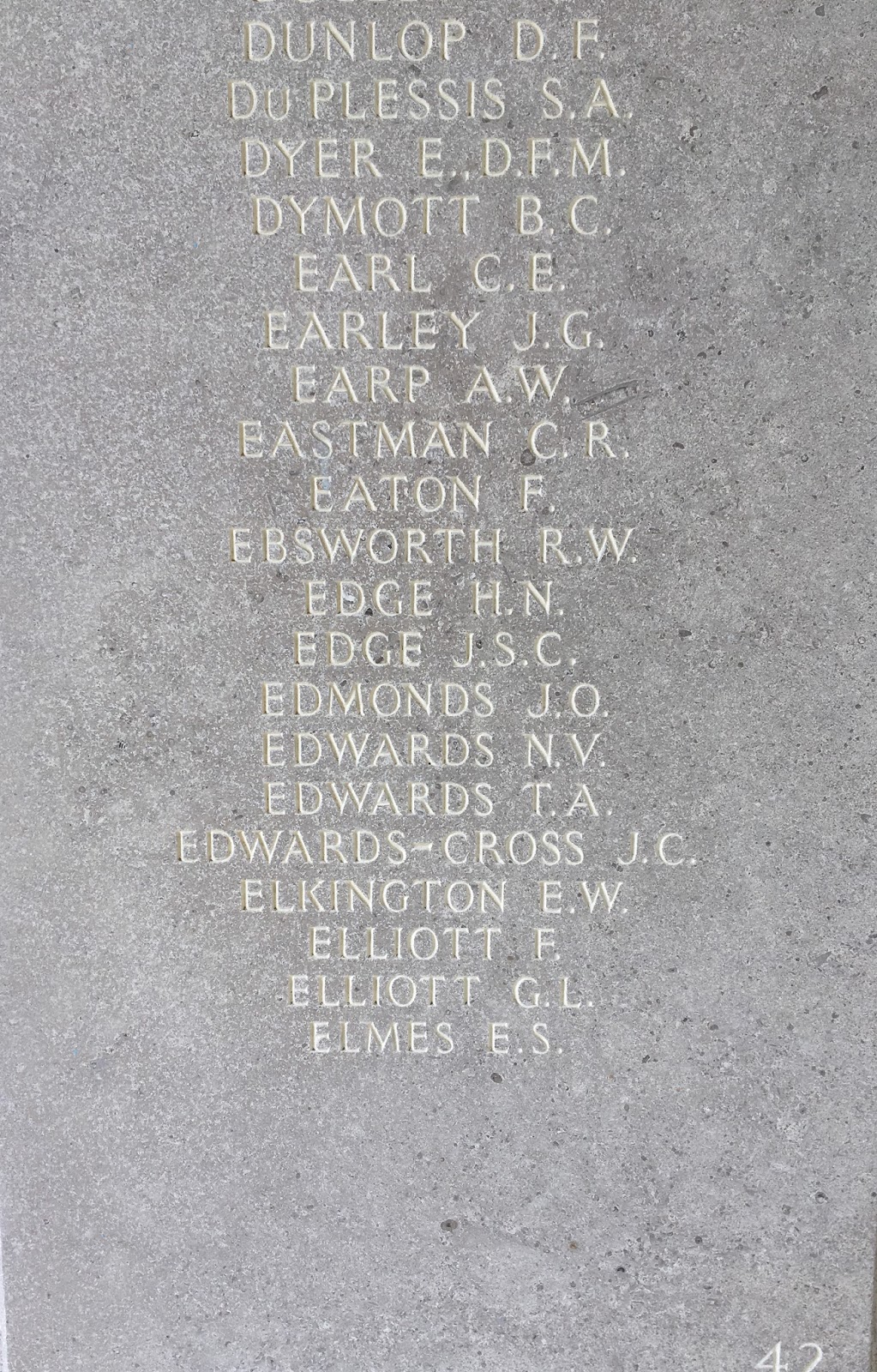
The first name that I was seeking out was Sergeant Ronald William Ebsworth of 214 Squadron in Bomber Command. In peacetime, Ron had been an accomplished amateur footballer, firstly for his local club Ilford FC, before he signed for Dulwich Hamlet FC in the summer of 1936. By the time of the declaration of war in September 1939, Ron was 33 years of age and perhaps having thoughts about retiring from football but despite his relatively advanced years (for a footballer and for aircrew), he volunteered to serve as aircrew and enlisted into the RAF on 13 July 1940. Upon completion of his training, Ron had qualified as a Wireless Operator/Gunner and was posted on 17 September 1941 to 214 Squadron, flying Vickers Wellingtons, based at Stradishall in Suffolk. Ron and his all-Sergeant crew had flown four operational sorties by 30 November 1941, when they departed for their fifth - a mission to Germany's second city of Hamburg. It was a mission from which they were destined not to return, as the squadron's Operational Record Book simply records "Failed to return" alongside his crew's aircraft. The circumstances of the bomber's disappearance are shrouded in mystery; no German night-fighters were operating in the area that the aircraft was flying and in any case, no claims were ever made by German pilots that could not be matched against other losses. A couple of weeks later, the body of the Second Pilot, Sergeant John Boland was washed up on the coast of the German occupied Dutch island of Texel and was buried with due honours by the occupying forces there. Of the remaining crew members, including Ron, there was no trace and today he is commemorated on Panel 42 at Runnymede, with his similarly missing crew mates all remembered in alphabetical order on adjacent panels.

Sgt Ron Ebsworth commemorated on Panel 42 (author's photo)

Before seeking out the other names for whom I was searching, I decided to explore the memorial more fully and decided to climb the steps, culminating in quite a tight spiral staircase, up to the viewing platform on the roof. The day of my visit had dawned with some pretty heavy spring downpours but by the time I reached the memorial, the weather had moderated somewhat and even though the sky was still angry in places, visibility was pretty good. The Thames stretched out below me and away to the east could be seen Heathrow Airport and whilst looking at the steady stream of modern airliners taking off, I speculated as to what the airmen commemorated here would have made of the sleek jet aircraft passing overhead every few minutes that were so different to the piston engined machines of war that they had flown. Further away still, landmarks such as Wembley Stadium and the London Eye could be clearly seen - a rebuilt London vastly different from the Blitz-scarred capital that these airmen would have known. Looking to the west, the view would have been more familiar with Windsor Castle still dominating the skyline.

The scene from Viewing Platform on the roof (author's photo)

Descending the steps once again, I next studied the words on the Great North Window and subsequently discovered that they were the words to the 139th Psalm, apparently sometimes known as the Airman's Psalm, which even to someone like me who is not particularly religious, could have been written for an airman.

If I climb up into heaven, Thou art there;
If I go down to hell, Thou are there also.
If I take the wings of the morning
And remain in the uttermost parts of the sea, 
Even there also shall Thy hand lead me;
And Thy right hand shall hold me.

I then paid a visit to the central courtyard at which many wreathes and more personal tributes to loved ones were on display. Some of these tributes were official and had been laid by representatives of the various Commonwealth nations, whilst some were from bodies representing different sections of the RAF, such as Bomber Command and Air Sea Rescue. There were also poignant tributes from the Association of Jewish Ex-Servicemen and the War Widows' Association. One particularly moving tribute was a personal one, left by the family of one Sgt Edward Buckingham and I hope that they do not object to my having photographed it, as the words at the beginning of the tribute eloquently summed up the essence of the work that I do, stating as it did "It is not just a name on a memorial, it is the story behind the name..."

"It is not just a name on a memorial..." (author's photo)

Looking through to the Central Courtyard (author's photo)

Tributes from far and wide (author's photo)

I then set out to find the other names I had been seeking out, two of whom I have previously written about on this blog. The first of whom was Warrant Officer Peter Leopold Godfrey, whose story I had told November 2012. Pete had been a member of Ickenham Cricket Club, of which I am a member and whose name features on the Club's Roll of Honour. He had been shot down into the sea whilst piloting a Hawker Tempest on flak-suppression duties on 17 September 1944 as part of the air operations connected with Operation Market-Garden. Having written about him and seen a photo of the impossibly young looking pilot, it was nice now to see his memorial.

Pete Godfrey's memorial panel (author's photo)
W/O Pete Godfrey (author's photo)

The other airman for whom I was searching was the subject of a much more recent post, as I had written about Flying Officer James Farrar as recently as January of this year. James had been a Navigator with 68 Squadron based at Castle Camps in Cambridgeshire, where they flew the De Havilland Mosquito. James was also a poet and would surely have become better known had he survived to see peace in 1945. Sadly, whilst his aircraft was on 'anti-diver' patrols, in other words attempting to shoot down V-1 Flying Bombs, his aircraft disappeared over the Thames Estuary. The body of his pilot was washed up in the Thames soon afterwards but Farrar was never found.

Flying Officer James Farrar (author's collection)

James Farrar's memorial tablet (author's photo)

Obviously, the vast majority of the aircrew recorded within the memorial are those of airmen but there are also women commemorated as well, both from the Women's Auxiliary Air Force and the Air Transport Auxiliary. I have not yet had the chance to research any of the female names on display but will hopefully get around to this at some point in the future.

Women are remembered too (author's photo)

Before leaving this memorial which is a place of great beauty and also incredibly moving, I took a final walk through the cloisters which were lined with names and recalled the tribute I had read earlier "It is not just a name on a memorial...." Name after name, each one a son, a husband, a brother, a father and as I had learned, in some cases a daughter, a wife, a sister or a mother. Some of the panels had photographs, individual poppy crosses and personal messages beneath. Incredibly moving and proof that these men and women are still honoured by family and friends.

Just some of the 20,456 names (author's photo)

As I left the memorial to return to my car, I remembered the words engraved on the gallery window, written by a student, Paul H Scott shortly after the memorial was unveiled:  

The first rays of the dawning sun
Shall touch its pillars,
And as the day advances
And the light grows stronger,
You shall read the names
Engraved on the stone of those who sailed on the angry sky
And saw harbour no more.
No gravestone in yew-dark churchyard
Shall mark their resting place;
Their bones lie in the forgotten corners of earth and sea.
But, that we may not lose their memory
With fading years, their monuments stand here,
Here, where the trees troop down to Runnymede.
Meadow of Magna Carta, field of freedom,
Never saw you so fitting a memorial,
Proof that the principles established here
Are still dear to the hearts of men.
Here now they stand, contrasted and alike,
The field of freedom's birth, and the memorial
To freedom's winning.

And, as evening comes,
And mists, like quiet ghosts, rise from the river bed,
And climb the hill to wander through the cloisters,
We shall not forget them. Above the mist
We shall see the memorial still, and over it
The crown and single star. And we shall pray
As the mists rise up and the air grows dark
That we may wear
As brave a heart as they.


If you haven't previously visited this memorial, I would strongly recommend doing so. It is open during the hours of daylight every day of the year except on Christmas Day and New Year's Day.

Source for background information: Commonwealth War Graves Commission 
All photos in this article © Steve Hunnisett unless stated otherwise


Friday, 2 October 2015

Recommended Wartime Reading

Over the past few weeks, several new and recently published books have been flooding into Blitzwalker Towers and whilst this blog isn't usually in the business of book reviews, such is the quality and importance of these publications, it seems only right to share the news around our many readers.

Being Silent They Speak (David JB Smith)

The first to arrive on my doormat wasn't exactly a new book but Being Silent They Speak is one of those titles that I have been meaning to getting around to reading since it first appeared on the scene in 2012 and which tells the story of HMS Unbeaten, a 'U' Class submarine lost in tragic circumstances in November 1942. The author, David J B Smith served with the Royal Navy for 23 years and this sense of being a part of and understanding the Navy's sense of 'family' shines through in this meticulously researched and well written volume on the birth, life and premature death of one of the Royal Navy's unsung heroines, as well of course as the men who served in her during some of the most difficult days endured by the Senior Service.

HMS Unbeaten wasn't a headline grabbing submarine of the Royal Navy, such as the Upholder (a squadron-mate of Unbeaten's and the most successful British submarine of the War) under the command of Lt. Cdr David Wanklyn VC, or the Torbay, commanded by another VC winner, Lt. Cdr. Anthony Miers, but was instead one of the many efficient, hard working ships that made up the backbone of the British Fleet. Unbeaten spent much of her brief career in the Mediterranean under the command of Lt. Teddy Woodward, who was quite a character in his own right, and was based on Malta as part of the Tenth Submarine Flotilla. HMS Unbeaten built up an impressive haul of enemy tonnage, including the Italian submarine Guglielmotti, the German U-Boat U-374 as well as sinking or damaging merchant vessels supplying the Axis forces in North Africa. During her times not on patrol, Unbeaten and her crew members had to endure the almost constant bombing of Malta during the height of the virtual siege of that island fortress. So bad did this bombing become, Unbeaten had to resort to remaining submerged whilst in harbour in an attempt to avoid being sunk at her berth.

David J B Smith tells the story of the submarine's building and commissioning and skilfully manages to interweave the story of the vessel with that of the men that crewed her and paints a picture of a happy ship, with a typical wartime complement that was a mixture of regulars and 'Hostilities Only' ratings, or 'Hostile Ordinaries' as they were sometimes known! 

The story is enhanced by many personal accounts from surviving crew members from Unbeaten and the author goes on to describe all facets of life on board one of His Majesty's Submarines, from the day-to-day proceedings ashore and at sea, to life at 'Action Stations' including what to this writer is the unimaginable terror of being depth charged. One surviving crew member's son said that his dad could only state that the nearest thing to an explanation he could come up with was to watch the classic wartime movie 'Das Boot', which in his opinion, best captured the experience. As the author says though, the only way that one would really know what it was like to be on the receiving end of 100 kgs of TNT exploding all around you at regular intervals, would be to actually experience it first hand.

The final two chapters of this fascinating book are of necessity, based on a certain amount of supposition because of the circumstances of HMS Unbeaten's loss. Without wanting to ruin the read, all that is known is that having completed a top secret mission entitled Operation Bluestone and heading for home, the submarine was sunk in the Bay of Biscay on 11th November 1942 by an RAF Coastal Command Wellington in one of those most tragic of wartime occurrences, what is nowadays called a 'Friendly Fire' incident.

HMS Unbeaten was lost with all hands, thirty six officers and men, so we will never know for sure what happened in those last fateful moments but David J B Smith has produced a remarkable testament to these brave men and indeed, all submariners during wartime. Being Silent They Speak at last.

I thoroughly recommend this book to you and look forward to the author's forthcoming volume on the French submarine Surcouf that is due out later this year.

Being Silent They Speak costs a modest £8.99 for the print version, is published by Stand Easy Books and is available from all the usual sources, or direct from the publisher either in conventional printed format or as an e-book.


The next book to arrive on my doormat, or rather in view of the size of it, into my arms, is this recently published work, The London County Council Bomb Damage Maps, 1939-1945.

This can best be described as a coffee table book and is massive both in it's size and the scope of it's subject matter. It has been compiled by Laurence Ward, a principal archivist at the London Metropolitan Archives and features as it's centre piece, new high definition images of each of the 110 Bomb Damage maps that were compiled during and immediately after the war by the London County Council. At the time, this was a truly herculean task, as the maps were meticulously hand coloured in order to record the damage inflicted on London's built up environment. Each colour used records whether a particular building was destroyed, damaged beyond repair, seriously damaged, repairable at cost and so on.

The maps themselves are things of great beauty and when studying them, it is sometimes easy to forget that each carefully coloured in building represents death, injury, personal loss and at the very least the loss of, or damage to, a place to live or work. These maps are also an important part of London's social history and it is right that they have at last been made available to a more general audience than just people like myself, who has frequently studied some of them at the archive.

Apart from the maps themselves, Laurence Ward has written several chapters that explain the raison d'etre behind the maps as well as a brief summary of the history and timeline of the various attacks on London, i.e. The Night Blitz of 1940-41, subsequent 'Tip and Run' raids carried out by fighter bombers, the Baby Blitz, or Little Blitz of early 1944 and the V-Weapons campaigns of 1944 and 1945. The author then goes on to describe the work of the LCC Architects and District Surveyors in wartime as well as the Light & Heavy Rescue Departments. The methodology of the recording of incidents is also described and a sample list of London-wide incidents is also given, which gives the general reader a good idea of the sheer number and range of incidents that the Civil Defence Services (as well as ordinary Londoners) were likely to encounter. A useful chapter on researching war damage at the London Metropolitan Archives is also included, followed by the maps themselves, which rightly take centre stage in this fascinating book.

The book is then supplemented by a selection of the remarkable bomb damage photographs taken by two City of London Police Officers, PCs Arthur Cross and Fred Tibbs, both keen amateur photographers who were tasked with the job of making a photographic record of the bomb damage within the City of London Police area. These photographs were nearly all taken the morning after a major raid and some of them show rescue work still in progress. Some of these photographs I had seen before but many of them are new to me and in this large format are remarkable in their detail and clarity.

There are really not enough superlatives for this truly magnificent work, which is an essential possession for the serious researcher but one which will not be out of place in the home of any Londoner, or indeed anyone with an interest in the history of our capital city and the men and women who lived and worked there at this time. Don't be put off by the list price of £48.00 - it is quite easy to make a considerable saving on this by shopping around.

The London County Council Bomb Damage Maps 1939-1945 is published by Thames & Hudson and is available from all booksellers and also online from the usual sources.


The next book to arrive with me was another with a distinctly 'London' feel to it being entitled The Isle of Dogs During World War II and is written by a local boy, Mick Lemmerman. The author was born on the Island and grew up there during the 1960s and 70s and is part of a trio of local historians who have made it their mission to collect and organize information and images of the Island as well as to foster interest in the locality. Any student of the London Blitz will be aware that the East End and the Dock areas in particular suffered the brunt of the early attacks on the capital and therefore, the Blitz is an integral part of the recent history of this historic area. The other thing that attracted me to this book as soon as I started reading the introduction was Mick's statement that his interest is not so much on the people but on the place - the docks, streets, schools, churches, pubs, bridges etc., and of the timeline of events. A man after my own heart!

In my opinion, some historians of this time have too much of an over reliance on personal accounts, which unsupported by facts, tend to become rather tedious after a very short time. In this comprehensive history, Mick manages to get a nice mixture of personal accounts and hard facts, well supported by a wealth of period photographs and some present day shots to give a 'then and now' perspective of many of the locations mentioned in the text.

The book starts with a brief introduction explaining something of the history of the Island and the construction of the docks, as well as providing the reader with some social history as to the demographic of the residential areas. The author then goes on to give a synopsis on the rise of Hitler in Germany and how Europe slipped inexorably into war during the 1930s.

There then follows a lengthy and useful chapter on the British preparations for war, covering the setting up of the Air Raid Precautions or ARP Sub-Committee in the late 1930s, which began to make provisions for the Civil Defence network across the country. This included the distribution of gas masks to the population, Gas Decontamination training, lighting restrictions (the 'Blackout'), air raid shelters, first aid posts, Air Raid Wardens, Rescue Squads, the Auxiliary Fire Service and Ambulance Service. Also covered in this chapter is the provision of anti-aircraft guns, barrage balloons, conscription and the evacuation of school children and pregnant women from the main centres of population to the relative safety of the countryside.

The scene is now set for the main focus of the book and Mick devotes a chapter to the First Day of The Blitz - 'Black Saturday' 7th September 1940.  The timeline of the evening's events is given on an incident-by-incident basis, with some useful maps to provide the reader with a good idea as to where the bombs fell as well as a good number of personal accounts to illuminate the text and to give the human touch to what was happening on the ground. This chapter really brings home what it must have been like for the local residents and for the Civil Defence workers doing their best to keep the fires at bay and to keep the populace safe.

The following chapter focuses on the remaining days of the Night Blitz and summarize on a daily basis, each raid that affected the Island. Once again, the author provides a nice mixture of hard facts, personal accounts, contemporary news items as well as many photographs that bring the whole period to life very vividly. The following chapter looks at the period after the Blitz and tells of Home Guard exercises with mock battles, 'Tip and Run' raids, daily life in post-Blitz London, the 'Little Blitz', the construction of the Mulberry Harbours for D-Day (of which a considerable portion were built locally) and of course, the V-Weapons and the impact that these had on the already war-weary Islanders.

The final chapters concentrate of the aftermath of the war and the effect on the local population as well as the devastation caused that now had to be rebuilt, including the rise of the once ubiquitous 'pre-fab' as well as the difficulties in dealing with the unexploded wartime ordnance that is unearthed from time to time. The book closes with a chapter on the various memorials to the victims of the Blitz and subsequent attacks that can be found in the area.

All in all, this is a well researched and well written book that is a credit to it's author and a deserved memorial to the people of the Island who suffered so much during times of great hardship. I noticed one small typo (the 7th September 1940 is inadvertently given as 1941 in a couple of parts of the text) but this is a minor quibble. This self published book is very good value at £10.95 and is available direct via the author's blog as well as usual internet sources.


The final book to reach me is another recent publication dating from 2014 and concentrates on an often overlooked aspect of the German air attacks on Britain, the 'Little Blitz' of early 1944. The official name given by the Luftwaffe was Operation Steinbock, but to Londoners hardened by five years of war, it was dismissively known as the 'Baby Blitz' or The Little Blitz and it the latter name from which this book takes it's title. Written by John Conen, the author provides one of the few detailed studies of what was very much the Luftwaffe's last throw of the dice against London, certainly when it came to conventional, manned aircraft.

Operation Steinbock was a strategic failure for the Germans for a number of reasons. Firstly, the Luftwaffe of 1944 was a different animal to that of 1940-41. The losses incurred during the Battle of Britain and subsequent campaigns in the Mediterranean and Russia had weakened it irreparably both in terms of numbers of aircraft and experienced crews. Secondly, the Luftwaffe had not really modernized it's bomber fleet in any meaningful way and still relied largely upon the same obsolescent types of medium bomber that had failed to deliver the knock out blows against Britain in the Night Blitz; the only new type to see service during The Little Blitz was the Heinkel He177, an attempt to produce a heavy bomber with a comparable bomb load to the British and American 'heavies' but a design which suffered many teething problems with it's engine design and which did not appear in sufficient numbers to make any difference to the outcome of the war. The final factor in the failure of Steinbock were the great developments made in the British night fighter network, with all aircraft radar equipped and vectored onto their targets by a well drillled network of controllers and the anti aircraft guns by now equipped with the new proximity fuse.

John Conen begins his book with a chapter devoted to putting the Little Blitz in context which gives a brief run down of the Luftwaffe's previous attacks on British cities before getting down to a month by month breakdown of the Steinbock raids. As the author states, the first raid on the night of 21st/22nd January 1944 was an inauspicious start to the campaign, with only around 40 of the 200+ bombers despatched actually managing to reach London. Of the 500 tonne bomb load, only 268 tonnes fell on land and of this, only 32 tonnes actually hit anything in London. Bombs were scattered all across southeastern England. From a German point of view, things had gone badly wrong and a combination of poor navigation, effective British counter-measures and bad weather were all reasons put forward for this ignominious failure.

The author goes on to describe each raid in some detail and although these raids were nowhere near the scale of the 1940-41 attacks, much death and destruction was caused and as well as the many tons of High Explosive dropped, there seemed to be a greater emphasis on incendiary bombs than previously - perhaps in some measure retaliation for the vast quantities dropped almost nightly on German cities by the RAF.

One incident in the Little Blitz was comparable to anything that happened in the 1940-41 raids and was indeed the worst wartime incident in Chelsea, despite this borough being the third most bombed in London. This was the 'Guinness' incident of the night of 23rd/24th February 1944, so called because the bomb devastated a block of flats belonging to the Guinness Trust. This incident was recounted in the February 2012 edition of this blog and resulted in the award of the George Cross to Tony Smith, a member of the Heavy Rescue squad, who rescued several people from the flooded basement ruins of the building. Despite Smith's heroism, 59 civilians were killed on this terrible night.

The raids petered out in April 1944, with what proved to be the last bomb dropped on London from a conventional aircraft in the early hours of the 19th of that month. Operation Steinbock lingered on with further desultory attacks on southern coastal targets and came to an end on 30th/31st May with attacks on Falmouth and Portsmouth.

Operation Steinbock had no adverse effect on Operation Overlord, the Allied invasion of Europe which began just six days after the final raid on Falmouth. To the contrary, Steinbock helped the Allies; at the start of Steinbock, the Luftwaffe had 695 serviceable bombers to call upon in Western Europe but the heavy losses incurred meant that by D-Day, they could only muster 133 bomber aircraft, against which were ranged some 45 squadrons (over 800 aircraft) of Air Defence of Great Britain (ADGB) plus the huge Tactical Air Forces at Eisenhower's disposal.

John Conen has produced an excellent and very detailed summary of Operation Steinbock and The Little Blitz is to be commended. At £14.99, the price is perhaps a little steep for a book of only 128 pages but by shopping around online, it is quite easy to obtain this book for considerably less.

All of the books reviewed above are well recommended and are a worthy addition to the libraries of either the serious historian or anyone with an interest in the Second World War.

Being Silent They Speak - David J B Smith - Stand Easy Books, 2012. ISBN 9780957392502
http://stand-easy.weebly.com/

The London County Council Bomb Damage Maps 1939-1945 - Laurence Ward - Thames & Hudson, 2015. ISBN 9780500518250

The Isle of Dogs During World War II - Mick Lemmerman - self published 2015. ISBN 9781507746110 
https://islandhistory.wordpress.com/2015/08/13/now-available-the-isle-of-dogs-during-world-war-ii/

The Little Blitz - John Conen - Fonthill Media, 2014. ISBN 9781781553084