Showing posts with label Charlton. Show all posts

Monday, 5 October 2020

A George Medal Hero in Charlton

During the lockdown forced upon us by the ongoing COVID-19 pandemic, I passed the time by writing up and producing a series of "virtual" Blitz Walks on Twitter, one of which covered my own local area of Charlton in Southeast London. One of the stories that came out at the time was that of Albert William Brittan, of the Greenwich Rescue Service, who was awarded a George Medal for his bravery in releasing victims trapped in a bombed house in Charlton Lane on 8 December 1940.

I had previously searched for a photograph of Albert at the National Archives and online but to no avail but was delighted recently when I chanced upon an edition of The Antiques Roadshow on BBC Television - not a programme I regularly watch - and saw an image of him appear, together with his medals, courtesy of his daughter who proudly told his story. As a result of this, I was able to take a screengrab of the photograph and can now tell his story a little more fully.

To begin with, we need to find out a little more about our hero; Albert William Brittan was born in 1904 to Amy Brittan (nee James) and her husband Joseph Brittan, a demolition worker. They lived at the family home in 41 Hamilton Street, Deptford. It was a large family, with Albert being one of five sons and with two sisters also living at home. Albert doesn't feature on the 1939 Register at that address, as he had married Emma Rose Roberts in 1929 and somehow seems to have slipped under the radar when the census was taken but three of the family are still at Hamilton Street; parents Joseph and Amy together with one of Albert's younger brothers, Sidney who is also listed as a demolition worker. This was obviously a family concern, for Albert's medal citation also shows this as his civilian occupation.

Albert William Brittan (centre) (screengrab from BBC Antiques Roadshow)

On the night of 8/9 December 1940, at approximately 02:40 close to where a level crossing takes the railway line from Woolwich Dockyard towards Charlton Station, two high explosive bombs fell on a terrace of houses located at 19/27 Charlton Lane. The incident log records "PEOPLE TRAPPED, 4 FATAL CASUALTIES, 6 TO HOSPITAL, 16 TO FIRST AID POST". 

It has to be remembered that this rather cold description was written in the heat of the moment, as were all such incident logs and is in fact, inaccurate in so far as five people lost their lives in this incident.

Albert Brittan's George Medal citation (author's image)

Shortly after the bomb fell, local Air Raid Wardens would have ascertained that persons were trapped in the ruins and it wasn't long before the Rescue Squad, under the command of 36-year-old Albert Brittan arrived on the scene. By this time, Albert was recorded as living at 14 Oxenham House, Benbow Street, Greenwich and had joined the Rescue Service soon after the outbreak of war. His experience as a demolition worker would no doubt have been of great benefit, given his knowledge of the construction of buildings.

On arrival at the scene, Brittan was informed that five people were trapped in the ruins of number 25 and soon worked out that they were trapped in the remains of the kitchen. He quickly set his squad to clearing as much of the debris as was safely possible and then entered the building himself. He was soon able to rescue a baby and after passing the infant to his colleagues, he went back into the ruins and after moving a door and beams obstructing his passage, he was able to rescue the baby's mother and carried her out of the building. Returning inside, he next freed a young girl and also recovered the body of an elderly lady. Shortly after re-entering the building yet again, the roof partially collapsed and almost trapped Albert but he persisted in his work, all the time whilst other bombs were falling and anti-aircraft shell fragments were falling in the vicinity.

After some five hours in the ruined house, he was finally able to rescue the final trapped person, a man who had been pinned down by floor joists. Once he rescued him, only then was Brittan satisfied that all of the occupants had been rescued. His hands were cut and bleeding and needed to be dressed by a doctor from a nearby First Aid Post, who happened to be Dr John Montgomery, Club Doctor of  Charlton Athletic Football Club, as well as being the Company Doctor at Siemen's (a large local employer at that time) and a future director at The Valley. Montgomery was one of the witnesses to Albert Brittan's recommendation for an award and was well qualified to do this, having no doubt witnessed his efforts at first-hand. 

Recommendation for Albert Brittan's award (author's image)

In total, thanks to the efforts of Albert Brittan and the other members of his Rescue Squad, seven of the twelve people they rescued between them came out alive and all subsequently survived. The five that lost their lives are listed at the bottom of the article.

Dr John Montgomery (centre in wing collar) (Charlton Athletic Museum)

Brittan was recommended for a George Medal by the London County Council, with the recommendation endorsed by Mr Tinslay, Officer in Charge of the Greenwich Rescue Service and by Dr John Montgomery of the Valley First Aid Post, with the award confirmed and gazetted in the London Gazette dated 25 April 1941. The citation concludes thus:

"Brittan was under the debris for five hours without relief and displayed initiative, resource and a high courage. Through his exertions, four persons were rescued alive."

The site of the bombed houses in Charlton Lane (Paul Chapman)

The bombed terrace of houses in Charlton Lane were never rebuilt after the war and today the site forms part of the grounds of Pound Park School but in a way, this is an apt memorial to the five who perished here as well as to the heroic efforts of Albert Brittan and his Rescue Squad who ensured that seven others lived to tell the tale.

I haven't yet been able to ascertain any real details of what Albert did subsequently but he appears to have died, aged only 46, on 31 October 1952 in Greenwich, leaving Emma Rose as his widow. One can only speculate whether his early death was due in some way to his dangerous work as a demolition contractor in an era when health and safety practices were largely absent in the workplace.

In remembrance of those who died here on the night of 8/9 December 1940:

Rachel Miekle Cumming, aged 72, of 27 Charlton Lane
Sidney Martin, aged 32, of 27 Charlton Lane
Florence Lilian Maud Budden, aged  37, of 25 Charlton Lane
Gertrude Budden, aged 59, of 25 Charlton Lane
Desmond Charles Lambert, aged 17, of 23 Charlton Lane

Postscript - 26 October 2020 - I have now been contacted by Keith Budden, aged 81 who was one of those pulled from the ruins of 25 Charlton Lane by the Rescue Squad, although in his case not by Albert Brittan. Keith too saw the Antiques Roadshow and was alerted to my blog post by a friend. Keith tells me that Barry Martin, then just seven months old and who was the baby rescued by Albert Brittan, is also still with us, aged 80. Both men subsequently married and have children and grandchildren, none of which would have been possible without the heroism of Albert Brittan GM and his rescue squad.

Both the Budden and Martin families, who counted amongst those rescued, as well as victims, are inextricably linked with the early history of Charlton Athletic FC and indeed a future Charlton legend, Brian Kinsey was related via marriage to the Budden family although he was not present in Charlton Lane on the night in question, as at that time he was living in nearby Priolo Road.


Published Sources:

The London Gazette - dated 25 April 1941


Unpublished Sources:

Metropolitan Borough of Greenwich Civil Defence Incident Log 1939 - 1945
Home Office Inter-Departmental Committee on Civil Defence Gallantry Awards, Case No. 843 - HO 250/19/843 - UK National Archives, Kew


Monday, 14 September 2020

The First Day of the Blitz in Greenwich

Luftwaffe reconnaissance photo taken in the early evening of Saturday 7 September 1940 (author's collection) 

The above photo was taken from a Luftwaffe aircraft during the early evening of Saturday 7 September 1940 - "Black Saturday" as Londoners came to call it - the first day of the London Blitz and an afternoon and evening never to be forgotten by anybody who experienced it. The annotations are mine as I wanted to mark some local landmarks to the image as 7 September was a day that impacted upon my family, as it did on many thousands of people across the eastern half of London, on both sides of the Thames.

My late Mother was one of those affected by the events of the day, in so far as she had been working at Woolwich Arsenal until lunchtime in her job at the Pay Office there. Although a half day on Saturday was the normal order of things, she quite often had to work a full day but fortunately on this day, her work was completed in time for a scheduled departure at 13:00. Had she left later in the afternoon, she could well have been caught up in the events there later.

In the Metropolitan Borough of Woolwich, the first incident was recorded at exactly 17:00 at 38, 59 and 61 Basildon Road, Abbey Wood, with a High Explosive (HE) bomb as well as a Delayed Action device (DAB) reported. Nos 59 and 61 were reported as completely demolished and a large fire burning out of control, although happily with no casualties. The LCC Bomb Damage Map for Basildon Road confirms that the two houses towards the top left of the road (between the 'L' and 'D' on the map) were damaged beyond repair and a look at Streetview today confirms this, with a much newer property (no. 61) in the space left by the two destroyed houses. This much more modern building coupled with the fact that the house numbers jump from 57 to 61 without a no. 59, tells the present-day looker what happened here.

LCC Bomb Map for Basildon Road (author's image)

The "new" no. 61 Basildon Road fills the space left by the destroyed 59 & 61 (Google Streetview)

Things soon began to deteriorate in the borough and by 17:50 buildings in the Woolwich Dockyard were well on fire. This is the huge column of smoke that can be seen at the top centre of the photograph at the head of this page. The Incident Log tells us "Major Fire, 30 pumps in service, one casualty dealt with locally. Commonwealth Buildings - three buildings on fire, only 2 pumps on spot." Clearly a dangerous situation as the Dockyard was by then being used by the Woolwich Arsenal for the storage of ordnance, amongst other things. Fortunately, this fire was brought under control before things got out of hand, although the fires at Commonwealth Buildings were still alight at 21:00. Elsewhere in the borough, casualties began to mount - two mortuary vans were required for an incident in Plumstead High Street at 17:52, whilst a direct hit on a shelter in Wickham Lane, near the 'Foresters Arms' pub saw two women, together with a boy and a girl killed. There was no let-up as the evening progressed and the raiders returned; four further fatalities were reported at Lakedale Road, including an AFS Station Officer, Frederick Tierney.

So it continued, throughout the early hours of the 8th with no respite - in total 92 incidents appear in the log for the night of 7/8 September, whilst across the borough boundary in Greenwich a similar story was developing.

In Greenwich, the first incident was not reported until 17:50 in Ordnance Crescent with "many IBs" (incendiary bombs) being the terse comment on the log. At 18:00 in Kidbrooke Grove (initially wrongly reported as Kidbrooke Gardens) we see the words "RAF parachutist badly injured" - this is Flight Lieut Richard Reynell who sadly was dead following the non-deployment of his parachute and whose story has been covered in this blog on several occasions, most recently in August 2017.

As in Woolwich, events intensified as the evening progressed - the first civilian fatality was reported at Armada Street in Greenwich at 18:15, whilst four minutes later, there is a report of an "aeroplane down" in Victoria Way, Charlton although I haven't yet been able to glean any further details of this, including whether it was a friendly or an enemy machine. At 22:56, the Johnson & Phillips cable factory in Victoria Way is also reported hit, with one building in danger of collapse, which seems to have occurred later when looking at the photographs taken later the following morning.


Damage to the Johnson & Phillips cable factory in Charlton (Greenwich Heritage)

Collapsed building at Johnson & Phillips (Greenwich Heritage)

The raid continued into the early hours, although in Greenwich there were slightly fewer incidents,  with 64 recorded by the local ARP Service. Fatal casualties in Greenwich amounted to 25, compared to 69 across the borough border in Woolwich. It was a bad night for London with some 400 civilians killed and was the precursor of fifty seven consecutive nights when London was bombed and of a wider Blitz across all major British towns and cities which would last until the spring of 1941.


Published Sources:

The London County Council Bomb Damage Maps 1939 - 1945, editor Laurence Ward - Thames & Hudson 2015

Unpublished Sources: 

Metropolitan Borough of Greenwich Civil Defence Incident Logs
Metropolitan Borough of Woolwich Civil Defence Incident Logs


Sunday, 11 August 2019

"An Unprincipled Rogue"

Vic Wilson - "an unprincipled rogue" (Mark Smith)

In a week when I was lucky enough to be part of the latest Football & War Seminar, hosted by the excellent Charlton Athletic Museum, it was fitting that the day after the event, a trail that I had thought had gone cold, suddenly and unexpectedly came back to life with a phone call out of the blue. Regular readers, may remember that in January 2018, following a post on the club's message board, I had made some enquiries about Vic Wilson, who is mentioned in Alfred Allbury's book "Bamboo and Bushido", which describes the author's experiences as a Prisoner of War at the hands of the Japanese following the fall of Singapore in February 1942.

Vic and Alfred both came from Greenwich and were close friends who served together in a Territorial Army Field Regiment of the Royal Artillery. Alfred described Vic in the narrative as "...an unprincipled rogue with a delightful wry sense of humour and a healthy hatred of the war that kept him from his wife and young baby back in Charlton."

First Edition cover of Bamboo and Bushido (author's collection)

The phone call came from Mark Smith, who is married to Vic Wilson's great granddaughter. After introducing himself, Mark explained that Vic's daughter, Val Jacob, who I had written to and subsequently had a long telephone conversation with, was sadly in hospital having suffered a nasty fall and had therefore not been able to pursue her promise to try and find me a photograph of her father, hence my thinking that the trail had gone cold. Mark had discovered my initial letter to Val and kindly offered to pick up the baton and sure enough, the next day, two photographs of Vic arrived by email - one of which can now be seen at the top of the page.

A few things in this story had intrigued me; it isn't often that my little backwater of Southeast London gets a mention in a book that doesn't concern football and the fact that the two men served in the Royal Artillery - a local regiment - meant that we were quite possibly looking at men from my immediate locality and perhaps who supported the same football club. Unfortunately, Allbury's book didn't say with which regiment of the Royal Artillery they had served but a delve in one of my many reference books provided the Order of Battle and this informed me that a local Territorial Army Battery - 118th Field Regiment, Royal Artillery - was present at the fall of Singapore and this encouraged me further.

A search of the excellent Commonwealth War Graves Commission website, as it so often does, provided the basis for my research. It told me that Gunner Victor Charles Wilson had sadly not survived the war but had indeed served with 118th Field Regiment. Vic had died in captivity on 27 July 1943 and was buried at Thanbyuzayat War Cemetery in Burma, which indicated that he was one of the many who perished whilst being employed as slave labour of the Japanese on the infamous Burma Railway.

Further research showed that Vic had been born in Greenwich in 1918 and lived at 49 Chevening Road. During the third quarter of 1939, Vic married Violet Elizabeth Brown from 60 Inverine Road, Charlton and in the first quarter of 1940, Violet gave birth to a baby daughter, Valerie. With the onset of the Blitz, Valerie and Violet were evacuated to the relative safety of Hampshire but Vic and his colleagues, being members of the Territorial Army, had been mobilised upon the declaration of war.

The War Diary of 118th Field Regiment RA reveals early mobilisation plans (author's photo)

In normal times, 118th Field Regiment was based at their Drill Hall in Grove Park, Southeast London but inspection of the Regimental War Diary reveals that the process of mobilisation began as early as 23 August 1939 with the call-up of civilian transport and by the evening of 1 September, an advance party of 150 officers and other ranks marched from Grove Park to Cambridge Barracks at nearby Woolwich, to take up their wartime duties. Apart from a brief spell in late November 1939 when the Regiment took part in an exercise in the Ramsgate area, they remained at Woolwich Garrison until mid-January 1940 at which point they moved to Eastbourne to take up coastal defence duties. The Regiment was equipped with a mixture of 18 pounder field guns of Great War vintage and 4.5" howitzers, of similar ancestry. From late June 1940, they moved to the Norfolk coast to take up anti-invasion duties and whilst here, were re-equipped with 75mm artillery supplied from the USA. In September 1940, a further move occurred, this time to Worstead during which time the Regiment was finally re-equipped with the iconic 25 pdr pieces so beloved of the Royal Artillery. Yet another move to the Scottish Borders followed in January 1941 and it was whilst here that the War Diary first mentions the possibility of a deployment to a "Tropical Climate" with training being arranged accordingly. In early April 1941, the Regiment moved to the Staffordshire area, where training continued. Study of the War Diaries tends to lend the lie to the usual perception that the British were forever unprepared for war and muddling through - the politicians may have been unprepared but the Regiment was making preparations for mobilisation over a week before the declaration of war and then training to fight in the Far East some eight months before the entry of Japan into the war.

The Regiment sailed from the Clyde on 30 October 1941 as Convoy CT 5 in eight large troopships, which in peacetime had been better known as the ocean liners ANDES, DUCHESS OF ATHOLL, DURBAN CASTLE, ORCADES, ORONSAY, REINA DEL PACIFICO, SOBIESKY and WARWICK CASTLE. The convoy took the troops as far as Halifax, Nova Scotia where they arrived on 7 November 1941. The next phase of the voyage saw them trans-shipped to six American Troop Transports, the JOSEPH T DICKMAN, LEONARD WOOD, MOUNT VERNON, ORIZABA, WEST POINT and WAKEFIELD. This particular aspect of the voyage is fascinating as the Americans were by now openly assisting their British allies some two months before their official entry into the war and were transporting the British soldiers to potentially fight against an enemy who had also not yet entered the war!

The American ships sailed as Convoy WS 12 X (a British convoy designation) even though the naval escort at this stage was entirely provided by the US Navy and proceeded via Port of Spain to Cape Town, where they arrived on 9 December 1941, two days after the USA's official entry into the war. From Cape Town, the naval escort was a mixed Royal Navy and US Navy affair and the convoy proceeded via Mombasa to Bombay, where they finally arrived on 27 December 1941. From here, the troops transferred to British ships for the final leg of the voyage to Singapore, where they arrived in mid-January 1941, barely one month before the surrender of the colony to the Japanese.

General Arthur Percival (IWM)

The fall of Singapore was arguably the biggest debacle in British military history and is a story of poor preparation, poor command and a classic case of resources being spread too thinly. Despite this, the Allied forces enjoyed a huge numerical superiority over the Japanese, consisting of some 85,000 British, Australian, Indian and Malay forces against some 36,000 invading Japanese. The Allies however, had no tanks in Singapore and were initially convinced that any Japanese assault would come from the seaward side and not via the Malay Peninsular. The air cover was also insufficient, consisting at first of obsolete Brewster Buffalo fighters and later, small numbers of Hawker Hurricanes, which were no match for the Japanese fighters and were quickly overwhelmed. As a result, there were constant air raids on Singapore and the British commander General Percival, faced with a civilian catastrophe as well as a military defeat, surrendered his forces on 15 February 1942. It was an utter humiliation and one from which British prestige in the region never really recovered.

Alfred Allbury wrote eloquently of the final hours before the surrender:

"My co-driver Vic Wilson and I sallied forth on nightly excursions to ammunition dumps scattered around the island-no transport could survive ten minutes on the road by day. Once our 15cwt was loaded, we had to deliver the shells to our guns. This called not so much for a knowledge of map reading as for the gift of clairvoyance. Jap planes and the unsuitability of the terrain for effective artillery positions kept our battery commanders roving the island in a desperate search for potential gun-sites. Those found and occupied were speedily made untenable by the sustained accuracy of the Japanese counterfire." 

"Vic Wilson and I had long been friends. He was an unprincipled rogue with a wry sense of humour, and a healthy hatred of the war that kept him from his young wife and baby back home in Charlton."

"On the morning of February 14th the first tentative shells landed among our supply-dumps. They quickly found the exact range and soon a searing bombardment developed that sent us scuttling into our fox-holes. The Japs were ranging on us from heights that overlooked the town. Bukit Timah was theirs after the bloodiest of struggles, the reservoir was stained crimson with the blood of those who had fought so bitterly to hold it, and the little yellow men whom we had ridiculed and despised were in swarm across the island. It was already theirs." 

"Next morning Vic and I set off on a last mad jaunt taking ammunition to ‘A’ Troop who were dug in behind a Chinese temple to the north of Racecourse Road. Vic drove like a maniac. He had, I found, been sampling a bottle of ‘John Haig’. We thundered along deserted roads, pitted and scarred with bomb craters. Wrecked and burnt-out vehicles lay everywhere, strewn at fantastic angles. The trolley-bus cables hung across the road in desolate festoons which shivered and whined as we raced over them. A few yards from the charred remains of an ambulance were a knot of troops gathered round a cook’s wagon. From them we scrounged a mug of hot tea and found out the guns of ‘A’ Troop were only a few hundred yards distant. We delivered our ammunition and an hour later rejoined Battery HQ close by the Raffles Hotel." 

"But late that afternoon came the news that we had surrendered. There was to be a cease-fire at four o’clock. We had fought and lost. And the ashes of defeat tasted bitter. At three o’clock all but a few of the guns were silent. Ammunition had been expended. From the hills there still came the occasional bark of a Japanese gun followed by the whine and crash of its shells. But by six o’clock, save for the spluttering of flames and the occasional explosion of ammunition, all was quiet over the island of Singapore. The carnage of the last ten days was quieted now, and in eerie silence our troops sat huddled together in puzzled but fatalistic expectancy."

"Vic and I returned to our lorry, ate some tinned bacon and biscuits and stretched ourselves luxuriously for our first uninterrupted sleep for many days. We took off our boots, smoked, talked and listened to the distant caterwauling of the Japanese." “They’ll probably,” said Vic “be crawling round us in the night, cutting off our ears.” 

"But we stretched out and slept the sleep of the utterly exhausted, while around us into the tropic rose a barbaric and discordant dirge: the victory song of the triumphant Japanese." 

With the fall of Singapore, some 80,000 Allied personnel became Prisoners of War. The Japanese had already signalled their scant regard for humanity when the day before the surrender, they had captured the Alexandra Hospital. A British lieutenant, clearly displaying a white flag, approached the Japanese in order to act as an envoy and explain the presence of a military hospital but was killed with a bayonet. As Japanese forces entered the hospital, they killed soldiers undergoing surgery and bayoneted doctors and nurses with no regard to their non-combatant status. The following day, a further 200 patients and staff were dealt with in the same manner. This was just the beginning of the now-familiar tale of atrocities committed by the Japanese.

With the exception of small parties who escaped Singapore by small boats, including a group of nineteen from the 118th Field Regiment, who safely arrived in India in April 1943 after an odyssey that lasted some fourteen months, the vast majority of those who surrendered went into captivity. After initially being held at Changi Prison, many of the men were sent to work as slave labour on the infamous Burma-Thailand Railway and this is where the story of Vic Wilson ended, succumbing to Beri-Beri on 27 July 1943 and thus never returning home to his wife and daughter.

The Nominal Roll records Vic Wilson's death (authors image)

The Regiment somehow managed to maintain a Nominal Roll which records the fate of Vic and his colleagues, despite the writer of the Roll being imprisoned at Changi and the Regiment being scattered far and wide. It makes heartbreaking reading and a manual count by this writer revealed that of the 744 Officers and Other Ranks that went into captivity at Singapore, 188 died whilst POWs, which represented a loss rate of 25.27%. The vast majority of these men died from disease but inspection of the Nominal Roll reveals some who died from acts of brutality, with for example, one cause of death recorded as "Fractured skull caused by rifle butts." Sadly, this is not uncommon, all of which confirms the Japanese lack of regard for Allied Prisoners of War. 

Despite the sad loss of Vic's life, this story does have an uplifting ending, as following further research, I was able to ascertain that Vic's daughter Valerie is still with us and lives in the local area. I rather tentatively wrote her a letter, explaining who I was and asking whether or not she was aware that her father featured in a book covering the fall of Singapore. I was delighted to receive a phone call a day or so later from Val and had a pleasant conversation with her. She doesn't really remember her Dad, as she was only a baby when he went overseas for what proved to be the final time and neither was she aware of Alfred Allbury's book. Val's Mum had of course told her something of her father and had frequently told Valerie that she shared many of Vic's characteristics. She also confirmed that as far as she had been told, Vic was a Charlton football fan and had attended matches at The Valley before going overseas. I sent copies of the pages in which Vic had been mentioned and subsequently had another long chat on the phone. 


The second photo that I received from Mark, courtesy of Val's son Paul was of Vic, together with a slightly disgruntled looking Val sitting on his knee, in the garden of what looks like a bomb damaged house - perhaps this is the reason for the move away from Inverine Road to the relative safety of Hampshire?


Vic and Valerie (Mark Smith)

It is always pleasing when a story finally comes together and when it happens unexpectedly when one had thought that the trail had gone cold, it is even more satisfying and thanks to the efforts of Mark, we now know the identity of a Charlton Athletic supporter and "unprincipled rogue" who now rests far away from Southeast London.


Published Sources:

Bamboo and Bushido - Alfred Allbury, Robert Hale Limited, London 1955


Unpublished Sources:


National Archives WO 166/1530 - 118th Field Regiment RA, War Diary 01 August 1939 - 30 September 1941

National Archives WO 361/235 - 118th Field Regiment RA, Malaya: Missing Personnel
National Archives WO 361/1300 - 118th Field Regiment RA, Thailand, Casualties
National Archives WO 361/2092 - 118th Field Regiment RA. Far East, Prisoners of War, Nominal Roll

Jacob family archive and reminiscences


Wednesday, 10 July 2019

Heroes and a Heroine of Charlton

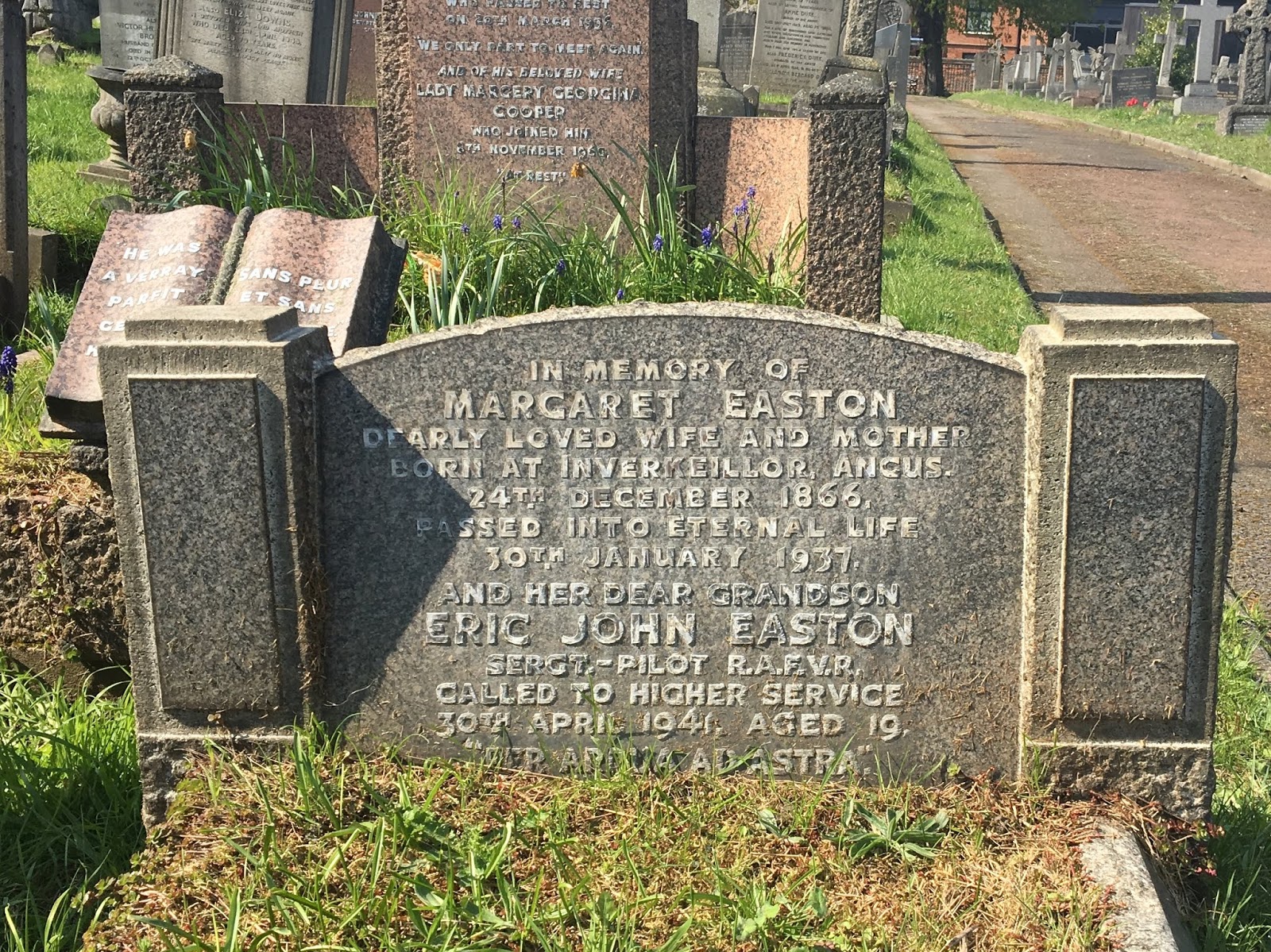
Sgt. Eric Easton's grave at Charlton Cemetery (author's photograph)

When I wrote recently about the Second World War aircrew buried in my local cemetery in Charlton, southeast London, I promised to tell the story behind one of the more unusual graves that I discovered there during my searches, one which appeared to hint at a double tragedy for the family concerned. It has taken a little longer than I anticipated and at the time of writing, I have still not been able to get my hand on any photographs of the individuals concerned but notwithstanding that, the story uncovered was indeed one of great heroism and warrants recounting here.

We have already heard how Sergeant Eric John Easton RAFVR was killed at the tragically young age of 19 whilst undergoing his operational training with 52 OTU at RAF Debden, when his Hurricane failed to pull out of a high speed dive and crashed in nearby Bishop's Stortford. This accident had occurred in 1941 and was most probably due to the pilot losing consciousness due to problems with his oxygen supply. 

What I hadn't revealed fully in the previous article was the fact that Eric's family grave contains a sibling who served in the Air Force, in her case the WAAF, who had also died during the Second World War in what appeared to be heroic circumstances. I needed to discover more about this double tragedy to beset the Easton family.

Section Officer Joan Marjorie Easton's grave at Charlton Cemetery (author's photo)

Joan Marjorie Easton was born in Woolwich on 30 May 1917 to parents Victoria Easton (nee Jamieson) and John W Easton and by the time of the 1939 Register being taken, she was still living with her parents who had moved to 32 Sandringham Drive in Bexley, with her occupation at that time recorded as a Shorthand Typist. It is unclear exactly when Joan enlisted into the Women's Auxiliary Air Force but given the accident that befell her younger brother in 1941, it is quite possible that it was this event that inspired her to join up.

By 1943, Joan had risen to the rank of Section Officer and was based at RAF Mepal in Cambridgeshire, the home to 75 (NZ) Squadron, Bomber Command, which at this time flew the four engine Short Stirling, the first of the Royal Air Force's four engine heavy bombers. The Stirling suffered from changes made to the wingspan during the design stage and thus always suffered from a lack of ceiling and thus at this time was already being replaced by the more capable Handley Page Halifax and especially the iconic Avro Lancaster. It was however, much liked by pilots who found it an easy aircraft to handle given its size but due to the height of the aeroplane, it was susceptible to cross winds when manoeuvring on the ground.

On 8 September 1943, the squadron had been tasked with bombing the port facilities at Boulogne and seventeen aircraft were detailed to undertake the mission. Amongst them was Stirling III serial BK809, coded 'AA-T' under the command of a 21 year old New Zealander, Flying Officer Ian Robert Menzies RNZAF, who had already accumulated 802 flying hours, 45 of which were on the Stirling and who was on his eighth operational mission. Under his command was a mixed New Zealand and British crew, whose ages ranged from 21 to 30 years of age. Each bomber was carrying the maximum bomb load it was capable of lifting, a total of 14,000 lbs or 6,350 kgs of 1,000 and 500 lb high explosive bombs.

The heavily laden bombers began to take off from the Cambridgeshire airfield from 20:45, with Flying Officer Menzies' aircraft scheduled to be amongst the last to do so but at 21:55, during take off, the huge bomber was caught by a slight gust in the crosswind and Menzies was caught slightly unawares. The aircraft veered off the runway as the pilot over-corrected and lurched to starboard, struck a fully laden fuel bowser and then ploughed through the perimeter fence into nearby houses, where it burst into flames.

Many of the residents of the houses were in bed, or were preparing to retire for the night. One of the occupants of the houses affected, a Mr. John Randall, aged 58, was killed instantly, although his wife Jessie managed to escape with cuts and burns to her feet. Other householders were trapped but were rescued through the heroic efforts of the National Fire Service, who were quickly on the scene, as were personnel from RAF Mepal, amongst whom was Section Officer Easton.

Hearing the explosions, Joan immediately ran from her billet on the airfield, as did an off-duty airman from the squadron, Flight Sergeant Peter Gerald Dobson RNZAF, 28 years old from Blenheim, New Zealand. Dobson was agonisingly close to the end of his tour, having already completed 28 missions (out of 30) when he ran to the rescue. The blazing bomber still contained a full bomb load and the prospect of these exploding must have been uppermost in the minds of the rescuers but Easton and Dobson, together with others from the base as well as members of the police and fire service managed to rescue the other occupants of the two burning houses as well as moving others to safety.

The rescuers were also trying to reach the trapped crew of the Stirling, five of whom managed to escape, or were rescued by the gallant group of helpers. Sadly, one of those rescued, the Flight Engineer, Sergeant Albert Leslie Mellor RAFVR, died from his injuries later in the day. Whilst the would-be rescuers were attempting to reach the remaining two crew members, who included the Pilot, Flying Officer Menzies and the Air Bomber, Flying Officer Norman Hathway Gale RAFVR, part of the bomb load exploded, killing the two crewmen, as well as three of the rescuers, Section Officer Easton, Flight Sergeant Dobson, as well as a Fireman from the NFS, 50 year old Albert Kirby, a local man from Sutton, Cambridgeshire.

Extract from The Scotsman of 15 January 1944 (author's collection)

In January 1944, it was announced that both Section Officer Easton and Flight Sergeant Dobson had been posthumously Mentioned in Dispatches for the bravery. The citation for the awards, rightly stated that many more lives would undoubtedly have been lost had it not been for the quick action of the rescuers.

Out of a total of 257 aircraft that took part in this operation against Boulogne, just three were lost, all of which were due to accidents during take off - none were lost due to enemy action!

Tragically, of the survivors of the crash of BK809, one of these airmen was to be killed later in the war whilst serving with 7 Squadron, when the Lancaster of which he was part of the crew, was shot down, with six of the seven crew being killed. Further details of this incident can be found on the excellent Aircrew Remembered website.

If any readers have photographs of any of the aircrew or rescuers, in particular of Joan Marjorie Easton, I would be happy and honoured to share them on this page.

Please note that all photographs used on this page are the property of the author and may not be used elsewhere without my express written permission. Offenders will be ruthlessly pursued!


The crew of Stirling BK809 as follows:

Pilot: Flying Officer Ian Robert Menzies NZ/415002 RNZAF. Age 21, killed. Son of Dougas and Violet Menzies of Gisborne, Auckland, New Zealand.
Flight Engineer: Sergeant Albert Leslie Mellor 943914 RAFVR. Age 30, killed. Son of Albert and Lucy Mellor of Buxton. Husband of Gladys Mellor of Buxton, Derbyshire.
Navigator: Pilot Officer Derek Albert Arthur Cordery 136360 RAFVR. Injured.
Air Bomber: Flying Officer Norman Hathway Gale 151013 RAFVR. Age 30, killed. Son of Thomas Redstone Gale and Millie Gale of Bristol. Husband of Elizabeth Ellen Gale of Bishopston, Bristol.
Wireless Operator/Air Gunner: Sergeant Ralph Herbert Barker NZ/417189 RNZAF. Injured.
Air Gunner: Sergeant G Bullivant 1395379 RAFVR. Injured.
Air Gunner: Sergeant Stewart Donald Muir NZ/416967 RNZAF. Age 21, injured. Son of William Thornton Muir and Lily Ellen Muir of Lyttleton, Canterbury, New Zealand. (NB - Sgt. Muir was killed on 15.16 June 1944 whilst serving with 7 Squadron.)

Those killed on the ground:

Flight Sergeant Peter Gerald Dobson MiD NZ/439022 RNZAF. Age 28. Son of Henry Bruce Dobson and Emily Daisy Houghton Dobson of Blenheim, Marlborough, New Zealand.
Section Officer Joan Marjorie Easton MiD 2986 WAAF. Age 26. Daughter of John W Easton and Victoria Easton of Bexley, Kent.
Fireman Albert Edward Kirby of the National Fire Service. Age 50. Husband of Lillian Kirby of Sutton, Ely, Cambridgeshire.
Civilian Mr John Randall. Age 58. Husband of Jessie L Randall of Sutton, Ely, Cambridgeshire.


Unpublished Sources:

75 (NZ) Squadron Operations Record Book: UK National Archives AIR 27/646/41 & 42
Ely Standard & Cambridgeshire Times 17 September 1943
Daily Record 15 January 1944
The Scotsman 15 January 1944

Internet Source:

Aircrew Remembered 


Thursday, 9 May 2019

The aircrew on my doorstep


The grave of Flight Lieut FJ Kemp at Charlton Cemetery (author's photo)

This piece was originally posted in January 2017 and concentrated on just one grave that I had discovered at Charlton Cemetery. Since then, I have now researched all of the aircrew buried at this cemetery and thought it would make sense to update the article so as to pay tribute to all of the RAF boys on my doorstep. As always, the photos used to accompany this article are credited accordingly and none may be used without my express written permission.

When I wrote the original piece in 2017, it was very much the result of some accidental researching that came about whilst engaged on an unrelated project for a paying client. Following on from my recent exploration of All Saints' Churchyard in Carshalton which I wrote about here in January 2019, it seemed a sensible progression to come back to my own local cemetery in order to look at the RAF aircrew buried here, especially as one of the Charlton buried aircrew had a coincidental Carshalton connection which linked the two projects nicely.

Charlton Cemetery in Southeast London contains 114 burials commemorated by the Commonwealth War Graves Commission, of which 55 are from the Second World War. I was aware of these and indeed had already written about a member of the Home Guard buried there in the May 2015 edition of this blog. The headstone that had caught my eye in 2017 was that of a Royal Air Force pilot, Flight Lieutenant Frederick John Kemp, who had died in July 1944. 

30 year old Frederick Kemp was born in Greenwich in 1914 and had married his wife Ellen in 1938, settling in the Charlton area of Southeast London. The 1939 Register shows Fred living with his wife in what must have been crowded conditions with his parents at 27 Mascalls Road, although they were later to move to a house of their own at 35 Eastcombe Avenue.

Upon the outbreak of war in September 1939, Frederick had joined the Royal Air Force, eventually qualifying as a pilot in 1941. By 1944, he had risen to the rank of Flight Lieutenant and was serving with 68 Squadron at RAF Castle Camps in Cambridgeshire, flying the De Havilland Mosquito NF XVII, which was a night-fighter variant of the sleek and versatile 'Wooden Wonder' as it was frequently referred to at the time.

Flying Officer James Donald Farrar (Aircrew Remembered)

His navigator was the 20 year old James Farrar from Carshalton, Surrey. James obviously had aviation in his family's blood, as his elder brother was the aeronautical engineer David Farrar. James had been called up in February 1942 and received his commission as a Pilot Officer the following year, serving with 68 Squadron. James was also an accomplished poet and had an anthology of his work, entitled "Unreturning Spring" published posthumously in 1950. He had been a pupil of Sutton Grammar School and his talent as a writer was described by Alwyn Trubshaw, his former English teacher who said of him "I say taught English but it would be truer to say that I taught English in his presence only. He had no need of my teaching. He was a natural born writer."

By July 1944, London was once again under German bombardment, not this time from manned bombers but from the V-1 Flying Bomb, known to Londoners as the Doodlebug or Buzz Bomb. These fearsome weapons were launched mainly from fixed sites in the Pas-de-Calais region and were programmed for their engine to cut out when over the London area. Thus, they were the first, albeit crude form of Cruise Missile, technologically advanced in their propulsion and guidance but aimed only in the general direction of London, falling indiscriminately on their target, whether factory, house or hospital.

James Farrar remembered at Runnymede Memorial (Author's Photo)

At first, the V-1 caused havoc amongst the war weary Londoners. The first one fell on 13 June 1944, barely a week after D-Day and at a time when the British people could have been forgiven for thinking that the end of the war was finally in sight. The British defences were quickly re-organised; the anti-aircraft guns located in and around London were quickly re-located to form a defensive strip around the Kent and Sussex coasts, where the majority of the missiles crossed on their steady course. Inland of the guns, the barrage balloons were re-deployed and behind these, RAF Fighter Command was given free reign to shoot down any of the Buzz Bombs that had not been brought down by the first two layers of this new and hastily improvised defence. The new arrangements proved extremely effective; the anti-aircraft guns with their proximity shells and radar guidance shot down the most, eventually gaining a success ratio of one V-1 for every hundred shells fired. The Barrage Balloons were less successful but were still thought to have been responsible for bringing down about three hundred missiles. The RAF shot down 1,954 of them, with the Hawker Tempest being the most successful with 638 'kills' and with other types such as the Mosquito taking 623, Spitfire 303 and Mustang 238, with other types accounting for the remainder, including the then new Meteor jet fighter, which gave the people of Kent and Sussex an early vision of the jet age. Overall, out of 9,250 Doodlebugs aimed at England, only some 2,400 reached their target, which represents a remarkable change in fortunes.

The extract from 68 Squadron's Operational Record Book (author's image)

The RAF nicknamed their flights against the V-1s as Anti-Diver Patrols and it is was on these missions that Flt. Lieut. Kemp and Flying Officer Farrar were employed in July 1944. As the threat from these weapons was of a round the clock nature, 24 hour patrols were maintained, with the fighters being vectored onto the Divers by radar. On the night of 25 July 1944, ten Mosquitos of 68 Squadron were on patrol, with Kemp and Farrar flying in aircraft serial number MM679 with a callsign of "Ferro 19". Shortly before midnight, they were vectored to intercept a Diver over the Thames Estuary. They replied to say that whilst they could see the V-1, they were out of position and that another aircraft of 219 Squadron was better placed to intercept. Shortly after making this transmission, they sent a further message to say that the Diver had exploded. At 04:12, they were given a new vector by control to intercept but did not respond to the message. Despite repeated efforts to contact Ferro 19, they could not be raised and had to be considered as missing.

Frederick Kemp's body was later washed ashore in the Thames Estuary but there was no trace of either the Mosquito or James Farrar, who is today commemorated on the Air Forces Memorial at Runnymede. Fred Kemp left a wife (who never remarried) two daughters and a son.

The grave of LAC Ronald Brooks at Charlton Cemetery (author's photo)

The above mentioned incident occurred whilst an experienced crew were on an operational flight but as can be imagined, the vast majority of those aircrew who are buried in local cemeteries such as Charlton were killed as a result of some sort of training accident. In Bomber Command alone, some 8,195 aircrew were killed in flying or ground training accidents and the following casualties interred in the cemetery reflect this.

On my return to the cemetery, the first RAF grave that I discovered was that of a young pilot under training, Leading Aircraftman Ronald Edward Brooks, who lived with his parents in Tallis Grove, Greenwich. So far, it has not been possible to discover much about this family but young Ronald, who had doubtless volunteered to fly on the strength of the then recent events of the Battle of Britain, died on 10 October 1940 when the Magister training aircraft in which he was a pupil pilot, crashed shortly after taking off from RAF Woodley on what should have been a routine stage in his training.

The circumstances of the accident are not recorded but when rescuers reached the stricken aircraft, both Brooks and his instructor, 24 year old Pilot Officer Ivor List were both seriously injured, and sadly died shortly after admission to hospital. Ronald Brooks was just 19 years of age and the news of his death whilst still under training would have been a heartbreaking blow to his parents

Sgt. HR Jennings grave at Charlton Cemetery (author's photo)

The next grave I investigated was not of the usual CWGC style and had obviously been erected privately as a family plot as it commemorated several members of the Jennings household. The person I was interested in was Sgt. Henry Rupert Jennings, who had died whilst serving in RAF Coastal Command as part of the crew of a Liberator bomber, used extensively on maritime patrol duties.

Henry had been born on 10 Jun 1918 to parents Henry Hough Jennings and Eva Florence Jennings who lived at 6 Church Street, Greenwich. The 1939 Register describes Henry junior as a 'Cycle and Tool Shop Manager' but shortly after this time, in common with many other young men across the country, he had volunteered to serve as aircrew. In his case, Henry qualified as a Wireless Operator/Air Gunner and was posted to 224 Squadron in Coastal Command, which had recently converted to fly the Consolidated Liberator, a large four engine bomber, which was to prove a game-changer in the Battle of The Atlantic.

Until the advent of the Liberator, Coastal Command had had to make do with the ever reliable Short Sunderland flying boat, a fine aircraft which could carry a formidable weapon load and which was a proven U-Boat killer but which did not have sufficient range to close the "air gap" between the United States east coast, Iceland and the UK in the North Atlantic. Other aircraft such as the Catalina and Lockheed Hudson also failed to meet this criteria and the Air Officer Commanding Bomber Command, the formidable Sir Arthur Harris refused to release any of his precious Lancasters for the task. The VLR or Very Long Range Liberator was the answer to this problem and these aircraft began to be introduced in penny numbers from December 1941 but did not appear in greater numbers until the spring of 1943.

The Liberator of which Henry Jennings was a crew member took off from RAF Beaulieu at 08:49 on Saturday 7 November 1942 under the command of 31 year old Flight Sergeant Kenneth Crabtree for an anti-shipping patrol over the Bay of Biscay. As far as is known, all had proceeded according to plan when the aircraft returned to Beaulieu at 19:30 that evening. The squadron's Operational Record Book does not state whether or not the aircraft was in a damaged condition when it attempted to land but merely states that the aircraft crashed on landing and subsequently exploded, with the loss of the entire crew of seven. Henry was just 24 years of age.

The grave of Sgt JV Hay at Charlton Cemetery (author's photo)

The next grave that I came across was that of Sergeant James Vincent Hay, aged 28 who had been born on 15 April 1916 and was recorded in the 1939 Register as being a Constable in the Metropolitan Police Force, based at Blackheath Section House. He had also recently married Madge Patricia Sheldsick but had not at that time set up home together as Madge was recorded as still living with her parents at Maidenstone Hill in Greenwich.

James would have no doubt served in the Metropolitan Police throughout the worst of the London Blitz and V-1 campaign but in common with many younger police officers, would have been released when things became a little quieter and had enlisted in the RAF towards the middle part of 1944. Sadly, it would appear that he never saw operational service with the RAF, for whilst he was training at No. 3 (Observer) Advanced Training Unit, based at RAF Halfpenny Green, Wolverhampton, his Avro Anson aircraft serial AX538, which was piloted by a Canadian, Sgt. John Mervyn Penonzek,  was involved in a mid-air collision with another similar aircraft over the Isle of Man. The second aircraft was able to make a forced landing nearby but sadly, AX538 crashed at Ballacurphy Farm with the loss of all four crew members on board. In addition to his wife Madge, John left a four year old son, a year old daughter and would also be a father to another daughter that he would never see, born in the third quarter of 1945.

Sgt. JH Atkinson's grave at Charlton Cemetery (author's photo)

Sgt. Jack Holder Atkinson was born on 20 February 1910 and is recorded in the 1939 Register as living at 15 Balloch Road, Lewisham, with a recorded occupation as a Motor Dealer. He had married Thelma Shutt during the fourth quarter of 1941 and had settled in the Charlton area of Southeast London. Jack had enlisted into the RAF during the second half of 1942 and by January 1943, he had completed his basic and operational training to be posted to serve in Bomber Command as an Air Bomber (Bomb Aimer). The large four engine heavy bombers such as the Stirling, Lancaster and Halifax were now coming on stream in steadily increasing numbers and so "Heavy Conversion Units" or HCUs were formed in order to mould the crews into the units required to man these large (and for the time) technically advanced aircraft. 

On 2 January 1943, Sgt. Atkinson formed part of  a crew of a Halifax bomber, serial R9388. The Halifax normally carried a crew of seven but for the purposes of this exercise was carrying a depleted crew of four, having dispensed with the services of a Navigator, Wireless Operator and an Air Gunner. The aircraft took off from the base of 1658 HCU at RAF Riccall in North Yorkshire just after 10:00 on a morning that was described in the Operational Record Book as "Fine, becoming cloudy with strong wintry showers". At around 10:20, the aircraft was seen from the ground as flying with one engine stopped and the propeller feathered, when it suddenly began to climb very steeply before it stalled and plummeted into the ground at Cawood, near Tile Bridge. Of the four man crew, there was just one survivor, Sgt. Gordon Maxwell Lipsett of New Brunswick Canada. He had been the tail gunner and was recovered from the wrecked aircraft suffering from extensive injuries. He was taken to nearby Selby Cottage Hospital and later transferred to the RAF Hospital at Rauceby. Fortunately, he recovered and survived the war, only to pass away at the young age of 53 in Winnipeg in 1974.

Sadly, the remaining crew members did not survive the crash and Jack Atkinson was returned to his young widow to be buried at Charlton Cemetery.

Sgt WH Lacey's grave at Charlton Cemetery (author's photo)

After a bit more exploration of this large cemetery, I came across another CWGC headstone which contained the grave of yet another RAF aircrew member who was sadly killed whilst undergoing his training.

Sgt. William Lacey (Stephen Lacey)

Sergeant William Haylett Lacey was born on 3 August 1922 and was the eldest of three children born to William Haylett Lacey (Senior) and Nora Lacey of 6 Ormiston Road, Plumstead. William's younger siblings were a sister, Doreen born in September 1925 and a brother, Robert born in September 1927. Young William's occupation in the 1939 Register was recorded as a Junior Clerk in a Gas Company but along with many thousands of others, he volunteered to serve in the RAF as aircrew and joined the service in late 1941. By April 1942, he had completed his basic training and had qualified as a Wireless Operator/Air Gunner and had already completed the "crewing up" process at 23 Operational Training Unit based at RAF Pershore in Worcestershire. He and his crew mates were nearing the end of their operational training and would no doubt have shortly been posted to an operational squadron, when on 8 April 1942 at 15:37, the Wellington serial R1597 in which he was flying, crashed at Llangammarch Wells in Breconshire. In addition to the embryo crew, there were two instructors also killed in the accident. I am indebted to family member Stephen Lacey for providing updated information and the photograph of William.

Pilot Officer Barton-Smith's grave at Charlton Cemetery (author's photo)

Our next grave revealed only the second officer to be found here at Charlton Cemetery and was yet another airman killed whilst undergoing training at a Heavy Conversion Unit, in this case 1654 HCU based at RAF Wigsley in Nottinghamshire. Reginald Lionel Barton-Smith of Charlton was the husband of Irene Miriam Barton-Smith and was aged 22 at the time of his death.

On 11 November 1943 at 17:30, Lancaster I serial W4902 piloted by Barton-Smith, took off from RAF Wigsley on a long cross-country flight which was to be the final conversion exercise for this crew prior to their being posted to an operational squadron. By 22:45 they were close to RAF Scampton in Lincolnshire in poor visibility when suddenly, the pilot had to manoeuvre sharply to avoid a collision with a Wellington aircraft. As a result of this, the collision was averted but the pilot lost control and the Lancaster crashed at Hackthorne, about one mile from Scampton. Of the seven man crew, there were four survivors, Sgt JF Snedker, the Flight Engineer, Sgt. CSW Wilkes, the Air Bomber and two Air Gunners, Sgts. WB Crawford and FW Murphy, both of the Royal Australian Air Force. The first three were taken to the RAF Hospital at Rauceby, whilst Murphy, who had a fractured left femur was admitted to Lincoln Military Hospital. All of these men subsequently survived the war. Sadly, the remaining three aircrew did not survive.

Pilot Officer Geoffrey Richard Davis's grave at Charlton Cemetery (author's photo)

The next headstone revealed another officer and on this occasion, although his death was accidental, it occurred during an operational mission, rather than during training and is arguably the most tragic of all of the various incidences recalled above.

Geoffrey Richard Davis was born on 12 June 1922 to Maxwell Charles and Lilian Davis of 77 Maze Hill, Greenwich. Maxwell was a wholesale tobacco merchant according to the 1939 Register but so far, we have not been able to ascertain Geoffrey's peacetime occupation. He had volunteered to serve with the RAF as aircrew and had qualified as a Sergeant Pilot, having been posted to 98 Squadron of 2 Group flying the twin engine Mitchell bomber. The squadron had by this time passed from Bomber Command to be part of the new Second Tactical Air Force as part of the prelude to Operation Overlord, the invasion of Europe in June 1944.

The squadron was based at RAF Dunsfold in Surrey, which gave the squadron easier access to it's intended targets within the invasion area of Northern France. In late April, Davis had been commissioned to the rank of Pilot Officer but the promotion hadn't been officially recognised in the squadron's Operational Record Book, when at 12:24 on 20 April 1944, the Mitchells of the squadron took off on a daylight bombing raid  on targets in Croisette, France. Unfortunately, Davis's Mitchell had been seen to crash shortly after take-off, about three miles from the airfield. There were no survivors amongst the four man crew.

What makes this loss particularly tragic is that Davis had been married just a month or so earlier, perhaps in anticipation of his impending promotion. He had tied the knot with Irene Marjorie Noble in North Bucks., and at the time of his death, were still living with Geoffrey's parents in Maze Hill. The headstone has the heartbreaking inscription "Forever In My Thoughts".


Sgt. Eric John Easton's grave at Charlton Cemetery (author's photograph)

Our final aircrew grave at Charlton reverted to type with a Sergeant being killed whilst undergoing training as a fighter pilot but which does have a fascinating, albeit tragic link with another member of the same family. Eric John Easton was just 19 years of age at the time of his death and little is known about his early life. He shares a grave at Charlton with his grandmother, Margaret Easton, so perhaps this suggests that he lost his parents at an early age.

Whatever the circumstances, Eric had volunteered to serve as aircrew in the RAF, no doubt in his case spurred on by the recent events of the Battle of Britain. He had qualified as a pilot and was undertaking his operational training at 52 OTU at RAF Debden in Essex, where he was in the latter stages of learning how to fly the Hawker Hurricane fighter.

Sadly, on 30 April 1941, his aircraft failed to pull out of a high speed dive and crashed off Danocoys Lane, Bishop's Stortford. He was undergoing an oxygen test at the time of the crash and it was thought that oxygen supply problems was the main contributory cause of the crash.

As mentioned earlier, the Easton family grave contains another family member from the Royal Air Force who gave her life in heroic circumstances later in the war and her story will be recounted in the next edition of this blog.

In the meantime, if any of our readers have connections with any of the families mentioned in the above piece and can obtain photographs of any of the people mentioned, I would be delighted and honoured to share these, so please leave a comment below and I will get back to you with my contact details, or you can leave a message via the contact page on my main website.

In Memoriam:

68 Squadron De Havilland Mosquito NF XVII serial MM679

Flight Lieutenant FJ Kemp RAFVR (Pilot) of Charlton, London
Flying Officer JD Farrar RAFVR (Navigator) of Carshalton, Surrey

8 EFTS Miles Magister I serial R1891

Pilot Officer IH List RAFVR (Pilot, Instructor) of Stoke on Trent, Staffs
Leading Aircraftman RE Brooks RAFVR (Pilot, Under Training) of Charlton, London

224 Squadron Consolidated Liberator III 'XB-C' serial FK245

Flight Sergeant K Crabtree RAFVR (Pilot) of Bingley, Yorkshire
Sergeant RS Horsley RAFVR (Pilot) of Old Coulsdon, Surrey
Sergeant KE Hunt RAFVR (Flight Engineer) of Lewisham, London
Sergeant AW Colston RAFVR (Navigator) of Southville, Bristol
Flight Sergeant ES Bayley RAFVR (W/Op Air Gunner) of Higher Crumpsall, Manchester
Sergeant RWJ Harrison RAFVR (W/Op Air Gunner) of Burnley, Lancashire
Sergeant HR Jennings RAFVR (W/Op Air Gunner) of Charlton, London

3 (O) Advanced Flying Unit Avro Anson I serial AX538

Flight Sergeant JM Penonzek RCAF (Pilot) of Rossburn, Manitoba, Canada
Sergeant EC Comer (Observer) of North Finchley, London
Sergeant JV Hay (Air Bomber) of Greenwich, London
Flight Sergeant AJ Bell (W/Op Air Gunner) of Wellingborough, Northants

1658 Heavy Conversion Unit Handley Page Halifax II serial R9388

Sergeant TD Watson RAFVR (Pilot) of Lanark, Scotland
Sergeant WF Hewitt RAFVR (Flight Engineer) of Wellington, Somerset
Sergeant JH Atkinson RAFVR (Air Bomber) of Charlton, London

23 OTU Vickers Wellington Ic serial R1597

Sergeant JM Kennedy RCAF (Pilot) of Red Lake, Ontario, Canada
Sergeant WM Lomax RAFVR (Observer) of Liverpool
Sergeant W Smith RAFVR (Observer) of Wallasey, Cheshire
Sergeant FT Ellingham RAFVR (W/Op Air Gunner) of Morden, Surrey
Sergeant WH Lacey RAFVR (W/Op Air Gunner) of Plumstead, London
Sergeant N Griffin RAFVR (W/Op Air Gunner/Instructor) of Palmers Green, Middlesex
Sergeant DW Dowling RAFVR (Air Gunner) of Salisbury, Wiltshire

1654 HCU Avro Lancaster I 'UG-Q' serial W4902

Pilot Officer RL Barton-Smith RAFVR (Pilot) of Charlton, London
Sergeant DH Ryder RAFVR (Navigator) of Leeds, West Yorkshire
Sergeant RJ Huish RAFVR  (W/Op Air Gunner) of Weston super Mare, Somerset

98 Squadron North American Mitchell II 'OE-J' serial FL182

Pilot Officer GR Davis RAFVR (Pilot) of East Greenwich, London
Sergeant G Aldridge RAFVR (Navigator) of Grays, Essex
Flying Officer JP Diversi RAAF (W/Op Air Gunner of Wavell Heights, Queensland, Australia
Sergeant T Shehan RAFVR (Air Gunner) of Cwmburla, Swansea

52 OTU Hawker Hurricane serial P3864

Sergeant EJ Easton RAFVR (Pilot) of Eltham, London


Unpublished Sources - Operational Record Books held at The National Archives, Kew:
 
68 Squadron - AIR 27/604 
8 EFTS - AIR 29/618/1
224 Squadron - AIR 27/1387/20
3 (O) AFU - AIR 29/544
RAF Jurby - AIR 29/545
1658 HCU - AIR 29/613/5
23 OTU - AIR 29/667
1654 HCU - AIR 29/613/1
98 Squadron - AIR 27/783/7 - 8
52 OTU - AIR 29/681/1
Published Sources:
Bomber Command War Diaries 1939-1945 - Martin Middlebrook & Chris Everitt, Pen & Sword 2014