Showing posts with label George Medal. Show all posts

Monday, 5 October 2020

A George Medal Hero in Charlton

During the lockdown forced upon us by the ongoing COVID-19 pandemic, I passed the time by writing up and producing a series of "virtual" Blitz Walks on Twitter, one of which covered my own local area of Charlton in Southeast London. One of the stories that came out at the time was that of Albert William Brittan, of the Greenwich Rescue Service, who was awarded a George Medal for his bravery in releasing victims trapped in a bombed house in Charlton Lane on 8 December 1940.

I had previously searched for a photograph of Albert at the National Archives and online but to no avail but was delighted recently when I chanced upon an edition of The Antiques Roadshow on BBC Television - not a programme I regularly watch - and saw an image of him appear, together with his medals, courtesy of his daughter who proudly told his story. As a result of this, I was able to take a screengrab of the photograph and can now tell his story a little more fully.

To begin with, we need to find out a little more about our hero; Albert William Brittan was born in 1904 to Amy Brittan (nee James) and her husband Joseph Brittan, a demolition worker. They lived at the family home in 41 Hamilton Street, Deptford. It was a large family, with Albert being one of five sons and with two sisters also living at home. Albert doesn't feature on the 1939 Register at that address, as he had married Emma Rose Roberts in 1929 and somehow seems to have slipped under the radar when the census was taken but three of the family are still at Hamilton Street; parents Joseph and Amy together with one of Albert's younger brothers, Sidney who is also listed as a demolition worker. This was obviously a family concern, for Albert's medal citation also shows this as his civilian occupation.

Albert William Brittan (centre) (screengrab from BBC Antiques Roadshow)

On the night of 8/9 December 1940, at approximately 02:40 close to where a level crossing takes the railway line from Woolwich Dockyard towards Charlton Station, two high explosive bombs fell on a terrace of houses located at 19/27 Charlton Lane. The incident log records "PEOPLE TRAPPED, 4 FATAL CASUALTIES, 6 TO HOSPITAL, 16 TO FIRST AID POST". 

It has to be remembered that this rather cold description was written in the heat of the moment, as were all such incident logs and is in fact, inaccurate in so far as five people lost their lives in this incident.

Albert Brittan's George Medal citation (author's image)

Shortly after the bomb fell, local Air Raid Wardens would have ascertained that persons were trapped in the ruins and it wasn't long before the Rescue Squad, under the command of 36-year-old Albert Brittan arrived on the scene. By this time, Albert was recorded as living at 14 Oxenham House, Benbow Street, Greenwich and had joined the Rescue Service soon after the outbreak of war. His experience as a demolition worker would no doubt have been of great benefit, given his knowledge of the construction of buildings.

On arrival at the scene, Brittan was informed that five people were trapped in the ruins of number 25 and soon worked out that they were trapped in the remains of the kitchen. He quickly set his squad to clearing as much of the debris as was safely possible and then entered the building himself. He was soon able to rescue a baby and after passing the infant to his colleagues, he went back into the ruins and after moving a door and beams obstructing his passage, he was able to rescue the baby's mother and carried her out of the building. Returning inside, he next freed a young girl and also recovered the body of an elderly lady. Shortly after re-entering the building yet again, the roof partially collapsed and almost trapped Albert but he persisted in his work, all the time whilst other bombs were falling and anti-aircraft shell fragments were falling in the vicinity.

After some five hours in the ruined house, he was finally able to rescue the final trapped person, a man who had been pinned down by floor joists. Once he rescued him, only then was Brittan satisfied that all of the occupants had been rescued. His hands were cut and bleeding and needed to be dressed by a doctor from a nearby First Aid Post, who happened to be Dr John Montgomery, Club Doctor of  Charlton Athletic Football Club, as well as being the Company Doctor at Siemen's (a large local employer at that time) and a future director at The Valley. Montgomery was one of the witnesses to Albert Brittan's recommendation for an award and was well qualified to do this, having no doubt witnessed his efforts at first-hand. 

Recommendation for Albert Brittan's award (author's image)

In total, thanks to the efforts of Albert Brittan and the other members of his Rescue Squad, seven of the twelve people they rescued between them came out alive and all subsequently survived. The five that lost their lives are listed at the bottom of the article.

Dr John Montgomery (centre in wing collar) (Charlton Athletic Museum)

Brittan was recommended for a George Medal by the London County Council, with the recommendation endorsed by Mr Tinslay, Officer in Charge of the Greenwich Rescue Service and by Dr John Montgomery of the Valley First Aid Post, with the award confirmed and gazetted in the London Gazette dated 25 April 1941. The citation concludes thus:

"Brittan was under the debris for five hours without relief and displayed initiative, resource and a high courage. Through his exertions, four persons were rescued alive."

The site of the bombed houses in Charlton Lane (Paul Chapman)

The bombed terrace of houses in Charlton Lane were never rebuilt after the war and today the site forms part of the grounds of Pound Park School but in a way, this is an apt memorial to the five who perished here as well as to the heroic efforts of Albert Brittan and his Rescue Squad who ensured that seven others lived to tell the tale.

I haven't yet been able to ascertain any real details of what Albert did subsequently but he appears to have died, aged only 46, on 31 October 1952 in Greenwich, leaving Emma Rose as his widow. One can only speculate whether his early death was due in some way to his dangerous work as a demolition contractor in an era when health and safety practices were largely absent in the workplace.

In remembrance of those who died here on the night of 8/9 December 1940:

Rachel Miekle Cumming, aged 72, of 27 Charlton Lane
Sidney Martin, aged 32, of 27 Charlton Lane
Florence Lilian Maud Budden, aged  37, of 25 Charlton Lane
Gertrude Budden, aged 59, of 25 Charlton Lane
Desmond Charles Lambert, aged 17, of 23 Charlton Lane

Postscript - 26 October 2020 - I have now been contacted by Keith Budden, aged 81 who was one of those pulled from the ruins of 25 Charlton Lane by the Rescue Squad, although in his case not by Albert Brittan. Keith too saw the Antiques Roadshow and was alerted to my blog post by a friend. Keith tells me that Barry Martin, then just seven months old and who was the baby rescued by Albert Brittan, is also still with us, aged 80. Both men subsequently married and have children and grandchildren, none of which would have been possible without the heroism of Albert Brittan GM and his rescue squad.

Both the Budden and Martin families, who counted amongst those rescued, as well as victims, are inextricably linked with the early history of Charlton Athletic FC and indeed a future Charlton legend, Brian Kinsey was related via marriage to the Budden family although he was not present in Charlton Lane on the night in question, as at that time he was living in nearby Priolo Road.


Published Sources:

The London Gazette - dated 25 April 1941


Unpublished Sources:

Metropolitan Borough of Greenwich Civil Defence Incident Log 1939 - 1945
Home Office Inter-Departmental Committee on Civil Defence Gallantry Awards, Case No. 843 - HO 250/19/843 - UK National Archives, Kew




Sunday, 19 March 2017

Firemen Remembered at Invicta Road

The Invicta Road plaque in situ overlooking the school playground (author's photo)

On Thursday last, 16 March 2017, I was fortunate enough to attend the unveiling ceremony of the latest memorial plaque erected by the charity Firemen Remembered which took place at Invicta Primary School, Blackheath and which commemorated events at the school some seventy seven years ago when the then vacated school premises were in use as London Auxiliary Fire Service Sub-Station 54X.

The day of the ceremony was a beautifully bright and sunny early spring day, which made it hard to imagine that this now happy place which today once again resonates to the cheerful sound of children playing, was once the scene of one of the worst tragedies in wartime Southeast London, when twelve London Auxiliary Firemen and three civilians were killed when the school received a direct hit from a Luftwaffe parachute mine.

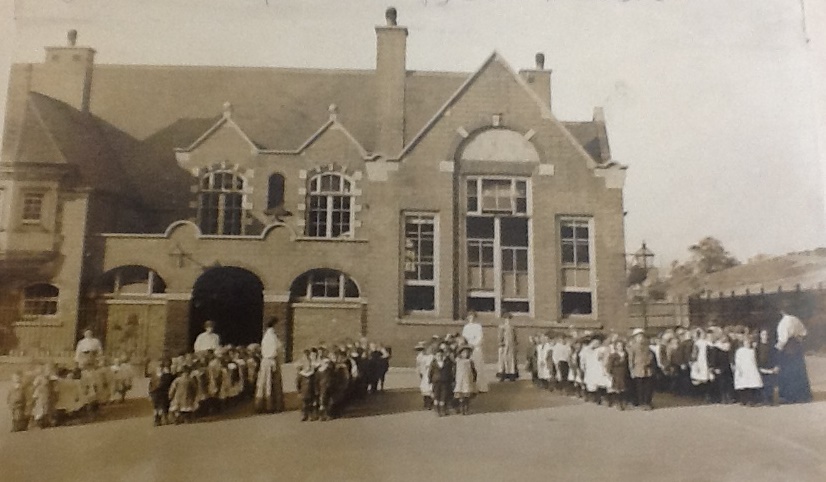
Invicta Road School shortly after opening in 1900 (Invicta Primary)

On 3 September 1939, Prime Minister Neville Chamberlain made his now famous radio broadcast in which he informed the British people that they were "now at war with Germany" but two days prior to this, schoolchildren from across London were being evacuated, in the case of those from Invicta Road School, to the relative safety of the Kent countryside. The school buildings dating from 1900, in common with many across the capital were taken over by the London Fire Brigade as a wartime fire station, being given the somewhat functional title of Sub-Station 54X. It then became home to members of the Auxiliary Fire Service, men and women who had volunteered to serve in the fire brigade should war come. These men and women have often been the subject of writings on this blog, most recently in November 2016 when we reviewed a book that concentrated on participation by the Jewish community in the Fire Services. Those who served were paid the princely sum of £3 per week and were exempt from the call-up to the Armed Forces for the duration of their service with the AFS and before the coming of the Blitz, met with hostility from some quarters, being dismissed as "£3 a week Army dodgers" from certain members of the public. They also met initial resistance and prejudice from some members of the regular Fire Services and it wasn't until after the Blitz started that Churchill's tribute to the "Heroes with Grimy Faces" gathered currency.

When the Blitz did begin on 7 September 1940, the men based at Invicta Road School would have seen plenty of action, since the school was located very close to the River Thames, adjacent to which were situated many factories, wharves and associated industries, all of which were by now undertaking vital war work. At 23:05 on 13 September, the school itself suffered its first damage of the war when a small bomb - probably of the 50 kg variety - fell through the roof of the School Assembly Hall. Fortunately for all concerned, the bomb failed to explode and it was carried out of the building by Fireman Arthur Grant into the Playground, where he then proceeded to bury it beneath a large pile of sandbags. The bomb did subsequently explode but because of being shielded by the sandbags, did little further damage to the school buildings. For this act of extreme bravery, Arthur Grant was recommended for a George Medal, the award of which was confirmed on 12 November 1940.

The ruined school following the bombing (Author's collection)

London suffered nightly bombing from 7 September 1940 for fifty seven consecutive nights but the evening of 14 November proved to be a quieter one than usual for the nation's capital, because on this night the attention of the Luftwaffe switched to Coventry, where one of the worst raids of the war took place. So bad was the destruction resulting from this raid that a new word entered the language, to "Coventrate" which came from a word that had similarly entered the German language at this time "coventrieren", meaning to raze a city to rubble from the air. The death toll from this raid was 568 people killed, with a further 863 who suffered severe injuries. Some 500 tonnes of high explosive bombs were dropped on the industrial city and around 3,600 incendiaries, which started so many fires that firemen were sent from as far away as London to help extinguish them. The industrial output of the city was disrupted but factories were quickly repaired or relocated to new "shadow" factories elsewhere and production recovered within a few months.

Whilst this raid was occurring in the Midlands, the situation in London remained quiet but at 19:30 the air raid sirens sounded and the men at Sub-Station 54X settled down waiting for their first "shout" of the evening. The first bomb in the Borough of Greenwich was reported just ten minutes later at 19:40 when a High Explosive bomb fell on the premises of J Stone & Company, a ship propeller manufacturer in Anchor & Hope Lane, Charlton but on this occasion the men of Invicta Road were not required to attend and they continued to wait patiently, little realising that they would in fact become the subject of the next incident to be reported. At 21:20, a one tonne parachute mine floated silently down and became entangled in the trees that lined Invicta Road and then exploded with the terrific air-burst effect that these weapons, converted naval mines, were capable of. These mines could flatten large areas from their blast and so the adjacent school buildings did not stand a chance.

Parachute Mine at the IWM London (author's photo)

The school buildings collapsed like a house of cards and left many firemen trapped and seriously injured beneath the rubble. These men, usually the rescuers, now found themselves in need of rescue themselves and help quickly came from their colleagues in surrounding fire stations. The work to free them went on well into the next day but sadly, when everyone had been accounted for, twelve firemen were dead, along with a further three civilians who had been in the school premises when the mine exploded. Amongst the firemen killed was Firemen Arthur Grant, whose award of the George Medal had been announced just two days previously and who had not yet received his decoration. One of the civilians killed was Mr White, the School Caretaker who died in his house on the school site. We shall probably never know the reasons as to why the other two visitors were at the school. One of them, Cecil Smith lived at 2 Invicta Road, so perhaps was visiting a newly found acquaintance amongst the firemen or perhaps was a friend of the caretaker. The reason behind the other civilian casualty, 21 year old tailoress Rosetta Florence Johnson, being at the school will remain an even bigger mystery, as being a resident of Islington, she was far away from home on this bleak November evening.

Ironically, despite the unfolding tragedy at Invicta Road, it was to be a relatively quiet night in Greenwich, with just three reported incidents.


Rescue and recovery work goes on (Invicta Primary/LFB)

The idea to place a memorial plaque at the present-day Invicta Primary School was first mooted as far back as 2010 but was delayed for various reasons, not least of which was the rebuilding of the school's temporary premises, first erected in the early 1950s, with a more permanent structure. The modern school is a splendid facility and they are rightly proud of their reputation of having a friendly and stimulating environment for the pupils and are also very conscious of their heritage and local history. 

Therefore, the ceremony, whilst under the overall auspices and guidance of Stephanie Maltman from Firemen Remembered, was very much driven by the school and for this initiative, Mrs Marie Corbett, the Executive Head Teacher and Emily Perfect, Creative Arts Leader, as well as the children themselves, deserve much credit. The ceremony started with Mrs Corbett welcoming everyone to the school and explaining to the pupils what was about to take place. There had been much excitement and anticipation amongst the children, not all of whom were in on the secret!

The Museum curators read the Roll of Honour under the watchful eye of Mrs Corbett (author's photo)

The Year 2 choir opened the ceremony with a delightful rendition of the popular wartime song "We'll Meet Again" before some of the curators of the School's own museum showed photographs of the aftermath of the bombing. A certain local historian and Blitz guide (who shall remain nameless) gave those present a brief description of the events of the night of 14 November 1940 before four pupils from Year 6 read poems that they had written about the war. We then heard the Roll of Honour read to us by fifteen of the School Museum's curators before Mrs Corbett, assisted by two hand-picked pupils from the assembly unveiled the plaque. A minute's silence followed after which the entire school sang "Tipperary", a song perhaps better known as a First World War number but which was sung with great enthusiasm and which seemed very fitting as it was undoubtedly a song with which all of the firemen would have been familar. The indoor part of the ceremony was then repeated with the older pupils coming to join in - this was because the Assembly Hall was too small to accomodate the entire school, such was the interest shown in the proceedings.

The plaque is unveiled as Stephanie looks on (Ken Sinyard)

Amongst the guests present were Ken and Graham Sinyard, whose Grandfather Frank Smart had been a member of the AFS based at Invicta Road, although fortunately not present on the fateful night. Fellow guide and official historian of Charlton Athletic FC, Clive Harris was also present, as was Darryl Chamberlain co-author of the Charlton Champion blog and an old boy of Invicta School from the 1980s (from the "old" school, not the "old old" school as the wartime premises are now known!) 

After the indoor ceremony was complete, we then repaired outside to the school playground, where the plaque was installed in it's new permanent home, fittingly located onto the last surviving retaining wall of the original Victorian school, which now overlooks the present school's playground.

Lest we forget - and the reason we were there (author's photo)

We left the school just as the children were emerging into the playground for their lunch break and the final photograph taken of a group of them inspecting the newly unveiled plaque spoke volumes.

Thanks are due to Stephanie Maltman and Bill Hickin of Firemen Remembered for continuing to raise awareness of the work done and sacrifices made by the men and women of our wartime Fire Services and also to Marie Corbett, Emily Perfect as well as all of the staff and pupils of Invicta Primary for making us all so welcome and for arranging such a wonderful ceremony, of which the fallen of 14 November 1940 would surely have been proud.

The unveiled plaque (Ken Sinyard)

Invicta Road School - Roll of Honour - 14/15 November 1940

David (or Davis) Appleby - Fireman AFS - 432 Bancroft Road, Mile End
John Arthur Axcell - Fireman AFS - 10 Archbishop's Place, Brixton
Charles William Barrow - Leading Fireman AFS - 18 Hassendean Road, Blackheath
Henry Arthur Charles Dixon - Fireman AFS - 35 Alberta Cottages, Kennington
Edmund Francis Emmett - Fireman AFS - 1 Lewis House, Greenhundred Road, Peckham
Edward James Fox - Fireman AFS - 12 High Street, Pinner
Arthur Hugh Grant - Fireman AFS - 107 Footscray Road, Eltham
Ronald Francis King - Fireman AFS - 71 Evan Road, Catford
Reginald Francis William Knight - Fireman AFS - 196 Croydon Road, Hayes
John Phelan - Fireman AFS - 151 Grove Lane, Camberwell
Stanley Sargent - Fireman AFS - 21 Havelock Road, Bromley
Frederick Charles Sutherland - Sub Officer LFB - 203 Kidbrooke Park Road, Blackheath

Rosetta Florence Johnson - 117 Southgate Road, Islington
Cecil Critoph Smith - 2 Invicta Road, Blackheath
Charles White - School Caretaker - School House, Invicta Road, Blackheath


Saturday, 8 November 2014

Remembering them all

The Charlton Athletic FC memorial (author's photo)

Last weekend, this writer was lucky enough to be present at The Valley, home of Charlton Athletic Football Club, at the unveiling of our Club's war memorial to the fallen of this famous old football club.

Fittingly, whilst this memorial was unveiled during the year marking the centenary of the outbreak to "The War to end all wars", Clive Harris, the military historian and Charlton fan who has been the driving force behind this project, was quick to point out in his brief but moving speech during the ceremony, that this memorial was for everyone associated with the club, whether they be players, officials or supporters and whatever conflict, or facet of the war they were involved in, whether military or civilian, as Charlton with it's close proximity to the Thames, was at the heart of the Blitz in 1940-41.

So perhaps with this in mind and at this remembrance weekend, perhaps now is a good time to remember those civilians and civil defence workers who lost their lives, either as innocent victims of bombing, or in the case of Civil Defence workers, trying to protect the citizens of their localities, whether in London, Coventry, Liverpool, Plymouth, or wherever in the UK that Hitler's bombs fell.

The statistics tell us that overall, some 30,000 civilians died in London during the Second World War due to enemy air attacks and the 'Vengeance' Weapons campaign of 1944-45. What mere statistics do not necessarily convey is the sheer awfulness of the reality of these figures; a glance at a typical incident log will impart some more detail - entire families wiped out, children and babies killed (the youngest this writer has seen mentioned was 9 hours old), groups of people in pubs and church congregations alive one moment and gone the next - nobody was immune. Even Armistice Day itself brought terror in wartime; on November 11th 1944, the Brook Hotel, a public house on suburban Shooter's Hill was obliterated by a V-2 rocket, the toll of 29 dead, including some on a passing bus, warranted 'major incident' status but probably had to be seen to realize the true horror of the aftermath.

Woolworth's V-2 memorial (author's photo)
The worst V-2 incident in London came just a few short miles along the A2 from Shooter's Hill, in New Cross, at a busy Woolworth's store. This time, everything that could go wrong, did - the 25th November 1944 was a busy pre-Christmas Saturday - the rumour had gone around that the Woolworth's store had received a consignment of saucepans, which had become something of a rarity in the austere conditions prevailing in the sixth year of the war and the store was busy with shoppers literally from all across London in search of one of these rare finds. In addition, the store was busy, as usual, with children eager to spend their pocket money (and 'personal points' under the rationing scheme) on sweets. At 12:25, the missile struck and what had been a bustling and busy high street was instantly turned into a scene of utter devastation and carnage as the Woolworth's store and the next door Co-op were destroyed. As with the Shooter's Hill incident, passengers on a passing bus were also victims and when, two days later, the final victims were retrieved by the rescue services, the final death toll was an appalling 168, with almost as many seriously injured, many of whom required amputations. There were few people indeed in south-east London who did not know a victim of this terrible incident.

So much for the civilians, but we should also not forget the work done by the Fire and Ambulance Services, Police, Rescue Squads, ARP Wardens and all of the other Civil Defence services, male and female, including the WVS, whose members, mainly ladies of a 'certain age' provided refreshments for those working during the Blitz, often placing themselves in as much danger as those doing the rescuing!

Wartime Civil Defence badges, from left WVS, ARP Wardens, AFS (author's photo)

The Firefighters' Memorial, appropriately sited opposite St Paul's Cathedral records the names of 1.027 men and women of the Fire Services who lost their lives during the Second World War, the London Ambulance Service lost 36 members of staff during the Blitz and the Metropolitan Police lost over 100 killed both on and off duty during the Blitz.

Apart from the casualty figures, a good indication of the bravery involved amongst the Civil Defence services, is the number of bravery awards made for services above and beyond the call of duty. We have already looked at the story of Anthony Smith GC in a February 2012 post on this blog but another example of a George Medal award is typical of those made during the Blitz.

Join the AFS (author's collection)
On the night of 19th/20th October 1940, the Red Lion public house just off Shooter's Hill was hit by a High Explosive bomb; there were thirteen fatal casualties both in the pub and in adjoining houses which had collapsed but there were also survivors trapped in the ruins. Without a thought for her own safety, Nurse Mary Thomas, whose job was to tend to the injured after they had been extracted, decided to crawl into the rubble to reach two trapped survivors and tended to their injuries whilst they were awaiting rescue. The survivors were eventually rescued and went on to make a full recovery. As a result of her bravery Nurse Thomas was awarded the George Medal.

Apart from their work with Blitz victims, the Ambulance services were often required to assist with transporting wounded soldiers who had been repatriated from the front line en route to hospitals back in the UK. The ambulance staff would always put on a brave and cheerful face for the soldiers, some of whom were suffering from appalling injuries. In Angela Raby's excellent book, 'The Forgotten Service', Babette Loraine recounted being sent to Paddington Station to collect wounded being returned from North Africa. Even her normal composure was rattled at the sight of a soldier, who had neither arms or legs and was also blind. Not surprisingly, she was temporarily taken aback but recovered sufficiently to ask the soldier the standard fall back question, if he would like a cup of tea. The soldier cheerfully replied "Can a duck swim?" Babette got the soldier his tea and gladly assisted him to drink it.

Perhaps the final word should go to an anonymous Firewoman, ostensibly operating the switchboard at Redcross Street Fire Station on the night of 29th/30 December 1940, the great City Blitz. The appliances had all been ordered out early in the raid and in the meantime, the fires were gradually creeping ever closer to the Fire Station. Senior Officers were debating whether to evacuate when an ARP Warden burst in, yelling "Hey! Your bloody roof is on fire!"

"Whoopee!" cried a Firewoman and grabbed a stirrup pump before making for the stairs followed by her colleagues armed with buckets of water. At last they had a chance to prove themselves equal to the men and made an expert job of extinguishing the fires. The Fire Station, along with the Whitbread Brewery, was one of the few buildings to survive in an area which was devastated by fires.

Such was the spirit of both civilians and Civil Defence workers.

Whatever you are doing this Remembrance Day, remember them all.

Published Sources:

Hitler's Rockets: The Story of the V2s - Norman Longmate - Frontline Books, 2009
The Forgotten Service: Auxiliary Ambulance Station 39 - Angela Raby - After The Battle 1999
The London Blitz: A Fireman's Tale - Cyril Demarne OBE - After The Battle 1991