|
| Flt Lt RC Reynell RAF (Shoreham Museum) |
Regular readers of this blog will be aware that I have written on a couple of occasions abour Flight Lieutenant Richard Carew Reynell RAF, an Australian pilot who died many thousands of miles from home, helping to defend London on 7th September 1940 during the Battle of Britain and who was shot down just a mile or so along the road from where I now live. As a result of my original piece back in February 2012 I was contacted by Andrew Rennie, a friend of the Reynell family back in Australia who is putting together a book on Dickie's life. We have kept in contact over the years and were finally able to meet in June 2013 when the Shoreham Aircraft Museum unveiled their monument to Dickie at Crown Point in Blackheath, not too far from the spot where his Hurricane crashed and where Dickie's body was discovered.
On Andrew's visit in 2013, he had gleaned information that perhaps Richard's body had been found at a different location to that originally reported in the Civil Defence Incident Log and seeing as this information came from what was thought to be a reliable source, we set about trying to piece together the latest threads of information. We were told that Richard's body had been found by a passer-by not at Kidbrooke Grove as shown in the Civil Defence records but in Dartmouth Row, on the opposite side of Blackheath and quite a considerable distance from the original recorded spot. The source shall remain nameless so as to avoid embarrassment but his information had supposedly been corroborated by an eye-witness. The location of the wreckage of Dickie's Hurricane V7257 had been spread across the heath, with the largest portions, including the engine, falling through the roof of St Ursula's Convent, so this much at least could not be disputed.
I have always had a great suspicion of "eye-witness" accounts and think that certain authors and researchers place a great over-emphasis on their importance. These accounts are all well and good if there are several of them and they broadly agree in their description of events. They are also generally reliable if they emanate from a trained observer, such as a Police Officer or a serviceman or woman but those written long after the event from someone whose memories may be faded have to treated with the utmost caution - these people sometimes tell one what one wishes to hear, or what they think might have happened but say it with great authority. Sadly, many of these "authentic" accounts prove to be unreliable to say the least and so it proved with the information given to Andrew.
The National Archives are in the process of gradually releasing the Casualty Branch enquiries into deceased airmen from the Second World War and when news of these became known to Andrew and myself, we anxiously awaited the release of the pack containing Dickie's details. The first batch was released in 2014 and infuriatingly for us at that time, only included details for casualties up to and including 31st August 1940 - so near and yet so far!
Almost three years were to elapse, with many enquiries as to their release dead batted away by the National Archives until the next tranche were finally released in July of this year and this time, we were not disappointed. The documents were ordered and a visit to Kew was made a few weeks ago. The file contained a great deal of correspondence, including copies of telegrams sent from the Air Ministry to Dickie's wife and family, letters from his employers the Hawker Aircraft Company enquiring about arrangements for obtaining a Death Certificate and most importantly from our point of view, a genuine eye-witness account, not from someone supposedly recalling events from thirty or so years' distance but from a Staff Sergeant Deeley of the Royal Army Pay Corps, who had been walking across Blackheath towards Shooter's Hill Road on 7 September 1940, when he witnessed the aircraft crashing and Dickie's partially opened parachute falling. After running for a short time, he commandeered a passing van and both he and the driver arrived on the scene of the incident at the same time as a Police Officer, PC Cochran from Lee Green Police Station.
This account, written by a trained observer, confirms that the original Civil Defence report was indeed correct and that Dickie's body was discovered in the garden at 3 Kidbrooke Grove, which was incidentally the residence of Commander HP Mead RN, who happened to be at home at the time of the incident. Dickie appeared to have been wounded in the chest and had crashed through a garden bench when he hit the ground. According to the report "Life was extinct and the body was removed to the Royal Herbert Military Hospital, Woolwich."
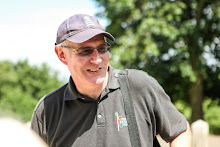
Andrew recently visited the UK once again, so on a rainy August day, we met in Blackheath and took ourselves to 3 Kidbrooke Grove and on the spur of the moment, in a fine display of Australian forthrightness, Andrew knocked on the door. We were greeted by the present owner of the house, Chris Richards, to whom we introduced ourselves and who was astonished to learn of the events of some seventy seven years ago in his back garden. Chris is a war gamer and has a keen knowledge of military history, so was fascinated to learn what had happened. Over a cup of coffee, Chris showed us his back garden and we were able to perhaps imagine what is must have been like in September 1940 with an air battle raging overhead, bombs falling and the terrible sight and sound of a fighter pilot's body suddenly arriving in one's garden.
To provide some wider background, I can do no better than include a slightly re-edited version of my original 2013 blog post which covered the day's events.
On Andrew's visit in 2013, he had gleaned information that perhaps Richard's body had been found at a different location to that originally reported in the Civil Defence Incident Log and seeing as this information came from what was thought to be a reliable source, we set about trying to piece together the latest threads of information. We were told that Richard's body had been found by a passer-by not at Kidbrooke Grove as shown in the Civil Defence records but in Dartmouth Row, on the opposite side of Blackheath and quite a considerable distance from the original recorded spot. The source shall remain nameless so as to avoid embarrassment but his information had supposedly been corroborated by an eye-witness. The location of the wreckage of Dickie's Hurricane V7257 had been spread across the heath, with the largest portions, including the engine, falling through the roof of St Ursula's Convent, so this much at least could not be disputed.
I have always had a great suspicion of "eye-witness" accounts and think that certain authors and researchers place a great over-emphasis on their importance. These accounts are all well and good if there are several of them and they broadly agree in their description of events. They are also generally reliable if they emanate from a trained observer, such as a Police Officer or a serviceman or woman but those written long after the event from someone whose memories may be faded have to treated with the utmost caution - these people sometimes tell one what one wishes to hear, or what they think might have happened but say it with great authority. Sadly, many of these "authentic" accounts prove to be unreliable to say the least and so it proved with the information given to Andrew.
The National Archives are in the process of gradually releasing the Casualty Branch enquiries into deceased airmen from the Second World War and when news of these became known to Andrew and myself, we anxiously awaited the release of the pack containing Dickie's details. The first batch was released in 2014 and infuriatingly for us at that time, only included details for casualties up to and including 31st August 1940 - so near and yet so far!
Almost three years were to elapse, with many enquiries as to their release dead batted away by the National Archives until the next tranche were finally released in July of this year and this time, we were not disappointed. The documents were ordered and a visit to Kew was made a few weeks ago. The file contained a great deal of correspondence, including copies of telegrams sent from the Air Ministry to Dickie's wife and family, letters from his employers the Hawker Aircraft Company enquiring about arrangements for obtaining a Death Certificate and most importantly from our point of view, a genuine eye-witness account, not from someone supposedly recalling events from thirty or so years' distance but from a Staff Sergeant Deeley of the Royal Army Pay Corps, who had been walking across Blackheath towards Shooter's Hill Road on 7 September 1940, when he witnessed the aircraft crashing and Dickie's partially opened parachute falling. After running for a short time, he commandeered a passing van and both he and the driver arrived on the scene of the incident at the same time as a Police Officer, PC Cochran from Lee Green Police Station.
This account, written by a trained observer, confirms that the original Civil Defence report was indeed correct and that Dickie's body was discovered in the garden at 3 Kidbrooke Grove, which was incidentally the residence of Commander HP Mead RN, who happened to be at home at the time of the incident. Dickie appeared to have been wounded in the chest and had crashed through a garden bench when he hit the ground. According to the report "Life was extinct and the body was removed to the Royal Herbert Military Hospital, Woolwich."
Andrew recently visited the UK once again, so on a rainy August day, we met in Blackheath and took ourselves to 3 Kidbrooke Grove and on the spur of the moment, in a fine display of Australian forthrightness, Andrew knocked on the door. We were greeted by the present owner of the house, Chris Richards, to whom we introduced ourselves and who was astonished to learn of the events of some seventy seven years ago in his back garden. Chris is a war gamer and has a keen knowledge of military history, so was fascinated to learn what had happened. Over a cup of coffee, Chris showed us his back garden and we were able to perhaps imagine what is must have been like in September 1940 with an air battle raging overhead, bombs falling and the terrible sight and sound of a fighter pilot's body suddenly arriving in one's garden.
To provide some wider background, I can do no better than include a slightly re-edited version of my original 2013 blog post which covered the day's events.
The raid on London of 7th September 1940 was what RAF Bomber Command and the US 8th Air Force would later call a 'Maximum Effort' raid. Goering deployed 348 bombers escorted by 617 Bf109 and Bf110 fighters. They were basically in one massive formation heading towards London at between 14,000 and 23,000 feet. It was no exaggeration to say that this huge force filled the skies and they must have presented an awe-inspiring sight to the defending Spitfire and Hurricane pilots of 11 Group, Fighter Command sent up to meet them. It was no wonder that Londoners were to dub this day 'Black Saturday' such was the intensity of the assault upon the capital.
 |
| 43 Squadron Crest - Gloria Finis |
The first two squadrons to intercept the attackers were the auxiliaries from 602 (City of Glasgow) Squadron and the 'regular' 43 Squadron, known as 'The Fighting Cocks' from their squadron badge. Three of 43's Hurricanes went in against the fighters, whilst the other six, led by the Squadron commander, the Rhodesian Caesar Hull, along with Dickie Reynell and Pilot Officer Alan Deller, took on the bombers. The engagements lasted all the way from the Sussex coast and even after they had exhausted their ammunition continued to harass the bombers as best as they could by making mock attacks. Hull shot down two Dorniers but was eventually shot down by an escorting fighter and crashed in the grounds of Purley Grammar School in Surrey, whilst Dickie's Hurricane exploded over Blackheath and he fell to earth without his parachute having deployed. Deller too was shot down but managed to bale out out of his blazing Hurricane and lived to fight another day. When John Kilmartin, leader of the rear section that had attacked the fighters landed, he could only mutter the words "My God, My God!"
Although the RAF quickly recovered it's equilibrium, Black Saturday was arguably the closest that Fighter Command came to being overwhelmed by sheer numbers. Air Vice Marshal Park of 11 Group had called upon the neighbouring 12 Group for assistance as per the well tried system within Fighter Command but as often happened, the 'Big Wing' took far too long to formate and to compound this delay, the leader of the Duxford Wing, Douglas Bader ignored the instructions of his controller and took his wing to patrol at 15,000 feet over North Weald instead of at 10,000 and whilst engaging a formation of bombers were 'bounced' by the escorting fighters which shot down or damaged six Hurricanes. The 'Big Wing' concept was unwieldy and on this day, was also hindered by communications breakdowns that slowed it's deployment still further. Despite all of this, pro and anti 'Big Wing' attitudes in the RAF would harden in the coming months.
 |
| The unveiled memorial stone |
At the end of the day's fighting, the Germans had lost only fourteen bombers, or 4% of the attacking force but had lost twenty three of the escorting fighters, which had sacrificed themselves in protecting the bomber force. It had been a bad day for Fighter Command, losing twenty six fighters and more importantly six of their pilots. Despite this attrition, the odds still favoured the RAF; their pilots that survived being shot down were over friendly territory and were usually quickly returned to the fray, whilst the Luftwaffe pilots were either killed or taken prisoner. Furthermore, by switching their attention to London, the Luftwaffe were no longer attacking the RAF's airfields.
London had already suffered grievously and with the Luftwaffe returning under cover of darkness to re-stoke the fires, the coming of the dawn would see 412 Londoners dead, with a further 747 seriously injured. To add to the confusion, somebody had issued an invasion alert - the codeword Cromwell had been issued and the church bells in some areas had been rung. Fortunately, this was a false alarm and the fuss soon died down. From now onwards though, London would be the Luftwaffe's main target and would suffer by night. There would be one more attempt to mount a major daylight raid - this would come just over a week later and would result in a vastly different outcome, although this is another story.
As a result of their mauling on 7th September and earlier losses during the Battle of Britain, 43 Squadron was withdrawn from the action and sent to recuperate at RAF Usworth, near Sunderland in 13 Group, Fighter Command. The squadron had been decimated and could only muster thirteen pilots, of whom six were recent postings from the Operational Training Units. Of the survivors, only John Kilmartin had any significant experience, so although the withdrawal was a painful blow for this proud squadron to bear, it was undoubtedly the correct decision. 43 Squadron's time would come again, in November 1942 as part of the Desert Air Force and in liberated France in 1944, where they became known to the local French populace as Les Coqs Anglais. Moving into the jet age, the squadron operated Meteors and Hunters in the 1950s, Phantoms in the 70s and 80s, before receiving Tornados in 1989. The squadron saw service in both Gulf Wars before standing down in 2009 as part of one of the seemingly endless rounds of defence cutbacks. The squadron is earmarked to reform as a Eurofighter Typhoon squadron at some point in the near future but whether this actually ever happens remains to be seen.
 |
| The memorial stone before unveiling |
The 2013 ceremony for Dickie Reynell was a simple but moving affair organised by the Shoreham Aircraft Museum in Kent, as part of their ongoing project to place a memorial at or near the site of every Battle of Britain pilot lost within a ten mile radius of the museum. The service was attended by the Mayor of the Royal Borough of Greenwich, Cllr Angela Cornforth as well as many members of the Reynell family, representatives from the Australian Embassy, RAAF and the RAF and of course many volunteers from the Shoreham Aircraft Museum as well as a decent turn out of members of the local Blackheath and Greenwich public who braved the rain and who wished to honour this brave man who died helping to defend the city that we all love and the freedom that we enjoy today.
 |
| Andrew Rennie tells us about Dickie's final mission |
Family friend Andrew Rennie, whose book on Dickie will doubtless make fascinating reading, gave a moving account of Richard's last sortie and of the events of the afternoon of September 7th. The memorial stone was then unveiled by Monsignor Nicholas Rothon of St Mary's Church Blackheath, Wing Commander Tony O'Leary of the RAAF and by David Caillard RAF (retired), who is a great nephew of Dickie Reynell. Following the unveiling ceremony, David gave a moving and insightful speech about Dickie Reynell and of his family's continuing pride in his achievements, not only during the Battle of Britain but in his pre-war service with the RAF and also as a test pilot for Hawker's, in which he did much valuable work in
perfecting the RAF's first monoplane fighter and which was the real
workhorse of the Battle of Britain, along with it's more glamorous
half-sister, the Spitfire.
 |
| Members of the Reynell family by the memorial |
From all accounts, Richard Reynell was not only a brave man, he was fine
pilot and a decent person too, who had a kind word of encouragement for
all and who was widely liked by not only his family but by his extended
family within the RAF, in Hawkers and in the aircraft industry. It was a
sad twist of fate that he had been recalled by Hawkers on 7th September
1940 but had chosen to see out the day's operations before returning to
his normal work as a test pilot.
 |
| The City that Richard Reynell died whilst defending |
When reflecting on Dickie Reynell and his contemporaries within the RAF during the Battle of Britain, one can only echo the words of Winston Churchill - "Never was so much owed by so many, to so few."
Unpublished Sources:
National Archives - AIR81/3127 Air Ministry P4 Casualty Branch Flight Lieutenant RC Reynell
Published Sources:
The Most Dangerous Enemy - Stephen Bungay, Aurum Press 2000
The Narrow Margin - Derek Wood with Derek Dempster. Tri-Service Press 1990