Showing posts with label Fighter Command. Show all posts

Thursday, 17 February 2022

Battle of Britain Day, Churchill and The Few

"Never in the field of human conflict was so much owed, by so many, to so few."

Winston Churchill was a master of the use of the English language, whether in it's written or spoken form but of all of his inspirational wartime speeches, his address to the House of Commons on August 20th 1940, in which the above passage formed a part, is arguably his most famous. Certainly the phrase 'The Few' which was how Churchill described the RAF's pilots and aircrews, passed immediately into folklore.

The origins of this phrase go back to a few days before Churchill made this speech to the House and appears to have been the result of a spontaneous piece of emotion on the Prime Minister's part. During the Battle of Britain, Churchill, always wanting to be close to the action, made a habit of calling into the Uxbridge Operations Bunker of Number 11 Group, RAF Fighter Command to see the battle developing. Uxbridge was conveniently en route from London to Chequers. His first visit came on August 16th and he was accompanied by his Chief Staff Officer, General Sir Hastings Ismay. As the afternoon's battle developed, the two watched Keith Park, AOC 11 Group, deploying his forces and seemingly having no reserves to spare. What the 'plot' in the Uxbridge bunker did not show, was that Park did in fact have reserves to call upon from the neighbouring 10 and 12 Groups. This was the strength of the defensive system perfected by Dowding and Park but all Churchill could see was that all forces had seemingly been committed. He was also very conscious of the fact that just a few weeks previously, before the fall of France, he had asked General Gamelin about the location of his strategic reserve, only to receive the terse answer "Aucune", meaning "None."

It was perhaps with this experience still fresh in his mind and unknowing of some of the other factors involved in Park's deployments, such as the neighbouring Groups' reserves, sizes of raids and the turnaround times on the ground of the RAF's fighter squadrons, that Churchill and Ismay departed by car for Chequers. The first thing Churchill said to Ismay was "Don't speak to me; I have never been so moved." Then about five minutes into the journey, he leant across and said to Ismay: "Never in the field of human conflict has so much been owed by so many to so few." Ismay was so struck by this comment that he repeated the phrase to his wife upon his return home.

So, the phrase that would mythologise the RAF's fighter pilots was born, but when Churchill made his speech just four days later, he spoke of the RAF as a whole when he said:

"The gratitude of every home in our Island, in our Empire, and indeed throughout the world, except in the abodes of the guilty, goes out to the British airmen who, undaunted by odds, unwearied in their constant challenge and mortal danger, are turning the tide of the World War by their prowess and by their devotion. Never in the field of human conflict was so much owed by so many to so few. All hearts go out to the fighter pilots, whose brilliant actions we see with our own eyes day after day, but we must never forget that all the time, night after night, month after month, our bomber squadrons travel far into Germany, find their targets in the darkness by the highest navigational skill, aim their attacks, often under the heaviest fire, often with serious loss, with deliberate, careful discrimination, and inflict shattering blows upon the whole of the technical and war-making structure of the Nazi power. On no part of the Royal Air Force does the weight of the war fall more heavily than on the daylight bombers who will play an invaluable part in the case of invasion and whose unflinching zeal it has been necessary in the meanwhile on numerous occasions to restrain…"

It was clear that the Prime Minister was speaking equally of the RAF's bomber squadrons, who were committed to attacking the German invasion barges and targets in Germany and their occupied territories. But to the British public, who could see the battles developing overhead on a daily basis, the phrase of 'The Few' struck a chord; it was the fighter pilots who were the saviours of the country. Whilst this was undoubtedly true, the men of Bomber Command felt somewhat hard done by that their equally vital work was going unnoticed by the British public and was summed up eloquently, although with natural overstatement by one Bomber Command veteran and quoted in Stephen Bungay's excellent work, The Most Dangerous Enemy:

"There was no fighter Battle of Britain. I was at Lympne in light bombers in 1940. There was some fighter activity overhead but no more than you would expect. We went out every night, destroying the German invasion barges in the Channel Ports. That was why the Germans never came. We fought the real Battle of Britain."

Despite this, the fighter battle continued and on Sunday September 15th 1940, whilst having breakfast at Chequers, Churchill decided once again to visit Uxbridge. By now, the Blitz on London had started and the Premier had decided that the weather being fine, that it was a "Blitzy Day" to use his own phrase. At just after 11 a.m., the British Chain Home radar at Dover picked up the first raid of the day forming up over Calais. During the day, some 1,120 German fighters and bombers would be pitted against 630 Hurricanes and Spitfires of Fighter Command. 

Sir Trafford Leigh-Mallory (IWM)
As the first raid approached the Kent coast, Keith Park deployed his forces with his customary skill and this time because of the numbers approaching, he requested 12 Group's involvement and ordered the Duxford Wing to patrol over Hornchurch. Leigh-Mallory and Park had clashed over tactics during the Battle of Britain. The New Zealander Park was anxious to hit the attackers with smaller numbers of squadrons and break up the enemy formations before they reached their targets, whereas Leigh-Mallory believed in attacking in large numbers and it was irrelevant to him whether or not the bombers had reached their targets. In reality, Park's tactics were the correct ones - the 'Big Wing' frequently took too long to assemble and then had to climb to reach it's designated height and often being led by the brave but maverick Douglas Bader, the Wing would frequently not patrol where ordered, but would go where Bader felt the action should be. 

The bottom line was that Park did not really trust Leigh-Mallory and although Park's tactics would win out in the Battle of Britain, in the longer term, his 12 Group counterpart would be the winner. Because of his closeness to Sholto Douglas at the Air Ministry, Leigh-Mallory would replace Park at 11 Group and eventually indeed, take the top job of AOC Fighter Command. All this was in the future but it was just as well for Britain and the RAF that he was a more peripheral figure at this stage of the Battle.

Sir Keith Park (IWM)
To return to September 15th, Churchill watched as it became clear that the Luftwaffe formations were indeed heading towards London. This was the day of Sergeant Ray Holmes' collision with what turned out to be an abandoned German bomber, a fact obviously unknown to him at the time. The attacking force, whilst not exactly routed, suffered heavy losses all the same; eighteen German aircraft had been shot down, representing 12.5% of their strength. However, due to massive overclaiming on the part of the RAF, especially the Big Wing, the claims had been for eighty one aircraft. The bomber brought down in the collision with Ray Holmes' Hurricane had been claimed nine times! This overclaiming was not deliberate but was understandable in the melee of a pitched battle. Dowding and Park realised this and had previously sought to take a more measured approach when dealing with claims - matching claims against wrecks of crashed aircraft was one way of doing this for example. Leigh-Mallory and his Air Ministry friends realised it too but on this occasion chose to ignore the overclaiming, partially for propaganda purposes but also to further their own ambitions to oust Dowding and Park for their own ends. The afternoon's air fighting saw similar overclaiming and by the end of the day, the RAF had claimed an incredible 185 German aircraft for the loss of 28 RAF machines. The actual German losses were 56 - still a resounding defeat but hardly decisive. 

Park was furious when he learned that these inflated figures had been released. He understood as well as anyone the need for maintaining the morale of the British public but he also knew what else lay behind these figures; of the 185 claims, no fewer than 105 of them came from the Duxford 'Big Wing!' 

When Churchill spoke to Park upon leaving the Uxbridge bunker, he was once again profoundly moved - he had seen the RAF's fighters handled with great skill by Park and his controllers and with great bravery in the air by the pilots. Park explained to Churchill that he was still not satisfied with the outcome and that he was disappointed that the German bombers had reached London. That was not good enough for Park but Churchill was impressed, especially with the claims from the Big Wing. They were beginning to be noticed.

As Stephen Bungay says, Fighter Command did not win the Battle of Britain on September 15th - it had done that already. It had won because it had endured the battles in August when it's airfields were attacked by repairing damaged machines, filling in craters on airfields and because of the faulty tactics of their enemy. It had won because it had enough brave pilots who overcame their own fears and doubts and it had won because of leaders like Keith Park and Hugh Dowding, who would soon be shamefully replaced by Trafford Leigh-Mallory and Sholto Douglas.

September 15th merely encapsulated this victory that had already been won - forgetting the overclaims, the appearance of the Big Wing over London, whilst not an effective military weapon in it's own right, made a massive psychological impact on the Luftwaffe's crews. They had been led to believe that the RAF was on it's knees and down to it's last fifty Spitfires. On the contrary, they had appeared stronger than ever and as the Luftwaffe could not master the skies over Britain, the proposed invasion of this country was never going to be a viable prospect. Operation Sealion was postponed indefinitely on September 17th 1940, just two days after the day we now commemorate as Battle of Britain Day.

For this reason if for no other, The Few deserve to be mythologised. Lest we forget.

Published Sources:

Churchill - Roy Jenkins, Pan Macmillan 2001
Dowding of Fighter Command - Vincent Orange, Grub Street 2008
The Most Dangerous Enemy - Stephen Bungay, Aurum Press 2001
The Narrow Margin - Derek Wood with Derek Dempster, Tri-Service Press 1990
Park - Vincent Orange, Grub Street 2001


Thursday, 31 January 2019

Tales behind the graves in Carshalton

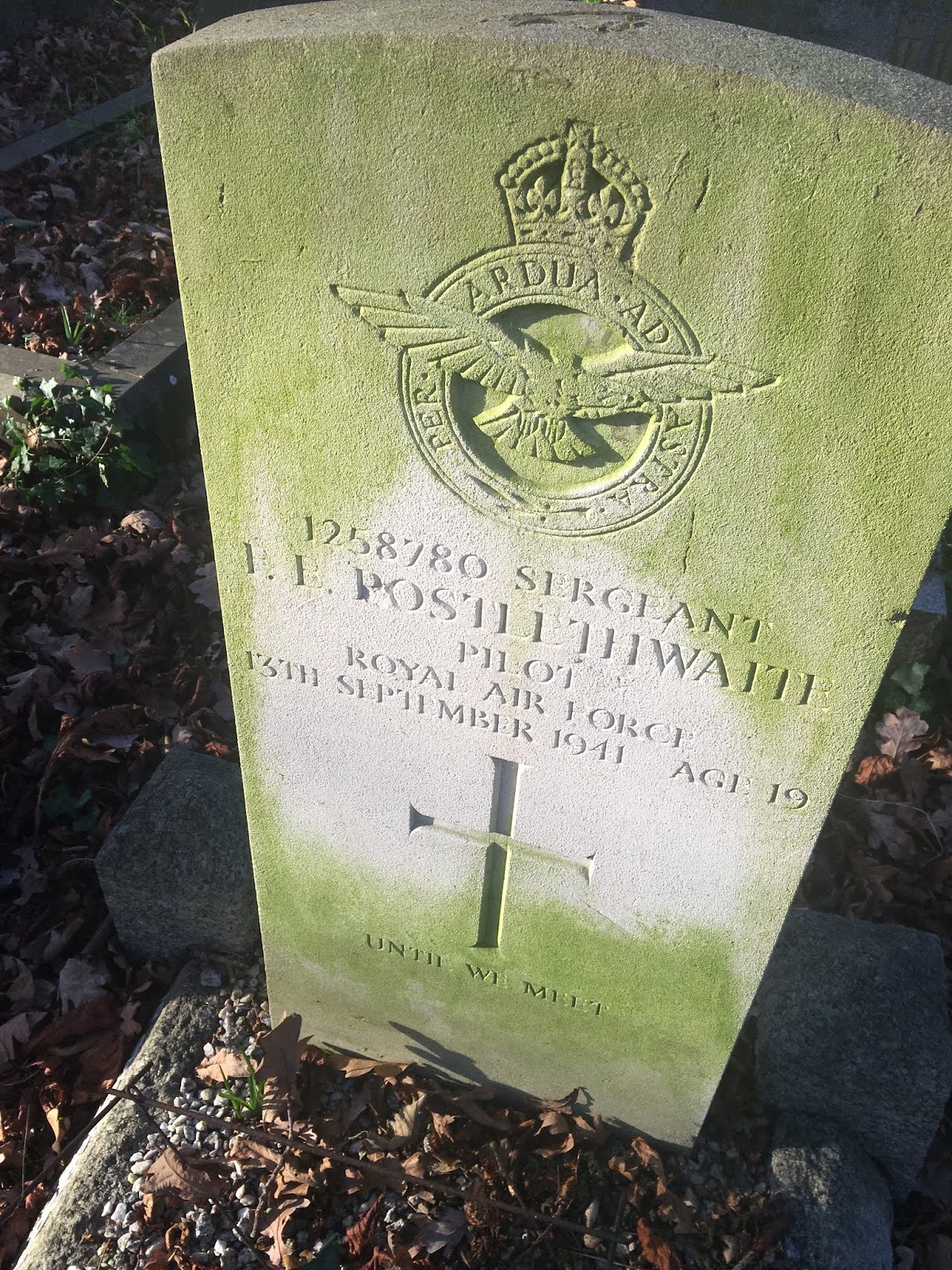
The grave of Sgt. Frederick Postlethwaite at All Saints Churchyard, Carshalton (Sam Dorrington)

One of the more satisfying aspects about my enthusiasm for history (or obsession depending on who you talk to) is how this tends to rub off on to my friends. This is partially because many of them have always shared this fascination in the subject but because we're never far from our wartime past in this country, they do all seem to notice points of interest much more easily these days!

Whatever the reasons, they all seem to have caught the history bug and are always quick to let me know about their finds. Sam Dorrington is one of my longest standing friends and has always shown a particular interest in the subject but in his case, this has perhaps been more a rekindling of a dormant fascination. Back in November 2016 I was proud to tell the story of his grandfather, Able Seaman Jack Dorrington and since then Sam, who is a talented professional photographer, has frequently accompanied me in searching out old wartime structures, visiting wartime airfields and often sends me photographs of various memorials and other wartime points of interest that he has discovered on his travels.

One such photograph he sent to me recently recalled memories of my own 'accidental researching' in Charlton which I reported on in January 2017 and which incidentally, had a connection with Sam's own local neighbourhood of Carshalton in suburban Surrey. Whilst taking a shortcut to the shops through his local churchyard, he came across a Commonwealth War Graves Commission headstone and upon closer inspection, discovered many more located around All Saints' Churchyard.

Despite being familiar with the area, Sam doesn't often use the churchyard as a short cut and had thus never previously noticed the distinctive CWGC headstones and as a result, decided to send me a photograph of the RAF airman's grave that had caught his eye. As always, I needed to know more and so set about trying to find something of the story of Sergeant FE Postlethwaite and the circumstances of his death, at the tragically young age of 19.

Frederick Postlethwaite and a letter from the King (Kelvin Youngs, Aircrew Remembered/Michael Taylor)

Frederick Edgar Postlethwaite was the son of Frederick William and Alice Marion Postlethwaite and had been born in Southwark in 1922. However, his mother and father both appear to have both died at a relatively young age in 1928 and 1932 respectively and so by the time of the 1939 Register being taken, the 17 year old Frederick had become the ward of one Elsie May Cogger of 2 Queen Mary's Avenue, Carshalton Beeches. In August 1941, having volunteered to serve as RAF aircrew and having qualified as a Sergeant Pilot, he was posted to the famous 92 Squadron, flying the Spitfire Mk. Vb based at Biggin Hill in Kent and on the 31st of that month, flew his first two operational patrols, a fighter sweep over the Channel, followed by a convoy patrol off the North Foreland. The beginning of September saw further fighter sweeps over France, interspersed with convoy patrols. On 8 September 1941, the Operations Record Book reports a "big party in the mess" to celebrate the anniversary of the squadron's arrival at Biggin Hill, which fortunately coincided with a day of non-flying due to bad weather!

The 92 Squadron Operations Record Book dispassionately records Sgt. Postlethwaite's death (author's photo)

The bad weather continued to play a part in the squadron's fortunes, with only one day of suitable flying weather on 11 September, which saw 'Rhubarb' fighter sweeps over France. The 13th saw another day of poor weather over France, which precluded any operational flying but which did allow the squadron to take part in training exercises. At 19:00 hours, whilst taking part in formation flying exercises, Postlethwaite's Spitfire, serial number W3562 was seen to go into an uncontrolled dive from about 2,500 feet from which the pilot did not bale out. The aircraft plunged into a house near Biggin Hill airfield, killing Sgt. Postlethwaite instantly. No explanation was ever discovered as to the cause of the accident.

This tragic incident caused us both to reflect upon this accidental death and as a result, we chose five more RAF headstones at random in the churchyard to try and discover more about these War Graves that were almost on our doorsteps.

Sgt. Frederick Jones at All Saints Churchyard, Carshalton (Sam Dorrington)

The first of these additional names we looked at concerned Sergeant Frederick Jones, who was aged 34 and at the time of his death, married to Violet Ellen Jones. Unfortunately, due to the sheer number of people bearing the name Jones, we have been so far unable to discover anything further regarding their family life, other than that they were living somewhere in North Cheam at the time of his death on 14 September 1943. Closer examination of the excellent CWGC website reveals that Frederick was serving in Bomber Command as a mid-upper gunner with 115 Squadron.

A look at the squadron's Operations Record Book for the date in question shows that as with our first casualty, he died as a result of a tragic accident.

At this stage of the war, 115 Squadron was one of the relatively few squadrons that flew the Avro Lancaster Mk II which was powered by four Bristol Hercules engines instead of the more usual Merlin power plant used for other marks of the iconic heavy bomber. The Bristol-powered variant was never as successful as the Merlin-powered Lancaster, being restricted to a smaller bomb load and having a lower ceiling, so when the expected shortage of the Rolls Royce and licence-built Packard Merlin engines failed to materialise, production of the Mk II was curtailed after just three hundred had been built. The Hercules engines were then used to power the Mk III version of the Halifax bomber, which ironically became a far more successful aircraft with this choice of engine than the original Merlin powered variants of this Handley Page aircraft!

On 14 September, the crew had been allocated a new aircraft, serial DS780 and at 10:53 took off from their base at RAF Little Snoring in Norfolk to carry out air tests on their new charge. In addition to the regular crew of seven, the Lancaster was carrying an additional crew member, Sgt. Harold Ashwin, a Flight Engineer who was on detachment from 1678 Conversion Flight but serving as a member of 115 Squadron. All seemed to have been going well until the operation of levelling and calibrating the bomb sight, at which point the Air Bomber, Sgt. M Read, requested the pilot, F/Sgt. Bradford RNZAF to maintain a height of 2,000 feet to ensure that the bomb sight would not jam but it soon became apparent that something was wrong and the pilot advised that he was unable to maintain height. F/Sgt. Bradford ordered the crew to their crash stations but shortly afterwards, the aircraft ploughed into a railway embankment at Magdalan, about four miles north of the RAF airfield at Downham Market. There were only two survivors, the Wireless Operator, Flight Sergeant Williamson and the Air Bomber, Sgt. Read. The investigation revealed that the two starboard engines had been feathered as part of the air test but could not be restarted due to the master fuel cock having been closed.

The cold facts of the loss of DS780 in the 115 Squadron O.R.B. (author's photo)

With the exception of Sgt. Ashwin, who was not a regular member, this was an experienced crew which had completed thirteen operational missions, with Flight Sergeant Bradford having logged a total of 743 flying hours, since he joined the squadron on 14 July 1943 from 1678 Conversion Flight. Of the survivors, the Wireless Operator, F/Sgt. Ivan Williamson RNZAF went on to complete two operational tours with 115 and 75 Squadrons, and left the service in 1946 as a Flying Officer. He died in his native New Zealand, aged 69 in 1981.

Incidentally, 115 Squadron was one of the 'original' Bomber Command squadrons, active at the outbreak of war and apart from a very short spell where they were attached to Coastal Command, served continuously with Bomber Command right through to the end of the war in Europe. They dropped the second greatest tonnage of bombs - approximately 23,000 tons - of any RAF Squadron during the war as well as participating in the third highest number of raids. As a counterpoint to these fine achievements and undoubtedly as a direct result of their almost continuous availability, 115 Squadron suffered the highest losses of any squadron within Bomber Command and were indeed, the only squadron to lose more than 200 aircraft in the war.

The grave of Sgt. Reginald Sharp at All Saints Churchyard, Carshalton (author's photo)

The next casualty that we selected at random was Sergeant Reginald James Sharp who died on 19 May 1942, aged just 22. Like the previous two individuals, he was a local boy and was an only child who lived with his parents George and Ethel Sharp at 196 Thornton Road, Carshalton.

After enlisting in the RAF and completing his aircrew training, Reginald was posted in November 1941 to Bomber Command as an Observer (the early-war phrase for Navigator) with 15 Squadron, based at RAF Wyton in Cambridgeshire, from where the squadron flew the Short Stirling, the RAF's first four engine heavy bomber. The Stirling was an unsatisfactory design which had had it's wingspan reduced whilst still on the drawing board for reasons of expediency concerning hangar accommodation. As a result, its operational ceiling suffered and it became the least popular and worst performing of the three types of heavy bomber ordered by Bomber Command, with most crews preferring the Lancaster or Halifax types. However, in the early stages of the war, squadrons had to make do with what was available and wait for the other types to become available in quantity.

Reginald does not appear to have been part of a regular crew but despite this, by May 1942 had flown sixteen missions with the usual mixture of night bombing over Germany and occupied Europe and 'gardening' or minelaying missions over the North Sea and Baltic. Closer inspection of the Operations Record Books reveals that four of these missions were aborted at various stages into the flight due to various technical issues typical of the Stirling.

On 19 May 1942, Reginald formed part of an expanded crew of nine, including Charles Evans Woodhouse, a USAAF civilian contractor electrician attached to Bomber Command and a member of RAF ground crew, Aircraftman 2nd Class Thomas Edwards of North Sheen. The reason for the latter's presence is not known but was perhaps a flight as a favour from his south west London neighbour, Reginald Sharp. Whatever the now unknown reasons, the crew took off shortly after midday from RAF Wyton in Stirling Mk I serial W7523 under the command of Sergeant Albert Douglass. The reason for the flight was an air test and the presence of the USAAF Electrician perhaps indicated that the aircraft had been suffering from some sort of electrical problem and was being tested following repairs. However, shortly after taking off, the bomber crashed into trees just north east of Gravely, with the Operations Record Book for RAF Wyton suggesting that the aircraft had caught fire whilst in the air. The aircraft rolled onto its back soon after hitting the ground and seven of the nine on board were killed outright, including Reginald Sharp.

There were two survivors from the initial crash, the Air Bomber, Pilot Officer Lionel Hack, who survived and the American Charles Woodhouse, who sadly succumbed to his injuries in hospital the following day.

The grave of Kenneth Snuggs at All Saints Churchyard, Carshalton (author's photo)

Our next casualty was Sergeant Kenneth Snuggs, born on 12 May 1910 in Humberstone, Leicestershire but who by the time of the 1939 Register being taken was living in Carshalton, where his civilian occupation was described as a 'Master Hairdresser' who prior to joining the RAF, also had a wartime job as an Ambulance Driver with the Cheam & District Auxiliary Ambulance Service.

Following his enlistment into the RAF and on completion of his aircrew training, Kenneth served with Bomber Command, in his case as a Wireless Operator/Gunner in 44 (Rhodesia) Squadron based at RAF Waddington, another 'original' Bomber Command squadron which served without a break for the entire war and whose squadron badge carried the splendidly appropriate motto for a bomber squadron of "Fulmina Regis Iusta", which translates to "The King's Thunderbolts are Righteous".

Sergeant Snuggs appears not to have been part of a regular crew, as the 44 Squadron Operations Record Book shows him flying eight missions with three different crews during June and July 1941. However, on his second mission, a raid on the Marshalling Yards at Hamm on 12 June 1941, he was credited with having shot down a Bf110 night fighter over Enschede. On 6 July 1941, he flew on a mission to attack German cruisers at Brest under the command of a Flight Commander (and future Squadron Commander) of 44 Squadron, Squadron Leader Kenneth Smales DFC. Smales was a colourful character who had managed to escape from under the noses of the advancing Germans in 1940, when he and a colleague were able to reach the port of Brest by motorcycle (having previously been shot down and then having commandeered another aircraft) in time to catch one of the last ships to leave the port on 17 June 1940, just before the Fall of France. Smales had a very individual style of low flying when attacking such naval targets, often flying so low that his aircraft would return caked in mud and salt splashes. Despite this bold approach, Smales survived the war and served in the peacetime RAF during the 1950s.

Having survived this mission, Snuggs was then posted to the Central Gunnery School, located at RAF Castle Kennedy near Stranraer. On 27 July 1941, he took off in Hampden serial number P1162 piloted by Sergeant HG Turner as part of a crew of four Wireless Operator/Gunners for the purpose of Gun Camera trials but shortly after taking off, the aircraft stalled whilst turning and crashed at 10:32, about one mile southeast of the airfield, killing all five on board.

The grave of Sgt. Horace James Cox at All Saints Churchyard, Carshalton (Sam Dorrington)

Horace James Cox was yet another local boy, the eldest of two sons of Horace Walter and Edith Cox who in the 1939 Register, were recorded as living at 100 Westmead Road, Carshalton. In 1942, Horace junior had married his wife Jose and lived at 217 Gander Green Lane, Sutton. Having volunteered to serve as aircrew with the RAF, Horace had completed his initial training and had been posted as an Air Bomber to 11 Operational Training Unit Bomber Command, based at RAF Westcott in Buckinghamshire and was a member of Course 69. Here, Horace would have been found himself as part of a bomber crew via the time honoured Bomber Command process known as 'Crewing Up' in which the men were placed inside a hangar or similar large space and left to sort themselves into the required number of crews. Once this was achieved, the newly formed crews would complete their training for night bombing operations on Wellington bombers which had been retired from front line service and which could often justifiably described as 'tired'. Just occasionally, the fledgling crews would be sent out on ops themselves but this became a less common occurrence as the war progressed and the front line Bomber Command squadrons became more numerous.

Course 69 at 11 OTU - infuriatingly, the photographed is not captioned, so the names remain unknown (Author's collection)

An important part of the training regime at an OTU was in the continual practice of night time bombing, as this formed the major part of Bomber Command's work. This meant replicating as far as possible the conditions in which crews would be expected to bomb a target and so in the early hours of 2 May 1943, the newly-formed crew took off from RAF Oakley, a satellite station of Westcott with the intention of dropping bombs on the range at Warpsgrove. Their charge was Vickers Wellington Ic serial Z8866, a twin engined medium bomber, once the mainstay of Bomber Command but now being increasingly relegated to training duties upon replacement by the four engined 'heavies' in the form of the Halifax and Lancaster.  At 02:45, observers on the ground witnessed that the aircraft dropped two bombs but then flew away to the south west. Shortly afterwards, an aircraft was seen to be on fire and it was soon reported that a Wellington had crashed at Belcher's Farm, close to Stadhampton. The nearby base at RAF Mount Farm sent two crash tenders and an ambulance but on arrival reported that the crew had all been killed.

The grave of F/O George Wigley at All Saints Churchyard, Carshalton (Sam Dorrington)

Our final casualty was the only officer in the group that we selected but whose story is perhaps the most heartbreaking of all those recounted previously. Flying Officer George Alexander Wigley was 22 years old when he died and like the others whose stories we have examined, was another local lad who lived with his parents and siblings at 41 St Albans Grove, Carshalton. As with many of his RAF colleagues buried at All Saints Churchyard, George was serving with Bomber Command, in his case as an Air Bomber with 97 Squadron of the Pathfinder Force based at RAF Bourn but unlike the others we chose, had received a commission as a Flying Officer.

George formed part of the seven-strong crew of Lancaster Mk III, JB219 under the command of Pilot Officer J Kirkwood DFC and at 16:50 on 16 December 1943, the aircraft lifted off from the Cambridgeshire airfield, heavily laden with five 2,000 lb 'High Capacity' or HC bombs, popularly known as 'Blockbusters' to be delivered to the "Big City" as Berlin was universally referred to in Bomber Command. These were bombs with a very thin casing, so as to maximise the blast effect and by 1943, formed a standard part of the RAF's armoury, along with the larger 4,000 lb HC bombs, known as 'Cookies'.

Kirkwood and his crew were highly experienced, having flown 23 missions with 207 Squadron since June 1943, before transferring to the Pathfinder Force (or PFF) on 29 November 1943. The PFF were viewed as something of an elite force within Bomber Command, being a specialist target finding and marking force. They were also viewed with some resentment amongst the senior echelons of the "Main Force" squadrons as the PFF tended to "cream off" the best crews to serve with them but the crews themselves were often keen to be selected. Partially, this was down to the professional pride at being seen to be part of an elite but was also due to more pragmatic reasons - a PFF tour of duty consisted of one single tour of 45 missions before being posted away from combat flying, whereas Main Force crews were expected to perform a first tour of 30 missions, then being rested as an O.T.U. Instructor for example, before undertaking a second tour of 20 missions.

Following their posting to 97 Squadron, this raid on Berlin was their first mission as part of the Pathfinder Force and according to the squadron's Operations Record Book, it went largely without incident, with only one aircraft from the squadron lost to enemy action over the target but this particular raid was to be tinged with tragedy upon the return to England.

George Alexander Wigley (Kelvin Youngs, Aircrew Remembered)

On the morning of the raid, low cloud and poor visibility had been forecast, so much so that the Met. Officer at RAF Bourn had been convinced that ops for the day would be cancelled by Bomber Command HQ at High Wycombe. No such order was received and the mission went ahead as scheduled, with 483 Lancasters from across Bomber Command being dispatched. During the raid itself, some 25 Lancasters were lost to enemy action but upon the return, the promised low visibility had indeed materialised and particularly affected the airfields of 1, 6 and 8 Groups (the latter of which 97 Squadron was a part). As a result, a further seven aircraft from the squadron were lost when attempting to land at their home airfields. Two of these crews managed to bale out safely, abandoning their aircraft, whilst of the remainder who attempted to land, none survived unscathed, ranging from one or two survivors from an aircraft, to entire crews being killed. Across the whole of Bomber Command, a total of 29 Lancasters were lost on returning to England as a result of the bad weather.

Lancaster JB219, of which George Wigley formed part of the crew, was one of those lost when attempting to land at RAF Gransden Lodge, a satellite airfield of RAF Bourn, when at 00:10 the bomber crashed killing all on board at nearby Hayley Wood. The aircraft immediately caught fire but the wreckage containing the bodies of the crewmen was not discovered until the following morning. This raid saw the worst bad-weather crashes incurred during the entire war and escalated the attrition rate for this mission to an unacceptably high 12.2 percent. No small wonder that Bomber Command crews dubbed this raid as "Black Thursday."

The 97 Squadron O.R.B. tells the sad story of JB219's end (author's photo)

It is a sobering thought indeed to consider that of the 55,573 killed in Bomber Command (out of an approximate aircrew strength of 125,000), some 8,195 of these lost their lives in flying or ground accidents such as we have examined above.

When all of the individuals whose cases we have examined joined the RAF, they must have had at least the occasional thought, quickly suppressed, that they may well be killed on active service and no doubt, the natural assumption would have been that it would always be someone else that would "buy it" but it somehow seems far worse that these men should have died by accidental causes, especially in the case of Flying Officer George Wigley, who with his crew-mates, had seemingly survived the worst dangers of a raid to Berlin, only to fall at the final hurdle when home and safety was so tantalisingly close at hand.

If any readers are in possession of any further photographs of those airmen mentioned above, or know members of their families who are prepared to share images, then please contact me using the 'comments' facility and I will be happy to add them to this article. My thanks are due to Sam Dorrington for alerting me to his latest find and for sharing his photos of the headstones with me.

In the meantime, the information garnered thus far will be shared to the excellent Aircrew Remembered website and linked to the relevant aircraft listed below, in order to ensure that these men and their crew mates are never forgotten.

This sort of history is on all of our doorsteps and the sort of research seen above is the type of service that we specialise in, so if you have a relative whose service you would like to explore further, then please contact us using the form on our main website.

As always, all of the photographs used in this article are copyright to me, or of the person credited in the caption and may not be used without my express written permission.

In Memoriam:

92 Squadron Spitfire Vb serial W3562

Sergeant FE Postlethwaite RAFVR (Pilot) of Carshalton Beeches

115 Squadron Lancaster II serial DS780

Flight Sergeant EAJ Bradford RNZAF (Pilot & Captain) of Hawke's Bay, New Zealand
Pilot Officer CR Morse RNZAF (Navigator) of Hanmer Springs, Canterbury, New Zealand
Sergeant F Jones RAF (A) (Mid Upper Gunner) of North Cheam
Sergeant M Fearn RAFVR (Flight Engineer) of Inverness
Flight Sergeant RV Griffiths RNZAF (Rear Gunner) of Penrose, Auckland, New Zealand
Sergeant HJB Ashwin RAFVR (Flight Engineer) of Kilburn

15 Squadron Stirling I serial W7523

Sergeant A Douglass RAFVF (Pilot & Captain) of Nottingham
Sergeant RJ Sharp RAF (Observer) of Carshalton
Sergeant DW Lewis RAF (Flight Engineer) 
Flight Sergeant NF Payne RAFVR (Wireless Operator/Gunner) of Southampton
Sergeant HV Edmonds RAFVR (Air Gunner) of Exeter
Sergeant N Cash RAFVR (Air Gunner) of Broughton
Aircraftman 2nd Class TA Edwards RAFVR (Air Gunner) of North Sheen
EL2C CE Woodhouse USAAF (Electrician) of Oklahoma, USA

Central Gunnery School Hampden I serial P1162

Sergeant HG Turner RAFVR (Pilot)
Sergeant K Snuggs RAFVR (Wireless Operator/Gunner of 44 Squadron) of Carshalton
Flight Sergeant GE Appleton DFM RAF (Wireless Operator/Gunner of 49 Squadron) of Newcastle-upon-Tyne
Flight Sergeant AHD Batty DFM RAF (Wireless Operator/Gunner of 226 Squadron) of Walsall
Flying Officer A Paterson DFC RAFVR (Wireless Operator/Gunner of 49 Squadron) of Clapham Common

11 OTU Wellington Ic serial Z8866

Sergeant JR Richmond RAF (Pilot & Captain) of Epsom
Sergeant LR Crouch RAFVR (Navigator) of West Ealing
Sergeant HJ Cox RAFVR (Air Bomber) of Sutton
Sergeant ED Scott RAFVR (Wireless Operator/Gunner) of Beckenham
Sergeant JA Cheetham RAFVR (Air Gunner) of Liverpool
Sergeant TN Harker RAFVR (Air Gunner) of Darlington 

97 Squadron Lancaster III serial JB219

Flying Officer J Kirkwood RAFVR (Pilot & Captain) of Kilwinning
Flight Sergeant EG Hubbard RAFVR (Flight Engineer) of Croxton
Sergeant RC Stewart RAFVR (Navigator) of Braemar
Flying Officer GA Wigley RAFVR (Air Bomber) of Carshalton
Sergeant RG Cleeve RAFVR (Wireless Operator) of Wyke Green
Sergeant L Madeley RAFVR (Mid Upper Gunner) of Manchester
Sergeant J Killen RAFVR (Rear Gunner) of Hollinfare


Published Sources:

The Berlin Raids - Martin Middlebrook, Viking 1988
Black Night for Bomber Command - Richard Knott, Pen & Sword 2014
The Bomber Command War Diaries: An Operational Reference Book 1939-1945 - Martin Middlebrook & Chris Everitt, Pen & Sword 2014


Internet Sources:

49 Squadron Association
Aircrew Remembered


Unpublished Sources:

92 Squadron Operations Record Books - National Archives Kew, AIR 27/744/8 - 10
115 Squadron Operations Record Books - National Archives Kew. AIR 27/892/4 - 18
15 Squadron Operations Record Books - National Archives Kew, AIR 27/203/20 - 34
RAF Wyton Operations Record Books - National Archives Kew, AIR 28/963
44 Squadron Operations Record Books - National Archives Kew, AIR 27/448/10 - 18
RAF Castle Kennedy Operations Record Book - National Archives Kew, AIR 28/125
Central Gunnery School Operations Record Book - National Archives Kew, AIR 29/605
11 O.T.U. Operations Record Book - National Archives Kew, AIR 29/942
11 O.T.U. Appendices - National Archives Kew, AIR 29/645
97 Squadron Operations Record Books - National Archives Kew, AIR 27/767/22 - 24
Casualty Information - Sgt K Snuggs - National Archives Kew, AIR 81/7957


Sunday, 20 August 2017

Dickie Reynell, Black Saturday and eye-witness accounts

Flt Lt RC Reynell RAF (Shoreham Museum)
Regular readers of this blog will be aware that I have written on a couple of occasions abour Flight Lieutenant Richard Carew Reynell RAF, an Australian pilot who died many thousands of miles from home, helping to defend London on 7th September 1940 during the Battle of Britain and who was shot down just a mile or so along the road from where I now live. As a result of my original piece back in February 2012 I was contacted by Andrew Rennie, a friend of the Reynell family back in Australia who is putting together a book on Dickie's life. We have kept in contact over the years and were finally able to meet in June 2013 when the Shoreham Aircraft Museum unveiled their monument to Dickie at Crown Point in Blackheath, not too far from the spot where his Hurricane crashed and where Dickie's body was discovered.

On Andrew's visit in 2013, he had gleaned information that perhaps Richard's body had been found at a different location to that originally reported in the Civil Defence Incident Log and seeing as this information came from what was thought to be a reliable source, we set about trying to piece together the latest threads of information. We were told that Richard's body had been found by a passer-by not at Kidbrooke Grove as shown in the Civil Defence records but in Dartmouth Row, on the opposite side of Blackheath and quite a considerable distance from the original recorded spot. The source shall remain nameless so as to avoid embarrassment but his information had supposedly been corroborated by an eye-witness. The location of the wreckage of Dickie's Hurricane V7257 had been spread across the heath, with the largest portions, including the engine, falling through the roof of St Ursula's Convent, so this much at least could not be disputed.

I have always had a great suspicion of "eye-witness" accounts and think that certain authors and researchers place a great over-emphasis on their importance. These accounts are all well and good if there are several of them and they broadly agree in their description of events. They are also generally reliable if they emanate from a trained observer, such as a Police Officer or a serviceman or woman but those written long after the event from someone whose memories may be faded have to treated with the utmost caution - these people sometimes tell one what one wishes to hear, or what they think might have happened but say it with great authority. Sadly, many of these "authentic" accounts prove to be unreliable to say the least and so it proved with the information given to Andrew.

The National Archives are in the process of gradually releasing the Casualty Branch enquiries into deceased airmen from the Second World War and when news of these became known to Andrew and myself, we anxiously awaited the release of the pack containing Dickie's details. The first batch was released in 2014 and infuriatingly for us at that time, only included details for casualties up to and including 31st August 1940 - so near and yet so far!

Almost three years were to elapse, with many enquiries as to their release dead batted away by the National Archives until the next tranche were finally released in July of this year and this time, we were not disappointed. The documents were ordered and a visit to Kew was made a few weeks ago. The file contained a great deal of correspondence, including copies of telegrams sent from the Air Ministry to Dickie's wife and family, letters from his employers the Hawker Aircraft Company enquiring about arrangements for obtaining a Death Certificate and most importantly from our point of view, a genuine eye-witness account, not from someone supposedly recalling events from thirty or so years' distance but from a Staff Sergeant Deeley of the Royal Army Pay Corps, who had been walking across Blackheath towards Shooter's Hill Road on 7 September 1940, when he witnessed the aircraft crashing and Dickie's partially opened parachute falling. After running for a short time, he commandeered a passing van and both he and the driver arrived on the scene of the incident at the same time as a Police Officer, PC Cochran from Lee Green Police Station.

This account, written by a trained observer, confirms that the original Civil Defence report was indeed correct and that Dickie's body was discovered in the garden at 3 Kidbrooke Grove, which was incidentally the residence of Commander HP Mead RN, who happened to be at home at the time of the incident. Dickie appeared to have been wounded in the chest and had crashed through a garden bench when he hit the ground. According to the report "Life was extinct and the body was removed to the Royal Herbert Military Hospital, Woolwich."

Andrew recently visited the UK once again, so on a rainy August day, we met in Blackheath and took ourselves to 3 Kidbrooke Grove and on the spur of the moment, in a fine display of Australian forthrightness, Andrew knocked on the door. We were greeted by the present owner of the house, Chris Richards, to whom we introduced ourselves and who was astonished to learn of the events of some seventy seven years ago in his back garden. Chris is a war gamer and has a keen knowledge of military history, so was fascinated to learn what had happened. Over a cup of coffee, Chris showed us his back garden and we were able to perhaps imagine what is must have been like in September 1940 with an air battle raging overhead, bombs falling and the terrible sight and sound of a fighter pilot's body suddenly arriving in one's garden.

To provide some wider background, I can do no better than include a slightly re-edited version of my original 2013 blog post which covered the day's events.

The raid on London of 7th September 1940 was what RAF Bomber Command and the US 8th Air Force would later call a 'Maximum Effort' raid. Goering deployed 348 bombers escorted by 617 Bf109 and Bf110 fighters. They were basically in one massive formation heading towards London at between 14,000 and 23,000 feet. It was no exaggeration to say that this huge force filled the skies and they must have presented an awe-inspiring sight to the defending Spitfire and Hurricane pilots of 11 Group, Fighter Command sent up to meet them. It was no wonder that Londoners were to dub this day 'Black Saturday' such was the intensity of the assault upon the capital.

43 Squadron Crest - Gloria Finis
The first two squadrons to intercept the attackers were the auxiliaries from 602 (City of Glasgow) Squadron and the 'regular' 43 Squadron, known as 'The Fighting Cocks' from their squadron badge. Three of 43's Hurricanes went in against the fighters, whilst the other six, led by the Squadron commander, the Rhodesian Caesar Hull, along with Dickie Reynell and Pilot Officer Alan Deller, took on the bombers. The engagements lasted all the way from the Sussex coast and even after they had exhausted their ammunition continued to harass the bombers as best as they could by making mock attacks. Hull shot down two Dorniers but was eventually shot down by an escorting fighter and crashed in the grounds of Purley Grammar School in Surrey, whilst Dickie's Hurricane exploded over Blackheath and he fell to earth without his parachute having deployed. Deller too was shot down but managed to bale out out of his blazing Hurricane and lived to fight another day. When John Kilmartin, leader of the rear section that had attacked the fighters landed, he could only mutter the words "My God, My God!"

Although the RAF quickly recovered it's equilibrium, Black Saturday was arguably the closest that Fighter Command came to being overwhelmed by sheer numbers. Air Vice Marshal Park of 11 Group had called upon the neighbouring 12 Group for assistance as per the well tried system within Fighter Command but as often happened, the 'Big Wing' took far too long to formate and to compound this delay, the leader of the Duxford Wing, Douglas Bader ignored the instructions of his controller and took his wing to patrol at 15,000 feet over North Weald instead of at 10,000 and whilst engaging a formation of bombers were 'bounced' by the escorting fighters which shot down or damaged six Hurricanes. The 'Big Wing' concept was unwieldy and on this day, was also hindered by communications breakdowns that slowed it's deployment still further. Despite all of this, pro and anti 'Big Wing' attitudes in the RAF would harden in the coming months.

The unveiled memorial stone
At the end of the day's fighting, the Germans had lost only fourteen bombers, or 4% of the attacking force but had lost twenty three of the escorting fighters, which had sacrificed themselves in protecting the bomber force. It had been a bad day for Fighter Command, losing twenty six fighters and more importantly six of their pilots. Despite this attrition, the odds still favoured the RAF; their pilots that survived being shot down were over friendly territory and were usually quickly returned to the fray, whilst the Luftwaffe pilots were either killed or taken prisoner. Furthermore, by switching their attention to London, the Luftwaffe were no longer attacking the RAF's airfields.

London had already suffered grievously and with the Luftwaffe returning under cover of darkness to re-stoke the fires, the coming of the dawn would see 412 Londoners dead, with a further 747 seriously injured. To add to the confusion, somebody had issued an invasion alert - the codeword Cromwell had been issued and the church bells in some areas had been rung. Fortunately, this was a false alarm and the fuss soon died down. From now onwards though, London would be the Luftwaffe's main target and would suffer by night. There would be one more attempt to mount a major daylight raid - this would come just over a week later and would result in a vastly different outcome, although this is another story.

As a result of their mauling on 7th September and earlier losses during the Battle of Britain, 43 Squadron was withdrawn from the action and sent to recuperate at RAF Usworth, near Sunderland in 13 Group, Fighter Command. The squadron had been decimated and could only muster thirteen pilots, of whom six were recent postings from the Operational Training Units. Of the survivors, only John Kilmartin had any significant experience, so although the withdrawal was a painful blow for this proud squadron to bear, it was undoubtedly the correct decision. 43 Squadron's time would come again, in November 1942 as part of the Desert Air Force and in liberated France in 1944, where they became known to the local French populace as Les Coqs Anglais. Moving into the jet age, the squadron operated Meteors and Hunters in the 1950s, Phantoms in the 70s and 80s, before receiving Tornados in 1989. The squadron saw service in both Gulf Wars before standing down in 2009 as part of one of the seemingly endless rounds of defence cutbacks. The squadron is earmarked to reform as a Eurofighter Typhoon squadron at some point in the near future but whether this actually ever happens remains to be seen.

The memorial stone before unveiling

The 2013 ceremony for Dickie Reynell was a simple but moving affair organised by the Shoreham Aircraft Museum in Kent, as part of their ongoing project to place a memorial at or near the site of every Battle of Britain pilot lost within a ten mile radius of the museum. The service was attended by the Mayor of the Royal Borough of Greenwich, Cllr Angela Cornforth as well as many members of the Reynell family, representatives from the Australian Embassy, RAAF and the RAF and of course many volunteers from the Shoreham Aircraft Museum as well as a decent turn out of members of the local Blackheath and Greenwich public who braved the rain and who wished to honour this brave man who died helping to defend the city that we all love and the freedom that we enjoy today. 

Andrew Rennie tells us about Dickie's final mission

Family friend Andrew Rennie, whose book on Dickie will doubtless make fascinating reading, gave a moving account of Richard's last sortie and of the events of the afternoon of September 7th. The memorial stone was then unveiled by Monsignor Nicholas Rothon of St Mary's Church Blackheath, Wing Commander Tony O'Leary of the RAAF and by David Caillard RAF (retired), who is a great nephew of Dickie Reynell. Following the unveiling ceremony, David gave a moving and insightful speech about Dickie Reynell and of his family's continuing pride in his achievements, not only during the Battle of Britain but in his pre-war service with the RAF and also as a test pilot for Hawker's, in which he did much valuable work in perfecting the RAF's first monoplane fighter and which was the real workhorse of the Battle of Britain, along with it's more glamorous half-sister, the Spitfire.

Members of the Reynell family by the memorial

From all accounts, Richard Reynell was not only a brave man, he was fine pilot and a decent person too, who had a kind word of encouragement for all and who was widely liked by not only his family but by his extended family within the RAF, in Hawkers and in the aircraft industry. It was a sad twist of fate that he had been recalled by Hawkers on 7th September 1940 but had chosen to see out the day's operations before returning to his normal work as a test pilot.

The City that Richard Reynell died whilst defending

When reflecting on Dickie Reynell and his contemporaries within the RAF during the Battle of Britain, one can only echo the words of Winston Churchill - "Never was so much owed by so many, to so few."


Unpublished Sources:

National Archives - AIR81/3127 Air Ministry P4 Casualty Branch Flight Lieutenant RC Reynell 

Published Sources:

The Most Dangerous Enemy - Stephen Bungay, Aurum Press 2000
The Narrow Margin - Derek Wood with Derek Dempster. Tri-Service Press 1990

Sunday, 19 July 2015

The Battle of Britain: Defiants & Disasters

Defiants of 264 Squadron (RAF official photo)

Friday July 19th 1940 was the worst day of the Battle of Britain thus far for RAF Fighter Command and in particular a day that was nothing short of disastrous for 141 Squadron, flying their Boulton Paul Defiants, which before the war had been championed in certain quarters of the RAF as the preferred choice over the eight gunned Hurricanes and Spitfires.

July 19th 1940 was a showery day with bright intervals and the nine Defiants of 141 Squadron, newly arrived from Edinburgh, took off from Hawkinge a little after 12:30 and had been ordered to patrol at a height of 5,000 feet south of Folkestone. They had not long been airborne when they were 'bounced' by twenty Bf109s diving out of the sun. It was a slaughter; within moments, five of the Defiants had plummeted into the Channel, whilst a sixth crashed in Dover itself. Another of the once much-vaunted 'turret fighters' was so badly damaged as to be a write off and the remaining survivors were only saved by the timely intervention of the Hurricanes of 111 Squadron who managed to break up the attacking fighters. At the end of the engagement, four pilots and five air gunners of 141 Squadron were dead, with two more injured. The battered remnants of 141 were hurriedly sent back north, this time to Prestwick, where they could lick their wounds and await conversion to the night fighter role. The other Defiant squadron, No. 264 was also removed from the fray shortly afterwards.

The events of July 19th were the final nail in the coffin for the so called 'turret fighter' experiment. In 1938, William Sholto Douglas, Assistant Chief of the Air Staff, had been of the opinion that Fighter Command should form at least 9 squadrons out of Fighter Command's then planned strength of 38. The Deputy Director of Home Operations, Donald Stevenson, went even further and argued for the Defiant to be produced in large numbers in preference to the Hurricane and Spitfire. Fortunately for the outcome of the Battle of Britain, the AOC of Fighter Command, Hugh Dowding, argued even more vigorously against this plan, and managed to keep the eight gun Spitfire and Hurricane in development and was eventually able to build his command around these two more than capable fighter aircraft.

Sholto Douglas, like Dowding and many of their contemporary senior officers in the inter-war RAF, had served in the First World War and had seen the success of the two seater Bristol Fighter in the air war over the Western Front. This was the thinking behind the Defiant, a two-seater 'heavy fighter', armed with an aft-facing powerful turret containing four .303 Browning machine guns but crucially and unlike the earlier Bristol, no forward firing machine guns. Douglas and Stevenson conveniently overlooked this fact, but fortunately for the RAF, Dowding did not and strongly objected to the introduction of what he saw as a white elephant designed on the basis of now outdated tactics. 

Sholto Douglas (left) with Keith Park at Malta 1943 (RAF)

To engage enemy bombers by day, the Defiant had to place itself in the most vulnerable position for an attacking aircraft - ahead of and below it's intended prey and whilst it could adequately defend itself against a stern attack by fighters, it was helpless against a determined head on attack. Furthermore, although it was powered by the same Merlin engine that made the Hurricane and Spitfire such nimble adversaries for the Luftwaffe fighters, the Defiant was over half a ton heavier than than the Hurricane, as it carried the extra weight of both the turret and the air gunner, making it sluggish in the extreme.

In it's initial encounters with the Luftwaffe over Dunkirk, the Defiants of 264 Squadron had acquitted themselves well as the pilots of the Bf109s had mistakenly identified them as Hurricanes and had received an unpleasant surprise when they attacked from astern. By July 1940, however, the secret was out and the German pilots had amended their tactics accordingly with disastrous results for the pilots and particularly the air gunners of the Defiants, who found their turrets almost impossible to bale out from in combat conditions.

As mentioned earlier, the remaining Defiants were quickly removed from the action and eventually converted to the night fighter role, in which they had some limited success. However, the truth of the matter was that the concept of the 'heavy fighter' was a faulty one, in much the same way as the Bf110 'Zerstorer' or Destroyer was for the Luftwaffe and whilst the Bf110 became a more than useful night fighter, the Defiants were eventually relegated to the menial role of target tugs, as far removed from the enemy as possible.

Had Sholto Douglas had his way - and he was a man who usually did get his own way - and had Dowding been less determined in his opposition to the concept of the 'turret fighter', then Fighter Command could have gone into the Battle of Britain saddled with large numbers of a fighter that was worse than useless and which could have lost the battle inside a matter of weeks. Fortunately, Dowding knew the potential of the Spitfire and Hurricane and fought tenaciously to equip his command with these two wonderful aircraft.

Sholto Douglas was also one of the main proponents of another faulty doctrine, that of the 'Big Wing'; once again he met with implacable opposition from Dowding and whilst the latter's view prevailed long enough to ensure that the Battle of Britain would be won using the tactics preferred by Dowding and Park, that of using smaller numbers of fighters to intercept the enemy as far forward as possible, this time Douglas did get his own way and replaced Dowding as Head of Fighter Command in November 1940, replacing Park with another of his 'Big Wing' champions, Leigh-Mallory at the same time. Both of these men favoured the policy of deploying large fighter sweeps or 'Rhubarbs' over enemy occupied Europe, a policy which showed that both men had learned nothing from the Battle of Britain and which effectively placed the RAF in the same position as the Germans in 1940 - i.e. that of sending large numbers of short range, single engined interceptor fighters over enemy territory with very limited fuel endurance and with any downed pilots having little chance of getting home. It was a policy which was to cost the RAF dearly both in machines and men but which is another story.


Published Sources:

Dowding of Fighter Command - Vincent Orange, Grub Street 2008
The Most Dangerous Enemy - Stephen Bungay, Aurum Press 2000
The Narrow Margin - Derek Wood with Derek Dempster, Tri-Service Press 1990


Friday, 12 September 2014

Who were The Few?

The Battle of Britain Memorial on London's Embankment (author's photo)
As we approach the 74th anniversary of Battle of Britain Day, it seems a good time to re-visit some of the myths surrounding The Few. Obviously, they were an extremely brave group of men, to whom we owe nothing less than the freedom that we take for granted today but to the average person, there are many misconceptions about these young men, their backgrounds, where they came from and what brought them to join the RAF in the first place.

The common conception of the Battle of Britain pilots portrayed in many movies about this era is that of the stereotypical upper class or upper middle class Englishmen, ex public schoolboys, who had a certain amount of independent means in order to allow themselves to support the financial burden of being an office in the RAF. This had been largely true in the very early years of the RAF when many of the pilot recruits had come from a public school background. 

However, Sir Hugh Trenchard, widely seen as the 'Father of the RAF' soon saw to it that it was essential for the infant service to set up it's own independent training establishments, such as Cranwell in Lincolnshire for officer training and Halton in Buckinghamshire for the training of ground crew. He also recognized the importance of widening the net for officer intake and an early step towards achieving this came when the best three apprentices each year from Halton were offered places at Cranwell. The next step came in late 1921 when outstanding candidates from the ranks were also offered the chance to learn how to fly, serving for five years as 'Sergeant Pilots' before returning to their trades.

At this point in time, the RAF had shrunk from being by far the largest air force in the World in 1918, to having it's very future threatened during the cash-strapped years of the 1920s and although the RAF was probably the most egalitarian of the three services, it's tiny size ensured that flyers from the ranks remained very much in the minority. 

This situation began to change in 1934 in response to events taking place in Germany, where the Nazi takeover in 1933 ensured that their armed forces began to expand rapidly and measures were put in place to increase the numbers of pilots and aircrew coming into the RAF. In addition to this increase in personnel, the infrastructure was also expanded; forty five new air stations were planned in 1935 in order to accommodate the increased number of home based squadrons, the number for these being set at one hundred and twenty three. In 1937, more money was spent on the RAF than on the British Army - the first time this had occurred and manpower was scheduled to be increased to 118,000 with 45,000 reserves by 1939 - a fivefold increase from the 1934 figure. Moreover, the number of Auxiliary squadrons was to be increased from eight to twenty and alternative reserve force, the Royal Air Force Volunteer Reserve (RAFVR) was established.

The Auxiliary Air Force (AAF) had been established in 1924 and if any branch of the RAF fitted the common public 'upper crust' perception of the RAF's flyers, then the Auxiliaries fitted it perfectly. The first four squadrons were 600 (City of London), 601 (County of London), 602 (City of Glasgow) and 603 (City of Edinburgh). Applicants were required to have already learned to fly from within their own financial resources, not a cheap hobby in the 1920s and 30s, which meant that these first squadrons were somewhat socially exclusive; this was despite Trenchard's wish that these squadrons be open to all comers. Indeed, 601 Squadron was known as the 'Millionaires Squadron' due to the large number of it's members who were pulled from the ranks of White's Club, that most exclusive of the London Gentlemens' Clubs. By the time of the Battle of Britain, the Auxiliaries had expanded to fourteen fighter squadrons and this expansion, combined with the high number of casualties incurred, ensured that the social exclusivity of these squadrons was steadily diluted as the war progressed.

The RAFVR, founded in 1936 was in complete contrast to the Auxiliaries, being a far more democratic organization. It gave young men who were interested in flying and in aircraft generally, the chance to escape their routine civilian jobs, at least at weekends and for annual training, and gave them the opportunity to learn to fly at the Air Force's expense. Men aged between 18-25 joined as 'airmen under training' and they were commissioned as officers strictly on merit. The initial aim of the RAFVR was to train 800 new airmen per year. Volunteers were paid a £25 per year 'bounty' and in addition to their weekends, had to attend an annual fifteen day flying course. By the spring of 1939, there were 2,500 RAFVR pilots in training, 310 of whom were fighter pilots. They were to play an essential role in the Battle of Britain and in the wartime RAF in general. 

So much for the organizations which gave us the men but what of the men themselves? Who were they and where were they from?

'Sailor' Malan' (author's collection)
The excellent film, 'Battle of Britain' first released in 1969, remains the tour de force of movies covering this facet of the war. Unlike many other films, it does not fall into the trap of showing all of the RAF's fighter pilots as being toffs, neither does it show them as being all British. There are many references to the Poles, Czechs, Free French, Canadians as well as many others and the pilots are shown as a true representation of all social classes - from Michael Caine's undoubtedly (and perhaps unlikely) upper class Squadron Leader, through Christopher Plummer's regular Canadian airman, Robert Shaw's 'Skipper' character, said to be based on the South African 'Sailor' Malan and Ian McShane's Sergeant Pilot amongst others. The incident in which the Polish 303 Squadron, ostensibly on a training exercise tore into a German formation and by default got themselves declared operational, is also based on a true incident and the film in general is an excellent account of the Battle.

 In the real life Battle of Britain, the men came from all manner of the social strata and from all parts of the world; there was the aforementioned 'Sailor' Malan from South Africa, covered in this blog in October 2010 and who seemed to have a real charisma about him. Stephen Bungay's excellent book, The Most Dangerous Enemy, quotes a fitter from Malan's 74 Squadron who said simply "I think Malan was the most wonderful man I ever met. Certainly in all my long service with the RAF, I never met another like him." Malan had had an interesting background, being originally a Merchant Seaman, before deciding to join the RAF in 1935, where he passed out as 'above average.'

More typical of the public schoolboy entrant to the RAF was Peter Townsend. He was the son of a civil servant of the British Empire and was born in Burma but grew up in Devon. A product of Haileybury School, he joined the RAF in 1935 and like many young officers of the period, felt that he had joined the best and most exclusive flying club in the world. He saw the German threat coming at the time of the Munich Crisis of 1938 and then realizing that war was inevitable, changed his attitude not only towards the Germans but towards the RAF, seeing it as being rather more than a flying club but rather than a serious weapon with which this country could defend itself. Townsend served throughout the War and remained in the RAF post-war, when sadly for him, he became better known for his on/off romance with Princess Margaret than for his exploits in the Battle of Britain.

A product of the Auxiliary Air Force was Sir Max Aitken, son of Lord Beaverbrook and who joined 601 Squadron in 1935. Born in Canada, he was educated at Westminster School and Pembroke College, Cambridge. Aitken was a talented sportsmen and more importantly as far as the AAF was concerned, a keen flyer. Aitken became CO of 601 Squadron in June 1940 and was uncompromising in his view of his Luftwaffe counterparts and was seen in the excellent ITV documentary series The World at War in which he stated "I hated them (the Germans). They were trying to do something to us. They were trying to enslave us." Aitken retired from the RAF in 1946 to become involved in his father's newspaper business, eventually taking over the Express Group of newspapers upon Lord Beaverbrook's death in 1964.

Amongst the many excellent flyers produced by the RAFVR was Bob Doe. He was a quiet young man from Reigate in Surrey and had been an office boy at the News of the World newspaper and like many of his counterparts, had joined the Volunteer Reserve because he wanted an escape from his boring job and had had a fascination with aeroplanes from a young age. Doe had good co-ordination, possibly as a result of being an amateur violinist and was a decent shot, the result of hours of practice in his garden with an air rifle. He narrowly passed his Wings examination but in November 1939 was posted to 234 Squadron at Leconfield in the East Riding of Yorkshire. One of the flight commanders at 234 Squadron was Pat Hughes, an Australian for whom Bob Doe gained a great deal of respect and who took Bob under his wing. From a hesitant start, which was as much to do with his shyness as much as anything else, Doe became an excellent pilot, ending the Battle of Britain with 14 'kills' to his name. Bob remained in the RAF post war, retiring in 1966 as a Wing Commander.

Pat Hughes was one of the many Commonwealth pilot who came to Britain under the short service commission scheme in the late 1930s. Hughes arrived in the UK in 1937 and qualified as a pilot in early 1939 and was posted to 64 Squadron at Church Fenton before moving to the newly formed 234 Squadron in November 1939. Pat had gained 14 'kills' plus 3 shared by 7th September 1940, the first day of the Blitz on London, when he was killed in a collision with a Dornier 17 over the village of Sundridge, Kent. Hughes was awarded a posthumous DFC in October and this was presented to his widow (after only five weeks of marriage) Kay Hughes.

Lord Dowding (centre) - Al Deere (in beret) next to him, Max Aitken fourth from left. (Crown Copyright)

The largest Commonwealth contingent, with 127 flyers in the Battle of Britain, was New Zealand. Amongst them was Alan Deere, who was another to take advantage of the short service commission scheme and who arrived in the UK in December 1937. After passing his examinations, Deere was posted to 54 Squadron at Hornchurch in 1938, at first operating Gloster Gladiator biplanes but converting to Spitfires in early 1940. Also on 54 Squadron was Colin Gray, another New Zealander who would become the top scoring pilot for that country during the war with 27 'kiils' plus two further shared. Deere himself some tough combat through the fall of France and covering the Dunkirk evacuation and of course, the Battle of Britain. Alan Deere served throughout the Battle and in Europe for the majority of the war, ending it with 22 'kills'. Deere remained in the RAF post war and retired in 1967 as an Air Commodore.

The largest overseas contingent had nothing to do with the British Empire or Commonwealth but was in many ways a windfall from the German occupation of mainland Europe. When Poland was conquered in September 1939, some 8,500 Polish airmen managed to escape, firstly to France and later to the UK. The Polish Air Force had been in the process of converting to modern aircraft but this had come too late to save them against the rampaging Luftwaffe. The Poles were good flyers but obviously, there was a massive language barrier to be overcome before the majority of them could fly as part of the RAF. Some individuals were posted into RAF squadrons, where they were immediately taken under the wings of the RAF men, who treated them almost as lucky mascots. One pilot, Ludwik Martel, who flew with 54 and 603 squadrons, twice refused transfers to a Polish unit and was quoted by Stephen Bungay as saying "My most cherished memories date from 1940 to 1941, when I was in an English squadron."

Unlike their British counterparts, the Poles had seen what the Nazis could do once they had conquered a land and fought the Luftwaffe with an implacable hatred and with a passionate desire to avenge their own country's defeat. 303 Squadron, based at Northolt, was the highest scoring squadron in Fighter Command with 126 accredited 'kills' and at first, there was some skepticism as to whether all of these claims were genuine. As a result, the Station Commander at Northolt, Group Captain Vincent, flew with 303 on one sortie and came back rather shaken but was certain after this experience that "what they claimed, they did indeed get!"

The Czechs were fighting with the same motivation as the Poles, but were somewhat more disciplined in their approach and once the language barrier was overcome, fitted into the RAF very comfortably.

Many of the Belgian contingent had already flown Hawker Hurricanes, with which the Belgian Air Force was re-equipping but as this force had been largely destroyed on the ground by the Luftwaffe, had not had the chance to use them in anger. Those that escaped to the UK were quickly integrated into the RAF and posted to squadrons which already flew the Hurricane.

Billy Fiske (Crown copyright)
One other overseas contingent should also be mentioned; it is uncertain exactly how many Americans fought in the Battle of Britain as some of them pretended to be Canadians in order to get around their government's strict neutrality laws. Some made it to France, planning to join that country's Air Force, just in time for France to fall and came to England instead. It was not yet an American war but there were around ten or eleven who fought in the Battle of Britain. One of them was Billy Fiske, a film producer, stockbroker and Olympic bobsleigh champion, who had married into English society when he wed the former wife of the Earl of Warwick. He joined 601, the so-called Millionaires Squadron so that he could fly with friends who were already members and thus became the first American to die in the War. On 16th August, Fiske's Hurricane was hit in the fuel tank by return fire from a Stuka dive bomber. Despite suffering severe burns, Fiske elected to bring his crippled aircraft back to Tangmere and although he was extricated from the burning Hurricane by medical teams moments before the aircraft's fuel tank exploded, Billy Fiske died from his wounds and from surgical shock in hospital the next day. He was 27 years of age.

This was Fighter Command - predominantly British but with significant numbers of oversea airmen making it a diverse, international force with men of vastly different backgrounds and upbringings as well as arguably, differing motivations. 

Whatever their nationality and whatever their motivation, we still owe these men an enormous debt of gratitude.


Remember them on Battle of Britain Day.

"Never in the field of human conflict has so much been owed by so many, to so few." Winston S Churchill

Printed Sources:

Battle of Britain - Patrick Bishop, Quercus 2010
The Most Dangerous Enemy - Stephen Bungay, Aurum Books 2001
The Narrow Margin - Derek Wood with Derek Dempster, Tri Service Press 1990
Nine Lives - Air Commodore Alan C Deere, Crecy 2012
Spitfire: Portrait of a Legend - Leo McKinstry, John Murray 2008