Monday, 1 June 2020

Another Aircrew Remembered


The postcard that started it all (author's photograph)

This piece originally appeared in January 2016 and as with all of my posts of this nature, I appealed for assistance at the end of the article, as at that time, I had no photographs of the aircrew involved. This has now been rectified thanks to the good offices of Wayne Buck, whose wife Jane's Grandfather, Eric Arthur Charles, had been the mid-upper gunner of EF364 and therefore one of the crew members who were lost on the night of 29/30 July 1943. Thanks to Wayne and Jane, we now have photographs of the entire crew, plus one or two more poignant mementos. I am indebted to them for this additional information and the photographs are now reproduced here with their kind permission.

The origins of my search for this particular Bomber Command aircrew began with the simple postcard shown at the top of this page, which was found in the archives of the now defunct Southall Cricket Club. The postcard makes heart rending reading and is a simple message of thanks from the parents of 21 year old Sergeant Raymond Bowyer RAFVR, who had been posted missing from an Operational Flight over Germany on the night of 29/30 July 1943. Ray's grieving parents had obviously been overwhelmed with messages of sympathy and support from the members of the cricket club of which he had been a playing member in peacetime and in those dark days, a simple 'thank you' postcard was the best method of conveying gratitude.

The aircrew of EF364 minus the pilot, Allan Forbes. Here we see (from left to right) Douglas Pool, Eric Charles, Dale Pushor, Ray Bowyer, Frederick Webb, Arthur Pyrah (Photo courtesy Wayne & Jane Buck)

The details on the card were for reasons of wartime security, scant and it is likely that Ray's parents would have been told nothing more than they had shared on the card but with the benefit of modern day research, we have been able to learn a little more about Ray's final mission.

Ray had joined the Royal Air Force in 1942 as a volunteer for aircrew duties - throughout the war, the RAF was able to rely on an all-volunteer intake for aircrew. After his basic training, he was posted to Bomber Command as an Air Bomber (Bomb Aimer) and after his Operational Training, was posted to 1651 Conversion Unit at RAF Waterbeach in Cambridgeshire in order to become accustomed to flying as part of a seven man crew on one of the four engine heavy bombers then becoming the backbone of Bomber Command's force. It was here that he would have "crewed up" with the men that he would serve with for the rest of his life. These men would rely on each other's skills to survive and would often become lifelong friends - it is clear from the photos of the crew that these men are good mates.

The crew was formed of Flying Officer Allan Forbes (Pilot), a 20 year old Canadian from Maple Creek, Saskatchewan. Another Canadian was Flying Officer Dale Pushor (Navigator) age 21, from East Coulee, Alberta, whilst the remainder of the crew were English. These were Sergeant Frederick Webb (Flight Engineer) age 22 from Fetcham, Surrey, Pilot Officer Douglas Pool (Wireless Operator/Air Gunner) age 21, nicknamed "Joe" from Surbiton, Surrey, Sergeant Ray Bowyer (Air Bomber) age 21 from Norwood Green, Middlesex, Sergeant Eric Charles (Mid-Upper Gunner) age 21 from Sheffield and Flying Officer Arthur Pyrah (Rear Gunner) age 29, by far the oldest of the crew and therefore nicknamed "Pop" - from Tingley, Yorkshire.

The crew's signatures minus that of the pilot Allan Forbes and that of Eric Charles (Wayne & Jane Buck) 

On completion of their training with 1651 Conversion Unit, the crew were posted to 15 Squadron at RAF Bourn, Cambridgeshire on 30 March 1943 but would soon move with the squadron to a new base at RAF Mildenhall. Their time with 15 Squadron was to prove short-lived, as after flying just three missions, they were posted to 7 Squadron at RAF Oakington, part of the elite Pathfinder Force on 23 April 1944.

It is possible that Forbes and his crew were "poached" by a member of the Pathfinder Force, quite possibly Group Captain Hamish Mahaddie, who had recently been posted out of 7 Squadron to 8 Group Headquarters after completing 58 missions and who despite his title of Group Training Inspector, was very much a "talent spotter" who would lure promising crews across to the newly formed force. A posting to the Pathfinders meant an increase in one's operational tour from 30 missions to 45 but such was the attraction of serving in what was seen as an elite force, many crews jumped at the chance.

As with the crew's previous posting, 7 Squadron was still flying the RAF's first four engine heavy bomber, the Short Stirling, although they were on the verge of converting to the more modern Avro Lancaster. The Squadron motto is "Per Diem Per Noctem" which translates into "By Day By Night" but it would be fair to say that by July 1943, it was the "Per Noctem" part of the motto which was relevant to 7 Squadron's activities and indeed, to Bomber Command as a whole. The Pathfinder Force was under the overall command of Air Vice Marshal Don Bennett, a no-nonsense Australian and it was their job to reach any target first, often under heavy fire and to mark the target accurately with marker flares of various colours, known as Target Indicators or 'T.I.s'. The Main Force following up, would be briefed beforehand to know what each of the different colour T.I.s referred to and therefore, which ones to aim at. Despite the initial misgivings of Bomber Command's Commander in Chief, Sir Arthur Harris, the system began to pay dividends and bombing accuracy did show a marked improvement.

7 Squadron crest
By July 1943, Bomber Command were beginning to hit German cities hard and Harris felt the time was right to provide another demonstration of the awesome hitting power of his force by effectively wiping one German city from the map, thus showing the citizens of the Third Reich that there was no effective defence against the RAF's heavy bombers and that it was only a matter of time before all the major cities and centres of war production went the same way. The Hanseatic port city of Hamburg was chosen as the target for the raids, which were ominously code-named 'Gomorrah' and for the first time, the USAAF was to join the party in a series of coordinated 'round the clock' raids that would give the population no respite and which would reduce Hamburg to a smouldering ruin, with tens of thousands dead and an estimated 1.2 million refugees fleeing the city.

The first raid came on the night of 24/25 July 1943 when 791 British heavy bombers set off from their bases. Confusion amongst the German defenders was sown by the British use of a radar countermeasure known as "Window" for the first time. It comprised of aluminium foil, painted opaquely on one side and cut in strips that were the same length as the wavelength used by the German radar, which effectively 'blinded' the Luftwaffe's radar system, creating thousands of false reflections. The RAF had had this for some time but had hesitated to use it for fear of it being copied by the Luftwaffe side and thus similarly paralysing the British radar system. In fact, the Germans had also developed the same countermeasure, named by them as "Doppel" ("Double") but had also been reluctant to use it for fear of it being imitated by the British!

The RAF dropped 2,300 tons of bombs, both High Explosive and Incendiary, mostly on the western and north western side of the city. The raid was compressed into just about an hour, which would have provided a terrifying amount of bombs to fall in such a short amount of time. Allan Forbes and his crew mates took part in this raid, dropping their bomb load and returning to base safely. They were in action again the following night, taking part in a large raid on Essen.

It is thought that the Pilot, F/O Allan Leighton Forbes is in the centre of the front row (Wayne & Jane Buck)

The USAAF followed up in Hamburg with a daylight raid on 25 July, concentrating on the shipyards and industrial areas in the Wilhelmsburg area south of the River Elbe. Although this raid was much lighter than that of their British allies, it would have meant that fire crews and civilians alike, dog tired from the night previously, would have no respite. 

The night of the 25th saw a 'nuisance' raid by six RAF Mosquito light bombers, which would have set nerves further on edge. A further USAAF daylight raid followed on the harbour district during the 26 July, followed by another 'nuisance' raid by RAF Mosquitoes the same night. The daytime of 27 July must have been a day of panic in Hamburg, as successive false alarms set off the Air Raid Sirens and nerves would have been jangling by the time the sirens sounded again at 23:40 that evening, for what was to prove the knockout blow, a raid in which Forbes and his crew once again took part and from which they bombed and returned without incident.

This raid on the night of 27/28 July saw 787 RAF heavy bombers leave their bases in eastern England from 22:00 and this time it was the eastern side of the city, home to many of the poorer working class citizens that was to suffer. Once again, the raid was compressed into less than an hour, with a tremendous concentration of bombs falling in the suburbs of Hammerbrook, Borgefelde and Hamm. Soon, the fires started by the incendiary bombs began to suck in vast amounts of oxygen and created a phenomenon known as a firestorm. The winds created by this were so strong that people were lifted bodily into the flames and those that were strong enough to resist it, could only crawl along on their hands and knees. It must truly have been a hellish spectacle for anyone fortunate enough to survive it.

The following day, the Nazi Gauleiter of Hamburg, Klaus Kaufmann ordered the evacuation of all women and children from the city and some 1.2 million people began their exodus into the countryside and eventually to other parts of Germany, some never to return to their old neighbourhoods.

Extract from 7 Squadron Operational Record Book (author's image)

A further nuisance raid by Mosquitos followed on the night of 28/29 July before a further massed raid set off for Hamburg on the night of 29/30 July, which again included the crew of Allan Forbes and their fellow members of 7 Squadron and which formed part of a greater force of 777 aircraft.

For this raid, they were assigned to Stirling aircraft serial number EF364, codenamed "MG-X" and the Operational Record Book for 7 Squadron tells us that they took off from Oakington at 22:12 with a load of 5 x 500 lb HE bombs, as well as 1 x Red Target Indicator, 5 x Green Target Indicators and 1 x Red Flare.

Sgt. Eric Arthur Charles (Wayne & Jane Buck)

The exact fate of Stirling EF364 was unknown and the aircraft is merely reported as 'missing' in the Squadron Records. No trace was ever found of the bomber or its crew, so one can only surmise that they were probably shot down by a night fighter over the sea on their northerly approach to the city. This aircraft was one of 31 lost on this raid, with 176 air crew killed or missing, with a further 17 being taken prisoner. The crew of EF364 were flying their thirteenth operational mission with 7 Squadron, although as has been mentioned previously, they had already flown three raids with 15 Squadron prior to their posting to the Pathfinder Force.

The raid itself caused another firestorm, this time centred on the north eastern suburb of Barmbek and once again, the raid was concentrated into around forty five minutes and was deemed a success.

There was one further raid in the "Gomorrah" sequence, on the night of 2/3 August, when a further 740 RAF bombers looked to hit Hamburg another massive blow. This time, the weather intervened and a massive thunderstorm scattered the attack all across northern Germany. Some bombs did fall on Hamburg but the raid was disorganised by previous standards and little further damage was caused. The all clear sounded at 03:30 and for those few people remaining behind, the task of extinguishing the fires, recovering the thousands of dead and tidying the rubble laid ahead.

Eric Charles's final letter home (Wayne & Jane Buck)

Hamburg was a shadow of its former self and would not recover until many years after the war had ended. Following the short series of raids by the RAF and USAAF, some 42,000 of the population were dead and many more were wounded or mentally scarred by their experiences. The RAF had dropped approximately 7,800 tons of bombs on the city and out of a total of 3,095 sorties that had been mounted, some 87 aircraft were lost. When one compares the tonnage of bombs dropped in four raids to those dropped on London (18,291 tons) in the entire war, and the London casualties for the same period (approximately 30,000), the Hamburg statistics make grim reading indeed.

As well as the photos of the crew, Wayne provided a copy of Eric Charles' final letter home, which makes poignant reading indeed and which is reproduced above, with permission.

Ray Bowyer remembered at Runnymede (author's photograph)

Bomber Command suffered a staggering 55,573 killed during the war, which was the highest loss rate of any single arm of the British Armed Forces during that conflict. This particular crew are commemorated on the Air Forces Memorial at Runnymede in Surrey that is dedicated to the 20,456 men and women from the British and Commonwealth Air Forces who were lost during the Second World War and who have no known grave.

We should remember them all; the bomber crews as well as the civilian victims on the ground and must fervently hope that we shall never again see the like of Operation Gomorrah.


In Memory of the crew of Stirling EF364

Flying Officer Allan Leighton Forbes RCAF (Pilot & Capt) - Maple Creek, Saskatchewan, Canada
Flying Officer Dale Ernest Pushor RCAF (Navigator) - East Coulee, Alberta, Canada
Pilot Officer Douglas Leonard Arthur "Joe" Pool RAFVR (Wireless Operator) - Surbiton, Surrey
Sergeant Frederick Herbert Webb RAFVR (Flight Engineer) - Fetcham, Surrey
Sergeant Raymond Marshall Bowyer RAFVR (Air Bomber/Front Gunner) - Norwood Green, Middlesex
Sergeant Eric Arthur Charles RAFVR (Mid Upper Gunner) - Sheffield, Yorkshire
Flying Officer Arthur "Pop"  Pyrah RAFVR (Rear Gunner) - Tingley, Yorkshire


Published Sources:

The Battle of Hamburg - Martin Middlebrook - Allan Lane, 1980
The Bomber Command War Diaries - Martin Middlebrook & Chris Everitt - Pen & Sword, 2014 
Inferno: The Devastation of Hamburg 1943 - Keith Lowe - Penguin Viking, 2007


Unpublished Sources:

7 Squadron Operational Record Books - UK National Archives Documents AIR 27/100/1 - 13
15 Squadron Operational Record Books - UK National Archives Documents AIR 27/203/17 - 56


Sunday, 10 May 2020

Lilliput, The Blitz and Mickey the Midget

Mickey Davies aka Mickey the Midget and a family friend (Author's collection)

Regular readers will remember that this article first appeared in March 2016 and was one of those stories that immediately caught people's imaginations. Therefore, last week I was delighted to receive feedback and a subsequent e-mail from Mickey's daughter, Simone Davies, in which she pointed out one or two inaccuracies which had crept into my original story and also kindly gave some more insights to her late father's life.

The main error was in the spelling of Mickey's surname - I had used three main sources for the article - two pieces by the journalist Ritchie Calder and a further article that appeared in Optical Connections magazine. Two out of the three spelled his name 'Davis' whilst the original Ritchie Calder chapter from his book 'Carry on London!' had what turned out to be the correct spelling of 'Davies.' Unfortunately, I took the majority view and decided upon the wrong version but am happy to correct the spelling. The other main problem was the identity of the lady in the above photo, which again in two out of the three source pieces, identified her as being Mickey's wife, whilst in 'Carry on London!' she was not identified in any way. Simone pointed out that the lady in question was a family friend who just happened to be in the shelter when Calder was visiting. Apparently, at some point she was wrongly identified as being Mickey's wife and the story gained legs. Once again, I am happy to put the record straight. The other inaccuracy that I perpetuated was the question of Mickey's height - the story of him being only 3 feet 6 inches tall is another urban myth that has been repeated over the years, when in fact he was a foot taller than this, so as with the other issues, I've set the record straight below.

With Simone's permission, I'm happy to repeat her email below - it clearly (and rightly) shows the pride in her Dad's achievements and offers some fascinating insights into what sort of man he was:

"Anyway, the lady in the picture was a family friend who happened to be in the shelter at the time when the journalist did the story - when and how she got mistaken for my mother I don't know. Also, my father was about four feet four, not three foot four, which is another error that has followed the story for years. I do have my parents wedding photos but most photos, i.e. the Boys' Club etc., and other bits have been given to my nephew who is now the keeper of all the family photos/papers/history etc.

I was very young when my father died but have loads of really nice and also some funny stories told by my mother to me and my sister of my father, the shelter and both of my parents parts in the war (she was in the Local Control, so sending out Ambulances and Rescue Teams to local bombings.) Also the Boys' Club (which wasn't basic but as you can imagine with anything organised by my father, well equipped and very nice.) His political and social work following the war. His Optician 'Shop' was relocated to his study at our home. He was a very much loved and respected man. His shelter visited by people from American ex-Presidents to Clementine Churchill (all signed his visitors' book) and counted amongst his friends following the war were people from Peter Rowntree to the leader of the Labour Party.

By the way, my father was only 43, not 46 when he died.

I hope these give you a tiny bit more insight into my father's life."

The original article, duly corrected and updated, is repeated below. I'm hoping to receive some more stories about Mickey and his life from Simone and if so, I will make a further update so as to share this information.

One of the many pleasures of my job (if you can call it a job) is that friends and acquaintences often become part of an extended detective network, alerting me to finds they have made that are of interest to my Second World War hobby that has now become a substantial part of my living. Such a find came to light recently, when a friend presented me with a delightful little book called Lilliput Goes to War, an anthology of articles, photographs and drawings that appeared in the pocket magazine Lilliput during the wartime years of 1939-45.

I have to confess to previously being only vaguely aware of Lilliput, as it had gone out of print in August 1960, before I was two years of age!

For those completely unaware, Lilliput was one of the many magazines and pictorials published in the pre television and internet age, when the printed media, along with radio and cinema, were the only forms of mass media available to the public. Lilliput was founded in 1937 by the photo journalist Stefan Lorant as a small format, pocket sized monthly journal of the arts, humour, photography and short stories. Apart from Lorant's own work, it was soon able to attract contributors of the calibre of Ernest Hemingway, Osbert Sitwell, HE Bates, John Pudney, Arthur Koestler, Robert Graves and Walter Trier, who illustrated many of the early covers. The magazine soon gained a reputation for its lively articles, illustrations and photographic jokes, which often took the form of juxtaposed or double photographs with humourous captions. It was also known for occasionally publishing what were for the time, quite daring photographs of female nudes.

In some ways, Lilliput became a victim of its own success, for by early 1939, the print runs had become so substantial that paying for them presented a serious cash flow problem for Lorant and he was simply unable to afford to continue printing the magazine. Fortunately, Sir Edward Hulton, publisher of another of the great pictorial magazines, Picture Post, stepped in and purchased Lilliput, which was able to continue publication with the existing editorial staff.

It was whilst thumbing through this charming anthology of wartime journalism that I happened across an article by the journalist Ritchie Calder about a wartime character called Mickey the Midget. This sparked something in my memory as I remembered reading about Mickey in another work by Calder, a 1941 book called Carry on London! which carried a longer piece about Mickey and his work in organising a shelter in London's Spitalfields Market.

The London Fruit & Wool Exchange Building (author's photo)

Mickey Davies, for that was his real name, was an optician in his late twenties, whose shop was reputedly located somewhere close to Spitalfields, in what we now know as the Borough of Tower Hamlets but which in 1940, formed part of the Metropolitan Borough of Stepney. Strangely perhaps, there are no records in local trade directories as to where this business was actually located but according to Mickey himself, it was destroyed by a German bomb on 13th September 1940. Mickey was only 4 feet 6 inches tall and with a mis-shapen back, hence his somewhat politically incorrect nickname but the destruction of his shop enabled him to devote time to helping those in the Spitalfields Shelter. In addition to his optician business, Mickey was also a local social activist and indeed was later to become a Stepney borough councillor and briefly, Deputy Mayor before his death in the 1950s. His activism was very much geared towards helping people in his local community and in wartime, ensuring that their shelter facilities were safe, sanitary and the equal of anything for those provided to the wealthier citizens of London in the West End.

The shelter in question was located beneath the London Fruit and Wool Exchange in Brushfield Street, Spitalfields. The interior of this building has now sadly been demolished to make way for a new development as part of the area's gentrification but the facade still remains. The original market building comprised a cavernous basement, which was capable of holding some 2,500 people in relative safety, although in practice, over twice that number frequently crammed into the space. 

To begin with, conditions were appalling, with almost non-existent sanitation, no proper bedding (people initially slept upon bags of rubbish) and minimal lighting. The floors soon became awash with urine, faeces and other filth. Mickey Davies was appalled by what he found and by the apparent lack of interest, or at best, will from the authorities to get things better organised. Davies was highly intelligent and more importantly, a superb organiser and he quickly became invaluable to the shelterers and a thorn in the side of the local authority in his efforts to improve the conditions for those using the shelter.

Firstly, he set about improving the sanitary conditions in the shelter as well as providing education about hygiene and establishing disease prevention practices in the shelter. He then began to get shelter users themselves to provide First Aid and Medical supplies by organising collections to purchase what was needed. Trained in First Aid himself, he then persuaded local Stretcher Parties to give up their off duty time to tend to the sick and injured in the shelter. He also built up a card index system recording the medical history of each person using the shelter and created what he called a "Passport to Health" amongst the shelterers. Using his many contacts in the profession, he also procured the services of a GP to visit the shelter every night. Proper steel bunk beds were also installed, which ensured that shelterers could get a decent night's sleep.

Lilliput Goes to War (author's image)

He also negotiated with a local Marks & Spencer branch to donate food in order to run a canteen in the basement, the proceeds of which were used to provide free milk for the children using the shelter. Under Mickey's stewardship, the Spitalfields Shelter was transformed and became a coherent community in it's own right, with his medical innovations pre-dating the introduction of the NHS by some eight years.

According to Calder, Mickey's form of common sense community socialism was seen by some, including some of the 'casual' (i.e. non regular) shelterers themselves as "Communism" and these concerns were raised to Calder, himself a sometime user of the shelter. When told that there were "Communists" amongst the Shelter Committee, he replied that "There may be bigamists amongst them for all I care!"

Calder's point being that the accusations of "Communism" were not only absurd but also irrelevant. Provided the shelter was being run correctly and was an improvement on what went before, which it certainly was, then any such accusations could rightly be seen as being largely based on petty jealousies touted by some in local government who should have known better. To be fair, others in government and local government never really regarded Communism as being a realistic menace at this time and saw these innovations by local people as being healthy manifestations of a community spirit.

Perhaps shamed by the actions of Mickey Davies and many other people like him elsewhere, the government instructed local authorities across the country to appoint official Shelter Marshals to control air raid shelters and to ensure that conditions were improved. On the face of it, this instruction made Mickey redundant but the Shelter Committee were having none of this and unanimously elected Davies as their Chief Shelter Marshal. To his eternal credit, the Civil Defence Controller of Stepney, a Mr Eric Adams, acquiesed to the Shelter Committee's wishes and confirmed Mickey in his 'new' official position, which importantly for Davies, without the income from his now destroyed business, was a salaried position.

Under Mickey's direction, a second canteen was established in the shelter, with all profits being re-invested in improving facilities such as the installation of a better lighting system. The shelter became largely self-policing, with shelterers becoming responsible for keeping their own parts of the shelter clean and tidy and for ensuring correct standards of behaviour amongst the shelter community.

Not for nothing did Ritchie Calder describe Mickey Davies as being "Three feet six inches (sic) of reckless unconcern and tireless energy."

After the war, Davies continued to live in the area and was elected as a councillor of Stepney Borough Council in 1949. In 1956, he was elected Deputy Mayor but sadly died later that same year, at the very young age of 43 before he was able to take up the post of Mayor, which would normally have become his the following year.

Lilliput magazine continued, latterly under the editorship of Jack Hargreaves, later of TV's "Out of Town" and "How" fame, until August 1960, when it was purchased and amalgamated into Men Only magazine, before that particular publication became better known for it's soft porn content.


Published Sources:

Carry on London! - Ritchie Calder, English Universities Press, 1941
Lilliput Goes to War - editor Kaye Webb, Hutchinson, 1985


Wednesday, 1 April 2020

Book Review: The Thames at War, Saving London from The Blitz by Gustav Milne


The Blitz remains a defining moment in the more recent history of our capital city, a time when Londoners found themselves under almost nightly attack from September 1940 to May 1941 and following a welcome intermission in the second half of 1941 and 1942, were once again under fire during the Little Blitz of late 1943 to early 1944 and rounded off by Hitler's so-called "Vengeance Weapons" from June 1944 right up until late March 1945, barely six weeks before the Nazi capitulation signalled the end of the war in Europe.

This new book by Gustav Milne and the Thames Discovery Programme, a community based archaeological project that surveys the Thames and it's foreshore, tells the story of the London County Council's Thames-Flood Prevention Emergency Repairs Service, or "T-F" for short, one of the lesser known facets of London's Civil Defence organisation during those wartime years, which was largely the creation of Sir Thomas Pierson Frank, the LCC's Chief Engineer from 1930 to 1946 - a classic case of "Cometh the hour, cometh the man" if ever there was one.

The River Thames is London's raison d'etre and then as now, feeds a major port, which during the Second World War was the largest and busiest in the world. But whilst acting as London's life blood, an enemy bomb, doodlebug or rocket could breach the river's embankments at high tide, or fracture one of the many tunnels running beneath it and instantly turn the Thames into a terrifying monster which could kill thousands, paralyse the capital's services and cripple a major part of the British war effort.

As we learn from this book, the embankments were breached on numerous occasions, as were at least two of the tunnels running beneath the Thames but thanks to the superb work of the T-F teams, coupled with a certain amount of good fortune, a major flood disaster in the capital never followed.

The book begins by telling us something of the history of the various floods to affect London in the years prior to the Second World War and of the establishment of the T-F Service. A detailed summary of the works undertaken by the various Rapid Response Teams of the T-F Service then follows, which explains how their work was undertaken of necessity always with one eye on the clock and the state of the ever changing tides. We then learn something of the other emergency services on the river, such as the Auxiliary Fire Service and the Thames Division of the Metropolitan Police, as well as the efforts to keep London's river crossings open throughout the Blitz and the running repairs that were frequently required following heavy raids. We also learn of the work of the various engineers and labourers who worked for the T-F Service, many of whom remain anonymous to this day. Of course, the Port of London would be meaningless without the shipping that served it and the book finishes up with a section devoted to the ships lost on the river and in it's estuary, as well as examining the role played by the Thames during two pivotal operations of the war, DYNAMO and OVERLORD, both of which were crucial to the ultimate Allied victory.

I have one very minor complaint - the author insists on calling the V-1 Buzz Bombs "Rockets" - this is not correct, they were "Flying Bombs" which were not rocket powered (they were propelled by a pulse-jet engine) and I suspect that he has perhaps got them slightly confused with the subsequent V-2 weapons, which were indeed rockets designed by one Wernher von Braun and his team.

However, this is a minor gripe which did not detract from my overall enjoyment of this well-written, profusely illustrated and meticulously researched book and I have no hesitation in commending it to you, whether you are a guide like me, or have a more general interest in London's wartime history.


THE THAMES AT WAR: Saving London from the Blitz
By Gustav Milne

RRP: £19.99
Hardback, pp208


Tuesday, 24 March 2020

Book Review: City of London at War 1939 - 45 by Stephen Wynn


The latest in Pen & Sword Military's excellent series of "Your Towns & Cities in World War Two" covers the City of London, the "Square Mile" that was and remains the financial and business heart of the United Kingdom and comes from the author Stephen Wynn, who has contributed many books to this series.

Several books have been written on the subject of the City of London during the Blitz, concentrating on specific raids, more usually the great fire raid of 29 December 1940, which became known as "The Second Great Fire of London" but in this new offering, Mr Wynn has sensibly decided to look at all aspects of the Square Mile during the conflict and does so in a chronological, year-by-year basis and covers such events as the establishment and organisation of the Civil Defence Services in the City and the Home Guard, as well as Parliamentary and local authority representation. The book also looks at how various establishments and institutions fared during the war, such as the Tower of London and St Bartholomew's Hospital.

As we travel through the years to 1940 and 1941, the focus inevitably shifts to the Blitz and it is with this aspect of the book that I have some issues. For example, in several of the larger raids, the author details the casualties but rather than just providing us with a list of those who lost their lives and perhaps their ages, Mr Wynn feels the need to attempt to provide details of each person; this is fine where the individual has an interesting past or has an intriguing story behind them but merely repeating "the author has been unable to confirm exactly where he/she was buried" becomes tedious in the extreme after in excess of fifty repetitions. Surely it would have been better just to list the names in an appendix and just mention some of those individuals in the main text whenever they had an interesting story to tell.

Another gripe - and one that suggests more than a little laziness in the author's research process - concerns the terrible incident at Bank Station, when he mentions a casualty who was serving with the Women''s Voluntary Service which warrants the comment from the author "This also suggests that the Bank Underground Station was being used as an air raid shelter at this time." This statement beggars belief as even a cursory check with the London Transport Museum or of the official London Transport wartime history would have revealed this to be a fact and indeed, it was the fact that the station was being used as a shelter which accounted for the high casualty figures.

A fault in the research process is also suggested when the author mentions another casualty, this time at Cannon Street, when he mentions "William worked as a fireman and in the circumstances, it was more likely that he was at Cannon Street working rather than just passing through at the time." Once again, this shows a lack of proper research, as an inspection of the London Fire Brigade Roll of Honour, which is readily and easily accessible, reveals that the person in question was indeed on duty. Incidentally, the author speculates over this particular fireman - William Frederick Knight - but then completely overlooks his colleague Stanley Thomas Conniff - who died with him at the same location on that same night. At least one other London fireman who died in the Square Mile on the same night, albeit at a different location completely fails to warrant a mention, so one has to wonder at the completeness of the casualty lists that the author provides.

My final complaint concerns one of the photographs, which is captioned incorrectly; a photo that purports to be The Guildhall is clearly the Mansion House and should be corrected.

Notwithstanding these shortcomings, the author relates many interesting anecdotes and facts during the narrative, which leads us through the slightly quieter years of 1942 and 1943, before we reach the momentous events of 1944 and 1945 which set the country firmly on the road to victory, against a home backdrop of the Vengeance Weapons campaign of those years, both of which affected the Square Mile, although curiously, the author fails to mention the V-2 attack on the City of London Corporation owned Smithfield Market of 8 March 1945, which caused heavy loss of life.

This book is an interesting resource which should appeal to the general reader but which in this reviewer's opinion, requires a carefully revised and updated second edition.


Published Sources:

London Fire Region Deaths on Duty During the Second World War - WF Hickin, The Watchroom 2006
London Transport at War 1939 - 1945 - Charles Graves, London Transport 1974
The Shelter of The Tubes - John Gregg, Capital Transport, 2001

Wednesday, 15 January 2020

Books, Books and more Books!

A "shelfie" of one of my new alcove shelves (author's photo)

Regular readers of this blog, together with anyone who knows me well, will testify to the fact that I am something of a bookworm and have a house full of books, mainly covering military history but also with a sizeable number on transport history, film and a decent sized cricket library too!

This hobby/obsession (depending who you listen to) had threatened to get out of control, as towards the end of 2018, I had simply run out of space and as well as two overflowing and inadequate bookcases, books had begun to pile up on the floor, on chairs and tables. 

Some of those who clearly don't know me suggested that I either sell some of those "that you hardly read" or that I have an even bigger clear out and transfer the lot to electronic format!

I must confess that I have disposed of a few, a very few titles that were either duplicates, didn't fit in with my general theme of interest, or frankly weren't very good but any idea of a mass cull just wasn't going to happen and towards the end of last year, I finally got around to getting some larger capacity, heavier-duty shelves installed. The idea for them came from a Twitter friend of mine, David J.B. Smith, aka @NavalAuthor whose own shelves I had inspected when paying him a visit a couple of years back. These were re-purposed scaffold boards, easily sturdy enough to carry the weight of books, sanded and cut to size to fit the space available. In Dave's case, these were located along one wall of his office but in mine, they were to fit in two alcoves, either side of the chimney breast and each arranged in a run of six shelves. This would give me ample storage for everything I currently have and also provide room for expansion, if necessary. I am useless at anything remotely connected with DIY, so apart from purchasing and preparing the scaffold boards, the actual installation was entrusted to a good mate of mine who is a professional handyman.

Installation took slightly less than an afternoon and once this was done, I was able to start re-stocking the shelves, as well as having a general sort-out and placing the books in some sort of order. The photograph at the top of the page shows mostly the naval side of things, with a section devoted to Dunkirk, another to individual ship or action histories and a further one to the Battle of The Atlantic and submarine warfare, before moving into the subject of military high command, with a few "unclassifieds" thrown into the mix!

Shelfie two, showing the air war section (author's photo)

On the other side, the second alcove shown above contains all of my transport books, together with air war, Blitz and Home Front titles, plus once again a few that don't really fall into any of these categories. The books you see in these "shelfies" aren't always continually being read but they are important sources of reference when writing this blog, when planning new walks, preparing talks and when undertaking research, which is another important source of income for me.

LCC Bomb Damage Maps (author's photo)

The 'London County Council Bomb Damage Maps 1939 - 1945' was reviewed by me in October 2015 and although anything printed on paper has been disparaged by some who should know better, this work often provides a useful first insight into a question that has been posed to me by a customer who needs general information into the wartime history of a specific area in London. Obviously, the maps cannot help with bomb incidents in the parts of London that fall outside the then LCC area and neither can they give dates of incidents but they do provide valuable clues from which to start

Another invaluable source of reference is William Kent's 'The Lost Treasures of London', published in 1947 for 12/6 (about 63 pence in today's money), which I found at a car boot sale for 50 pence about ten years ago. This book proves that no idea is new and indeed, William Kent was giving us Blitz Walks some seventy three years ago and indeed, this work often accompanies me on my City walks, where some of the personal accounts prove invaluable and insightful.

Title paper of The Lost Treasures of London (author's photo)

Another fascinating book that is long out of print but which forms part of my collection, is Richard Collier's 'The City That Wouldn't Die', published in 1959 and which concentrates solely on one raid during the London Blitz, the night of 10/11 May 1941, the heaviest raid of the campaign and what proved to be last against the capital for some eighteen months. The book provides many eye-witness accounts and looks at the events of the night from many viewpoints - members of the public and Civil Defence workers on the British side and from airmen on the German side. I use some of the personal accounts from here in my "Thames on Fire" walk.

The City That Wouldn't Die (author's photo)

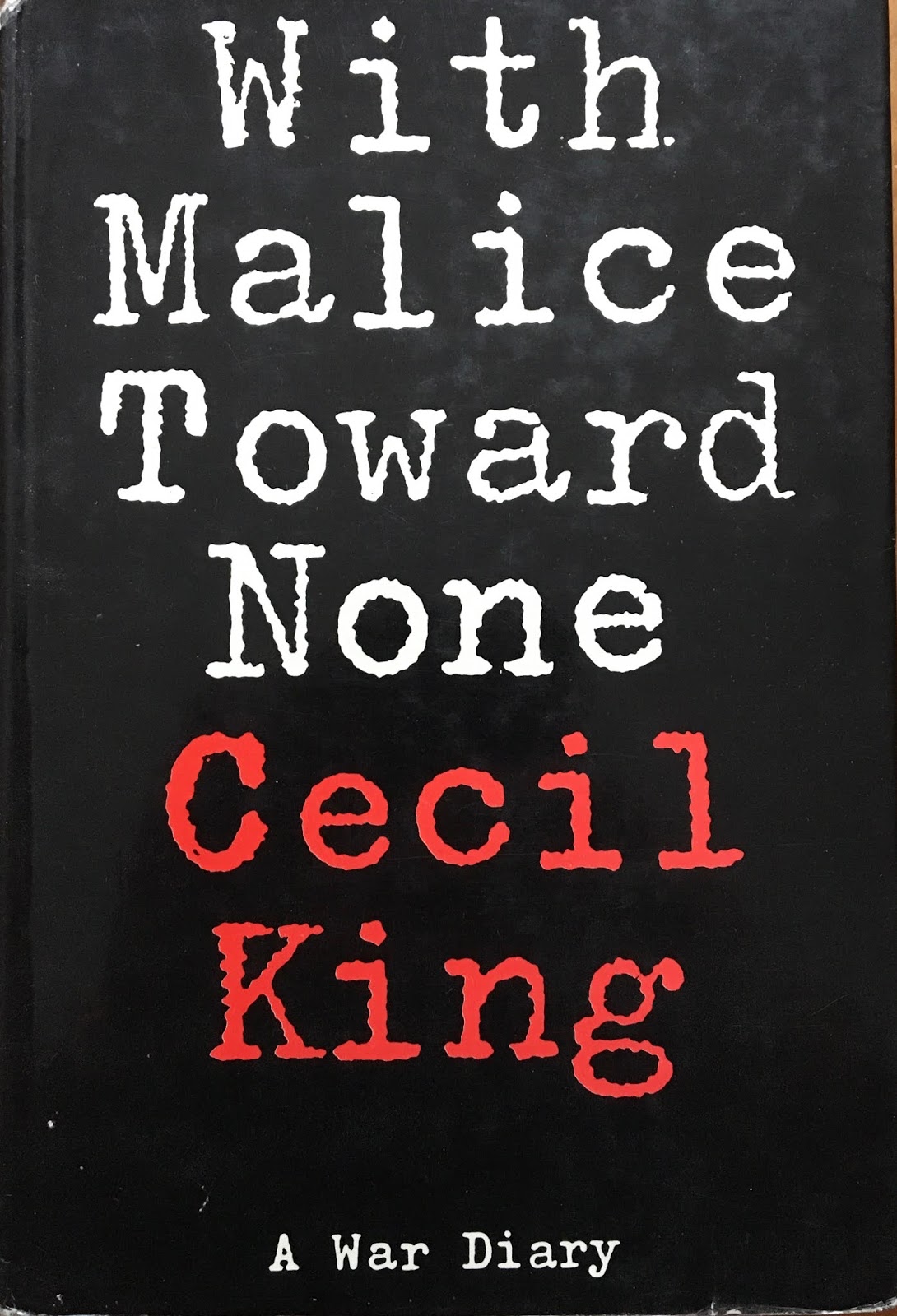
With Malice Toward None (author's photo)

Another work which contains an excellent account of the events of 10/11 May 1941, mainly in and around Fleet Street, is 'With Malice Toward None', written by Cecil King and published in 1970. The Fleet Street connection immediately falls into place when one understands that King was the proprietor of the Daily Mirror and Sunday Pictorial newspapers and the book is written in the journalistic style that would be expected of the author.

Westminster in War (author's photo)

William Sansom was an author and travel writer in peacetime but during the Blitz, was a member of the Auxiliary Fire Service and so his book, 'Westminster in War' published in 1947, must have contained at least some of his own personal experiences. Once again, it has proved an invaluable source of reference over the years and has often accompanied me on my travels around the streets of the present-day City of Westminster. I was lucky enough to pick up this copy, signed by the author, for the princely sum of £5, from a Chelsea antiquarian bookshop some years ago.

Bomber Command War Diaries (author's photo)

Apart from guiding walks, another important source of my income these days is researching family history enquiries, often from the descendants of Allied airmen. This usually entails at least one visit to the National Archives at Kew to examine operational record books from the relevant squadrons but for those who served with RAF Bomber Command, a useful first point of reference can be to check out 'The Bomber Command War Diaries; An Operational Reference Book 1939 - 1945' compiled by Martin Middlebrook and Chris Everitt, which was first published in 1985. Putting this work together must have required many visits indeed to the then Public Records Office to go through the various squadron records and RAF archives. Obviously, this book doesn't provide a squadron-by-squadron guide as to who bombed where and when but it does provide details of every single operation mounted throughout the war by Bomber Command on a daily (or nightly) basis. From this information and from the service histories of the individual airmen, it can then usually be ascertained from a follow-up visit to Kew, exactly how many missions a particular airman flew, to which targets and even in which individual aircraft.

The Blitz (author's photo)

Bomber's Moon title paper (author's photo)

Returning to the Blitz, two of my earliest second-hand purchases remain amongst my most prized possessions, partially because of the illustrations contained therein. These are 'The Blitz' by Constantine FitzGibbon, published in 1957 and 'Bomber's Moon' by the journalist James Negley Farson. These wonderful books contain illustrations by no less than Henry Moore in FitzGibbon's book and some beautiful, evocative pencil drawings by Tom Purvis in 'Bomber's Moon'. The book is themed on Purvis and Farson's travels through London in the Blitz, including various nights spent in air raid shelters and a trip down river to Greenwich. One of the drawings relating to the Thames trip is shown below - 'Old Ron' the Billingsgate Fish Market porter - '45 years in the market' and one of those London faces instantly recognisable to one who grew up in the capital when it was a working city, rather than the somewhat bland place that it has increasingly become.

'Old Ron' the Billingsgate Porter by Tom Purvis (author's collection)

Both Negley Farson and Constantine FitzGibbon were Americans, although both spent much of their time on this side of the Atlantic and indeed, in FitzGibbon's case, served in the British Army until 1942, when he was commissioned into the US Army. The American contribution to the literature of London at War cannot be overstated and I am fortunate enough to possess several of them, including 'Ernie Pyle in England' a 1941 work by the eponymous author, 'I Saw England', another 1941 publication, this time by Ben Robertson, 'A London Diary', also from 1941, written by Quentin Reynolds and finally 'Hell Came to London', a 1940 work by Basil Woon which concentrates on the author's experiences of two weeks living in London starting on 7 September 1940, the first day of the Blitz, which became known to Londoners as 'Black Saturday'. Woon's personal accounts have been much-quoted by other authors and still make remarkable reading to this day.

Title paper from 'Hell Came to London' (author's photo)

It is fair to say that all of the books mentioned above and indeed all of those that you see in the 'shelfies' shown at the beginning of this article, are much-loved by me and have become very much part of the furniture here at Blitzwalker Towers, whether they be old or new publications. I couldn't possibly write about all of them here but will perhaps return to the subject in the future and look at some of the other subjects covered in my library.

All of the photographs used to illustrate this piece are copyright to the author and may not be reproduced without my express written permission.


Books referred to in this piece:

The Blitz - Constantine FitzGibbon, with illustrations by Henry Moore, published in 1957 by MacDonald.
The Bomber Command War Diaries: An Operational Reference Book 1939-1945 - Martin Middlebrook & Chris Everitt, published (paperback) in 2014 by Pen & Sword.
Bomber's Moon - Negley Farson, with illustrations by Tom Purvis, published in 1941 by Victor Gollancz.
The City That Wouldn't Die - Richard Collier, published in 1959 by Collins.
Ernie Pyle in England - Ernie Pyle, published in 1941 by Barnes & Noble.
Hell Came to London - Basil Woon, published in 1940 by Peter Davies.
I Saw England - Ben Robertson, published in 1941 by Jarrolds Limited.
The London County Council Bomb Damage Maps 1939-1945 - editor Lawrence Ward, published in 2015 by Thames & Hudson.
A London Diary - Quentin Reynolds, published in 1941 by Random House.
The Lost Treasures of London - William Kent, published in 1947 by Phoenix House.
Westminster in War - William Sansom, published in 1947 by Faber & Faber.
With Malice Toward None - Cecil King, published in 1970 by Sidgwick & Jackson.

Monday, 16 December 2019

Book Review: Little Ship, Big Story: The adventures of HMY Sheemaun and the amazing stories of those who have sailed in her by Dr. Rodney Pell


The latest book to land on the doormat at Blitzwalker Towers is this fascinating account of the life and times of one of the many "little ships" that served, not in this case at Dunkirk but one which took part in another equally important, although perhaps unsung role as part of the Royal Naval Auxiliary Patrol on the River Thames and it's estuary. 

The book is entitled "Little Ship, Big Story" and to quote directly from the cover, it tells of "the adventures of HMY Sheemaun and the amazing stories of those who have sailed in her." It is written by Sheemaun's current owner, Dr. Rodney Pell and his obvious affection for this doughty vessel is apparent on every page.

The author has taken a novel and quite clever approach to telling Sheemaun's story and rather than just writing a standard account of the vessel's building and subsequent service in peace, war and peace once again, which could appear somewhat "dry" to the general reader, he has told the story by skilfully interweaving the history of the Sheemaun through the eyes of those who have owned her, sailed aboard her and those whose lives have been affected in one way or another by her. Not content with that aspect alone, Dr Pell expands on the life stories of her various owners, telling us what they did before and after Sheemaun came into their lives. In the case of some of the other characters who feature in the Sheemaun story, a few names have been changed in order to "protect the innocent" as the saying goes!

The story is all the better and more entertaining because of this approach and to give the reader further perspective, the author writes the story in a logical, year-by-year basis with a timeline added at the end of each chapter so that the reader can look at Sheemaun's history against the wider background of what was going on at any given time in the rest of the world.

Sheemaun came into this world in 1934 in a place that is just about as far from the sea as it is possible to get in the United Kingdom - Matlock in Derbyshire. She was the dream of one Ernest Richards, manager of the local branch of the erstwhile Williams Deacons Bank, later to become part of Williams & Glyns Bank and nowadays a constituent part of the Royal Bank of Scotland group. Richards had a love of the sea and of sailing and indeed was the owner a motor boat called the Gypsie, which fulfilled his dream up to a point but which rolled uncomfortably when at sea and was somewhat cramped for the needs of his family. Ernest, perhaps with an eye on his future retirement, decided to commission something altogether more suitable for his needs and approached a company of naval architects, Messrs GL Watson & Company in Glasgow to design a 25 ton auxiliary ketch rigged yacht. She was to be built from pitch pine and larch on sturdy oak frames and had a comfortable teak deck house to boot. 

The new yacht was to be built at the yard of James Noble & Company in Fraserburgh, some 450 miles north of Ernest Richards' home in Matlock. She was Yard No. 561 (all ships are initially known by their Yard Number) and was of a sturdy construction typical of this yard. A ship might have a predestined name but is only christened at launching, or when substantially complete. The idea for the name of Yard No. 561 came to Ernest Richards from his then fourteen-year-old daughter Helen as she sat at home one evening reading aloud Henry Longfellow's poem, "The Song of Hiawatha"  which refers to Cheemaun, a war canoe. Helen loved the name and it was quickly decided upon, with the proviso that the spelling was amended by substituting the 'C' for an 'S', giving the softer spelling of the name that the ship carries to this day. She was launched in spring of 1935 and christened by Helen with a bottle of white wine.

Following successful completion of sea trials, Sheemaun was delivered to her owner by the shipyard to Colwyn Bay, the nearest convenient port for Ernest Richards but one which was still some 75 miles distant, a daunting prospect, especially as Richards did not drive. The realities soon hit home to Mr Richards and reluctantly, in September 1935, after just one summer of enjoying Sheemaun, he decided to put her up for sale. It was inevitable that such a fine new yacht would find a new owner and sure enough, after being on the market for about one month, she was purchased by a Mr LSL Saunders for £1,100.00, which ensured that Ernest Richards had at least made a modest profit on the amount he had paid for the initial construction. Incidentally, £1,100 in 1935 equates to around £72,500 at today's values, so we can see that the commissioning and building of a yacht such as Sheemaun, was not something to be taken lightly.

From these beginnings, Sheemaun has gone on to lead an eventful life in wartime and in the subsequent peace. Today, she is part of the National Register of Historic Ships, a similar accolade to a Grade One Listed Building on land and as such, rubs shoulders (or perhaps rubs gunwales) with vessels such as HMS Victory, HMS Warrior HMS Belfast, the surviving 'Little Ships' of Dunkirk and many others, all of which are listed online on the National Historic Register's website.

Rodney Pell has owned Sheemaun since 1987 and thus was her custodian when she was included on the National Register in 2003 and when she took part in the Grand Thames Pageant for HM The Queen's Diamond Jubilee in 2012 and acted as Flagship of the historic vessels taking part that day.

I've given some modest details above of the birth of Sheemaun as well as some of her more recent highlights; in between, there are many fascinating tales of the ship herself and of the many characters who have owned her and featured in her life, as well as the sometimes world-shaping events that she has witnessed, which Rodney Pell has very skilfully interwoven in this fine book. Unfortunately, in the edition sent to me, there were one or two very minor errors of omission and commission in the text, which was down to the absence through illness of the original editor of the book. These have been corrected in a subsequent edition, so further mention is pointless and in any case did not detract from my enjoyment of this book, which I most highly recommend to you.

Little Ship, Big Story by Dr Rodney Pell is published by Conrad Press at £9.99 and is available at all good bookshops and also direct from the author via his website as per this link.


Wednesday, 13 November 2019

Two Villains and a Hero in Wartime London

The original version of the article below first appeared on this blog in June 2010 but as we approach the seventy-fifth anniversary of this notorious wartime crime, it seems a good time to revisit this piece, which has been updated to take into account some corrections and additional information that has come to light.

Memorial Plaque in Birchin Lane (Author's Photo)

During 2019, we have seen the seventy-fifth anniversary of some significant events during the Second World War, such as D-Day, Operation Market Garden and the advent of the German Vergeltungswaffe or V-Weapon attacks on London and other towns and cities across the United Kingdom, as well as parts of Europe that had then been recently liberated by the Allies. The anniversaries of these events have all been rightly commemorated and will no doubt continue for the remainder of the year.

However, there is another far more sinister anniversary approaching that will almost certainly not make the headlines and so should be mentioned here. It is easy to look back on life in London during the Second World War through slightly rose-tinted spectacles and imagine that the populace were as one, all pulling together with the sole aim of defeating the common enemies and returning to more peaceful lives. Despite this somewhat romanticised image, it has to said that by 1944, the citizens of the United Kingdom were becoming distinctly war weary, although most people continued to abide by the law. There was also a much shadier side to London and our other large towns and cities in the form of a significant criminal population, which due to the sheer size of the capital city, was perhaps much more prevalent in London than elsewhere in the country. It is sometimes forgotten that 'normal' crimes took place in wartime Britain but in fact, it was a real problem, made easier for the criminal fraternity by many factors, the blackout, the depleted size of wartime police forces with many war reservists filling the positions of younger men serving with the forces, rationing which helped the so-called 'Black Market' to thrive and an influx of many overseas service personnel were just some of the factors that made life easier for criminals.

One particularly notorious wartime crime in December 1944 made the headlines in both the national and local newspapers and horrified the law abiding citizens of London in particular. Today, in Birchin Lane in the City of London, many people must have walked past the unassuming black plaque on the wall of what is now a sandwich shop without giving it a moment's thought. Closer examination of the plaque reveals that it marks the scene of one of London's most notorious wartime crimes and celebrates the memory of one of the heroes of wartime London, a Royal Navy officer who died not in action with the enemy but in trying to thwart this violent crime.

Capt Binney pre-war wearing the uniform of a Commander, RN (Caroline Brodrick)

Ralph Douglas Binney was born in Cookham, Berkshire on 14th October 1888 and joined the Royal Navy as a Midshipman in 1903. Promoted to Sub-Lieutenant in 1907, he served in the Great War most notably as Gunnery Officer in the battleship HMS Collingwood and postwar in the battleship HMS Royal Sovereign before eventually taking his first command, the monitor HMS Marshal Soult in 1930. In 1934, on the completion of a final shore appointment at The Admiralty he was promoted to Captain and placed on the retired list, marking what seemed the end of an honourable career in the Royal Navy. From 1934-39, he served on secondment to the Colombian Navy and was instrumental in the setting up of their naval cadet and officer training system. He was extremely well thought of in Colombia and indeed today there is still an annual "Binney" Class within the Escuela Naval Almirante Padilla's intake of cadets.

A portrait of Captain Binney (Caroline Brodrick)

On the outbreak of war in 1939 in common with many retired officers, he was recalled to the Royal Navy and on 9 June 1940, was appointed as Flag Captain of HMS Nile, the naval base at Alexandria. On 11 June 1942, he was appointed CBE in the King's Birthday Honours List and by late January 1943 was back in the UK serving as Chief of Staff to the Flag Officer in Command of the London Area.

So it was on 8 December 1944 whilst turning into Birchin Lane from Lombard Street, perhaps on his way to or from a meeting with one of the many merchant shipping companies then located within the Square Mile, the 56-year-old Captain Binney came across an armed robbery in progress at Thomas Wordley's jewellery shop. A man had swung an axe, smashed the shop window and was rushing across the road to a waiting getaway car carrying a tray of jewellery worth £3,795 at 1944 values (approximately £167,000 in 2019), including a pearl necklace valued then at £1,700. As the car pulled away, Binney ran into the road in an attempt to jump on the running board to stop the getaway but instead of stopping, the driver merely accelerated, running over the Captain. Onlookers said that the car momentarily reversed but by this time, a member of the public had blocked the road behind them with another vehicle, so the desperate men drove forwards again with Binney caught under the car as it turned left into Lombard Street. As it sped away, horrified onlookers could hear the Captain calling for help but he remained trapped beneath the car until after it had crossed London Bridge, when he was thrown free of the vehicle as it swerved left into Tooley Street, on the south side of the bridge. Taken to nearby Guy's Hospital, Captain Binney died three hours later from multiple injuries but before he died, the getaway vehicle was found abandoned further along Tooley Street.

How the Daily Herald reported the story on 9 December 1944 (author's collection)

The Police launched a massive operation to apprehend the perpetrators and felt certain that the robbers were local men and after a three week manhunt, during which some two hundred criminals had been hauled in for questioning, they arrested two local men. Thomas James Jenkins, a welder aged 34 from Rotherhithe and Ronald Hedley, a 26-year-old labourer of no fixed address appeared in court at the Mansion House on Friday 19 January 1945, along with "two other men not in custody" and were charged with the murder of Captain Binney, who according to Mr Lawrence Walton for the prosecution "was killed while doing his duty as a brave citizen." The accused had previously been charged with shopbreaking at the jewellers and of the theft of jewellery to the value of £3,795.

Although both men denied any involvement in the robbery and subsequent murder of Captain Binney, witnesses had identified Hedley as the car driver, with Jenkins as the man in the front passenger seat of the car. Another witness, a motorist, said that he had followed the car, sounding his klaxon to alert them to the man trapped beneath but the car failed to stop and the motorist ceased his pursuit once the Captain rolled from beneath the car as it swung left from London Bridge into Tooley Street.

The Liverpool Daily Post reports from the Old Bailey (author's collection)

The men stood trial at the Old Bailey on 6 March 1945 and whilst they both admitted to knowing each other slightly, they still denied all knowledge or involvement in the robbery and murder, despite the testimony of the eye witnesses that proved their involvement. The jury took only eighty minutes to find both men guilty; Hedley, the car driver was convicted of murder and sentenced to death by hanging, whilst Jenkins was found guilty of manslaughter and sentenced to eight years imprisonment. After the verdict was announced, Hedley was heard to mutter "Nothing I can say will make any difference."

Hedley was due to hang at Pentonville Prison on Saturday 28 April 1945 but the day before the sentence was to be carried out, the Home Secretary, Herbert Morrison announced a reprieve and commuted the sentence to one of life imprisonment. The reasons behind this are unclear but as another man sentenced to hang, one Phillip Berry, was also reprieved on the same day, it might have been part of a wider amnesty granted with the approaching end of the European war in sight, or it was perhaps connected with a lingering element of doubt concerning the two other men "not in custody" at the time of the original arrests, whose identities never seem to have been established. Whatever the reasons, Hedley could consider himself a very lucky man given the prevailing attitudes at the time. In the event, Hedley was released after ten years in prison and so could count himself doubly fortunate.

Hedley's reprieve reported in The Citizen of 27 April 1945 (author's collection)

The death of Captain Binney marked a double tragedy for his family, as his son Sub Lieutenant David Binney, aged just 20, had been killed whilst serving in the destroyer HMS Tynedale when it was torpedoed off the Algerian coast on 12 December 1943.

As a result of Captain Binney's selfless action, his fellow officers in the Royal Navy established a trust fund to enable an award to be made to members of the public who put themselves at great personal risk in attempting to intervene in violent crimes in the Metropolitan and City of London Police areas. For many years, Captain Binney's widow would attend the annual ceremony and present the award in memory of her late husband.

The Binney Award has today been absorbed into the annual Police Public Bravery Awards but incorporates the award of a Binney Medal which is proudly presented every summer by the Captain's great niece, Caroline Brodrick to "The Bravest in The Land" and thus keeps alive the name of a man who died upholding the finest traditions of the Royal Navy, albeit in extremely unusual circumstances and surroundings.


Published Sources:

Daily Herald - 9 December 1944
Essex Chronicle - 15 December 1944
Hampshire Telegraph - 19 January 1945
Liverpool Daily Post - 13 March 1945
The Citizen - 27 April 1945
Daily Mirror - 17 January 1973

Unpublished Sources:

Caroline Brodrick's family photographs