Showing posts with label Books. Show all posts

Wednesday, 15 January 2020

Books, Books and more Books!

A "shelfie" of one of my new alcove shelves (author's photo)

Regular readers of this blog, together with anyone who knows me well, will testify to the fact that I am something of a bookworm and have a house full of books, mainly covering military history but also with a sizeable number on transport history, film and a decent sized cricket library too!

This hobby/obsession (depending who you listen to) had threatened to get out of control, as towards the end of 2018, I had simply run out of space and as well as two overflowing and inadequate bookcases, books had begun to pile up on the floor, on chairs and tables. 

Some of those who clearly don't know me suggested that I either sell some of those "that you hardly read" or that I have an even bigger clear out and transfer the lot to electronic format!

I must confess that I have disposed of a few, a very few titles that were either duplicates, didn't fit in with my general theme of interest, or frankly weren't very good but any idea of a mass cull just wasn't going to happen and towards the end of last year, I finally got around to getting some larger capacity, heavier-duty shelves installed. The idea for them came from a Twitter friend of mine, David J.B. Smith, aka @NavalAuthor whose own shelves I had inspected when paying him a visit a couple of years back. These were re-purposed scaffold boards, easily sturdy enough to carry the weight of books, sanded and cut to size to fit the space available. In Dave's case, these were located along one wall of his office but in mine, they were to fit in two alcoves, either side of the chimney breast and each arranged in a run of six shelves. This would give me ample storage for everything I currently have and also provide room for expansion, if necessary. I am useless at anything remotely connected with DIY, so apart from purchasing and preparing the scaffold boards, the actual installation was entrusted to a good mate of mine who is a professional handyman.

Installation took slightly less than an afternoon and once this was done, I was able to start re-stocking the shelves, as well as having a general sort-out and placing the books in some sort of order. The photograph at the top of the page shows mostly the naval side of things, with a section devoted to Dunkirk, another to individual ship or action histories and a further one to the Battle of The Atlantic and submarine warfare, before moving into the subject of military high command, with a few "unclassifieds" thrown into the mix!

Shelfie two, showing the air war section (author's photo)

On the other side, the second alcove shown above contains all of my transport books, together with air war, Blitz and Home Front titles, plus once again a few that don't really fall into any of these categories. The books you see in these "shelfies" aren't always continually being read but they are important sources of reference when writing this blog, when planning new walks, preparing talks and when undertaking research, which is another important source of income for me.

LCC Bomb Damage Maps (author's photo)

The 'London County Council Bomb Damage Maps 1939 - 1945' was reviewed by me in October 2015 and although anything printed on paper has been disparaged by some who should know better, this work often provides a useful first insight into a question that has been posed to me by a customer who needs general information into the wartime history of a specific area in London. Obviously, the maps cannot help with bomb incidents in the parts of London that fall outside the then LCC area and neither can they give dates of incidents but they do provide valuable clues from which to start

Another invaluable source of reference is William Kent's 'The Lost Treasures of London', published in 1947 for 12/6 (about 63 pence in today's money), which I found at a car boot sale for 50 pence about ten years ago. This book proves that no idea is new and indeed, William Kent was giving us Blitz Walks some seventy three years ago and indeed, this work often accompanies me on my City walks, where some of the personal accounts prove invaluable and insightful.

Title paper of The Lost Treasures of London (author's photo)

Another fascinating book that is long out of print but which forms part of my collection, is Richard Collier's 'The City That Wouldn't Die', published in 1959 and which concentrates solely on one raid during the London Blitz, the night of 10/11 May 1941, the heaviest raid of the campaign and what proved to be last against the capital for some eighteen months. The book provides many eye-witness accounts and looks at the events of the night from many viewpoints - members of the public and Civil Defence workers on the British side and from airmen on the German side. I use some of the personal accounts from here in my "Thames on Fire" walk.

The City That Wouldn't Die (author's photo)

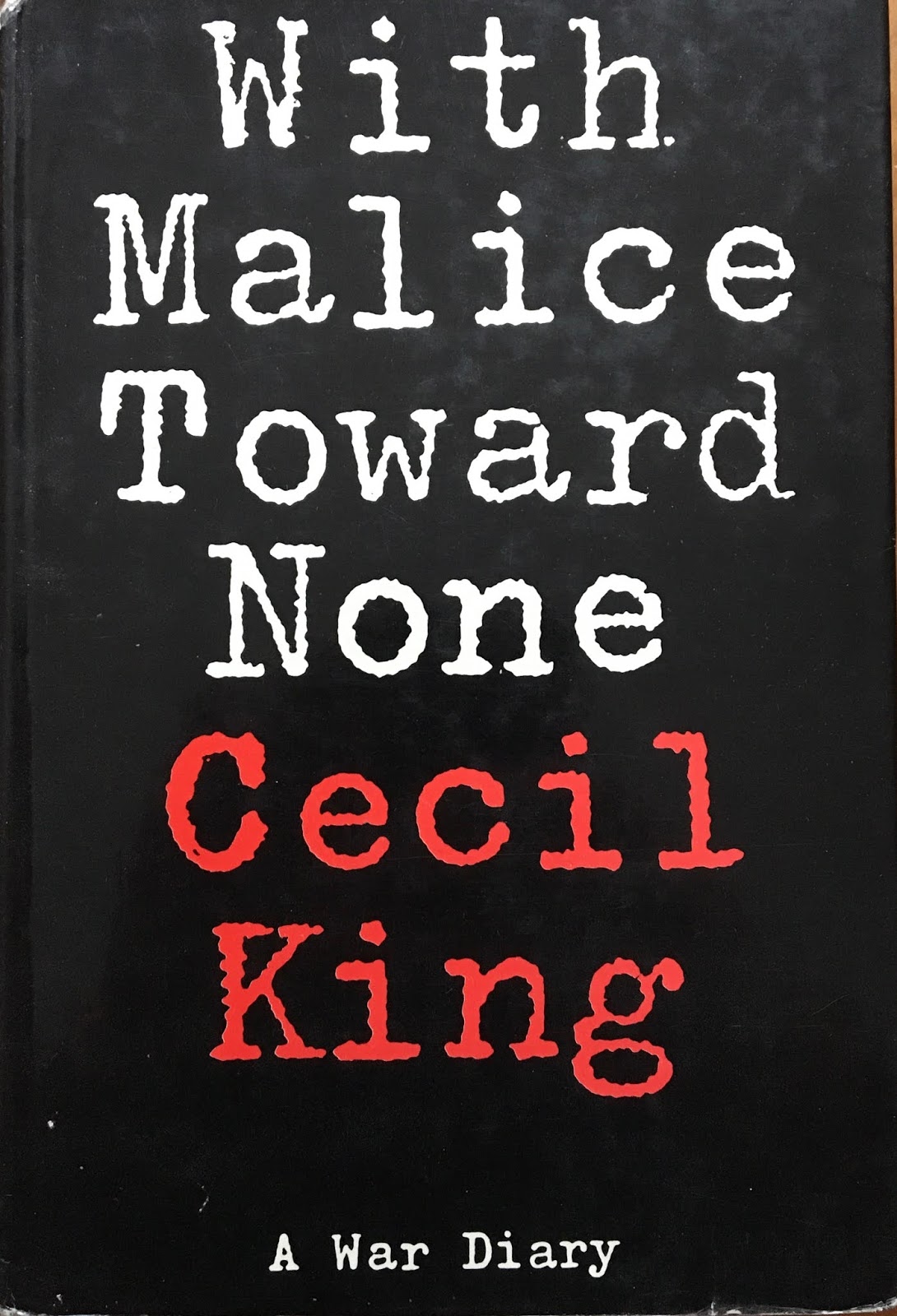
With Malice Toward None (author's photo)

Another work which contains an excellent account of the events of 10/11 May 1941, mainly in and around Fleet Street, is 'With Malice Toward None', written by Cecil King and published in 1970. The Fleet Street connection immediately falls into place when one understands that King was the proprietor of the Daily Mirror and Sunday Pictorial newspapers and the book is written in the journalistic style that would be expected of the author.

Westminster in War (author's photo)

William Sansom was an author and travel writer in peacetime but during the Blitz, was a member of the Auxiliary Fire Service and so his book, 'Westminster in War' published in 1947, must have contained at least some of his own personal experiences. Once again, it has proved an invaluable source of reference over the years and has often accompanied me on my travels around the streets of the present-day City of Westminster. I was lucky enough to pick up this copy, signed by the author, for the princely sum of £5, from a Chelsea antiquarian bookshop some years ago.

Bomber Command War Diaries (author's photo)

Apart from guiding walks, another important source of my income these days is researching family history enquiries, often from the descendants of Allied airmen. This usually entails at least one visit to the National Archives at Kew to examine operational record books from the relevant squadrons but for those who served with RAF Bomber Command, a useful first point of reference can be to check out 'The Bomber Command War Diaries; An Operational Reference Book 1939 - 1945' compiled by Martin Middlebrook and Chris Everitt, which was first published in 1985. Putting this work together must have required many visits indeed to the then Public Records Office to go through the various squadron records and RAF archives. Obviously, this book doesn't provide a squadron-by-squadron guide as to who bombed where and when but it does provide details of every single operation mounted throughout the war by Bomber Command on a daily (or nightly) basis. From this information and from the service histories of the individual airmen, it can then usually be ascertained from a follow-up visit to Kew, exactly how many missions a particular airman flew, to which targets and even in which individual aircraft.

The Blitz (author's photo)

Bomber's Moon title paper (author's photo)

Returning to the Blitz, two of my earliest second-hand purchases remain amongst my most prized possessions, partially because of the illustrations contained therein. These are 'The Blitz' by Constantine FitzGibbon, published in 1957 and 'Bomber's Moon' by the journalist James Negley Farson. These wonderful books contain illustrations by no less than Henry Moore in FitzGibbon's book and some beautiful, evocative pencil drawings by Tom Purvis in 'Bomber's Moon'. The book is themed on Purvis and Farson's travels through London in the Blitz, including various nights spent in air raid shelters and a trip down river to Greenwich. One of the drawings relating to the Thames trip is shown below - 'Old Ron' the Billingsgate Fish Market porter - '45 years in the market' and one of those London faces instantly recognisable to one who grew up in the capital when it was a working city, rather than the somewhat bland place that it has increasingly become.

'Old Ron' the Billingsgate Porter by Tom Purvis (author's collection)

Both Negley Farson and Constantine FitzGibbon were Americans, although both spent much of their time on this side of the Atlantic and indeed, in FitzGibbon's case, served in the British Army until 1942, when he was commissioned into the US Army. The American contribution to the literature of London at War cannot be overstated and I am fortunate enough to possess several of them, including 'Ernie Pyle in England' a 1941 work by the eponymous author, 'I Saw England', another 1941 publication, this time by Ben Robertson, 'A London Diary', also from 1941, written by Quentin Reynolds and finally 'Hell Came to London', a 1940 work by Basil Woon which concentrates on the author's experiences of two weeks living in London starting on 7 September 1940, the first day of the Blitz, which became known to Londoners as 'Black Saturday'. Woon's personal accounts have been much-quoted by other authors and still make remarkable reading to this day.

Title paper from 'Hell Came to London' (author's photo)

It is fair to say that all of the books mentioned above and indeed all of those that you see in the 'shelfies' shown at the beginning of this article, are much-loved by me and have become very much part of the furniture here at Blitzwalker Towers, whether they be old or new publications. I couldn't possibly write about all of them here but will perhaps return to the subject in the future and look at some of the other subjects covered in my library.

All of the photographs used to illustrate this piece are copyright to the author and may not be reproduced without my express written permission.


Books referred to in this piece:

The Blitz - Constantine FitzGibbon, with illustrations by Henry Moore, published in 1957 by MacDonald.
The Bomber Command War Diaries: An Operational Reference Book 1939-1945 - Martin Middlebrook & Chris Everitt, published (paperback) in 2014 by Pen & Sword.
Bomber's Moon - Negley Farson, with illustrations by Tom Purvis, published in 1941 by Victor Gollancz.
The City That Wouldn't Die - Richard Collier, published in 1959 by Collins.
Ernie Pyle in England - Ernie Pyle, published in 1941 by Barnes & Noble.
Hell Came to London - Basil Woon, published in 1940 by Peter Davies.
I Saw England - Ben Robertson, published in 1941 by Jarrolds Limited.
The London County Council Bomb Damage Maps 1939-1945 - editor Lawrence Ward, published in 2015 by Thames & Hudson.
A London Diary - Quentin Reynolds, published in 1941 by Random House.
The Lost Treasures of London - William Kent, published in 1947 by Phoenix House.
Westminster in War - William Sansom, published in 1947 by Faber & Faber.
With Malice Toward None - Cecil King, published in 1970 by Sidgwick & Jackson.

Monday, 9 May 2016

Book Review: The Silent Deep - The Royal Navy Submarine Service since 1945

The Silent Deep (Author's image)

As regular readers know by now, this blog is usually strictly devoted to events during the wartime years of 1939-45, so this particular article is going to break new ground as it deals with much more recent history including the Cold War and the Falklands Conflict amongst others. I've decided to break with precedent as the book in question is such an important and interesting piece of work about a group of men for whom I have the utmost respect and admiration - the men of the Royal Navy Submarine Service, or RNSS to use one of the many acronyms that appear in the book.

The Submarine Service is traditionally known as "The Silent Service", such is it's aversion to self-publicity. Indeed to this day, the standard response to any questions made through official channels is that "The Ministry of Defence does not comment upon submarine operations."

Peter Hennessy, one of our most respected historians and James Jinks, also an accomplished historian and former PhD student under Hennessy, have compiled an authoritative and well-reserched history of the post-war Submarine Service, in which they not only examine the men who commanded and manned the submarines but also look at the vessels themselves, the rationale behind the various policy decisions such as the procurement of Polaris and Trident, as well as describing in compelling detail some of the Cold War exploits of the submarines and submariners, as well as the actions of the RNSS during the Falklands War, thus far and hopefully, the only time that a nuclear submarine has fired torpedoes in anger against an enemy maritime target.

The book opens with a description of the 'Perisher' , or as it is correctly described, the Submarine Command Course, a five month ordeal held twice yearly through which any potential Royal Navy submarine commander must pass. It is designed to replicate the relentless pressures piled upon a submarine captain and failure to pass the course means that the candidate's career aboard submarines is over. He will never again set foot aboard a Royal Navy submarine. Faced with the ruthlessness of the course, it is no surprise that the Navy's submarine captains are universally recognised as being the best in the business. The authors describe some of the goings on aboard HMS Tireless during the 'Private War' which forms part of the course and during which the aspiring commanders are put through their paces.

The course is so well respected that allied navies, including the US Navy frequently send their own top commanders to take part and indeed the late Tom Clancy, author of The Hunt for Red October once wrote that Royal Navy submarine commanders are feared, even by the US Navy. He explained thus:

"Note that I use the word 'fear.' Not just respect. Not just awe. But real fear at what a British submarine, with one of their superbly qualified captains at the helm, might be capable of doing."

From an American, praise indeed but as the authors explain in this book, it was another American, Admiral Hyman Rickover, who was largely responsible for the Royal Navy going along the nuclear submarine route in the first place.

In the years immediately following 1945, the Royal Navy made do with it's fleet of wartime submarines, the diesel powered 'T' and 'A' Class boats (submarines are always 'boats' within the Navy) and these old warriors, such as HMS Totem found themselves being modernised by a cash-starved Navy and adapted for Cold War intelligence gathering missions, including early forays into the Barents Sea and beneath the Artic ice, operations which pushed these boats and the crews to the very limit. These diesel powered boats were known as SSKs (Submarine Killers) as apart from their intelligence gathering duties, their wartime mission would be to shadow and 'take out' Soviet submarines. It was soon clear though that these ageing boats would be no match for the newer and faster Soviet nuclear submarines and that an alternatives method of propulsion was needed, as well as developing a new class of diesel powered submarines, the Porpoise Class, which began to appear in the mid 1950s.

At first the Navy demurred from taking the nuclear powered route, partially on grounds of cost and partly because of worries about the UK's capability of producing sufficent fissile materials to power submarines and meet the country's weapons requirements. Instead, the Ministry of Defence at first explored the possibility of using Hydrogen Peroxide, or HTP as a means of propulsion. This method was being actively explored by the Germans at the end of the war and indeed a captured U-Boat, renamed HMS Meteorite was used for tests. This was followed by two experimental submarines HMSs Explorer and Excalibur, which given the fearsome reputation for the highly unstable and extremely dangerous propellant, were quickly given the nicknames Exploder and Excruciator. The Navy's HTP experiment came to an abrupt end when an HTP powered torpedo aboard the submarine HMS Sidon exploded on 16 June 1955, causing the loss of the submarine as well as the deaths of twelve men as the boat sank in Portland Harbour.

Detail on the Royal Navy Submarine Memorial (Author's photo)

Following this disaster, the Royal Navy turned to their American allies for help in producing their own nuclear powered submarines, or SSNs to use another of the many acronyms in the book. Admiral Hyman Rickover was known as the 'Father of the Nuclear Submarine' and it was indeed largely down to his remarkable drive and single mindedness that the US navy had gotten the USS Nautilus into service in 1955, the same year that the Royal Navy finally abandoned their ill-fated HTP project. Rickover was rude, arrogant and an extremely unpleasant man to deal with but one who recognised the importance of encouraging the Royal Navy to join the 'Nuclear Club' and thus provided every assistance to them in achieving this aim, albeit sometimes a seemingly grudging assistance. However, he did form a close relationship with Lord Louis Mountbatten, at that point First Sea Lord, the professional head of the Royal Navy. 

Rickover agreed to supply the British with an American reactor for the first Royal Navy submarine, named HMS Dreadnought, in order to give British industry a chance to catch up and perfect techniques of manufacture for their own reactor, which would go to sea in the second British SSN, HMS Valiant. Dreadnought, a hybrid British and American design with a 'British' fore end and an 'American' aft end, which contained the reactor, entered service in 1963. Despite some quirks, including a 'Checkpoint Charlie' sign that provided the demarcation point between British and American methods of working in the boat's two halves, Dreadnought proved to be a success and a quantum jump over any previous British submarine. Her appearance began a slow but steady stream of British SSNs coming into service which were able to take over the task of shadowing Soviet submarines and intelligence gathering, invariably in the Soviets' own backyard, the Barents Sea and Arctic Circle.

The book then concentrates on the Nuclear Deterrent, the acquisition of Polaris and the transfer of the UK's independent deterrent from the RAF to a new class of ballistic submarine, or SSBN and the establishment of what has been a continuous series of patrols beginning with that of HMS Resolution in 1968, which continues to this day with the Vanguard class and which is likely to continue into the 2050s with the so-called and as yet un-named Successor class boats (even a 17,500 tonne 'bomber' submarine is called a 'boat' in the Royal Navy!)

The authors tell of an amusing story describing the uncertaintly as to whether the incoming Labour government in 1964 would continue with the programme and a contingency design to convert the as yet unbuilt SSBNs into SSNs by using as much of the already procured materials as possible, thus averting waste. The nickname for this hastily redesigned submarine (and one which was never revealed to the new Prime Minister) was HMS Harold Wilson but it was a vessel which never sailed as the new government, largely driven by then Defence Secretary Denis Healey, decided to continue with the programme, albeit reduced from five boats to four, the minimum number that could safely constitute a continuous at sea deterrent.

The book continues to describe the design and entry into service of the next class of SSN, the Swiftsure class, followed by the Trafalgar class before going on to describe in some detail the submarine operations around the Falkland Islands in 1982, which culminated in the sinking of the Argentinian cruiser General Belgrano and the ultimately unsuccessful attempts to locate and sink the aircraft carrier 25 de Mayo.

The authors go on to describe subsequent submarine operations following the end of the Cold War, including actions against Libya, Afghanistan and both Gulf Wars before covering the latest class of SSN to enter service, the Astute class and gives some useful insight into the Successor SSBN programme.

The book closes where it began, aboard HMS Tireless and provides a quite moving description of the decommissioning ceremony of one of the Royal Navy's Cold War warriors and tells us something of the difficulties in disposing of nuclear submarines that have been taken out of service.

This volume is a truly magisterial piece of work and the casual reader should not be put off by what at first glance may appear to be a mass of diagrams, acronyms and naval jargon, for this book contains a great deal more than that and indeed a great deal more than my brief descriptions shown above. It tells the stories of the reasons behind the decision making, the ships and most importantly of the men - the submariners themselves. Truly a breed apart and a group of men to whom we should be profoundly grateful for helping to keep us safe over the past seventy years or so. I thoroughly commend this book to you.

The Silent Deep: The Royal Navy Submarine Service since 1945 is written by Peter Hennessy & James Jinks and is published by Allen Lane in hardback at a price of £30.00


Sunday, 29 November 2015

Book Review: The Last Big Gun

Front cover (Author's image)


Regular readers of this blog might remember that in the October 2015 edition of this blog, we broke new ground by printing some book reviews of some new additions to my library. I'm pleased to say that following a positive response that was reflected in comments received via social media and in the readership figures for the blog, I have decided to include a few more reviews in the coming weeks and months as and when new books are received.

The latest new title to arrive on my doormat is another from one of the foremost naval historians of our times, Brian Lavery, entitled The Last Big Gun: At War & At Sea with HMS Belfast and is a 352 page, full narrative 'biography' of the ship, the first such account to be written.

Since 1971, HMS Belfast has been an integral part of the London tourist scene and in the 44 years that she has been berthed in the Upper Pool of London, she has become a familiar sight to Londoners and visitors alike; in fact the imposing and purposeful looking cruiser has served in her current role for longer than she saw active service with the Royal Navy.

In this well written and lavishly illustrated book, Brian Lavery tells the story of the Royal Navy's last surviving 'big gun' cruiser from the inception of her design and building at Belfast's famous Harland & Wolff Shipyard, via her near demise just months after commissioning following massive damage caused by a German magnetic mine, her subsequent repairs that amounted to a major reconstruction at Devonport Dockyard, service on the Arctic Convoys and her part in the Battle of North Cape, in which the German battlecruiser Scharnhorst was sunk. The author then goes on to describe HMS Belfast's role at Normandy in 1944, followed by her service with the British Pacific Fleet in the immediate aftermath of the Japanese surrender.

The cruiser's post war service, which was largely in the Far East, is also well covered. These duties varied from traditional peace time 'showing the flag' duties to further active service during the so-called 'Yangtse Incident' of 1949 and during the Korean War from 1950-52, where she provided invaluable gunfire support to Allied forces. HMS Belfast's second major reconstruction from 1955-59 is also covered as are her final years of service, once again mainly as part of the Far East Fleet before her relegation to the Reserve Fleet in 1964 and what looked the inevitable ignominy of the breaker's yard, a fate shared by so many of the Royal Navy's wartime fleet.

Brian Lavery covers the rescue of the wartime cruiser in some detail and explains that whilst the British have a fine maritime tradition and an enviable array of preserved ships from the age of sail and the early days of steam, such as HMS Victory, HMS Warrior, the Mary Rose, Cutty Sark and the Great Britain, our record of preserving great warships from the more modern era, especially in comparison with the United States, is less than enviable. The saving of HMS Belfast from what looked her certain end in the scrapyard began to at least partially reverse this 'sea blindness' when it came to preserving our historic warships and we do at least now have the destroyer HMS Cavalier and submarine HMS Alliance to swell the ranks a little, although in this reviewer's opinion, it is nothing short of a national scandal that we failed to preserve for future generations at least one of our fleet of battleships at the end of the Second World War.

Of course, the history of any ship would not be complete without the stories of the crew members and this book is as much of a social history of the Royal Navy during the years of HMS Belfast's existence as that of a history of the ship herself as these two facets are intertwined very skillfully by the author. Fortunately though, the personal accounts never become the centre of attention and Brian Lavery has achieved a nice balance between these accounts and the hard facts behind the ship's various activities both in war and peacetime.

Brian Lavery has produced a very readable biography of HMS Belfast, that should appeal to both the serious naval historian and those with a more general interest in the Royal Navy and it's history alike. The book costs a very reasonable £25.00, is published by The Pool of London Press and I highly recommend it to you.

The Last Big Gun: At War & At Sea with HMS Belfast -  Brian Lavery - The Pool of London Press Ltd, 2015. ISBN 9781910860014


Friday, 15 July 2011

The Pen is Mightier........


A blog of this nature, although we try to be comprehensive and accurate in the subjects covered, cannot compete with the depth of knowledge and sheer detail that goes into many of the books written on the Second World War.

Such books began to appear immediately the war was over and continue to be written to this day. As someone who guides Blitz-related walks around London and as a Blitz-related blogger and writer, I am often asked what books I would recommend to someone starting a wartime library or to someone who has even a passing interest in the subject. Both Neil and I are very careful to add a ‘Published Sources’ footnote to our blog and whilst our articles are by no means a ‘cut and paste’ job, we are always very aware of the work that goes into producing any piece of writing and are happy (and proud) to acknowledge our sources and inspirations.

Therefore, in answer to the oft asked question, here are my thoughts on the very best of Second World War writing. By its very nature, such a list is subjective and I would welcome the comments of our readers as to their favourites.

As can be imagined, many books were written once the Blitz was over and in the immediate aftermath. These books are still of tremendous value, although some of them are written in the style of their time which can sometimes be seen as politically incorrect and were also written at a time when some of the secrets of the war were still to be revealed.

Of books written whilst the war was still in progress, Front Line 1940-41, published by HMSO in 1942 is a remarkable pictorial study of the Blitz which was issued as a tribute to Britain’s Civil Defence services. Probably the best of the contemporary histories is Carry on London! written in 1941 by Ritchie Calder, who wrote for the now defunct newspaper The Daily Herald and later became Science Editor of the also long disappeared News Chronicle. He was also the father of the author and historian Angus Calder, of whom more later. As might be expected, it is written in a journalistic style and concentrates on the trials, tribulations and triumphs of the ordinary people.

Of the books written in the immediate aftermath of the war, easily the best written in my opinion is Westminster in War by William Sansom and published in 1947. During the war, Sansom was a full time London firefighter, serving initially in the Auxiliary Fire Service and later the National Fire Service, who had several close calls, especially on 29th December 1940, when he narrowly avoided being buried by falling masonry on the night the City of London was firebombed. Well qualified to write on his subject, Sansom became a full time novelist, short story and travel writer post-war and this book stands up well to this day.

Specific raids have also been well covered; The City That Wouldn’t Die by Richard Collier, published in 1959 concentrates on the last night of the Blitz – 10th/11th May 1941 – and is written in a compelling style as befits a journalist with the Daily Mail amongst other publications. Collier skilfully selects various participants, both on the British and German sides and follows their stories through this night of nights. Blitz, by M J Gaskin, is a much more recent addition to the ranks of the publications, not appearing until 2005 and covers the night of 29th December 1940, the great fire raid on the City of London and is written in a similar style to Collier’s book, concentrating on the stories of many of those involved during this raid, cleverly interweaving their stories. Margaret Gaskin wrote this book because she was initially puzzled why so much of the history of the City of London was seemingly punctuated by the recurring date of 29th December 1940 and simply wanted to get to the bottom of the story, which she has done supremely well.

Of general histories of the Blitz, there are several that stand out; Backs to the Wall by Leonard Mosley published in 1971 deals with the general subject pretty well and uses the by now tried and tested methods of concentrating on specific people who were involved and following their stories through the war. This is a fine book but suffers, in this writer’s opinion due to the author’s political viewpoint clouding his judgement occasionally. For example, he accuses Lord Alanbrooke, Chief of the Imperial General Staff, of being out of touch with the situation in London. This is patently incorrect; Alanbrooke was based in London throughout the war and although his job dictated periodic absences, he was well aware as to what was going on and suffered losses amongst his own friends and family during the war. Out of touch he wasn’t! London at War 1939-45 by Philip Ziegler and published in 1995 is a masterful study of life in London not only during the Blitz, but during the war in general and as such grasps the atmosphere of London during this period very well.

However, in this writer’s opinion the best of these ‘general’ histories is The Blitz by Constantine FitzGibbon, first published in 1957 and which remains a magisterial piece of work. FitzGibbon was a well known novelist and historian who had previously written an account of the attempt on Hitler’s life, so was well qualified to write this history. It is supremely well-written and contains some of the best personal accounts of various incidents, known and lesser known. The illustrations by Henry Moore also add a touch of class to this wonderful book.

Another general history, this time of the Battle of Britain, The Narrow Margin by Derek Wood with Derek Dempster and first published in 1961, remains a valuable chronicle of the Battle of Britain. The Battle is viewed on a day-by-day basis, detailing the actions, participants and captures well the cut and thrust of the battle for the survival of this island. The organisational detail of both RAF Fighter Command and the Luftwaffe, together with the stories of the personalities and equipment used makes this a fascinating publication. An updated and illustrated version of this book was released in 1990 which takes into account many of the 'Ultra' secrets which could not be mentioned when this book was first published.

Many social histories of the ‘Home Front’ have been written. In this writer’s opinion, Angus Calder, son of the aforementioned Ritchie is the writer of two of the best books on the subject, The People’s War published in 1969 and The Myth of the Blitz published in 1990. Don’t be put off by the title of this latter book; this is in no way a revisionist work and Angus Calder is not a debunker. As he explains in his own introduction, he doesn’t use the word ‘myth’ as if exposing lies, as does one particularly forgettable book on the subject (that Calder refers to but which I will not do the honour of advertising) but rather re-examines already known facts and looks at the whole event in a rational manner, whilst at the same time reminding us that the Blitz wasn’t just about cheeky, salt-of-the-earth cockneys taking Hitler’s worst on the chin (which they actually did surprisingly often) but was also about looting, road accidents, official incompetence and the general effect on the British people, as well as how this period is portrayed in films, for example. As for The Myth itself, as Calder himself points out, it still holds true as London did survive as did the majority of Londoners without becoming gibbering wrecks.

Many companies and organisations published war histories and some of these are surprisingly interesting and well-written, mainly because the bigger organisations were able to commission first rate authors to write these histories. War on the Line published in 1946 and written by Bernard Darwin is a history of the Southern Railway during the war and although the Southern covered a vast area of Southern England from Dover to Padstow, London features prominently within its pages and includes some fascinating personal accounts from railwaymen and women of the time. London Transport at War, originally published in 1946 as London Transport Carried On and written by Charles Graves covers the story of London’s buses, trams and tubes through the wartime years and again, contains some very good personal accounts as well as being very well illustrated. It slightly glosses over the initial difficulties caused by the tubes not being originally made available as shelters but since the book is an official history written just after the war, perhaps this can be forgiven.

There have been many biographies have been written about the personalities involved during the Blitz and the Battle of Britain. Vincent Orange has written two excellent biographies of the leading RAF protagonists of the Battle of Britain; Dowding of Fighter Command is an honest and well written account of the ‘Father of Fighter Command’ whilst the simply titled Park is a biography of Sir Keith Park, the head of 11 Group, Fighter Command during the Battle of Britain and the man who was aptly christened ‘The Defender of London’ by the Germans of all people. It tells the story well of the jealousies and in-fighting within the RAF that was to lead to the dismissal of this wonderful man shortly after the Battle's conclusion but who was later to mastermind similar victories in Malta and later in the Far Eastern theatre against the Japanese.

So many books have been written about Winston Churchill, it is impossible to mention them all here. In my opinion, the best of them for sheer depth of research is Martin Gilbert’s voluminous biography Winston S Churchill of which Volume Six: Finest Hour 1939-41 published in 1989 extensively covers the Blitz period. An altogether easier to handle work on the great man is Churchill by Roy Jenkins published in 2001. This book covers the whole of Churchill’s life but there is a lengthy chapter on his Premiership during the Second World War.

There is one other book which does not really fit any of the above categories, such as they are and which goes to prove that Blitz Walking is nothing new. This book is called simply The Lost Treasures of London and was written by William Kent in 1947 when the Blitz was still very fresh in people's minds. It is a wonderful little book which consists of a series of walks through London linking those buildings, the treasures of the title, which were destroyed during the Second World War. William Kent's narrative vividly describes what was lost and when this occurred. It is beautifully illustrated and gives a startling insight into the London that might still have been had it not been for the intervention of Hitler and his Luftwaffe.

As has been mentioned earlier, this selection of books is very subjective and is certainly not exhaustive; when one has a library of over 200 books on the subject of the Second World War, of which a large proportion cover the Battle of Britain and Blitz periods, it is difficult if not impossible to mention all of them, save for presenting them in an uninspiring list but hopefully the above will give a good idea as to what to look out for. Some of the older books are now quite rare but given a bit of detective work and trawling of the internet, it is usually still possible to pick up most, if not all of the books referred to without costing a King’s Ransom.

There are many, many other fine pieces of writing, both old and new on the subject which have not been mentioned here due to the constraints of space but as mentioned earlier, I'd love to know your favourites on the subject.

Books referred to above:

Front Line 1940-41 - HMSO 1942

Carry on London! - Ritchie Calder, The English Universities Press 1941

Westminster in War - William Sansom, Faber & Faber 1947

The City that Wouldn't Die - Richard Collier, Collins 1959
Blitz - MJ Gaskin, Faber & Faber 2005
Backs to the Wall - Leonard Mosley, Weidenfeld & Nicolson 1971

London at War 1939-45 - Philip Ziegler, Sinclair Stevenson 1995
The Blitz - Constantine FitzGibbon, Macdonald 1957

The Narrow Margin - Derek Wood with Derek Dempster, Tri-Service Press 1990

The People's War - Angus Calder, Jonathan Cape 1969

The Myth of The Blitz - Angus Calder, Jonathan Cape 1991

War on The Line - Bernard Darwin, Southern Railway 1946

London Transport at War - Charles Graves, Almark Publishing 1974

Dowding of Fighter Command - Vincent Orange, Grub Street 2008
Park - Vincent Orange, Methuen 1984

Winston S Churchill, Volume 6 Finest Hour 1940-41 - Martin Gilbert, Heinemann 1989

Churchill - Roy Jenkins, Macmillan 2001

The Lost Treasures of London - William Kent, Phoenix House 1947