Showing posts with label history. Show all posts

Wednesday, 4 December 2024

Gotha Terror: The Forgotten Blitz 1917-1918 by Ian Castle


Gotha Terror by Ian Castle cover (author's photo)

As regular readers will be aware, Ian Castle has been writing about Germany's air raids on Britain during the First World War for some seventeen years now and he must surely be regarded as one of the foremost authorities on the subject, which has invariably been somewhat overshadowed by the better-known and more destructive Blitz of the  Second World War. Nevertheless, this was certainly the first sustained strategic bombing campaign in history and the author has taken great strides in documenting this campaign over the years.

Ian's most recent project has been to meticulously research every raid and incursion during this conflict and his latest book, entitled Gotha Terror forms the final part of his Forgotten Blitz trilogy and covers the final two years of the war from 1917-1918.

This period saw the transition from the Zeppelin being the primary means of attack, to the conventional aeroplane, mainly in the form of the Grosskampfflugzeug, perhaps better known as the Gotha but also the Riesenflugzeug, the aptly named Giant and it was the raids by these latter two types of aeroplanes in squadron strength, initially by day but latterly by night, that was to bring renewed terror to the civilian population of the United Kingdom.

Apart from the Gotha and Giant raids, the Zeppelins continued their campaign against Great Britain when circumstances permitted, still under the command of the redoubtable Fregattankapitan Peter Strasser, the splendidly titled Fuhrer der Luftschiffe, who continued to believe in these weapons and who commanded a fierce loyalty from those who served under him.

On the Allied side, the year 1916 had closed with the British under the illusion that following what seemed to be the defeat of the Zeppelins, the threat of future air attacks from Germany had evaporated and as a consequence of this complacency, the country's air defences were downgraded accordingly but following a report commissioned by the War Cabinet, written by Jan Christian Smuts, the air defence system was thoroughly overhauled and reconstituted to meet the renewed threat.

As in his previous volumes, the author records each raid in meticulous detail, using a mixture of official sources as well as many contemporary eyewitness personal accounts, the majority of which have never been previously published. The book also tells the story of the re-establishment of Britain's air defence system in the shape of the London Air Defence Area, or LADA, under Major General Edward Ashmore and follows the evolving system in the face of experience gained during the campaign.

This volume completes what is an invaluable triptych of reference works, each meticulously researched and written in an extremely readable style. 

This volume will appeal to both the serious military historian as well as anyone interested in the history of air warfare and I have no hesitation in recommending it to you.


Published by Frontline Books/Pen & Sword
RRP £29.99
hardback, pp392


Thursday, 15 February 2024

From Doodlebugs to Devon - by Sarah Shaw

From Doodlebugs to Devon cover (author's photo)

Sarah Shaw's latest book "From Doodlebugs to Devon" is subtitled "one war...one woman...one year..." and is very much a personal journey for the author, for the "one woman" mentioned in the title happens to be Sarah's mother, Yvonne Shaw, whose letters to her husband form the basis of this book.

I have to declare an interest in this book now because during the various Covid lockdowns and the periods in between, I assisted Sarah in a very small way by checking and verifying the various BC4 Bomb Census reports for some of the V-1 and V-2 incidents that are referred to in this book, both in Yvonne's letters and in the narrative that the author skilfully weaves around them, which help provide context to the letters and help the reader get a real idea of what was happening in the wider world of the British "Home Front" at this later stage of the Second World War.

Yvonne Shaw and her four-year-old son, Oliver begin the period covered in this book living in Foxley Lodge, a Victorian detached house in the outer London suburb of Purley, to the south of Croydon and at that time, still in the county of Surrey. Yvonne is almost 33 and her husband Clem, is an army officer stationed in Scotland. His work is something of a mystery to Yvonne but we soon learn in the author's narrative that he is actually working with the Home Guard in Scotland.

The first letter to him we read is dated 1st April 1944 and apart from mention of an air raid late in the preceding month (one of the last such raids by manned Luftwaffe aircraft), most of these early letters cover the relatively mundane life of a young wife with a husband serving in the armed forces, somewhat struggling to make ends meet and finding life in wartime London fairly boring.

It is when the Doodlebugs mentioned in the book title start falling that the tone of the letters suddenly change. As most people know, "Doodlebug" was one of the nicknames given by the British people to the V-1, the first of Hitler's so-called "Vengeance Weapons", a pilotless aircraft as they were somewhat quaintly called initially by the British Civil Defence service, before they were given the name of "FLY" for "Flying Bomb", which is essentially what these weapons were - an early form of cruise missile.

Croydon was to become the most "Doodlebugged" borough in London. This was not due to any particular singling out of the citizens of the south London suburbs but more due to subterfuge on the part of the British, who had double agents on the ground whom the Germans were convinced were providing them with accurate information regarding the fall of shot of the V-1s. Whereas in fact most of them were initially falling as intended on the central area of the capital, false information fed to them by one agent in particular, Juan Pujol Garcia, better known as Agent Garbo, persuaded the Germans to adjust the targeting of these devices downwards, so that they would fall on what in 1944, were the much more lightly populated areas of outer suburban London, rather than the densely packed inner London.

It was a terrible decision by the authorities to have to take, for whichever option ensured that people would die. In the end, it was just about numbers and sadly, Croydon became the recipient of 141 these weapons. 

Yvonne's growing anxiety is reflected in her letters to Clem and she reports some very close calls nearby which although they do not directly impact the family home, happen to be far too close for comfort and it is clear from the tone of her writing that the mental strain is growing, as well as concern for the well-being of young Oliver.

As a result of this and a phone call from her uncle in Exmouth, Yvonne and Oliver decamp to Devon, at first staying with her Uncle Dudley and family but later moving to Budleigh Salterton and enduring something of an odyssey of moves and re-locations to various parts of that delightful seaside town, although doubtless in 1944, it was somewhat different to the Budleigh Salterton that I am quite familiar with today.

The letters home, which sometimes cover seemingly quite mundane matters, actually provide an interesting window of this important period of British history and the author's accompanying commentary and explanations, provide a fascinating context.

The book ends with a chapter which tells us about the family from 1945-1973, which sadly doesn't provide us with a particularly happy ending to the story - but there will be no further spoilers from this reviewer!

Sarah Shaw has produced a delightful social history of wartime Britain which I would thoroughly recommend to you.

Available from www.amazon.co.uk

RRP: £11.99

softback, pp 227 (also available as an e-book)


Tuesday, 31 October 2023

Book Review: Streatham's 41


Cover of Streatham's 41 (author's image)

In mid-June 1944, Londoners could perhaps have been forgiven for thinking that the days of attacks on them from the air were a thing of the past but on 13 June, a new threat to their safety appeared in the form of the V-1, the first of Hitler’s Vergeltungswaffen or “Vengeance Weapons”. In excess of 2,400 of these early cruise missiles were to fall upon London in a campaign that was to last until early September 1944, in which the various neighbourhoods of south and southeast London bore the brunt,

The original edition of this account was written by Kenneth Bryant, Senior District Air Raid Warden of the Metropolitan Borough of Wandsworth and appeared in 1946 as a basic record of the forty-one flying bombs that fell upon the south London suburb of Streatham. In 2019 an updated and expanded edition was produced by the Streatham Society to mark the 75th anniversary of the campaign and which has recently been re-issued once again.

This attractive A4 softback booklet provides a detailed analysis of each of “Streatham’s 41” flying bombs, each one accompanied by a map, as well as personal accounts from those affected by each incident and where available, contemporary photographs of the aftermath of each bomb.

In addition, there are useful and informative chapters on the organisation of the ARP (Air Raid Precautions), later the Civil Defence Service in general and in particular within the Borough of Wandsworth. There is also a brief history and timeline of the V-1 offensive and the counter-measures put in place, as well as an interesting chapter covering the human cost of the campaign and financial cost of rebuilding in Streatham, most notably the “pre-fabs” that sprung up across London as a temporary solution to re-housing those who had been rendered homeless.

There is also a chapter on the design of the V-1, which leads to my only minor gripe with the book, in so far that the authors describe the propulsion system as a ram jet, whereas in fact the V-1s were propelled by a pulse jet system, which gave rise to the peculiar rasping sound made by the engine.

Overall though, this is an excellent local history publication which should be of interest to Home Front historians as well as those with a love of our capital city’s history.


Streatham's 41: The V-1 Flying Bomb Offensive as experienced in Streatham

Author: Kenneth Bryant (updated edition prepared by John W Brown)

Published by The Streatham Society (www.streathamsociety.org.uk)

RRP £11.00

Softback, pp 90


Tuesday, 20 June 2023

Old Palace School - the largest Fire Service tragedy on British soil

The order of service for the ceremony (author's photograph)

Towards the end of last month, I was honoured to be invited to the dedication and unveiling of the latest commemorative plaque placed by the charity Firemen Remembered, at the Old Palace Primary School in Bow, in London's East End.

In many ways, this represents a full circle for the charity as the first commemorative plaque ever placed by the charity was at Old Palace School in 1997. Whilst this plaque is still in situ, it is no longer visible to the public and although the names were known at the time, they were not listed on original blue plaque and so it was right that the story was brought up to date.

The original plaque, now obscured from public view (author's photograph)

In common with many London schools, whose pupils had largely been evacuated out of the capital, Old Palace School, in St Leonard's Road was taken over by the Auxiliary Fire Service to serve as Sub-Station 24U, under the control of the erstwhile Brunswick Road Fire Station. It had served throughout the Blitz, including the dark days of "Black Saturday" on 7 September 1940, the great fire raid of 29 December 1940 and countless other raids affecting the East End of London. 

Old Palace School before the war (Firemen Remembered)

By April 1941, although Londoners didn't know it at the time, the Blitz was drawing to an end. Hitler was about to strike east at the Soviet Union and despite the misgivings of senior figures within the Luftwaffe such as Hugo Sperrle, the majority of the Luftwaffe's bomber forces were redeployed east. 

Despite the impending changes, bombing on London continued for the time being, with another particularly heavy raid being mounted on the night of 16/17 April 1941, a raid which became known to Londoners simply as "The Wednesday".

Three days later, on the night of 19/20 April came another heavy raid, said by some to coincide with Hitler's 53rd birthday and again, it was a sufficiently heavy and devastating raid to be given the simple label "The Saturday" by those that experienced it.

One of the purposes of the Auxiliary Fire Service was for the various units to act as a mobile reserve to be deployed wherever the need was greatest and on this night, as all of the local crews had been called out to fires in the local area, the call went out to Beckenham Fire Station for reinforcements. The twenty one Beckenham Firefighters arrived at 01.30 on Sunday 20th April and were mustering for orders alongside fellow crews from Homerton and Bow, when at 01:53 a high explosive bomb scored a direct hit on the school, demolishing a large part of it and setting the remainder on fire.

The results were catastrophic; all thirty two Firemen at the school as well as two Firewomen (1941 ranks used) were killed outright. It was - and remains - the largest loss of Fire Service personnel in a single incident in British history.

The grim task of recovery (Firemen Remembered)

The ceremony was presided over by Stephanie Maltman of the charity Firemen Remembered and the Rev'd Cathy Wyles; it was attended by Steve Dudeney, the former London Fire Brigade Borough Commander for the area when the original plaque was unveiled, as well as members of the present day Beckenham and Bow Fire Stations. As always, it was an extremely moving ceremony, especially as the names of the fallen were read.

Stephanie Maltman and the Rev'd Cathy Wyles (author's photo)

Fire Brigade guests, past and present (author's photo)

After the ceremony, we repaired to the school for tea and cakes but before we did, the School Caretaker invited us to the rear of the school buildings, where he showed us the splinter-strewn car park walls, the only part of the original school still standing, mute witnesses to an appalling horror. The walls had been slated for demolition a few years ago, he told us but the-then Head Teacher had mounted a campaign to save them, which ensured that they are now listed and saved for future generations to see.

Splinter strewn wall at Old Palace School (author's photo)

Splinter strewn walls (author's photo)

Thanks are due, as always to Stephanie Maltman and Bill Hickin of Firemen Remembered for organising the ceremony and for inviting yours truly to attend.

The new plaque in situ (author's photo)


Saturday, 31 December 2022

Grenfell Road - a previous tragedy

It is probable that most people around the world will be aware of the tragedy that befell the residents of Grenfell Tower in 2017 but fewer will know the area in which the 1974-built block is located. Grenfell Road, on which the tower stands, is today part of the Royal Borough of Kensington & Chelsea, a product of the reorganisation of London's local government in 1965. Prior to this date, Grenfell Road had formed part of the Metropolitan Borough of Kensington, a solidly working class area known as Notting Dale and as we can see from the extract from the 1939 A to Z atlas, a warren of smaller roads running to the east of Latimer Road Station, which was then part of the Hammersmith & City Branch of the Metropolitan Line.

The impact area (arrowed) on the 1939 A to Z (author's image)

As Christmas 1944 approached, the war-weary residents of the area, along with all Londoners were hoping for a quiet Christmas and perhaps had begun to have thoughts about the end of the war in Europe being on the distant horizon. Since September 1944, London had been under attack from the latest of Hitler's vengeance weapons, the V-2 rocket but on the evening of 12 December 1944, the residents of Notting Dale were hoping for a peaceful night - there had been no nearby incidents since 6 December, when the "Red Lion" pub in Marylebone had been destroyed by a direct hit but at 22:40, the silence was shattered by an explosion in the area between Treadgold Street, Lancaster Street and Grenfell Road.

As was usual with these weapons, destruction was widespread and not limited to the immediate area of impact. As we can see from the extract reproduced below from the LCC Bomb Survey, many buildings were destroyed or rendered uninhabitable but remarkably, just two people lost their lives in the incident; 61-year-old Edith Bryant of 21 Grenfell Road and 39-year-old Edith Ryell of 9 Grenfell Road. The BC4 report held at the National Archives in Kew informs us that 30 people were seriously injured, with another 20 "lesser injuries". The missile had been fired just minutes earlier from Battery 444 at Scheveningen, in the Netherlands and was one of ten fired by this particular battery on the day and one of twenty two in total fired on that day.

Extract from BC4 Report held at the UK National Archives (HO198/106)

The National Archive file connected with this incident also contains some useful sketch maps and photographs, with which it is possible to compare some of the views with a "then and now" perspective, although such was the level of damage incurred not only as a result of this incident but also due to earlier damage in the Blitz, that when the London County Council began the post-war redevelopment of the area, the local geography of the road network was changed, further compounded by the construction of the Westway in the 1960s and 70s, which submerged many of the roads in the north of the area seen on the 1939 map.

The 1944 map drawn immediately after the incident (HO198/106)

Google Maps view of the comparable area today (author's screen grab)

We can see above some of the changes on the geography by comparing the BC4 map drawn immediately after the incident, with the Google Maps view of the comparable area today. For example, Lancaster Road no longer exists, apart from a short section of it which has now been renamed Whitchurch Road and Grenfell Road today continues north on a new alignment, crossing the site of Lancaster Road, at the end of which lies the ill-fated Grenfell Tower.

Photograph Plot from BC4 Report (HO198/106)

There is also a useful map in the file which references where each of the bomb survey photographs were taken and using this map, it is fairly easy to use Streetview to take a comparable view of the same scene today. In the first comparison shots below, we see image #1, which is the view from Bomore Road, looking towards Grenfell Road, compared with the similar view today.

This is image #1 from 1944 looking from Bomore Road towards Grenfell Road (HO198/106)

The same view taken in 2020 (author's screen grab from Google Streetview)

Whilst in the views below, we see 1944 images #3 and #4 which show Treadgold Street forking off to the right, with Grenfell Road bearing left. The modern image has been incorrectly labelled Barandon Walk by Google Maps, when this is actually a public walkway in the Lancaster West Estate which is out of sight behind the camera operator.

Treadgold Street on the right with surface air raid shelter, with Grenfell Road bearing left (HO198/106)

Comparable view today, with Grenfell Road mis-captioned as Barandon Way (author's screen grab)

Next, we see 1944 photographs #8 and #9, taken from the corner of Treadgold Street looking into Grenfell Road. We can see in the modern comparison view that the Victorian houses in Grenfell Road have been totally demolished and replaced by the Lancaster West Estate.

Photos #8 and #9 looking from Treadgold Street into Grenfell Road (HO198/106)

The comparable view today looking towards the Lancaster West Estate (author's screen grab)

The final view is a montage of photographs #10, #11 and #12, which is impossible to compare with a modern view as the houses in the photograph have been demolished but it does demonstrate the level of blast damage caused to the houses in Grenfell Road.

Images #10, #11 and #12 taken from the rear of Lancaster Street, looking towards Grenfell Road (HO198/106)

This then is Grenfell Road, like many parts of London, an area who's modern geography is framed by events of almost eighty years and ago and which has seen tragedy in war and more recently.


Unpublished Sources:

HO198/106 - Region 5: London Headquarters Forms BC4 12 Dec 1944 to 1 Feb 1945 - UK National Archives, Kew

Web Sources:

http://www.v2rocket.com/start/deployment/timeline.html


Monday, 26 September 2022

The Little Reminders.....

I've been guiding regularly now since 2010 but have been interested in our wartime history for as long as I can remember and in that time, have come to appreciate that as well as the formal memorials and plaques commemorating incidents and events from the Blitz and beyond, there are so many more reminders that can be seen, often hiding in plain sight.

We've covered some of these in previous posts, such as surviving signage, bomb splinter damage and air raid shelters but today we're going to look at some of the quirkier and perhaps more subtle reminders of our wartime past.

We start at St Margaret's Church, adjacent to Westminster Abbey, a 12th Century place of worship that is sometimes called "The parish church of the House of Commons".

The now mostly plain glass window marks the entry point of the bomb (author's photo)


Scorch marks still apparent on Pew 38 (author's photos)

On 25 September 1940, an oil-incendiary bomb smashed through one of the stained glass windows on the eastern side of the church and started to burn inside the ancient building. The fire was soon extinguished but even some 82 years later, we can still see a plain window where there was once stained glass and scorched timber at the end of Pew 38.

Some reminders are so elusive that they can only be seen at certain times of the day, depending on the state of the tide in the River Thames. Walk from St Margaret's around to the Victoria Tower Gardens and if your visit coincides with low water, carefully look over the embankment wall and you will see rubble left over from when the river wall was breached by a high explosive bomb on the night of 16/17 April 1941. The wall over which you might very well be leaning was repaired using a concrete infill and it is quite fitting that this repair carries a City of Westminster green plaque commemorating Sir Thomas Peirson-Frank, the London County Council's Chief Engineer and the man responsible for that organisation's Thames Flood team, who were responsible for ensuring that speedy repairs were made whenever the river walls and flood defences were breached by the enemy's bombs and missiles.

Rubble from the Thames embankment wall now on the beach below the Victoria Tower Gardens (author's photo)

The repair - a concrete infill (author's photo)

Sir Thomas Peirson-Frank green plaque (author's photo)

Contiust a mile or so upstream on the Thames from the Palace of Westminster lies Vauxhall Bridge, the northernmost buttress of which carries splinter damage from a V-1 which like the rubble at Victoria Tower Gardens, can only be seen at low water. This too dates from the night of 16/17 April 1941, the second heaviest (and penultimate) raid of what we now call the First, or Night Blitz.


Close-up of the splinter damage at the northern end of Vauxhall Bridge (author's photo)

Continue north along Vauxhall Bridge Road until you reach Victoria Station. On the forecourt of the station, behind the new entrance to the busy Underground Station, one can see damage to the wall of the mainline station. This is not bomb splinter damage but instead is damage caused by a Luftwaffe bomber, the wreckage of which plunged to the ground on to the station forecourt on 15 September 1940. This was part of the Dornier 17 that was brought down when Sgt. Ray Holmes' Hurricane collided with it in the skies over central London on the day that is now commemorated as Battle of Britain Day. The Dornier, which had already been abandoned by it's surviving crew members, was flying on autopilot, and apart from two dead crew, contained a full bomb load, most of which flew from the bomber during its uncontrolled descent.

The contemporary photo shows the wreckage being guarded by soldiers and police to discourage would-be souvenir hunters. The new entrance to the Circle and District Line platforms stands almost exactly where the wrecked "Locks and Cutlery" shop once stood.

Dornier 17 wreckage on the forecourt of Victoria Station (author's collection)

In the modern photographs, we can see the masonry of the station wall, which although recently cleaned, is still disfigured by the impact of the German bomber on that late summer lunchtime.


The battle-scarred walls of Victoria Station (author's images)

In the next edition, we shall take a look at similar reminders of our wartime past elsewhere in the capital.

Please note that all photographs in the above article are the property of the author and may not be used elsewhere without my express written permission. Offenders will be pursued ruthlessly!


Monday, 16 August 2021

Firemen Remembered: Harry Errington and the George Cross

The Invicta Road plaque remembrance ceremony in 2018 (author's photograph)

Since taking up guiding some twelve years ago, I have met some delightful people who have helped and encouraged me and frequently collaborated on various projects. One of my very earliest such contacts was Stephanie Maltman, the moving force behind the Firemen Remembered charity, an independent organisation that is dedicated to recording and remembering those firemen and women who served in the London Civil Defence Region during the Second World War and which commemorates those who died whilst serving.

Observant Londoners will have spotted the distinctive white, oval shaped plaques at various locations across the capital upon which the names of firemen and firewomen (the rank of "Firefighter" was not introduced until the late 1980s) are recorded, sometimes along with the names of other Civil Defence workers who died alongside them. Thanks to Stephanie, I have been fortunate enough to have been invited to a number of unveiling and dedication ceremonies of new plaques and on one occasion, worked with her to get a plaque installed at Invicta Road School, the scene of a tragic loss of fire service lives in November 1940.

The most recent plaque to be installed was of necessity, unveiled without ceremony due to Covid restrictions in 2020 but commemorates seven Auxiliary Fire Service members who died at the former Jackson & Allum's Garage at Rathbone Street, in the area of London's West End that we now know as Fitzrovia. The garage was then in use as an annexe of AFS sub-fire station 72Z but on 17 September 1940, received a direct hit from a high explosive bomb that killed the seven firemen, as well as nineteen civilians who were using the basement as a shelter. 

Firemen Remembered plaque at 7-9 Rathbone Street, London W1 (author's photograph)

However, as the plaque informs us, apart from the tragic loss of life, Jackson's Garage was the scene of an act of great bravery that saw the only George Cross awarded to Harry Errington, the only member of the London Fire Service to be so awarded during the Second World War.

Harry Errington was born on 20 August 1910 in a small, two roomed flat at 47 Poland Street, Westminster. He was one of four children born to Yiddish speaking, Jewish immigrants from Poland, Solomon and Bella Ehrengott, who were tailors originally from Lubartov, near Lublin. They had come to England in 1908 in order to flee the pogroms and had changed their name to Errington shortly before Harry's birth. He was educated at the Jewish Free School in Westminster and had vague memories of the Zeppelin raids of the First World War, when with his school friends, he remembered collecting pieces of shrapnel from the streets after each raid.

Upon leaving school, Harry initially trained as an engraver but the fumes from the nitric acid used in the process affected his chest and so instead, he went to trade school and became a tailor working for his uncle in Savile Row. His job at this time was to take finished articles of clothing to other Savile Row shops and bring back other work for his uncle. After completing his training as a cutter, he got his first job with a famous Dutch tailor called Sholti but as soon as he discovered that Harry was Jewish, sacked him in a move that would be illegal today but was typical of the widespread anti-Semitism of the time.

The site of Jackson's Garage in 2018 (author's photograph)

Harry eventually obtained another job in 1936 with the famous tailors Simpsons of Piccadilly but in August 1939, three weeks before the declaration of war, he volunteered to join the AFS full time, along with three friends at Shaftesbury Avenue Fire Station. Harry was highly motivated in his desire to help defend his local neighbourhood, as he had numerous relatives still living in Poland, all of whom he later learned were murdered in the Holocaust.

His first base was at his former school at Hanway Place, which was the main Station 72Z and as this was during the period known as the "Phoney War", they saw little action and were able to concentrate on training. Harry and his crew of four had the typical equipment of the time - a requisitioned taxi and a trailer pump. Harry recalled that morale was high and that as they had several chefs amongst their number from West End restaurants, the food was excellent.

In early 1940, he was transferred to Jackson & Allum's garage in Rathbone Street, which for Harry was a bonus as it meant that he could now walk to work from his home in Poland Street. This station had five crews and larger purpose built wagons for towing the trailer pumps. One of the main raisons d'etre of the AFS was to act as a mobile reserve to reinforce other areas and on the first night of the Blitz, 7 September 1940, Harry and his colleagues found themselves tackling fires a long way from their usual "manor" in places as far-flung as the Surrey Docks, Peckham, Camberwell and the Woolwich Arsenal.

On 17 September 1940, Harry and some twenty colleagues were awaiting their next "shout" in the basement of Jackson's Garage, along with around thirty members of the public who were sheltering there. At 00:14, the floors above crashed into the basement as the building received a direct hit from a high explosive bomb. The garage petrol store was also located above the basement and the burning fuel created a fireball that swept through the basement. Harry was blown across the floor and knocked unconscious but quickly awoke to find himself unhurt but stunned. The cellar was burning and smoke-filled and although the main exit was blocked, he was able to make his way to the emergency exit but on his way, heard screams for help; he saw his friend John Hollingshead laying face down in great pain with his legs trapped by masonry. Without hesitation, Harry found a blanket and placed it over his head to try and get a measure of protection from the flames and returned to help his friend.

Harry Errington GC (author's collection)

Harry was able to scrape away and lift the rubble with his bare hands, seriously burning and cutting them in the process. Freeing Hollingshead, he then carried him out into the street but on his way, noticed another friend, John Terry, trapped beneath a heavy radiator. Having taken Hollingshead to safety, Harry then returned into the burning basement, by then in danger of imminent collapse and freed Terr, dragging him out of the building.

Harry was by this time in serious pain from his cut and burned hands, which he must have surely known could end his peacetime livelihood. The injured men, including Harry were taken to the nearby Middlesex Hospital for treatment but later transferred to the relative safety of a hospital in Cheshunt, Hertfordshire. It was whilst recovering here that he recalled being given copious supplies of beer, courtesy of some Canadian soldiers who were also patients here. The Canadians didn't think much of English beer and so were happy to give it away to the English firemen!

Harry was eventually discharged by the AFS as his wounds failed to heal in the thirteen weeks allowed by the Civil Injuries Act and as his parents had moved to Bromsgrove, near Birmingham, he moved there and got a job working at Austin Aero, which manufactured Lancaster bombers. He also attempted to join the Army at this time but was refused as medically unfit due to his injured hands. Harry later re-joined the now-nationalised National Fire Service in Bromsgrove as a part-timer and remained with them until the end of the war.

Harry's George Cross was gazetted on 8 August 1941 based on the recommendation of Hollingshead and Terry, the two men he had rescued, who had reported his actions to a senior officer. Despite his injuries (he had third degree burns to his hands and arms), Harry had modestly not mentioned his act of rescue to his superiors. His GC was awarded to him in October 1942 by the King in a ceremony at Buckingham Palace.

After the war, Harry returned to Simpsons but eventually established his own tailoring business, Errington & Whyte in Sackville Street, which he ran until his retirement in 1992. In his youth, he had been a keen basketball player and after the war coached the Regent Street Polytechnic team and later still became Vice Chairman of the UK Amateur Basketball Association. He was heavily involved with the Great Britain basketball team at the 1948 London Olympics and travelled around the world with the British team. Harry was also an active member of AJEX - the Association of Jewish Ex-Servicemen, which have also placed a plaque in Harry's memory at Rathbone Street.

AJEX plaque honouring Harry at Rathbone Street (author's photograph)

Stephanie Maltman, who met Harry on several occasions, describes him as having been a "gentle and self-effacing" man. In his retirement, Harry was a welcome visitor to Soho Fire Station in Shaftesbury Avenue, who gave him a splendid 90th birthday party in 2000 and he was particularly honoured to have a road named after him at the Fire Services College at Morton-in-Marsh.

In 2002, Harry became a resident of the Nightingale Jewish Old Age Home in Wandsworth and died in 2004 at the age of 94, His medals are now on display at the Jewish Museum in Camden Town, having been gifted by his family.


Published Sources:

Jewish Participation in the Fire Service in the Second World War - Martin Sugarman - Valentine Mitchell, 2016
The London Gazette - 5th August 1941
The Salamander, Journal of the Worshipful Company of Firefighters, Issue 7, April 2006

Unpublished Sources:

Metropolitan Borough of St Marylebone Civil Defence Incident Log


Wednesday, 15 January 2020

Books, Books and more Books!

A "shelfie" of one of my new alcove shelves (author's photo)

Regular readers of this blog, together with anyone who knows me well, will testify to the fact that I am something of a bookworm and have a house full of books, mainly covering military history but also with a sizeable number on transport history, film and a decent sized cricket library too!

This hobby/obsession (depending who you listen to) had threatened to get out of control, as towards the end of 2018, I had simply run out of space and as well as two overflowing and inadequate bookcases, books had begun to pile up on the floor, on chairs and tables. 

Some of those who clearly don't know me suggested that I either sell some of those "that you hardly read" or that I have an even bigger clear out and transfer the lot to electronic format!

I must confess that I have disposed of a few, a very few titles that were either duplicates, didn't fit in with my general theme of interest, or frankly weren't very good but any idea of a mass cull just wasn't going to happen and towards the end of last year, I finally got around to getting some larger capacity, heavier-duty shelves installed. The idea for them came from a Twitter friend of mine, David J.B. Smith, aka @NavalAuthor whose own shelves I had inspected when paying him a visit a couple of years back. These were re-purposed scaffold boards, easily sturdy enough to carry the weight of books, sanded and cut to size to fit the space available. In Dave's case, these were located along one wall of his office but in mine, they were to fit in two alcoves, either side of the chimney breast and each arranged in a run of six shelves. This would give me ample storage for everything I currently have and also provide room for expansion, if necessary. I am useless at anything remotely connected with DIY, so apart from purchasing and preparing the scaffold boards, the actual installation was entrusted to a good mate of mine who is a professional handyman.

Installation took slightly less than an afternoon and once this was done, I was able to start re-stocking the shelves, as well as having a general sort-out and placing the books in some sort of order. The photograph at the top of the page shows mostly the naval side of things, with a section devoted to Dunkirk, another to individual ship or action histories and a further one to the Battle of The Atlantic and submarine warfare, before moving into the subject of military high command, with a few "unclassifieds" thrown into the mix!

Shelfie two, showing the air war section (author's photo)

On the other side, the second alcove shown above contains all of my transport books, together with air war, Blitz and Home Front titles, plus once again a few that don't really fall into any of these categories. The books you see in these "shelfies" aren't always continually being read but they are important sources of reference when writing this blog, when planning new walks, preparing talks and when undertaking research, which is another important source of income for me.

LCC Bomb Damage Maps (author's photo)

The 'London County Council Bomb Damage Maps 1939 - 1945' was reviewed by me in October 2015 and although anything printed on paper has been disparaged by some who should know better, this work often provides a useful first insight into a question that has been posed to me by a customer who needs general information into the wartime history of a specific area in London. Obviously, the maps cannot help with bomb incidents in the parts of London that fall outside the then LCC area and neither can they give dates of incidents but they do provide valuable clues from which to start

Another invaluable source of reference is William Kent's 'The Lost Treasures of London', published in 1947 for 12/6 (about 63 pence in today's money), which I found at a car boot sale for 50 pence about ten years ago. This book proves that no idea is new and indeed, William Kent was giving us Blitz Walks some seventy three years ago and indeed, this work often accompanies me on my City walks, where some of the personal accounts prove invaluable and insightful.

Title paper of The Lost Treasures of London (author's photo)

Another fascinating book that is long out of print but which forms part of my collection, is Richard Collier's 'The City That Wouldn't Die', published in 1959 and which concentrates solely on one raid during the London Blitz, the night of 10/11 May 1941, the heaviest raid of the campaign and what proved to be last against the capital for some eighteen months. The book provides many eye-witness accounts and looks at the events of the night from many viewpoints - members of the public and Civil Defence workers on the British side and from airmen on the German side. I use some of the personal accounts from here in my "Thames on Fire" walk.

The City That Wouldn't Die (author's photo)

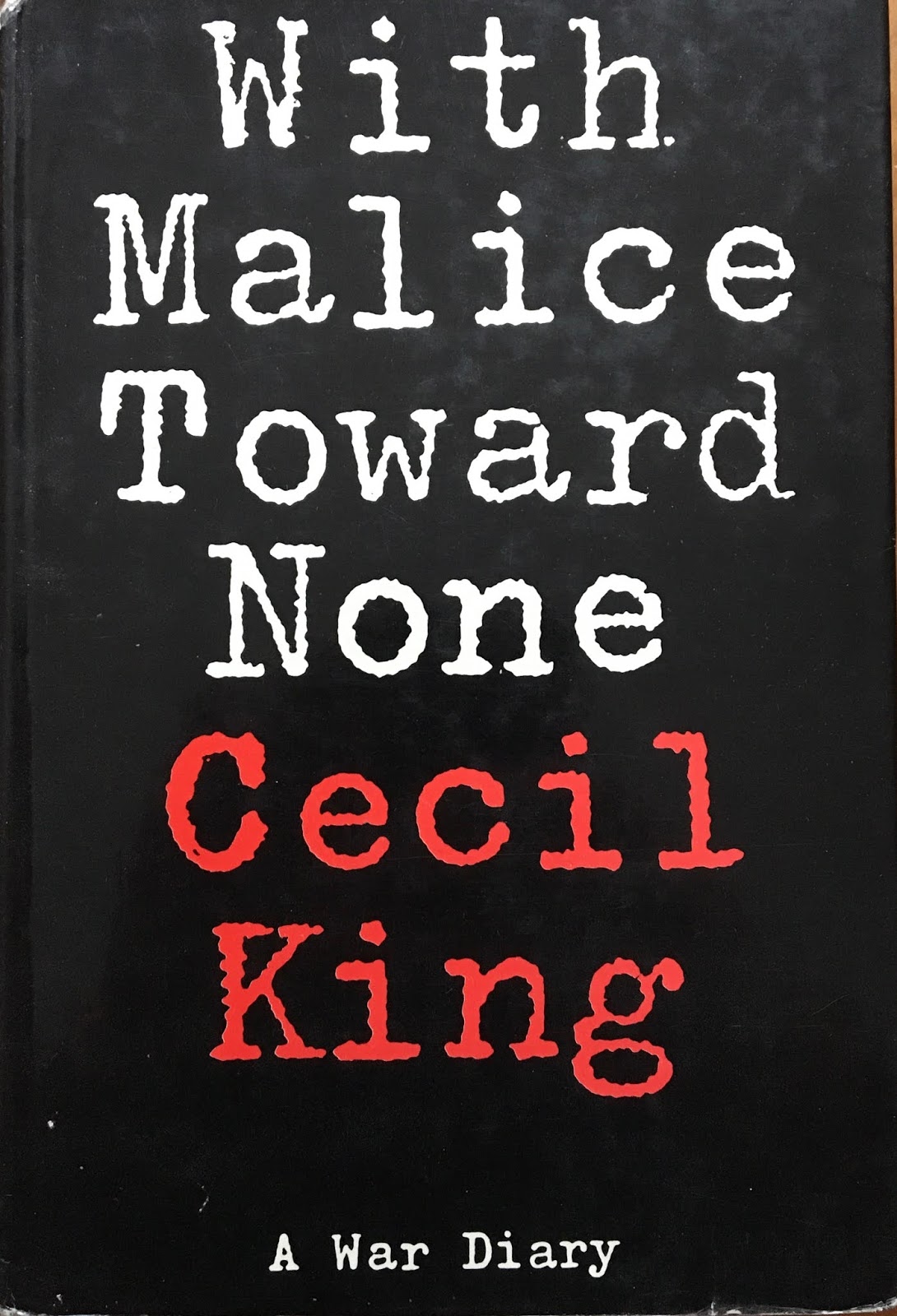
With Malice Toward None (author's photo)

Another work which contains an excellent account of the events of 10/11 May 1941, mainly in and around Fleet Street, is 'With Malice Toward None', written by Cecil King and published in 1970. The Fleet Street connection immediately falls into place when one understands that King was the proprietor of the Daily Mirror and Sunday Pictorial newspapers and the book is written in the journalistic style that would be expected of the author.

Westminster in War (author's photo)

William Sansom was an author and travel writer in peacetime but during the Blitz, was a member of the Auxiliary Fire Service and so his book, 'Westminster in War' published in 1947, must have contained at least some of his own personal experiences. Once again, it has proved an invaluable source of reference over the years and has often accompanied me on my travels around the streets of the present-day City of Westminster. I was lucky enough to pick up this copy, signed by the author, for the princely sum of £5, from a Chelsea antiquarian bookshop some years ago.

Bomber Command War Diaries (author's photo)

Apart from guiding walks, another important source of my income these days is researching family history enquiries, often from the descendants of Allied airmen. This usually entails at least one visit to the National Archives at Kew to examine operational record books from the relevant squadrons but for those who served with RAF Bomber Command, a useful first point of reference can be to check out 'The Bomber Command War Diaries; An Operational Reference Book 1939 - 1945' compiled by Martin Middlebrook and Chris Everitt, which was first published in 1985. Putting this work together must have required many visits indeed to the then Public Records Office to go through the various squadron records and RAF archives. Obviously, this book doesn't provide a squadron-by-squadron guide as to who bombed where and when but it does provide details of every single operation mounted throughout the war by Bomber Command on a daily (or nightly) basis. From this information and from the service histories of the individual airmen, it can then usually be ascertained from a follow-up visit to Kew, exactly how many missions a particular airman flew, to which targets and even in which individual aircraft.

The Blitz (author's photo)

Bomber's Moon title paper (author's photo)

Returning to the Blitz, two of my earliest second-hand purchases remain amongst my most prized possessions, partially because of the illustrations contained therein. These are 'The Blitz' by Constantine FitzGibbon, published in 1957 and 'Bomber's Moon' by the journalist James Negley Farson. These wonderful books contain illustrations by no less than Henry Moore in FitzGibbon's book and some beautiful, evocative pencil drawings by Tom Purvis in 'Bomber's Moon'. The book is themed on Purvis and Farson's travels through London in the Blitz, including various nights spent in air raid shelters and a trip down river to Greenwich. One of the drawings relating to the Thames trip is shown below - 'Old Ron' the Billingsgate Fish Market porter - '45 years in the market' and one of those London faces instantly recognisable to one who grew up in the capital when it was a working city, rather than the somewhat bland place that it has increasingly become.

'Old Ron' the Billingsgate Porter by Tom Purvis (author's collection)

Both Negley Farson and Constantine FitzGibbon were Americans, although both spent much of their time on this side of the Atlantic and indeed, in FitzGibbon's case, served in the British Army until 1942, when he was commissioned into the US Army. The American contribution to the literature of London at War cannot be overstated and I am fortunate enough to possess several of them, including 'Ernie Pyle in England' a 1941 work by the eponymous author, 'I Saw England', another 1941 publication, this time by Ben Robertson, 'A London Diary', also from 1941, written by Quentin Reynolds and finally 'Hell Came to London', a 1940 work by Basil Woon which concentrates on the author's experiences of two weeks living in London starting on 7 September 1940, the first day of the Blitz, which became known to Londoners as 'Black Saturday'. Woon's personal accounts have been much-quoted by other authors and still make remarkable reading to this day.

Title paper from 'Hell Came to London' (author's photo)

It is fair to say that all of the books mentioned above and indeed all of those that you see in the 'shelfies' shown at the beginning of this article, are much-loved by me and have become very much part of the furniture here at Blitzwalker Towers, whether they be old or new publications. I couldn't possibly write about all of them here but will perhaps return to the subject in the future and look at some of the other subjects covered in my library.

All of the photographs used to illustrate this piece are copyright to the author and may not be reproduced without my express written permission.


Books referred to in this piece:

The Blitz - Constantine FitzGibbon, with illustrations by Henry Moore, published in 1957 by MacDonald.
The Bomber Command War Diaries: An Operational Reference Book 1939-1945 - Martin Middlebrook & Chris Everitt, published (paperback) in 2014 by Pen & Sword.
Bomber's Moon - Negley Farson, with illustrations by Tom Purvis, published in 1941 by Victor Gollancz.
The City That Wouldn't Die - Richard Collier, published in 1959 by Collins.
Ernie Pyle in England - Ernie Pyle, published in 1941 by Barnes & Noble.
Hell Came to London - Basil Woon, published in 1940 by Peter Davies.
I Saw England - Ben Robertson, published in 1941 by Jarrolds Limited.
The London County Council Bomb Damage Maps 1939-1945 - editor Lawrence Ward, published in 2015 by Thames & Hudson.
A London Diary - Quentin Reynolds, published in 1941 by Random House.
The Lost Treasures of London - William Kent, published in 1947 by Phoenix House.
Westminster in War - William Sansom, published in 1947 by Faber & Faber.
With Malice Toward None - Cecil King, published in 1970 by Sidgwick & Jackson.