Friday, 17 June 2016

The Cap Arcona - A very private tragedy

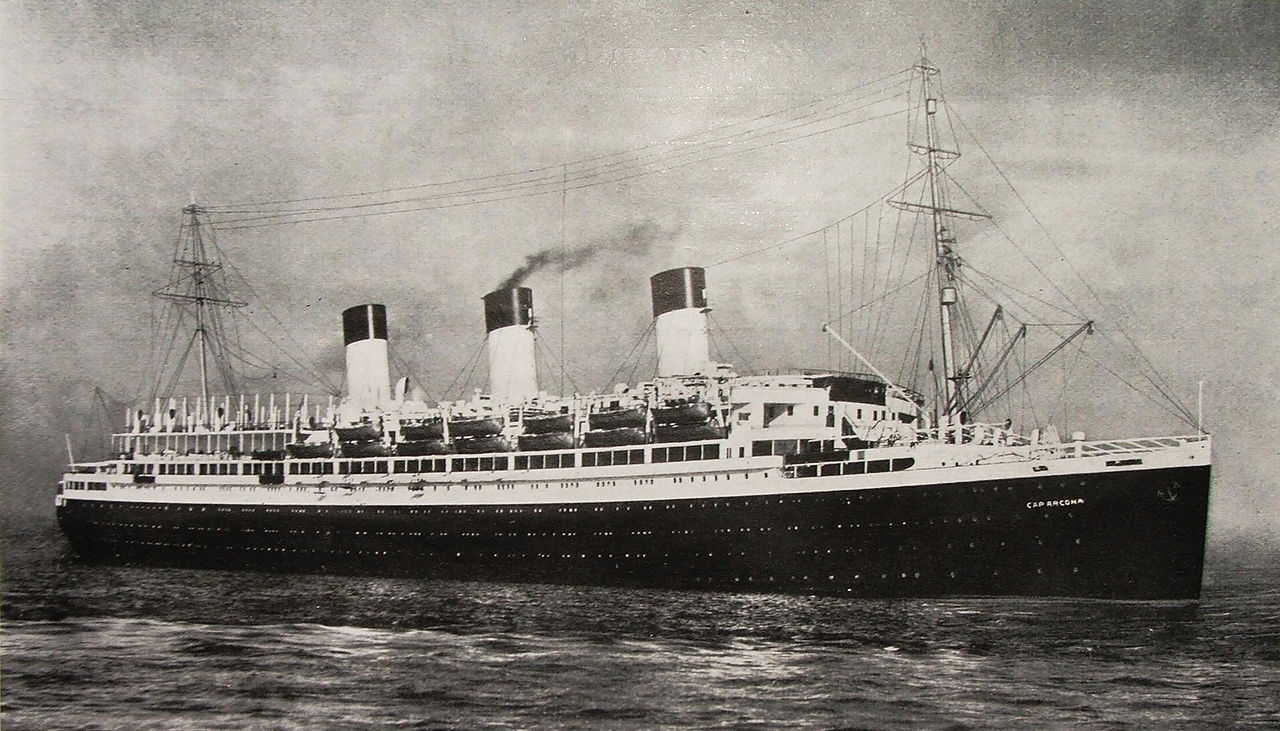
ss Cap Arcona - (postcard view - author's collection)

Over the years, apart from the Blitz, this blog has looked at many other aspects of Second World War including some of the many tragic occurrences during the War at Sea that inevitably involved civilians or other innocent parties. These events included the loss of Italian prisoners of war aboard the Arandora Star which we looked at in July 2010, soldiers of the British Expeditionary Force and other refugees aboard the Lancastria which was covered in May 2011 as well as the loss of the Athenia carrying Americans attempting to escape the outbreak of war in Europe. 

All of these tragedies have involved British vessels which were sunk by German forces and which with the exception of the 'own goal' involving the Arandora Star and her 'cargo' of Italian POWs, all of the victims were either British, Allied or in the case of the Athenia, neutral citizens as the Americans were at that very early stage of the war. 

It is often overlooked that German ships carrying evacuees of that country, both military and civilian were sunk, with massive loss of life during the latter days of the war. One such vessel, the Wilhem Gustloff  was sunk by a Soviet submarine in January 1945 and holds the melancholy record of being the greatest maritime disaster in history, with deaths estimated at over 9,300, including some 5,000 children. This story is about to be recounted by the renowned author Roger Moorhouse in a forthcoming book and will be reviewed here in due course. There was another disaster, a very private tragedy which has been frequently overlooked, which occurred right at the very end of the war in Europe on 3rd May 1945 and which involved the most hapless and helpless of all possible victims - concentration camp prisoners from Neuengamme.

Before the war, the steamship Cap Arcona had been known as the 'Queen of the South Atlantic' and was the largest and fastest vessel of the Hamburg South America Line's service between Hamburg, Buenos Aires and other ports on the eastern coast of South America. Entering service in 1927 and built at the famous Blohm + Voss shipyard in Hamburg, she could carry 1,315 passengers, including 575 in First Class, whose passengers enjoyed excellent cuisine, comfortable accomodation and amenities such as a full sized tennis court.

In 1940, the Cap Arcona was requisitioned by the Kriegsmarine and sent to Gotenhafen, the Nazis name for Gdynia in occupied Poland, where she was used as an accomodation ship. In 1942, she was used as an enormous film prop in a Nazi production about the sinking of the Titanic. In 1945, she was used as part of Operation Hannibal, the evacuation of German military personnel and civilians from East Prussia, which was being steadily overrun by the advancing Soviets. This was the same operation that claimed the Wilhelm Gustloff mentioned above. The Cap Arcona was able to evacuate almost 26,000 people to the relative safety of Hamburg and occupied Denmark in several voyages. These voyages were fraught with danger and apart from the Gustloff, over 150 other vessels fell prey to Soviet submarines and other naval craft. So stressful were the conditions that on 20 February 1945, Johannes Gertz, the Captain of the Cap Arcona, shot himself in his cabin rather than face another such voyage. By the end of March 1945, the old liner had made her final voyage to Copenhagen. She was worn out and could not be made properly seaworthy other than by a complete refit, which was impossible in the conditions prevailing in a Third Reich which by this time was in it's death throes.

A Neuengamme inmate being used for 'Bomb Disposal' work in Hamburg - August 1943 (Mahnmal St Nikolai)

There was however, one final, shameful, mission in store for the battered old liner - the evacuation of prisoners from Neuengamme Concentration Camp, near Hamburg. Established in 1938, Neuengamme was estimated to have held a total of some 106,000 prisoners during it's existence, of whom about half were estimated to have perished. By the end of 1944, the number of prisoners was estimated at around 49,000 with about 12,000 at Neuengamme itself, with the remainder held at subsidiary camps in the surrounding area. The British had already discovered and liberated Belsen Concentration Camp and had made public the worst excesses of the Nazi regime. Heinrich Himmler, Reichsfuhrer SS, and the man ultimately responsible for these camps, still harboured delusions of being able to cut a separate deal with the British and Americans with himself as head of state of a Germany that would soon be fighting the Russians alongside the Western Allies. Such was his delusion, he was determined that no further camps would fall into the hands of the British or Americans and that all inmates would either be evacuated into Sweden, through the White Bus scheme, brokered by the Swedish Red Cross, or quietly placed aboard vessels such as the Cap Arcona, where they were placed below decks with the eventual intention of moving them to a new camp in Norway. The White Bus operation had initially been aimed solely at Scandinavian inmates and although quickly expanded to include other nationalities, the majority of those imprisoned aboard the Cap Arcona were Poles, Latvians and other Eastern Europeans.

Whilst Himmler in Berlin had given the order to remove the remaining inmates, the actual execution of the plan fell to others. Karl Kaufmann was the Nazi Gauleiter for Hamburg and it was he that came up with the idea to move the inmates to the Cap Arcona and three other vessels that were anchored and empty in Lubeck Bay. He felt that these vessels would be ideal for the task and perhaps he felt that they could be quietly sunk, with their human cargo onboard and thus removing any evidence to the soon to be arriving British.

It was 26 April 1945 when the first batch of prisoners were brought on board Cap Arcona but unlike the vessel's pre-war passengers who were given only the finest service, these poor unfortunates were herded deeper and deeper into the ship's holds, which never having been designed for this function, were cold, damp and unsanitary. The SS guards took great care to remove all life belts, rafts and anything else that could aid a drowning person. It was the same story aboard the other vessels and although various rumours filtered amongst the prisoners that they were being embarked as a prelude to evacuation to neutral Sweden, something which Gauleiter Kaufmann himself declared after the war at his War Crimes trial, the fact that none of the ships had been declared to the Red Cross, or had been given appropriate markings, it is hard to believe that this was a credible option. It becomes even less believable when one remembers the condition of the Cap Arcona and the other vessels as being barely seaworthy.

On 1 May 1945, the vessels anchored in Lubeck Bay had caught the attention of the RAF when the pilot of a Hawker Typhoon of 83 Group reported that an evacuation fleet was gathering off Lubeck. As the ships hadn't been declared to the Red Cross, the answer to the RAF Intelligence officers was simple - the British Army were closing in and the Germans were seeking to evacuate to Norway in order to continue the fight. The seeds of tragedy had been sewn.

On 2 May 1945, the British reached Lubeck and discovered the now empty Concentration Camp at Neuengamme. Because Lubeck had been used as an evacuation port, it contained an office of the International Committee of the Red Cross and the representative here, Mr De Blonay, informed Major General 'Pip' Roberts of 11th Armoured Division of his understanding that between 7,000 and 8,000 prisoners were detained on board the ships anchored in Lubeck Bay.

On board those ships, hopes amongst the prisoners began to rise; earlier on 2 May, the final prisoners were brought on board by barge, this time from another camp near Danzig and although many of them had died on the voyage due to the appalling conditions on the barges, the survivors were brought on board the Cap Arcona, which now had over 4,500 crammed inside her holds. Captain Bertram, the ship's captain refused to take any more prisoners and vehemently informed the SS Guards as much. Whilst these final prisoners were being loaded, firing could be heard ashore and the SS Guards, were becoming jumpy and visibly scared as perhaps their thoughts turned to what might happen to them once their human cargo was discovered by the advancing British soldiers.

Despite the fact the Major General Roberts had been made aware of the possibility of prisoners being aboard the ships in Lubeck Bay, the war was now moving too fast for information to filter through and RAF operations against shipping in the Baltic had gathered their own momentum and as far as the pilots of 83 Group were concerned, the ships contained elements of the hated SS or important Nazis fleeing either to the new seat of government in Flensburg or trying to escape to neutral Sweden.

Monument to Cap Arcona victims at Neustadt (Waterproof947)

So it was on the morning of 3 May 1945, Typhoons of 184, 193, 197, 198 and 263 Squadrons dived in to attack the assembled fleet. Each of the renowned ground attack fighters carried four 20 mm cannon and either two 500 lb bombs or eight 60 lb unguided rockets. As the attack began, the SS guards began to abandon ship, unlocking the life preservers that they had saved for themselves and jumping over the side. Some prisoners managed to get themselves on deck and one, Erwin Geschonneck, a German political prisoner, witnessed a man armed with a machette, flailing his way through the crowd and cutting down anyone who impeded him; this was Captain Bertram, who together with his crew and officers, were amongst the first over the side. Geschonneck also witnessed one SS man, armed with two revolvers, firing off his guns until the ammunition was spent, at which point he was overrun and trampled to death by his former prisoners, more and more of whom had managed to break out of the holds and reach the deck.

By now the Cap Arcona was ablaze and those who could not reach the deck and were trapped below were consumed by the flames in appalling scenes. Many of those in the sea fared little better; a small fleet of rescue boats approached the burning ships but any prisoners hoping for rescue were invariably shot as the boats were being sent to rescue SS guards and crewmembers only. Fortunately, some managed to get themselves picked up, whilst others struggled ashore, where they were 'greeted' by German sailors, some of whom were as young as 16 years of age. Fortunately, these sailors looked after the survivors and later that same day, they were liberated by the British.

The few that made it ashore were in a very lucky minority. Of some 8,500 prisoners on board the Cap Arcona, Deutschland and Thielbek, at least 7,500 perished, although the actual number will never be known. It is thought that some thirty nationalities were on board the prison ships and as well as men, women and children from all of the Nazi occupied countries, there were also victims from American, Britain and Canada, as well as Swiss, Spanish and Italians. Victims were washed ashore for weeks after the attacks and are today buried in mass graves at Neustadt, Scharbeutz and Timmerdorfer Strand. Human remains were still being washed up as recently as 1971.

Even 71 years after the end of the war, which came just days after the "Shipping Strike" attack, this remains a little known tragedy, the result of a genuine mistake casued by the fog of war at the end of the European conflict.


Published Sources:

Monty's Greatest Victory: The Drive for the Baltic April-May 1945, Charles Whiting, Pen & Sword 2002

Unpublished Sources:

197 Squadron Operations Record Book - National Archives Kew AIR 27/1169/53


Monday, 9 May 2016

Book Review: The Silent Deep - The Royal Navy Submarine Service since 1945

The Silent Deep (Author's image)

As regular readers know by now, this blog is usually strictly devoted to events during the wartime years of 1939-45, so this particular article is going to break new ground as it deals with much more recent history including the Cold War and the Falklands Conflict amongst others. I've decided to break with precedent as the book in question is such an important and interesting piece of work about a group of men for whom I have the utmost respect and admiration - the men of the Royal Navy Submarine Service, or RNSS to use one of the many acronyms that appear in the book.

The Submarine Service is traditionally known as "The Silent Service", such is it's aversion to self-publicity. Indeed to this day, the standard response to any questions made through official channels is that "The Ministry of Defence does not comment upon submarine operations."

Peter Hennessy, one of our most respected historians and James Jinks, also an accomplished historian and former PhD student under Hennessy, have compiled an authoritative and well-reserched history of the post-war Submarine Service, in which they not only examine the men who commanded and manned the submarines but also look at the vessels themselves, the rationale behind the various policy decisions such as the procurement of Polaris and Trident, as well as describing in compelling detail some of the Cold War exploits of the submarines and submariners, as well as the actions of the RNSS during the Falklands War, thus far and hopefully, the only time that a nuclear submarine has fired torpedoes in anger against an enemy maritime target.

The book opens with a description of the 'Perisher' , or as it is correctly described, the Submarine Command Course, a five month ordeal held twice yearly through which any potential Royal Navy submarine commander must pass. It is designed to replicate the relentless pressures piled upon a submarine captain and failure to pass the course means that the candidate's career aboard submarines is over. He will never again set foot aboard a Royal Navy submarine. Faced with the ruthlessness of the course, it is no surprise that the Navy's submarine captains are universally recognised as being the best in the business. The authors describe some of the goings on aboard HMS Tireless during the 'Private War' which forms part of the course and during which the aspiring commanders are put through their paces.

The course is so well respected that allied navies, including the US Navy frequently send their own top commanders to take part and indeed the late Tom Clancy, author of The Hunt for Red October once wrote that Royal Navy submarine commanders are feared, even by the US Navy. He explained thus:

"Note that I use the word 'fear.' Not just respect. Not just awe. But real fear at what a British submarine, with one of their superbly qualified captains at the helm, might be capable of doing."

From an American, praise indeed but as the authors explain in this book, it was another American, Admiral Hyman Rickover, who was largely responsible for the Royal Navy going along the nuclear submarine route in the first place.

In the years immediately following 1945, the Royal Navy made do with it's fleet of wartime submarines, the diesel powered 'T' and 'A' Class boats (submarines are always 'boats' within the Navy) and these old warriors, such as HMS Totem found themselves being modernised by a cash-starved Navy and adapted for Cold War intelligence gathering missions, including early forays into the Barents Sea and beneath the Artic ice, operations which pushed these boats and the crews to the very limit. These diesel powered boats were known as SSKs (Submarine Killers) as apart from their intelligence gathering duties, their wartime mission would be to shadow and 'take out' Soviet submarines. It was soon clear though that these ageing boats would be no match for the newer and faster Soviet nuclear submarines and that an alternatives method of propulsion was needed, as well as developing a new class of diesel powered submarines, the Porpoise Class, which began to appear in the mid 1950s.

At first the Navy demurred from taking the nuclear powered route, partially on grounds of cost and partly because of worries about the UK's capability of producing sufficent fissile materials to power submarines and meet the country's weapons requirements. Instead, the Ministry of Defence at first explored the possibility of using Hydrogen Peroxide, or HTP as a means of propulsion. This method was being actively explored by the Germans at the end of the war and indeed a captured U-Boat, renamed HMS Meteorite was used for tests. This was followed by two experimental submarines HMSs Explorer and Excalibur, which given the fearsome reputation for the highly unstable and extremely dangerous propellant, were quickly given the nicknames Exploder and Excruciator. The Navy's HTP experiment came to an abrupt end when an HTP powered torpedo aboard the submarine HMS Sidon exploded on 16 June 1955, causing the loss of the submarine as well as the deaths of twelve men as the boat sank in Portland Harbour.

Detail on the Royal Navy Submarine Memorial (Author's photo)

Following this disaster, the Royal Navy turned to their American allies for help in producing their own nuclear powered submarines, or SSNs to use another of the many acronyms in the book. Admiral Hyman Rickover was known as the 'Father of the Nuclear Submarine' and it was indeed largely down to his remarkable drive and single mindedness that the US navy had gotten the USS Nautilus into service in 1955, the same year that the Royal Navy finally abandoned their ill-fated HTP project. Rickover was rude, arrogant and an extremely unpleasant man to deal with but one who recognised the importance of encouraging the Royal Navy to join the 'Nuclear Club' and thus provided every assistance to them in achieving this aim, albeit sometimes a seemingly grudging assistance. However, he did form a close relationship with Lord Louis Mountbatten, at that point First Sea Lord, the professional head of the Royal Navy. 

Rickover agreed to supply the British with an American reactor for the first Royal Navy submarine, named HMS Dreadnought, in order to give British industry a chance to catch up and perfect techniques of manufacture for their own reactor, which would go to sea in the second British SSN, HMS Valiant. Dreadnought, a hybrid British and American design with a 'British' fore end and an 'American' aft end, which contained the reactor, entered service in 1963. Despite some quirks, including a 'Checkpoint Charlie' sign that provided the demarcation point between British and American methods of working in the boat's two halves, Dreadnought proved to be a success and a quantum jump over any previous British submarine. Her appearance began a slow but steady stream of British SSNs coming into service which were able to take over the task of shadowing Soviet submarines and intelligence gathering, invariably in the Soviets' own backyard, the Barents Sea and Arctic Circle.

The book then concentrates on the Nuclear Deterrent, the acquisition of Polaris and the transfer of the UK's independent deterrent from the RAF to a new class of ballistic submarine, or SSBN and the establishment of what has been a continuous series of patrols beginning with that of HMS Resolution in 1968, which continues to this day with the Vanguard class and which is likely to continue into the 2050s with the so-called and as yet un-named Successor class boats (even a 17,500 tonne 'bomber' submarine is called a 'boat' in the Royal Navy!)

The authors tell of an amusing story describing the uncertaintly as to whether the incoming Labour government in 1964 would continue with the programme and a contingency design to convert the as yet unbuilt SSBNs into SSNs by using as much of the already procured materials as possible, thus averting waste. The nickname for this hastily redesigned submarine (and one which was never revealed to the new Prime Minister) was HMS Harold Wilson but it was a vessel which never sailed as the new government, largely driven by then Defence Secretary Denis Healey, decided to continue with the programme, albeit reduced from five boats to four, the minimum number that could safely constitute a continuous at sea deterrent.

The book continues to describe the design and entry into service of the next class of SSN, the Swiftsure class, followed by the Trafalgar class before going on to describe in some detail the submarine operations around the Falkland Islands in 1982, which culminated in the sinking of the Argentinian cruiser General Belgrano and the ultimately unsuccessful attempts to locate and sink the aircraft carrier 25 de Mayo.

The authors go on to describe subsequent submarine operations following the end of the Cold War, including actions against Libya, Afghanistan and both Gulf Wars before covering the latest class of SSN to enter service, the Astute class and gives some useful insight into the Successor SSBN programme.

The book closes where it began, aboard HMS Tireless and provides a quite moving description of the decommissioning ceremony of one of the Royal Navy's Cold War warriors and tells us something of the difficulties in disposing of nuclear submarines that have been taken out of service.

This volume is a truly magisterial piece of work and the casual reader should not be put off by what at first glance may appear to be a mass of diagrams, acronyms and naval jargon, for this book contains a great deal more than that and indeed a great deal more than my brief descriptions shown above. It tells the stories of the reasons behind the decision making, the ships and most importantly of the men - the submariners themselves. Truly a breed apart and a group of men to whom we should be profoundly grateful for helping to keep us safe over the past seventy years or so. I thoroughly commend this book to you.

The Silent Deep: The Royal Navy Submarine Service since 1945 is written by Peter Hennessy & James Jinks and is published by Allen Lane in hardback at a price of £30.00


Monday, 18 April 2016

Richard Hannaway, Bill Watson and the unknown Baby - a story of The London Blitz

The Daily Mirror headline from 9th September 1940 (Kay Evison)

One of the more gratifying aspects of writing this blog is receiving feedback from around the globe and learning about hitherto unknown or forgotten aspects of the Blitz and the Second World War from relatives of the people involved. In the past, I have heard from readers in the USA, Australia, South Africa and Canada, as well of course, from closer to home here in the United Kingdom.

The latest correspondence came via our Facebook page and was from Kay Evison in New Zealand and read as follows:

"Hi there I am new to this group and I am doing some research on my grandfather who was an ARP hero during the Blitz.

I now know my grandfather lived in 34 Pigott Street, Limehouse, for about 5 year from 1936 until 1940 and was an Air Raid Warden. His name was William Watson (which wasn't his real name) and he was in his 40's when she first met him. My grandmother would have been about 19 at
the time she first met him, ironically he deserted her before she had her baby in 1935 (my father, he was adopted by his grandmother in Bristol.) My grandmother then went on to work as a short hand typist at the Lewisham NAAFI to help support her family. I have for some time now been trying to find out more about my grandfather as this was the biggest family secret ever and anyone who knew anything has now passed on. I would like to find out his nationality and date of birth to further my research, I couldn't find him on the 1939 register although I found details of him on the Electoral rolls. (I have located the relatives of the boy Richard Hannaway in the story and the attached newspaper clipping has been passed onto his relatives (he died in 2012) and hope to hear more from them. His family lived in 33 Pigott Street.

I would love to hear from anyone who recognises which street the birth occurred in as I would love to find the child of the lady in the cutting but she was only recorded as Mrs R Foster. Her husband was also an ARP Warden."


The newspaper cutting from the Daily Mirror is reproduced above, courtesy of Kay and the story makes remarkable reading. Given the date of the cutting, 9th September 1940, one can easily surmise that the incident took place on the night of 'Black Saturday' 7th September 1940 - the first night of the London Blitz, when the East End bore the brunt of the bombing which killed 448 Londoners and left large areas of East and Southeast London in ruins.

Rose (we are not certain of her first name) Foster was heavily pregnant and in bed when the raid started. She was waiting for an ambulance to take her to hospital but the raid developed and she found herself stranded in bed about to give birth. One of the puzzles from this story is exactly where was she located? 

The location of the horse trough circled - Pigott Street runs to top right of the map (Mick Lemmerman)

There is someone by the name of R Foster mentioned on the Electoral Register but she was located a tidy distance away in Milward Street, close to the London Hospital. We know that Richard Hannaway, the little boy mentioned in the article, lived at 33 Pigott Street, opposite Bill Watson at number 34 and was bringing water from a nearby horse trough in order to wash the baby.

The location of the horse trough was located courtesy of a brilliant piece of local detective work by another follower of the blog, the author  and Isle of Dogs historian Mick Lemmerman, two of whose books on the Blitz have been reviewed here in October 2015 and February of this year. Mick worked out the location of the horse trough as being in the middle of Commercial Road at the junction with West India Dock Road as he recognized the public loos seen in the photograph!

From that piece of deduction, we now know that young Richard had run to the end of Pigott Street to the horse trough in Commercial Road; a relatively short distance but considering the fact that bombs would have been falling and shrapnel flying through the air, this was an incredibly brave act for anyone under fire, let alone a thirteen year old boy.

The extract from the Daily Mirror tells us that despite "never having done anything like this before" Bill brought the baby girl safely into the world and that she and her mother were both doing fine.

The article also mentions a bomb falling about eighty yards from the house which actually blew off the roof. A check of the LCC Bomb Map for Pigott Street reveals that it suffered from what looks like at least one direct hit and that several properties were destroyed as well as more that were seriously damaged. Amongst those properties seriously damaged was Richard Hannaway's house at number 33 (immediately to the right of the church in Pigott Street) as was Bill Watson's house directly opposite. Could it be that Rose Foster was visiting or living with Richard's parents when she went into labour?

The Bomb Damage Map for Pigott Street (Author's image)

It sort of adds up - perhaps Richard Hannaway was sent out by his Mum to get water to boil for the soon to be born baby and encountered his neighbour 'Uncle Bill' Watson and enlisted his help. Sadly, Richard passed away in 2012 and so far, Kay has been unable to trace the family of Rose Foster or to ascertain whether the baby is still alive, which given that she would now be 75, is quite possible.

Kay is also anxious to learn more about her Grandfather Bill Watson, who appears to have had something of a mysterious past. As can be seen from Kay's original communication, William Watson wasn't his real name and his nationality was also something of a mystery, although he was obviously an accepted part of his local community, being known as 'Uncle Bill' to all the local children.

Hopefully, one of our many readers around the world can throw some more light on this puzzle - it would be wonderful if a member of the Foster family could read this, or perhaps someone who knew or was related to Bill Watson. The power of the internet is remarkable, so we live in hope!

I am indebted to Kay Evison for contacting me and also to Mick Lemmerman for his local knowledge and insights into the area's social history.


Thursday, 18 February 2016

The Tide of Change

Enderby's Wharf 1946 (Dave Wood @liverpoolimages)

Whilst browsing through Twitter the other evening, I came across a photo posted by Dave Wood of the Greenwich Riverside in 1946. More precisely, the photo features the old Telcon Works at Enderby's Wharf, which is nowadays the proposed site of a Cruise Ship Terminal, which would have been unimaginable in those days when London was a working, industrial city. It shows a glimpse of a busier and more industrialised Thames than we are now accustomed to as well as a fascinating panorama of part of the Greenwich Peninsula in the immediate post-war era, when the scars of the Blitz were fresh, both on the ground and no doubt in the memories of those who had experienced it first-hand.

The Telcon Works runs vertically almost along the dead centre of the photograph but a closer look at the image reveals bomb damage in the form of large gaps in the terraced housing, freshly repaired roofs and even from the air, the look of general decay, as well as large areas which were soon to fall under the demolition ball for industrial use and later for the construction of the A012 Blackwall Tunnel Southern Approach.

The excellent Greenwich Heritage Centre has the LCC Bomb Damage Maps for the area and checking the 1946 photo against the relevant map, we can see that it is quite easy to match up the damage on the map with many of the scars on the photo.

The corresponding portion of the Bomb Damage Map (author's image from original held at Greenwich Heritage Centre)

The road running diagonally across the top left hand corner of the photograph is Tunnel Avenue and whilst this road is still largely extant, much of it has been swallowed and overshadowed by the A102. The houses at the top of the map are shaded in orange, which according to the colour coding system in use for them, indicates that the damage incurred was "General Blast Damage - Not Structural" and which would have been relatively easy to repair. Looking at the Civil Defence Incident Logs for the area, it is difficult to ascertain exactly when this damage occurred, given the frequency of the attacks on this part of Greenwich but given the fact that there is a large circle indicating a V-1 Flying Bomb hit, with the smaller circle of a V-2 nearby, it is possible that this was the blast from one, or both, of these weapons. The V-1 involved was the very first one to fall on the borough, indeed one of the first to fall on London - on 16th June 1944, whereas the V-2 concerned was the penultimate rocket to fall on Greenwich, on 9th March 1945, just two months before the end of the war in Europe. No casualties were reported for either incident, falling as they did on largely open ground.

The only other V-1 affecting the area shown in the photograph fell at the extreme bottom left hand corner of the image and was a far more serious affair. This occurred at 19:40 on 29th July 1944 and was reported as falling on the 'Towpath' near the 'Sea Witch' Public House in Morden Wharf Road. This resulted in two fatal casualties, 18 year old Ernest Tinton of Grenada Road, Charlton and Walter Saveall, 39 from nearby Azof Street. Interestingly, the Commonwealth War Graves Commission report Saveall as being a member of the Home Guard but it is unclear whether or not he was on duty at the time of his death. Nine others were sufficiently badly injured to be taken to St Alfege's Hospital. The area was, as could be expected, devastated by the blast and as well as the human casualties, the 'Sea Witch' pub, was lost forever. Local Historian Mary Mills wrote about the pub in her excellent Greenwich Peninsula History blog in 2013 and as she points out, had the pub survived, it would doubtless nowadays be enjoying a new lease of life given the prime location it once occupied.

The two roads running parallel to the Telcon Works are Mauritius Road and Azof Street. Nearly every property in these two roads seems to have been affected in some way. Most of the damage is marked in yellow, which means "Blast Damage - Minor in Nature", although there are some buildings shaded in light red indicating "Seriously Damaged - Repairable at Cost." The buildings do appear to be still standing in the 1946 photograph but it is difficult to see what sort of condition they are in, although in 2016, there are newer properties at this location on the map. In common with the entire locality, the area received the attention of the Luftwaffe on a regular basis during the Blitz, doubtless because of its proximity to the various industries strung out along the Thames. Most notably, the area attracted a large number of Incendiary Bombs during September and October 1940. Most of these were efficiently dealt with by ARP Wardens, the Auxiliary Fire Service and occasionally by members of the public defending their own homes but 14 Azof Street was reported as being damaged by fire on 11th September 1940, as was 63 Mauritius Road later in the Blitz, on 19th April 1941, when one of the occupants had to be treated at hospital. By this stage of the Blitz, the area seemed to be attracting High Explosive Bombs in the vicinity and whilst no direct hits are reported, number 80 Azof Street was seriously damaged on 1st November 1940 by such a bomb and the blast from similar weapons falling nearby was no doubt responsible for the lesser damage to the other properties in these two roads.

Enderby's Wharf in 2016 (Google Maps)

The road leading off to the right of Azof Street is Bellot Street, named after Joseph Bellot, the French Arctic explorer, who perished in mysterious circumstances in 1853 whilst searching for Sir John Franklin, who had disappeared on his own expedition in search of the Northwest Passage. This road, like the eponymous explorer, is shrouded in a certain amount of mystery. A close look at the 1946 photograph clearly shows some fairly catastrophic bomb damage, with 'prefabs' or some other type of temporary buildings appearing in the gaps left by the demolished houses. The Bomb Damage Map confirms this by showing several properties shaded in black, meaning "Total Destruction" and yet on the Incident Log, Bellot Street features only once, on 14th March 1944, with the explosion of an Anti-Aircraft Shell. Such an explosion could not possibly have caused the demolition of what looks on the map like 39 properties but nothing is mentioned. This level of damage could only realistically have been caused by either a Parachute Mine, or by a V-1 or V-2 weapon. The Incident Logs are usually a pretty good indicator of when and where bombs fell but just occasionally, being written up in the heat of the moment, things can go off the rails and this seems to be a case in point. One possible answer to the mystery lies on 9th September 1940 when an Unexploded Bomb is reported in Christchurch Way which is the road running parallel and beneath Bellot Street on the map. No further mention is made of this bomb, whether it was defused, or whether it subsequently exploded. This lack of further information might suggest that an error was made in the initial entry and that the UXB was in fact, in Bellot Street and that it did indeed explode. The only other possibility was the Parachute Mine that fell in the vicinity on 29th December 1940 and is reported as 'Dyson House, Ship & Billet P.H. and 28 Commerell Street.' This spreads the net pretty widely but seeing as the majority of the fatalities emanated from Dyson House (10 from this location), it does seem unlikely that the blast affected Bellot Street whilst leaving buildings in between still standing. We shall possibly never know the answer but the former of the two theories put forward seems the most plausible.
Christchurch Way is the road running at the bottom of Mauritius Road and Azof Street and shows some fairly serious damage on the map, with a long stretch in light red "Seriously Damaged - Repairable at Cost", with similar levels of damage in adjoining Derwent Street, along with some black "Total Destruction" and an area of green indicating a "Clearance Area." As before, the damage in September and October 1940 seems to have been caused more by Incendiaries, with one report on 18th September 1940 stating that "every street in the district" was affected. It must have been a nightmarish scene for those attempting to fight the numerous fires lit by these innocuous looking but deadly bombs. A High Explosive bomb on 1st November 1940 caused serious damage at the Azof Street end of Christchurch Way, whereas a further HE on 17th September seems to be the culprit for the damage at the junction with Derwent Street. 

The roads running at the top of the 1946 photograph also suffered their fair share of damage. The thoroughfare running across the top of the Telcon Works and intersecting Tunnel Avenue is Blackwall Lane and the first road running off this immediately after the green space at Tunnel Avenue is Lenthorpe Road. There is a large empty space both in the photograph and also marked in black on the Bomb Map. This building was destroyed in the early hours of 19th September 1940 by a High Explosive bomb, which not only demolished the building but which ruptured the gas and water main supplies for the area. There was one casualty resulting from this incident but fortunately not a fatality. The next turning along is Glenister Road and it was here, on the  afternoon of 17th October 1940, that a more serious incident occurred. Another High Explosive bomb caused the destruction of numbers 27-35 Glenister Road as well as seriously damaging several others. The destruction is duly marked in black on the map as well as a large swathe of purple, indicating that these properties were "Damaged Beyond Repair." More serious was the human cost, with two fatal casualties, both of whom were children; Ronald Rose, 12 years old of 31 Glenister Road and 4 year old Ronald Finch of 19 Glenister Road. A further 14 people were seriously injured and taken to St Alfege's Hospital. Closer inspection of the 1946 photograph reveals the bomb damaged sites to have been cleared and replaced by Nissen Huts or similar temporary housing.

This part of Greenwich, in common with the rest of London, was to face many years of rebuilding war damage, so-called 'Slum Clearance', demolition due to the 1960s mania for road building and coming into the present day, more development due to that scourge of modern London - "Luxury Apartments." The Google Maps image, when compared to the 1946 photograph and the Bomb Damage Maps, show the Greenwich Peninsula vastly changed, although not perhaps totally out of all recognition to a 1940s resident who was transplanted into the area in 2016. Whether he or she would prefer the modern version has to remain a matter for conjecture!

Unpublished Sources:

Metropolitan Borough of Greenwich Civil Defence Incident Logs 1939-45 - Greenwich Heritage Centre
LCC Bomb Damage Maps for Metropolitan Borough of Greenwich - Greenwich Heritage Centre
Internet Sources:


Sunday, 7 February 2016

Book Review: Heavy Rescue Squad Work on The Isle of Dogs - Ann Regan-Atherton

Cover to the book - Bill Regan at front, extreme right (author's photo)

Christmas seems a long time ago now but during the Festive Season, several new books arrived at Blitzwalker Towers but only now am I beginning to make some headway with reading them. One excellent addition to my 'Home Front' library comes in the form of Heavy Rescue Squad Work on The Isle of Dogs: Bill Regan's Second World War Diaries, which were discovered by Bill's daughter Ann Regan-Atherton as they were on the verge of being thrown out - indeed Bill had already disposed of some pages. Being a History Graduate, Ann immediately recognised the importance of these diaries, not just as a family heirloom but as a document of wider historic value and originally transcribed them in the late 1980s. This latest version has been edited by local Island historians Con Maloney and Mick Lemmerman, whose recent book The Isle of Dogs During World War II was reviewed in an October 2015 edition of this blog.

Readers of MJ Gaskin's excellent book Blitz: The Story of 29th December 1940 will be familiar with the exploits of Bill Regan and his wife Vi, as their efforts in reaching home on the night of 'Second Great Fire of London' forms an integral part of her book.

Bill Regan was a bricklayer by trade but for the majority of the War, served in the Heavy Rescue Service, which like the majority of the various arms of the Civil Defence network, had been originally regarded by many members of the public during the 'Phoney War' period as a waste of space but with the onset of the Blitz, were now viewed as heroes by those same fickle members of the public. Bill was an intelligent man, widely read and whose inspiration for keeping a diary was Samuel Pepys, whose own journal he had borrowed from his local library. He was also a keen amateur self taught artist as well as an amateur photographer. 

This latter hobby also helps to illustrate this collection of Bill's diaries, as he took many photographs of the bomb damaged local area. This activity was strictly illegal in wartime and was punishable by up to three years in prison. It was ironic therefore, that his photos were developed by a friend who served in the Metropolitan Police!

Bill's Heavy Rescue Squad, like similar teams across the country, were trained to deal with bomb incidents where damage was serious enough to warrant using heavy lifting and excavating equipment in order to reach victims who were trapped in the debris. Like Bill, many of the Squad members were experienced in peacetime as civil engineers, carpenters and bricklayers as well as from other areas of the construction industry, where their knowledge was particularly valuable in understanding the layout and construction of buildings in order to work out the safest and quickest ways to reach trapped people. Like many others in the Civil Defence service, Bill's squad was based at a school vacated by the wartime evacuation of school children. Bill Regan's Squad was based at the former Millwall Central School in Janet Street on the Isle of Dogs.

The diary starts on 7th September 1940, 'Black Saturday' and the first day of the Blitz on London. The first 'rescue' for Bill's squad turned out to be in his own words 'a non-survivor' - an elderly man who was found still sitting in his armchair but totally embedded in rubble. Bill tells us in great detail about the work his squad undertook on that day and night as well as providing fascinating insights into the other events on the Island, such as the Anti Aircraft gun site in the area we now know as Mudchute (the remnants of which can still be seen incidentally). The Squad's subsequent rescues that day proved to be more successful, with people being evacuated alive from buried Anderson Shelters and into Rest Centres, although as Bill remarks in the diary, such was the noise "You would have to be stone deaf to rest in any kind of centre."

As well as accounts of the action during and after air raids, Bill's diary also tells of the more mundane facets of life in wartime London, such as the rare moments of leisure and time spent with his beloved wife Vi, as well as some more stressful and personal times in their relationship. There are also moments of humour such as the foul-mouthed (or beaked) parrot, discovered in a bombed out house on the Island. According to Bill, "It was well educated, and after preening itself, it gave a most wonderful recital of obscene language I have ever heard." You will have to buy the book to find out exactly what the parrot said!

Being a Greenwich boy, I was also interested to read many references to my own locality, including the damage to Greenwich Foot Tunnel, which although repaired, can still be seen to this day. Bill mentions the damage in his diary as well as the fact that during the period that the tunnel was closed, "Rowing boats from Greenwich are ferrying people across at 2 shillings (10p in today's money) a time." This seems quite a steep fee for the time and was presumably an unofficial arrangement by local opportunists.

Wartime damage repairs to Greenwich Foot Tunnel still apparent today (author's photo)

Arguably the saddest part of the diary also shows that despite becoming hardened to the worst that the Blitz could throw at him, Bill Regan's humanity remained intact in the aftermath of the bombing of Saunders Ness School, in use by the Auxiliary Fire Service and which was largely destroyed on the night of 18th September 1940 with great loss of life. It soon became clear that the majority of the work for Bill's Squad would be recovery of victims, rather than rescue and he writes with great tenderness of how he personally insisted on removing the bodies of two young AFS Firewomen who had been recovered some time after the actual incident. These two girls were quite unmarked, looking to all effects as if they were sleeping and Bill's account of how he gently removed the two girls is extremely moving. Bill later learned that the two girls were named Joan Bartlett, aged 18 and Violet Pengelly, aged 19. They had the same Christian names as his own daughters (as well as his wife, Vi) and this fact moved Bill to tears.

Memorial Plaque at Millwall Fire Station to Joan Bartlett and Violet Pengelly (author's photo)

From the violence of the First Blitz, Bill Regan's diary goes on to cover life on the Island during the relatively quiet years of 1942 and 1943 before covering the Little Blitz and the V-1 campaign of 1944. The diaries end rather abruptly in mid-August 1944 without covering the remaining part of the V-1 campaign and omitting the V-2 Rocket incidents and VE Day completely, so perhaps this is the portion of the diary that Bill had already disposed of when his daughter Ann discovered it.

Despite this minor disappointment, Ann Regan-Atherton, together with Mick Lemmerman and Con Maloney have produced a fascinating and invaluable record of life in wartime London and I highly recommend it to you. The book runs to 200 pages and is priced at a very reasonable £10.95, with all proceeds from sales being donated to the Friends of Island History Trust, which is a charitable trust run by local people who wish to preserve and record the local history of the Isle of Dogs.

Heavy Rescue Squad Work on the Isle of Dogs: Bill Regan's Second World War Diaries - Ann Regan-Atherton, editors Mick Lemmerman and Con Maloney - CreateSpace Independent Publishing Platform, 2015. ISBN 9781519610867


Wednesday, 23 December 2015

We're Doomed! Dad's Army & The Real Home Guard

John Laurie as Private Frazer (Wikipedia)
Many readers of this blog will have watched the excellent 'We're Doomed!' on BBC Television last night, which for those who missed it told the story of how David Croft and Jimmy Perry came up with the idea of Dad's Army, the long running and much loved comedy about the Home Guard in the fictional seaside resort of Walmington on Sea, established as in real life, in the dark days of World War 2 when this country faced invasion.

The programme showed the battles faced by the two writers in getting the show commissioned and aired in the face of strong opposition from senior executives at the BBC, who obviously didn't know a good thing when they saw it. The idea was originally mooted by Jimmy Perry, who had served in the Home Guard as a 17 year old awaiting his call up and upon whom some of the characteristics of Private Pike were based, such as having a fussing mother who didn't approve of the 17 year old Perry being out all night in the cold.

The BBC is now very quick to wallow in self congratulation over hit comedy shows such as Dad's Army, The Goon Show and Monty Python, as well as many more but the truth is that all of these shows faced tremendous battles by their creators and casts in the teeth of serious opposition from BBC management, who always seemed afraid to do anything original and outside their comfort zone, perhaps for fear of causing offence, rather than recognizing that they were often dealing with inspired, creative forces.

It was this fear of causing offence that provided much of the initial opposition to Dad's Army, with the then controller of BBC1, Paul Fox being openly doubtful of the whole idea of a comedy show about the Home Guard, for fear of it being seen to be making fun of people who would have willingly laid down their lives in the event of a German invasion. Fox perhaps had a point but the writers insisted that one only had to read the scripts to see that although there was much gentle humour, there was also acknowledgement that despite the occasional bumbling and pomposity, there was indeed recognition that the men of the Walmington on Sea Home Guard would have been prepared to lay down their lives had the need arisen. For example, the series one episode "The Battle of Godfrey's Cottage", finds the platoon believing that the invasion has indeed come and at one point Captain Mainwaring, thinking that the platoon would have to buy time to allow the regular Army reinforcements to arrive, states to his men "It'll probably be the end of us, but we're ready for that aren't we men?" 

On reflection, Fox was probably right to insist on one more change, this time to the opening credits. Perry and Croft had originally planned to show real life archive footage of German soldiers on the march along with refugees fleeing ahead of them. Fox thought it wrong to use archive footage in this way, himself finding it offensive and feeling that others might have similar feelings. He insisted that it be changed and the now familiar simple animation sequence showing the British retreat through France, hotly pursued by three large 'German' arrows, forming the letter 'H', was substituted instead.

The show's characters were beautifully crafted, very well cast and very much reflected the  mixture of ages and backgrounds that made up the real life Home Guard. The platoon was led by Captain George Mainwaring (pronounced Mannering), played with a mixture of pomposity and bluster by Arthur Lowe. Mainwaring was the local bank manager and had not served in the First World War, sometimes much to the disgust of the dour Scot, Private James Frazer played by John Laurie. Frazer was a Royal Navy veteran of the Battle of Jutland and was the undertaker in Walmington on Sea, which suited his sometimes gloomy and pessimistic character.

Capt Mainwaring & Warden Hodges (author's collection)

Mainwaring's second in command was his chief clerk at the bank, the diffident Sergeant Arthur Wilson, played by John Le Mesurier. Unlike Mainwaring, Wilson had served in the Great War as a Captain and had seen action at Mons, Passchendaele and Gallipoli and this, combined with the fact that Wilson had been educated at a public school, caused the snobbish Mainwaring to be resentful of his better connected sergeant. Wilson, although he privately thought Mainwaring a pompous idiot, never allowed this to upset him and he usually went about his duties in a serene manner, preferring to make suggestions such as "Would you mind awfully falling in, please?" rather than shouting orders as a sergeant would do normally.

The remainder of the platoon is made up from a mixture of veterans, such as Boer War and Great War stalwart Corporal Jack Jones the butcher, played by Clive Dunn, who was in reality much younger than the character he played. Jones was a soldier down to his boots, although his age usually caused him to be a split second behind the rest of the platoon when conducting 'drill' on parade. He often told long, rambling and ultimately pointless stories about Lord Kitchener and 'Fuzzy Wuzzies' in The Sudan and was an exponent of the use of the bayonet - "They don't like the cold steel up 'em sir!" - as well as frequently reminding people not to panic in times of crisis, even though he was invariably the first to get excited!

Another veteran (and probably the oldest) member of the platoon was Private Godfrey, played by Arnold Ridley, who was a retired shop assistant from the Army & Navy Stores and who lived with his sisters Cissy and Dolly (who was renowned for her cake making abilities.) They lived in an idyllic cottage on the edge of the town and like Frazer, Jones and Wilson, Godfrey too took part in the Great War, although as a Conscientious Objector (at first derided for being so by Frazer) he served as a stretcher bearer and indeed won the Military Medal for his bravery in tending wounded men under fire at The Somme. With this background and also in view of his relative infirmity, Godfrey was appointed as the platoon's first aider.

The younger members of the platoon were Privates Walker, played by James Beck and Pike, played by Ian Lavender. Walker is a 'spiv' or as he preferred to put it, a 'Wholesale Supplier', who later in the series managed to avoid the call up to the Army due to an allergy to corned beef. Walker was able to procure pretty much anything for a price and was also something of a ladies man, often with his girlfriend (played by Wendy Richard) in tow at social events. By contrast, Pike was a Mummy's Boy who sucked his thumb at times of crisis and who sometimes wore an enormous scarf over his uniform, much to Mainwaring's disapproval, who frequently called him a "Stupid Boy!" It was also tacitly written into the script, though never overtly mentioned, that he was Wilson's son, through the latter's 'friendship' with Pike's mother, Mavis and he usually referred to Wilson as 'Uncle Arthur' much to Wilson's embarrassment.

There was also a plethora of supporting characters, including Mainwaring's nemesis, Chief Air Raid Warden William Hodges, played by Bill Pertwee. Hodges was a somewhat course figure, given to calling Mainwaring 'Napoleon' and who was usually at loggerheads with the platoon and perpetually looking for ways to thwart them, efforts which usually ended in failure for the warden and his sidekick, Mr Yateman the Verger who was played by Edward Sinclair. The platoon was based at the Church Hall and the long suffering vicar, the Reverend Timothy Farthing, played by Frank Williams often played the role of peacemaker between Mainwaring and Hodges.

'We're Doomed' also describes how Jimmy Perry wrote to one of his childhood heroes, Bud Flanagan (played here by the great Roy Hudd) in order to ask him to perform the show's now famous theme tune "Who do you think you are kidding Mr Hitler?" Flanagan agreed to perform and in a very poignant scene, Perry is moved to tears as Flanagan sings the song perfectly in one take and before leaving the studio, remarks to Perry that the song reminded him of those he had sung during the war.

The series, like all good comedy programmes, featured a multitude of catch phrases such as "Don't Panic", "You stupid boy", "Ruddy Hooligans!" "Put that light out!" and of course, Private Frazer's very own "We're Doomed!" as well as many others that are still remembered today, no doubt as the show is still often repeated and is still funny, which is not a bad effort for a show which is 47 years old.

Despite the best efforts to stop the show, Dad's Army was first broadcast in 1968 and went on for nine series. It was also voted 13th in a survey by the British Film Institute of the 100 Greatest British Television Programmes.

Dad's Army was superbly written by people who had lived through those times and in Perry's case, who had served in the Home Guard and was acted by people who had also for the most part lived during the war and had often served in the Forces during the war. It was beautifully observed and immediately struck a chord with the British public, not only with the wartime generation but also with younger people, who perhaps recognized traits from their parents or grandparents.

Watching how Dad's Army was conceived and eventually made it to the small screen got me thinking of our own real life Home Guard and especially in my own locality of Greenwich and Woolwich. Through my various researches at the excellent Greenwich Heritage Centre, I do know a little of these men and thought it appropriate to share some of the various photographs I have unearthed.

On 14th May 1940, with the invasion of this country beginning to look imminent, the Secretary of State for War, Anthony Eden made a radio broadcast in which he announced the formation of the Local Defence Volunteers or LDV for short and appealed for volunteers to come forward. The criteria was that men had to be aged between the ages of 17 and 65, not eligible for military service and reasonably fit. There was no shortage of volunteers but there was at this time a shortage of uniforms and equipment. The bulk of the British Expeditionary Force was to be successfully evacuated from France in the ensuing weeks but apart from their rifles, the bulk of their equipment had to be destroyed and left behind. This did not dissuade the embryonic Home Guard, as they were renamed in July 1940 and training continued apace, whilst the supply of weapons gradually improved, with First World War Ross Rifles being brought out of storage as well as instruction in how to carry out guerilla warfare using Molotov Cocktails amongst other improvised weapons. Fortunately, there was never any need to put these makeshift weapons into action against German Panzers.

'R' Sector Home Guard at Southend Hall, Eltham 1942 (Greenwich Heritage Centre)


In Greenwich, the local Home Guard was the 25th County of London Battalion, based in Blackheath at Hollyhedge House and the 34th County of London (London River South) Battalion. In Woolwich, there were again two battalions, the 22nd County of London (Royal Arsenal) and the 26th County of London based at Lowood House on Shooter's Hill Golf Course.

The photograph of 'R' Sector at Eltham taken in 1942, shows a similar mixture in ages as the Dad's Army platoon and there are many proudly wearing their First World War medal ribbons, although not even Jimmy Perry and David Croft could invent the somewhat fearsome character wearing the eye patch!

The 26th County of London Battalion had originally been formed as the 19th Company, LDV and rather confusingly, kept the Roman Numerals 'XIX' as their Unit Badge even after they had adopted their new Home Guard identity. Their original commander, a Mr Shrewsbury was transferred elsewhere at a relatively early stage, although he seems to have been well regarded and was replaced by Major Arthur Dickens, who was highly thought of both as a great and tireless organiser as well as being a great gentleman. Sadly, Major Dickens, not a young man, passed away in 1943 and was replaced by Major HRJ Tobin, who saw the battalion through to the end of the war and the 'stand down' in 1944.

26th County of London Battalion in 1942 - Major Dickens front centre wearing gloves (GHC)

In addition to their anti-invasion duties, the Home Guard performed invaluable service manning guard posts and thus freeing up regular soldiers for front line duties. They also manned anti aircraft guns, which explodes the myth that they never fired a shot in anger.

With the coming of the American entry into the war and the subsequent Allied invasion of France in June 1944, the Home Guard's relevance diminished and they were 'stood down' on 3rd December 1944 but not officially disbanded until the end of that year. The 26th Battalion held a 'Stand Down' Dinner and Cabaret on the 4th December 1944 and the programme to this event survives in the Greenwich Heritage Centre. It looks to have been quite a night and no doubt many beers were sunk and many tall tales exchanged!


Stand Down Cabaret (Author's Collection)

Once the Home Guard was disbanded, each member who had served received a certificate signed by the King, which stated that the holder of the certificate had "In the years when our country was in mortal danger, given generously of his time and powers to make himself ready for her defence by force of arms and with his life if need be."

Home Guard Service Certificate (Author's collection)

The words on the certificate say it all and in it's own small way, Dad's Army does the real life men of the Home Guard and indeed the British people as a whole during the dark days of 1940, a great honour.

Unpublished Sources:

26th County of London Battalion documents - Greenwich Heritage Centre

Sunday, 29 November 2015

Book Review: The Last Big Gun

Front cover (Author's image)


Regular readers of this blog might remember that in the October 2015 edition of this blog, we broke new ground by printing some book reviews of some new additions to my library. I'm pleased to say that following a positive response that was reflected in comments received via social media and in the readership figures for the blog, I have decided to include a few more reviews in the coming weeks and months as and when new books are received.

The latest new title to arrive on my doormat is another from one of the foremost naval historians of our times, Brian Lavery, entitled The Last Big Gun: At War & At Sea with HMS Belfast and is a 352 page, full narrative 'biography' of the ship, the first such account to be written.

Since 1971, HMS Belfast has been an integral part of the London tourist scene and in the 44 years that she has been berthed in the Upper Pool of London, she has become a familiar sight to Londoners and visitors alike; in fact the imposing and purposeful looking cruiser has served in her current role for longer than she saw active service with the Royal Navy.

In this well written and lavishly illustrated book, Brian Lavery tells the story of the Royal Navy's last surviving 'big gun' cruiser from the inception of her design and building at Belfast's famous Harland & Wolff Shipyard, via her near demise just months after commissioning following massive damage caused by a German magnetic mine, her subsequent repairs that amounted to a major reconstruction at Devonport Dockyard, service on the Arctic Convoys and her part in the Battle of North Cape, in which the German battlecruiser Scharnhorst was sunk. The author then goes on to describe HMS Belfast's role at Normandy in 1944, followed by her service with the British Pacific Fleet in the immediate aftermath of the Japanese surrender.

The cruiser's post war service, which was largely in the Far East, is also well covered. These duties varied from traditional peace time 'showing the flag' duties to further active service during the so-called 'Yangtse Incident' of 1949 and during the Korean War from 1950-52, where she provided invaluable gunfire support to Allied forces. HMS Belfast's second major reconstruction from 1955-59 is also covered as are her final years of service, once again mainly as part of the Far East Fleet before her relegation to the Reserve Fleet in 1964 and what looked the inevitable ignominy of the breaker's yard, a fate shared by so many of the Royal Navy's wartime fleet.

Brian Lavery covers the rescue of the wartime cruiser in some detail and explains that whilst the British have a fine maritime tradition and an enviable array of preserved ships from the age of sail and the early days of steam, such as HMS Victory, HMS Warrior, the Mary Rose, Cutty Sark and the Great Britain, our record of preserving great warships from the more modern era, especially in comparison with the United States, is less than enviable. The saving of HMS Belfast from what looked her certain end in the scrapyard began to at least partially reverse this 'sea blindness' when it came to preserving our historic warships and we do at least now have the destroyer HMS Cavalier and submarine HMS Alliance to swell the ranks a little, although in this reviewer's opinion, it is nothing short of a national scandal that we failed to preserve for future generations at least one of our fleet of battleships at the end of the Second World War.

Of course, the history of any ship would not be complete without the stories of the crew members and this book is as much of a social history of the Royal Navy during the years of HMS Belfast's existence as that of a history of the ship herself as these two facets are intertwined very skillfully by the author. Fortunately though, the personal accounts never become the centre of attention and Brian Lavery has achieved a nice balance between these accounts and the hard facts behind the ship's various activities both in war and peacetime.

Brian Lavery has produced a very readable biography of HMS Belfast, that should appeal to both the serious naval historian and those with a more general interest in the Royal Navy and it's history alike. The book costs a very reasonable £25.00, is published by The Pool of London Press and I highly recommend it to you.

The Last Big Gun: At War & At Sea with HMS Belfast -  Brian Lavery - The Pool of London Press Ltd, 2015. ISBN 9781910860014