Showing posts with label Royal Navy. Show all posts

Monday, 22 January 2024

Book Review - "Unbroken Glory" The Great War Story of Anson Battalion, The Royal Naval Division by Dr Robert Wynn Jones


This is Dr Jones’ second foray into the world of military history and as with his first book, “Soldiers and Sportsmen All”, the subject matter has a definite family connection for the author, as his paternal grandfather, Able Seaman Francis Wynn Jones served in both the Nelson and Anson Battalions of the Royal Naval Division, spending the final eight months of the war in captivity, having been captured on 23 March 1918, during the German Spring Offensive.

The author begins by explaining the raison d’etre of the Royal Naval Division and telling us something of his paternal grandfather, who in normal life was a Post Office clerk in London, although he hailed from Llandrillo in North Wales.

The book charts the formation of the Royal Naval Division, which immediately became known to some as “Churchill’s Private Army” or perhaps worse as the “Tuppeny untrained rabble” and explains the makeup of the various battalions, all named after Royal Navy heroes of the past and how, perhaps confusingly to those on the outside, the men all retained their naval ranks, ensuring that Able Seaman, Leading Stokers and Chief Petty Officers could be found far away from their usual maritime locations!

We hear about the training process for war, something that is vividly illustrated by letters written by Rupert Brooke, himself a member of Anson and later Hood Battalions and includes a hilarious description of the latter Battalion’s Christmas celebrations in 1914 at Blandford Camp.

A wider description of the war on the Western Front follows, with interesting comparisons of the arms, equipment and organisation of the combatant nations involved, as well as a good description of how life on the Western Front would have been for the typical British soldier in the dugouts and trenches along the front line – “either frightened to death or bored to tears” – as one contemporary account succinctly put it.

The bulk of the remainder of the book is taken up with descriptions of the various actions that the Division were involved with starting with the ultimately unsuccessful attempt to defend Antwerp, followed by the Gallipoli and Salonika Campaigns, before we return to the various campaigns on the Western Front that occupied the Division for the remainder of the war, culminating in the German Spring Offensive of 1918 and the Allied “Hundred Days” Offensive that resulted in the ultimate German collapse. The author vividly describes not only the Anson Battalion’s involvement but also the battles in the wider context of the war and has drawn not only from War Diaries but also from contemporary publications and letters from those involved.

The author has visited many of the battlefields himself and as any of us who have trodden the ground can testify, has found it often to be a profoundly moving experience.

The book concludes with an extensive and comprehensive series of maps, photographs and biographical sketches of men from the Anson Battalion, as well as a chapter covering the life of the author’s paternal grandfather (or “Taid) Francis Wynn Jones. Without wishing to give away too many “spoilers”, we last heard of Wynn, as he was universally known, ending the war in captivity but before this was confirmed, he had in fact been posted as “missing” on the Flesquieres-Havrincourt Salient on 23 March 1918 and it was not until over a month later on 25 April, that word was received that he was still alive and was being held in captivity.

The author’s description of his grandfather as an elderly man, whom he regularly met during his childhood in the late 1960s, is heart-warming and ends this book on a suitably optimistic note.

As with this author's previous military history volume, this is a well-research and fascinating read which I have no hesitation in recommending to you.


Available from www.amazon.co.uk 

RRP £9.99

softback, pp 314

Wednesday, 17 October 2018

Mr Midshipman VC: The short, accident-prone life of George Drewry, Gallipoli Hero


For this month's blog post, we stay with the First World War for a review of a book with which I must confess at the outset, I had a very small hand in the research on behalf of the author, Quentin Falk. This input was minimal however, and the work under review here is very much the fruit of the author's own labours.

The author of this splendid biography of George Drewry VC is perhaps better known as a show business journalist and film critic who has written acclaimed biographies of Sir Alfred Hitchcock, Anthony Hopkins and Albert Finney amongst others and so is venturing into somewhat uncharted waters with his latest work.

As Falk himself explains, it was a family connection that first took him to Gallipoli, with a mission to find a memorial to his wife's great uncle, Major John Jocelyn Doyne Sillery, known as 'Jack', who had served with the 11th Battalion, The Manchester Regiment and was most probably killed the day after going ashore on 6 August 1915. As part of this pilgrimage, Quentin and his wife had booked a battlefield tour, guided by a mutual friend, Clive Harris and it was his tour that he first heard the story of how no fewer than twelve Victoria Crosses had been won on the first day of the invasion, including the famous 'Six before breakfast' exploits of the Lancashire Fusiliers on 'W' Beach at Cape Helles. It was on the adjacent 'V' Beach that Quentin first heard the name of George Leslie Drewry, a 20 year old Royal Naval Reservist and former Merchant Navy officer with my old company, the Peninsular & Oriental Steam Navigation Company, known universally simply as the P&O. Further research on the campaign followed and having now decided to write George Drewry's story, a further visit ensued in 2017, as well as to another of the young officer's haunts, Scapa Flow, where he would meet his premature end.

George Leslie Drewry was born in 1894 and his career as a mariner was perhaps almost predestined, for his father Thomas was a Marine Engineer, originally from Lincolnshire but who by the time of George's birth, had relocated to Forest Gate. This was due to Thomas's job as a Engineer Superintendent for P&O, based at the nearby Royal Albert Dock. George was the second youngest of four brothers and eventually, all four of Thomas Drewry's sons were to follow in his footsteps by joining the P&O in various capacities. 

George was educated at Merchant Taylors' School but by May 1909, at the age of just fourteen and a half, he was one of six apprentices taken on board the Indian Empire and joined his new ship, a three masted barque, at Liverpool's Queen's Dock. It was whilst serving on board the Indian Empire, that George's 'accident prone' tag perhaps first became apparent when he fell some 20 feet from the rigging in to the Hunter River in Newcastle, New South Wales whilst in the course of clearing an obstruction from the vessel's top-hamper. He was fished out of the river by the Second Mate and suffered an injured ankle as well as from bruises and shock but was otherwise none the worse for his ordeal.

The author goes on to describe George's early exploits on the Indian Empire, culminating in a shipwreck in 1912 close to Cape Horn, following which he and his shipmates were marooned on an island for sixteen days before rescue was forthcoming. Following George's return to home shores and still just shy of his eighteenth birthday, he became an employee of the P&O and was registered as Fifth Officer on the passenger/cargo liner Palma. By the following year, he had risen in rank to Fourth Officer and was serving on a sister vessel, the Isis. It was around this same time, Falk informs us, that Drewry enlisted as a Midshipman in the Royal Naval Reserve, which was at the time the branch of the Royal Navy for professional (i.e. Merchant Navy or retired RN) seafarers, as opposed to the Royal Naval Volunteer Reserve, which was for the so-called "weekend sailors" who had civilian occupations other than the sea.

On the outbreak of war on 3 August 1914, George was in Port Said and was called up for Naval service, along with 30,000 of his fellow officers and men. He was now a Midshipman RNR and after a short spell at HMS Egmont, a "Stone Frigate" or shore base at Malta, he was sent to his first seagoing draft, HMS Hussar, a veteran minesweeper serving in the Eastern Mediterranean.

It would not be fair on the author for me to describe in this review George's Victoria Cross winning exploits at 'V' Beach whilst serving aboard the River Clyde and so you will need to purchase a copy of the book to read about this amazing action. Suffice to say, like all those awarded the VC, George showed total disregard for his own safety, in his case trying to assist troops who were being cut down under murderous fire and despite having received a head wound early in the action.

George's Victoria Cross citation was announced in August 1915, although the wheels had been set in motion for his and the other awards almost immediately following the action. His medal was awarded on 22 November 1915 by King George V at an investiture at Buckingham Palace. His VC award was followed by the presentation of a Sword of Honour from the Imperial Merchant Service Guild in recognition of George being the first officer of the Royal Naval Reserve and the Merchant Service to win the Victoria Cross.

Following the award of the VC, Quentin goes on to describe George's subsequent career in the Royal Navy as well as something of the exploits of his brothers during their own wartime service. George, by this time promoted to Acting Sub Lieutenant, was drafted to the battleship HMS Conqueror on 28 December 1916 and whilst undoubtedly a prestigious appointment for the young officer, it would have seemed a strange life after the excitement and action aboard the Hussar and River Clyde, as the great battleship spent most of her time in the anchorage at Scapa Flow, rarely proceeding to sea in the post-Jutland days.

The promise of further action appeared on the horizon when in  early 1918, now promoted to Lieutenant, George attended an anti-submarine course at Portland, during which he received instruction in the use of hydrophones, which in those days were an integral part of the new art of submarine detection. Following completion of the course, he was appointed in command of HMT William Jackson, a naval trawler designed for minesweeping, patrol and anti-submarine work. George took command of the vessel upon her completion at the shipyard of Cochrane & Sons in Selby and saw her through her trials and working-up exercises.

Sadly, George was never to take command of his new charge in action, for on 2 August 1918, barely two days after he had brought the vessel from the successful completion of sea trials and working-up to the fleet base of Scapa Flow, he was dead, having suffered a fractured skull and broken arm when a derrick (a ship's crane) fell on him following the failure of a retaining shackle and block.

Thus ended the short, action packed but accident-prone life of Lieutenant George Drewry VC. Quentin Falk has brought him back to life in this illuminating biography that not only tells of his life but also captures something of the period in which George lived. I commend this book to you most heartily.

Mr Midshipman VC: The short, accident-prone life of George Drewry, Gallipoli Hero by Quentin Falk, is published by Pen & Sword Books Limited and is available direct from the publisher's website at the price of £15.99 or from all good booksellers or other online sources.


Monday, 24 July 2017

My thoughts on Dunkirk


As regular readers will know by now, this blog isn't usually in the business of film reviews, so please don't expect a Mark Kermode or Barry Norman style appraisal. As readers will know, I belong to the generation brought up on the classic British war films of the 1950s and 60s and have an in-built suspicion of anything made later than about 1977. In my opinion at least, many of the more recent films of the genre are pretty ordinary and I struggle to take them seriously. It's difficult for me as a military historian and guide to watch these films without forever nit-picking about the accuracy, or lack thereof concerning the uniforms, the equipment, the aircraft, the ships and so forth, at which point my long suffering friends who have been dragged along to watch the film, usually begin to lose the will to live!

However, the new Dunkirk directed by Christopher Nolan is an important work that has attracted much attention and it was because of this that I decided to go along and watch it for myself at the cinema with (hopefully) an open mind.

I still had a fair amount of trepidation and maybe even some misgivings as I entered the Barbican Centre yesterday and perhaps this was because subconsciously, I was allowing comparisons with the 1958 Ealing Studios version of Dunkirk, which starred Richard Attenborough, Bernard Lee and John Mills to prejudice my thinking and was wondering whether the new film would measure up to this British classic.

Firstly - and this doesn't give away any spoilers - the new Dunkirk cannot be compared to the 1958 film as they look at the evacuation of the British Expeditionary Force (BEF) in completely differing ways. The old film tells the story of the whole campaign and covers the fighting withdrawal through Belgium and northern France to the coast and the subsequent evacuation, as well as telling us something of the mood in Britain, of the complacency of the 'Phoney War' period and how people were shaken out of that complacency with a jolt. By contrast, Nolan's work establishes where the British and French allies are inside the opening shots of the film. They have already been defeated and pushed back inside the Dunkirk perimeter, where the armies await evacuation back to England.

The new film contains very little dialogue and is a series of three separate threads that gradually become interlinked. Firstly we follow the stories of two British soldiers, Tommy and Alex played by Fionn Whitehead and Harry Styles (who can act and does so very well) and their various attempts to get home. Next we see the evacuation through the eyes of a small boat owner, Mr Dawson who is assisted by his son Peter and a deck hand, George. Mr Dawson is a plausible character played with great authority by Mark Rylance as are his two young helpers played by Tom Glynne-Carney and Barry Keoghan. The last of the three stories shows the evacuation through the eyes of Farrier and Collins,  two Spitfire pilots played by Tom Hardy and Jack Lowden respectively. In a nice nod to British war films of an earlier era, we hear the voice of Michael Caine as the RAF Fighter Controller coming over the radios of the Spitfires. As would be expected, the Royal Navy features strongly in this film and one of the major supporting characters is Commander Bolton, played by the excellent Kenneth Branagh, who is the Naval Beachmaster in command of the evacuation through the East Mole (a breakwater) in Dunkirk Harbour.

Without giving too much of the plot away, the film follows the attempts of the two soldiers to get away as various ships they are on board are sunk by bombs, torpedo and gunfire in some harrowing and suspenseful scenes before they are eventually rescued by Mr Dawson and his small boat, the Moonstone. On their way to Dunkirk, Mr Dawson and his son rescue a soldier played by Cillian Murphy, who appears to be the only survivor of a destroyer that has been sunk and who is not surprisingly, suffering from severe shock. He at first unwillingly, becomes part of their crew and we see how the Moonstone is first on the scene when one of the Spitfires is shot down and ditches in the sea adjacent to the small boat. Collins the pilot, is rescued just before the aircraft sinks with him inside it and he too ends up helping the others with the evacuation. The Moonstone, along with the remainder of the armada of small boats eventually reach Dunkirk harbour, where they assist in rescuing Tommy and Alex from their sinking minesweeper, as well as the remaining small craft lifting men from the beaches and from the Mole.

There is much more to the plot than this but I do not want to spoil the film for those wishing to see it for themselves. There are, in my opinion, one or two slight holes in the plot and there are some minor criticisms as to the equipment and the look of some of the scenes. For example, we never see more than one large ship alongside the East Mole at any one time and we know that in reality, the breakwater was used extensively by multiple numbers of destroyers, minesweepers and requistioned ferries. This can probably be explained by budgetary restraints and the director's aversion to using CGI in his films, so this criticism can be tempered by Nolan's quest for realistic looking scenes. Another small gripe is that the beaches never quite looked crowded enough for me, although this can probably be answered in a similar way - you can only have so many extras and the days of a "cast of thousands" are probably long gone. Some of the equipment is not quite right but it is not possible to find an authentic 1940 vintage destroyer or minesweeper without resorting to CGI - the vessels used do by and large, have the right look to them. Also, in one scene, we see container cranes in the background when we are supposed to be in 1940, some thirty years or so before the invention of the shipping container - could these not have been airbrushed out of the picture?

We also see the three Spitfires buzzing across the Channel at wavetop height - this is absurd, as for them to enter into any sort of air combat with the Luftwaffe, they would need to be at height in order to have any sort of advantage with the Bf109s that they were likely to encounter. This was the main reason for the perception amongst the soldiers of the BEF that the RAF were not there to protect them. Of coure, the RAF were there but much of their combat with the Luftwaffe took place at high altitude or inland from the beaches. The Spitfires in the film also seem to have an unlimited supply of ammunition for their machine guns, when in reality the Mark 1 only had enough for fourteen seconds firing. There is also too much emphasis placed on the role played by the 'Little Ships', which in reality were only responsible for lifting between five and seven percent of the total number of 338,226 British and French soldiers evacuated, although they did perform vital work in ferrying men off the beaches. The vast majority of those evacuated were lifted from the Mole at night by the Royal Navy destroyers and minesweepers, as well as the requisitioned ferries and excursion steamers of the Merchant Navy and in this respect, the film does perpetuate the myth of the Little Ships of Dunkirk. My only other very slight criticism is not specifically aimed at this film but is a more general complaint in that it is extremely loud. I know war is loud but whenever I see any film in the cinema these days, the volume in the theatre does always seem to be set at level eleven but perhaps this is more to do with the vagaries of my ears rather than anything else!

However, the above are minor criticisms in the scheme of things and there are a whole lot more positives than negatives about this film. Much of the location filming was shot in and around Dunkirk and that counts for much with me, at least. The three Spitfires we see are all Mark 1s, absolutely authentic for the period. Amongst the ships used for the film, we see MTB 102, which in reality was one of the final vessels to leave Dunkirk in June 1940 and some twelve of the surviving 'Little Ships' were also used in various scenes to recreate the evacuation.

The film is also extremely respectful to the period as well as to the people of this time and succeeds in capturing something of the real spirit of 1940. Also, although there are some understandably harrowing scenes of battle and of ships sinking - it would be impossible to make a film of this nature without showing people getting killed - it is done in a restrained way. There is no gratuitious blood and gore in the way that some recent war films seem to delight in. 

In one important respect, this film does resemble the 1958 version of Dunkirk, as well as many other British war films of the period, in that it is extremely understated and almost modest in the portrayal of events that helped shape history and director Christopher Nolan together with his cast and crew are to be congratulated on having achieved this, especially as this is an American production that covers events from a British perspective during a period that was long before America entered the war.

As has to be the case with any film portraying real life events, much of the action is compressed and many of the characters are amalgams of several real people. For example, Branagh's character, Commander Bolton appears to be a mix of Captain Bill Tennant, the Senior Naval Officer at Dunkirk and of Commander James Campbell Clouston, a Canadian officer in command of the East Mole, who was drowned when his motor launch was bombed and sunk whilst returning to Dunkirk from Dover after a short rest period. Mark Rylance's character, Mr Dawson seems to be at least in part based upon Charles Herbert Lightoller, one time Second Officer of the Titanic, who survived that particular disaster and who in retirement, took his yacht named Sundowner, across to Dunkirk with his son as a deck hand and rescued the implausibly large number of 130 soldiers, squeezed into the cabin and on deck. On arrival back at Ramsgate, the men filed out in a seemingly never ending stream, at which point a bystander suddenly said to Lightoller "God's truth mate, where did you put them all?" a line that is repeated in the film. Some of the exploits of the Spitfire pilot played by Tom Hardy appear to be at least in part based on Al Deere, the New Zealander who became a Battle of Britain 'ace' and who also took part in fierce air combat over Dunkirk.

There was one scene towards the end of the film that even had this cynical old military historian slightly moist eyed. As they disembark from the Moonstone at Dover, one of the young soldiers we have been following and who is by now caked in oil and dirt says to an elderly man who is handing out blankets "I'm not a hero, all I've done is survive." The old man, who we assume is himself a veteran of the previous conflict replies "Well, that's good enough - well done!"

If you haven't yet seen this film, I urge you to do so as I feel it is a respectful and moving tribute to all of those who took part in the real life evacuations some seventy seven years ago.

Thursday, 20 July 2017

The Wrens and The Royal Naval College, Greenwich

A familiar view (author's photo)

As regular readers of this blog will know by now, I'm a Southeast Londoner, born in Greenwich and continue to be a proud resident of the Royal Borough of Greenwich as we are now honoured to be called.

Centrepiece of the Maritime Greenwich UNESCO World Heritage Site is the Old Royal Naval College, designed by Sir Christopher Wren, built between 1696 and 1712 and originally designed to serve as the Greenwich Hospital, a home for retired and disabled sailors, in which role the magnificent buildings served until 1869. It was established as The Royal Naval College in 1873 and was designed to act as a centre for further education of officers - indeed it was described as "The University of The Navy" and over the years became an established part of officer training within the Senior Service. In October 1939, it gained a new function when the training of officers of the Womens Royal Naval Service, the WRNS or Wrens as they were affectionately known, began to be undertaken here.

The WRNS had originally been established in 1917 during the First World War and having been established solely as a wartime expedient, was disbanded in 1919. The coming of a new conflict in 1939 saw the WRNS re-born with a greatly expanded list of duties on offer for new recruits, which included piloting aircraft on ferry duties, acting as mechanics for a vast range of equipment and serving aboard small boats such as harbour launches. In their new incarnation, the Wrens made an invaluable contribution to the running of the Royal Navy.

They were again perhaps seen as a temporary expedient for wartime and one of their wartime recruiting posters which proclaimed "Join the Wrens - and Free a Man for the Fleet" tended to support this feeling. This time however, the sterling work done by the Wrens during wartime, ensured that they had a role to play in the peacetime Navy and the training of new officers continued at Greenwich until 1976. Over the years, the WRNS gradually became more and more integrated within the main service. The first Wrens served at sea from October 1990 in HMS Brilliant and in 1993, achieved complete integration with the Royal Navy when the WRNS was abolished as a separate service. 

Join The Wrens (author's collection)

Sadly, since the war, a succession of governments have suffered from "sea blindness" and have taken any possible opportunity to slash the defence budget, especially that of the Royal Navy and one of the consequences of this was the closure of the Royal Naval College as a service establishment in 1998. Fortunately, the buildings continue to serve in an educational function, today being home to the University of Greenwich as well as the Trinity Laban College of Music.

To mark the centenary of the establishment of the WRNS and acknowledging the important role played by the Royal Naval College at Greenwich, a special exhibition - WRNS Untold Stories: The Women's Royal Naval Service at Greenwich - is being held at The Visitor Centre until 5 December 2017 and I was fortunate enough to pay a visit to this fascinating exhibition last week.

The exhibition tells the story through a mixture of film, still photography and oral histories of how the Wrens overcame initial skepticism and sometimes downright hostility in a predominantly male environment, to win the respect and affection of their colleagues. During the First World War, they were given menial tasks such as serving as cooks, drivers and telephonists, thus releasing men to serve with the fleet but as mentioned previously, during the WRNS' second incarnation, in the Second World War, the roles given to the Wrens were far more varied and responsible.

W/T Operator (author's image from the exhibition)

Torpedo Wren (author's image from the exhibition)

To emphasise this growth in the range of roles available, the exhibition is illustrated by some delightful drawings showing some of the new roles given to the young Wrens, which must have seemed completely alien to the vast majority of the new recruits. We also see some newsreel footage of the time shot at Greenwich showing the Wrens in some of their more traditional roles, such as cooking and being taught how to cater for large numbers of hungry sailors. Other new responsibilities for the Wrens included jobs such as Radio Operators, Meterologists, Cypher Officers and Boat Crews.

Sadly, as with all service personnel in wartime, there were casualties and the worst incident came when the ss Aguila bound for Gibraltar, was torpedoed and sunk with the loss of twenty one Wrens who were heading for their first overseas posting as Cypher Officers. The author Nicholas Monsarrat, aluded to this tragedy when he included a similar incident in his masterful novel on the Battle of the Atlantic, The Cruel Sea.

The wartime training at Greenwich had to contend with the Blitz and the building attracted the attention of the Luftwaffe on several occasions. Perhaps the most notable incident came on 20 January 1943 during one of the so-called Tip and Run raids following the main Night Blitz of 1940-41, when the Admiral's House in King Charles Court was bombed with the loss of life of a Royal Navy Officer, Commander Alexander Reginald Chalmer. This was a day when for some unaccountable reason, the capital's balloon barrage was not deployed and the FW190 fighter-bombers used on the raid were also able to bomb Sandhurst Road School in Catford at low level, killing thirty eight children and six staff. The attackers also machine-gunned the streets of Greenwich and Charlton, with one eye-witness claiming that he could "see the pilot grinning as he gunned up the tram yard."

The Admiral's House after the bombing on 20 January 1943 (author's collection)

In 1949 with the war over, it was decided that the WRNS would continue as a part of the peacetime Royal Navy and the exhibition continues to tell the stories of the peacetime training that took place at the Royal Naval College right up until 1976, when the training of Wren officers was transferred to the Britannia Royal Naval College at Dartmouth.

A group of Wrens being shown around the Painted Hall in 1961 (author's collection)

In closing, I feel it appropriate to include below, the following piece which was written by Second Officer Nancy Spain WRNS in 1945 about her experiences in joining the Wrens during the winter of 1940/41. The experiences Nancy Spain refers to are relevent to the exhibition and as I was born and grew up within a stone's throw of the Royal Naval College, I make no apologies for repeating it verbatim below, with acknowledgements of course.

"The lorry stopped inside a courtyard, I think, where dusk was already falling and I saw nothing but a dark hall and cold grey stones and a strip of carpet and the superintendent of the OTC reading out names from a list held in the left hand.

This moment was not altogether a shock to me. The superintendent had once taught me history at school when I was eleven years old and I was prepared for her to be there, as she was for me.

She nodded at me as she called my name and I knew that the years had not impaired her perception, nor the war her kindliness, nor circumstances her friendly interest in human nature. Just the same, I felt she knew there was a hole in my stocking. But the moments that followed. They were like a blow between my eyes.

Like many people in England, many Wrens indeed, I was still unaware of much of the inheritance that Nelson, Drake, Frobisher, Raleigh and the rest, fought for and held for us serenely and splendidly over five centuries."

Second Officer Nancy Spain WRNS

"Until the moment that I walked out into the January dusk and saw the white Palladian colonnades and domes of which Samuel Pepys wrote "The King (Charles II) is mightily pleased with his new building", I was almost unaware of Greenwich.

But that evening, rising from the snow, like a conception of God rather than of man, all English history spread itself before my eyes.

The history of England, of which Nelson is a part and which I, and so many others like me, had taken for granted. And I knew that I too, should in future feel a sense of responsibility.

So, with Pepys, to dinner.

A joy, the selection of a table napkin from the pigeon-holed erection under the blind, marble stare of Nelson and St Vincent....and then....the Painted Hall, for which no contemporary eulogy, nor nineteenth century engraving, had wholly prepared me.

How could I know what I ate, under the lovely, silly paintings of Sir James Thornhill, from the perfect copies of Queen Anne tables, carved from the timbers of ships that had fought at Trafalgar, that had sailed against the enemies of England. The lights blazing from a thousand points in silver candlesticks, again 'after' Queen Anne, seemed limelight as much as illumination. The echoing floor, the lofty grandeur of the high tables under rarer, sillier paintings recalled the cold to me.

It certainly was cold.

And what was that?

We had to sleep in the air raid shelter?

Well....well.

And sure enough, through the Painted Hall there echoed the sound of the guns from Woolwich. England's enemies, at it again.

The Blitz punctuated the whole of that fortnight. It held up our trains, it disturbed our sleep, it smashed the buildings around us, it sent us to bed at 2200 hours like a lot of gloomy, eiderdown-trailing sheep, but it did one good thing, for me at any rate. It made me appreciate still more the beauty and power of those buildings which mere Luftwaffes could not damage."

The exhibition encourages visits from past members of the WRNS and features a 'Memory Board' at which former Wrens who trained at Greenwich are asked to share their reminiscences and experiences.

The exhibition, to which entry is free and which runs until 5 December 2017, is well worth an hour of anyone's time and I would thoroughly recommend a visit either as part of a wider day spent in Greenwich, or as a stand alone visit.

Internet Sources:

WRNS Untold Stories website 

Printed Sources:

Red Alert - Lewis Blake, self-published, 1982
Thank You, Nelson - Nancy Spain, Hutchinson 1945

Monday, 27 February 2017

His Majesty's Stationery Office at War

One of the many bonuses of my job as a guide, speaker and researcher is being able to indulge myself in one of my old hobbies of collecting old books, although this is something of a double-edged sword, as my home is rapid becoming submerged in an ever growing tide of books both old and new. Indeed, one item firmly on the agenda for 2017 is to build some new bookshelves.

One of the publications I have found myself collecting over the years are the excellent and numerous series of wartime booklets published by HMSO, or His Majesty's Stationery Office to give this organisation it's correct title.

It would be easy to dismiss these works as mere propaganda but this would be to do them a great disservice; of course they tell the stories from a staunchly pro-Allied point of view but there is a great difference between these works and the blunt nature of the works put out by the HMSO's Nazi counterparts. For one thing, the British works do tend to tell things pretty much as they were and some of the photographs pull no punches. For example, in the first of these booklets I acquired, Front Line 1940-41, which tells the story of Britain's Civil Defence Services during this time, the images of destroyed buildings, injured civilians and people being rescued are all real enough and are in no way "manufactured" shots for the benefit of the book. The narrative, although understandably of its time, is thoughtful and well-written and leaves nobody in any doubt that the country has suffered grievously. The underlying message of course, is a positive one - that although times are hard, everything will eventually come right. The books themselves are a masterpiece of good design - the covers are innovative and the standard of some of the photography is first class. The price of these little booklets varied depending on the size of them but were generally between 6d and 2 shillings (between 2 1/2 and 10 pence in today's money) and were an invaluable way for the British public to keep up with events during the wartime years.

Not strictly an HMSO publication but one in which they doubtless had an input is Fire Over London, which tells the story of the London Fire Service during the Night Blitz of 1940-41. Published by the London County Council, who were about to relinquish control of the capital's Fire Brigade into the nationalised National Fire Service, it is a slimmer volume at 34 pages in comparison to most of the HMSO publications, which were generally around the 100 page mark but follows a similar format. It starts with a brief summary of the wartime Fire Service and of the preparations that had been made for war, before going into an account of events of some of the various great raids on London up to that point - 'Black Saturday' 7th September 1940, 'The Second Great Fire of London' 29th December 1940 and the heaviest raid of them all on the night of 10th/11th May 1941. It also tells us of the different types of bomb dropped by the Luftwaffe and gives an insight as to how various types of fires were tackled and as with the HMSO booklets, it is well illustrated with some fascinating photographs. Once again, this is not by any means a piece of blunt propaganda.

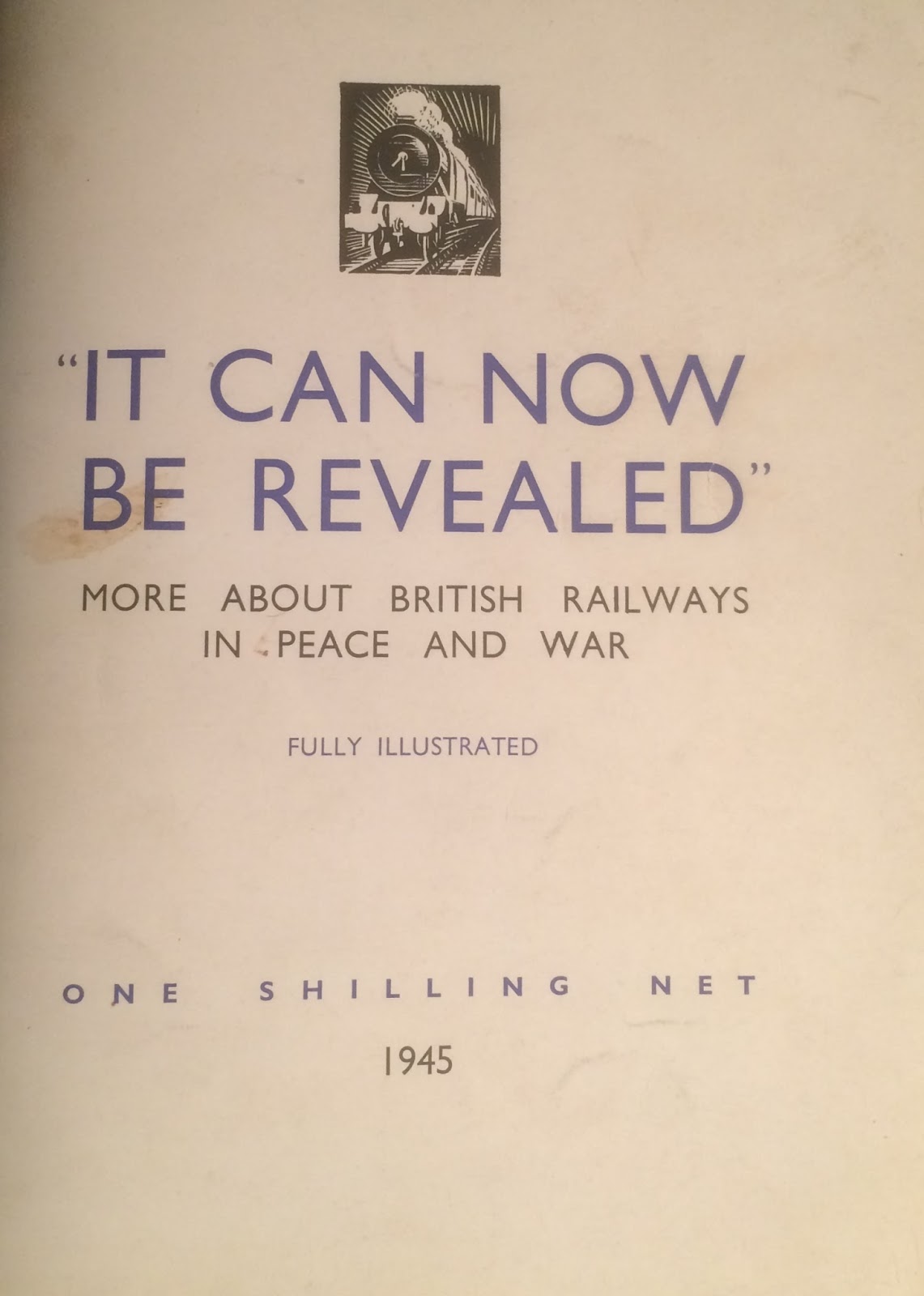
Another non-HMSO publication but one with which they undoubtedly were involved is It Can Now Be Revealed published in 1945 on behalf of the four major railway companies - GWR, LMS, LNER and Southern Railways, together with London Transport - by the British Railways Press Office. This is an early use of the phrase 'British Railways' as the railways were not to be nationalised until 1948 but had been effectively under state control during the wartime years under the Railway Executive Committee. Interestingly, each of the railway companies, plus London Transport were to publish their own wartime stories in the early years of peacetime but this is another well written piece, which apart from telling us of the railways' work during the recent war, also tells us something of the plans for peace. The booklet starts by telling us not of railway operations but of the war work undertaken by the railway companies - of building tanks, Halifax bombers and Horsa gliders, anti-aircraft guns and even motor boats. This section reminds us that the railway companies contained superb in-house heavy engineering and manufacturing capabilities, all of which were put to good use to aid the war effort. We then turn to the railways themselves and the arrangements put in place for handling child evacuees, war workers, troop movements and war production. We then look at the preparations and arrangement for D-Day, which as well as being the largest sea-borne invasion of all time, was probably the greatest logistical achievement ever likely to be undertaken. The booklet then closes by telling us the work undertaken to maintain services during the V-Weapons campaigns of 1944-45 as well as something of rebuilding for the future.

Staying with the Civilian Services for now, we turn to Merchantmen at War, an HMSO publication that tells the story of Britain's Merchant Navy and the great convoy battles of the war. The booklet starts by telling us of the men of the sea, the Masters, Chief Engineers, officers and men and also tells us of the diversity amongst the crews of the British Merchant Fleet and reminds us that many of the seamen came from places as widespread as Sierra Leone, Bombay and Mombasa. We learn of the convoys themselves, the pre-sailing conferences and of the cargoes themselves, which could be anything from foodstuffs to vital wartime supplies of raw materials and finished products such as tanks, aircraft and ammunition. Like the other booklets, it pulls no punches and there are some pretty graphic photographs of ships being torpedoed and men being rescued who were clearly at the limits of their endurance. We learn of the Arctic Convoys, which were arguably the most arduous of all and finally we see the 'turn of the tide' the preparations for the various landings at Sicily and Normandy. As someone who served in the Merchant Navy in a small way during the 1970s and 80s, this is a fascinating account of a subject close to my own heart.

The fighting services are not ignored either and there is comprehensive coverage of various aspects of the 'sharp end' of the war. A recent acquisition courtesy of the excellent David JB Smith aka @NavalAuthor on Twitter (with whom some swapping of doubles was done), is The Mediterranean Fleet, which is the Admiralty's account of Naval operations in that theatre from April 1941 to Janaury 1943. Like all of the others, this is well written with a copious amount of illustrations and covers some of the hardest moments such as the evacuations from Crete and Greece and the losses of such ships as HMSs Ark Royal, Barham and York, as well as the Malta Convoys, to the more triumphant moments such as the victories at Cape Matapan and Sirte. Once again, the standard of photography is outstanding and leaves the reader in no doubt that before the final victories, there were many moments of tragedy along the way. Some of the photographs of the sinking of HMS Manchester are particularly hair raising and it is hard to imagine anything nearly so candid being published in Nazi Germany at any stage of the war.

Neither are our various Allies forgotten in these booklets either and another recent acquisition  focuses on the exploits of Queen Wilhelmina's Navy or the Royal Netherlands Navy to use the correct title. At twenty five pages, this is a slimmer volume but like the others described earlier, is still well-written and contains a large number of excellent photographs. In common with the other booklets in the series, the narrative doesn't just provide the reader with mindless propaganda but also speaks candidly of the defeat and losses suffered when the Netherlands were invaded and how the Dutch Navy fought a brave delaying action. Despite the loss of their homeland to the German invaders, the Navy fought on and suffered further heavy losses when the Japanese entered the war and attacked Dutch colonies in the East Indies and the booklet tells of the heroic defeat of Admiral Doorman's combined Dutch, American and British force at the Battle of Sunda Straits. Like the other booklets reviewed above, this one also ends on a hopeful note and tells of the Dutch Navy's ongoing fight against both Germany and Japan and looks forward to the day when they will be able to return to a liberated country.

Staying with the Allied theme, Target: Germany examines the work done by the United States 'Mighty Eighth' Air Force in it's first year of operations over Europe. The booklet in my possession is marked "British Edition" so this was clearly something produced for consumption on both sides of the Atlantic. The narrative here starts with the description of two  daylight raids (all American raids were in daylight) on a synthetic rubber factory at Huls as well as the General Motors' factory in Antwerp and tells of how important it was for the American bombers to stick in a close defensive formation. As before, the narrative is quite candid in it's descriptions of massed attacks by German fighters, of bombers exploding and of others coming down in the Channel and the crews awaiting rescue by the British Air-Sea Rescue services. The chapter closes with the post-mission interrogation of the surviving crews and the questions asked of them. Next, we read about the comparisons between the two main American heavy bombers used, the B-17 Flying Fortress and the B-24 Liberator, such as relative bomb loads, speeds, defensive armaments etc. The next chapter steps back in time and gives us the background of the raison d'etre of the Eighth Air Force and the early developments in it's formation and deployment to Britain. All in all, this is another quality piece of work and whilst the narrative is perhaps the most 'gung-ho' of all those reviewed thus far, it is also fairly candid in it's descriptions and like the other books, the standard of the photography is first class.

Staying with the theme of air power, our next booklet RAF Middle East concentrates on the work of the Desert Air Force and air operations in the Middle Eastern Theatre of War from February 1942 to January 1943. This volume tells of operations primarily in the North African desert but also covers the defence of Malta. We hear descriptions of the unique conditions encountered in the desert that made flying so difficult and the maintenance of aircraft challenging in the extreme. Like most of the other volumes, we read descriptions of the early reverses and the back and forth struggles across the desert during this most fluctuating of wartime theatres. The siege of Tobruk is covered as is the later fall of this supposed fortress-port. Air operations in support of the British Eighth Army at Alamein are covered in some detail, when probably for the first time there was really close and effective co-operation between the British Army and Royal Air Forces. This was one of Montgomery's finest achievements and was something of which all those involved could be justly proud. The booklet closes with the pursuit of the Afrika Korps across the Western Desert until their final surrender in Tunisia. Once again, the narrative is truthful and speaks of the reverses as well as the triumphs and the standard of photography is excellent.

We stay in the desert for our next HMSO publication for The Eighth Army which covers this Army from it's official formation in September 1941 through to the brink of final victory in that theatre during January 1943. When the Eighth Army was formed, British fortunes in North Africa were at a low ebb following the earlier brilliant successes achieved by General Wavell's Western Desert Force against the Italians early in the war. Wavell was replaced by General Auchinleck and the book really opens by describing The Auk's (as he was nicknamed) first offensive in November 1941. The book makes a point of describing the cosmopolitan nature of Eighth Army, as besides men from all of the home nations of the British Isles, there were soldiers from Australia, India, New Zealand and South Africa. We again hear of the siege of Tobruk, this time obviously from the point of view of the men on the ground. The book tells us of the great advances and retreats that symbolised this campaign before the Army settled on it's defensive line at El Alamein. It was at this point that Churchill decided on another change of command and Auchineck was relieved both as Commander in Chief, Middle East and as General Officer in Command of Eighth Army. He was replaced by Alexander in the former position and the then little-known (outside the Army) Bernard Law Montgomery as Eighth Army Commander. After halting the Afrika Korps at Alam Halfa inSeptember 1942, Montgomery's thoughts turned to the offensive and the booklet covers the ensuing Battle of El Alamein in some details but perhaps understandably considering when the book was written, does not cover any of the later controversies with regard to Monty's perceived over-cautious approach to battle. Seemingly after years of defeats on land, the British at last had a winning General and would not allow dissent in an official publication!

We close by looking at a regiment which formed an integral part of Eighth Army and in The Royal Armoured Corps published in 1945, the narrative gives a brief account of the formation of the regiment during the First World War following the invention of the tank and tells us of how Germany embraced the tank under Hitler and of the early British defeats in France during 1940, during which campaign the Royal Armoured Corps was one of the relatively few parts of the British Army to come out with credit, although they were to lose the majority of their equipment during the hurried retreat and subsequent evacuations. We then learn of the regiment during the Western Desert campaign and the rapid expansion caused by the massive influx of wartime conscripts. There follows a detailed account of the recruiting and training process. The book closes with accounts of the victorious battles in the desert as well as the return to France in 1944 and the future advance into Nazi Germany. Although published in 1945, the book was clearly written in mid 1944 before final victory was achieved but like the other HMSO publications described above, this is a candidly written and well illustrated account.

There is a seemingly endless list of these HMSO booklets and I have yet to see the publications covering the Battle of Britain, RAF Bomber Command, The Fleet Air Arm, His Majesty's Submarines, His Majesty's Minesweepers, The Royal Marines, Australian Forces, Coastal Command and Combined Operations amongst many others that are out there. So far, my acquisitions have come from junk shops, internet auction sites, swaps and the odd gift from friends who know what a sad character they have befriended. They are a fascinating view of the war as written at the time.


HMSO Publications:

The Eighth Army: September 1941 to January 1943 - published 1944 
Fire Over London: The Story of the London Fire Service 1940-41 - published by the London County Council, August 1941
Front Line 1940-41 - published 1942
It can now be revealed: More about British Railways in peace and war - published 1945
The Mediterranean Fleet: Greece to Tripoli - published 1944
Merchantmen at War - published 1944
Queen Wilhelmina's Navy - published 1944
RAF Middle East - published 1945
The Royal Armoured Corps - Through mud & blood to the green fields beyond - published 1945
Target: Germany - The US Army Air Forces' official story of the VIII Bomber Command's first year over Europe - published 1944


Friday, 11 November 2016

An Ordinary Hero

Ordinary Seaman Jack Dorrington (Dorrington family collection)

On this Remembrance Day, it is fitting to publish the story of one of the many hundreds of thousands of ordinary men and women who served their country during the Second World War. Happily, Jack Dorrington, the subject of this article survived the war to lead a long and happy life in peacetime but we should also remember the many thousands who were not so lucky and who made the ultimate sacrifice. The piece below is the result of the sort of typical family history research that we are able to undertake. If you're interested in learning more about one of your wartime ancestors, please contact me either via the main website or by leaving a comment below.

Jack Dorrington’s story in the Royal Navy is similar to many of those citizen sailors, soldiers and airmen who served in the Second World War. Reginald Jack Dorrington was born in Southwark in 1924 and was a young man who like many others found himself suddenly transplanted from civilian life into something that must have seemed very alien to him – a new life of training, obeying orders and overseas travel into a war zone. What is remarkable about Jack and all of these reluctant warriors is that they so readily adapted and to paraphrase a contemporary saying “kept calm and carried on” with their lives.

His introduction to the Royal Navy would be familiar to any new entry to the Service, then or now, as it began at HMS Raleigh, a Shore Establishment or ‘Stone Frigate’ at Torpoint in Cornwall. This establishment was commissioned in 1940 to provide basic training to new entries into the Navy, a role which continues to this day. Jack was a member of Class 93 from 16 June 1943 and due to the exigencies of wartime, he received a very basic fourteen days training, in which he would have been given aptitude tests, learned drill, weapon training and basic aspects of seamanship as well as something of the structure of the Royal Navy. It is interesting to note that today, in peacetime, the equivalent induction into the Service and basic training takes ten weeks, so Jack and his wartime shipmates had ten weeks’ worth of training crammed into fourteen days!

On arrival at HMS Raleigh, Jack was allocated a Service Number, which like everything in HM Forces, has a meaning and is not just a random collection of letters and numbers. He was given the number JX 566902. The letter ‘J’ signified that he was to be trained as a member of the Seaman & Communication Branch (as opposed to Fleet Air Arm, Stoker, or Cooks & Stewards Branch), meaning that he would be involved either as a Signalman, Radar Operator, Gunner, or any seaman’s duty ‘above decks’ rather than in the Engine Room, for example. The letter ‘X’ signified that he was on the post-1925 basic pay scale, which at that time amounted to the princely sum of 2 Shillings (10 pence) per day for an Ordinary Seaman, rising to 4/3 (about 22 pence) per day for an Able Seaman with six years’ service. Even the number itself told a story; by 1943, the original six-figure sequence of numbers begun in 1925 at 125001 was beginning to run out due to the massive wartime expansion of the service, so from 1 April 1943, a new sequence starting at 500000 was instigated, which instantly told administrators and paymasters that a rating in this sequence of numbers was a ‘Hostilities Only’ engagement, or ‘Hostile Ordinary’ as the regulars nicknamed them. This service number would remain with the serviceman for his entire career and would be used for pay, welfare and disciplinary records. It was probably during his time at Torpoint that Jack acquired a nickname and being a six footer, it was almost inevitable that he would become known as ‘Lofty’ from this point onwards during his Royal Navy service.

Jack (top, second from right) and HMS Raleigh shipmates (Dorrington family collection)

His basic training completed, Ordinary Seaman Dorrington as he was now officially known, was allocated a Port Division, effectively a home barracks, which in his case was Chatham. The letter ‘C’ was therefore added as a prefix to his service number which now read C/JX 566902. Other prefixes regularly in use were ‘D’ for Devonport, ‘P’ for Portsmouth and ’L’ for Lee-on-Solent Fleet Air Arm ratings. Upon arrival at Chatham, Jack was based at HMS Pembroke, the name for the barracks at the Naval Base, where he would doubtless have received further training before being drafted to his first ship, the frigate HMS Lawford, then building at the Boston Navy Yard, USA. It hasn’t been possible to ascertain from his Service Record exactly what Jack’s specialization was but given his service number and looking at the types of vessels he served in, it is highly likely that he was either a Radar or a Sonar (at that time in the RN called ASDIC – an acronym for the fictitious Anti-Submarine Division Indication Committee) Operator, or perhaps a lookout – all extremely responsible positions for a young lad straight out of basic training.

Reaching the USA could be a nightmare journey for many servicemen, often being allocated to a slow and overcrowded troop ship in an equally slow moving convoy through U-Boat infested waters. Jack however, was one of the more fortunate individuals, being transported across the Atlantic in the Cunard liner RMS Queen Mary, converted into a troop ship and therefore with fairly basic accommodation but which had the saving grace of being fast – too fast in fact for a submerged U-Boat to touch – so that any discomfort and overcrowding would be short-lived. Jack was on Voyage TA66, which sailed from the Clyde on the evening of 29 September 1943 and arrived at New York City just over five days later, on the morning of 5 October 1943. Upon arrival in New York, a welcome sight would have been that of a US Navy Paymaster on the quayside, whose job was to present ten dollars to each British sailor arriving in the USA. The exchange rate at this time was around four dollars to the pound, so this would have represented a small fortune to the poorly paid British servicemen. The reason for this generous act was that the cost of living in the USA was higher in comparison to the UK, so it was designed to make life easier for the lads when buying drinks and food ashore, which would have been difficult, if not impossible on their low Royal Navy rates of pay.

RMS Queen Mary in her wartime guise as a troopship (IWM)

An overnight train journey from New York to Boston then beckoned for the young sailors. Upon arrival in Boston, the next stop was at Fargo Barracks, where the seamen would be accommodated until such time as their ship was ready for them. Fargo Barracks was a vast complex in the centre of Boston that had begun life as a wool warehouse but which had now been requisitioned by the US Navy as their Induction Centre for the crews destined for the many frigates being built at the nearby Boston Navy Yard at Charlestown. The barracks had a reputation for plentiful supplies of excellent quality food, which was in sharp contrast to the rationing back home in England. Some of the young sailors were able to lodge with local Boston families rather than stay in the huge barracks. Jack was one of those selected to do so and recalled being fussed over by a kindly local family anxious to do their bit for the war effort. The lads also had free access to cinema and theatre tickets, with every effort made to ensure that these youngsters, most of whom were on their first ever overseas trip, felt welcome in their new surroundings far away from home. Of course, the British sailor enjoys his beer and there were plenty of bars for them to sample, although some of these were deemed strictly ‘off limits’ to the British, being considered home territory to US Navy men. Some fierce fights between the sailors of the two allied nations were recorded as a result of unsuspecting (or foolhardy) British tars entering an 'American' bar. One of Jack's tasks at this time was to be part of a squad that collected a member of Lawford's crew that had drunk too much in order to return him to his ship.

Whilst here, the ratings and junior officers would receive further training from US Navy instructors in connection with the layout and equipment of their new ships. This training was of a high standard and during his time in Boston, Jack learned how to drive, although whether this was part of his official training, or something done to relieve the boredom is not clear.

The Ship's Company moved aboard HMS Lawford at the Navy Yard on 30 October 1943 shortly before she was commissioned on 4 November, after which the new frigate would have conducted further trials and training. Some minor defects must have come to light during these trials, as Lawford was back in shipyard hands from 7 to 12 November 1943, with the crew back in shore accommodation.  The men finally moved on board permanently on 13 November and following further trials and a basic working-up exercise, HMS Lawford sailed at 14:30 on 5 December 1943, in company with her sister ship HMS Kingsmill, on passage to Liverpool. The Commanding Officer of the Lawford, Lieutenant Commander Sydney Ayles RNR, was the Senior Officer and therefore had overall responsibility for the two ships.

HMS Lawford at Liverpool in 1944 (IWM)

Both ships were ‘Captain’ Class Frigates, designed primarily for anti-submarine convoy escort work but these two vessels had been earmarked for conversion into Headquarters Ships for the forthcoming Normandy invasion, so their usual anti-submarine training at Bermuda was omitted, which was to have repercussions later on the voyage to the UK. All ships of the class were named after famous Captains and Admirals of the Royal Navy, mostly from the Nelson era and HMS Lawford was no exception, being named after Captain John Lawford, commander of HMS Polyphemus at the Battle of Copenhagen in 1801.

It is hard to imagine a tougher initiation for the embryonic sailors as that which befell those aboard HMS Lawford, for two days after sailing she ran into a Force Nine gale and by 22:30 on 7th December, she was 'hove to' with the ship’s bows heading into the wind at reduced speed in order for the frigate to ride out the storm without causing serious damage to the ship or endangering it’s safety. The conditions on board at this time do not bear thinking about and many of the men would have been wishing for the warmth and comfort of their Boston lodgings once again!

The ship resumed passage at 08:10 the following morning but there was some further excitement on the 10th December when a radar contact was reported at 20:11 at a range of six and a half nautical miles. Four minutes after initial radar contact, a German U-Boat was then sighted on the surface ahead of the two frigates. The submarine spotted the two ships closing in and dived at 20:22, by which time the range had reduced to around two miles. The Sonar crews were obviously well trained as contact was held despite the poor weather but the depth charge attacks can only be described as shambolic, with the poorly trained novice depth charge supply teams only managing a sporadic supply of depth charges up to the decks. At this point, Ayles the CO of Lawford, decided on a ‘Hedgehog’ attack. The Hedgehog was a forward throwing weapon which fired charges ahead of the ship designed to explode on contact with a submarine’s submerged hull. However, just as Ayles was about to open fire, sister ship HMS Kingsmill crossed the bows of the Lawford, inadvertently placing herself in range of the Hedgehog projectiles, thus forcing the attack to be aborted. By this stage, at 22:41 on the 10th, the weather was closing in again and the decision was taken to abort the attack for fear of the two frigates having to 'heave to' once more and thus leaving them potentially sitting targets for the submarine. The decision to proceed was vindicated because by 00:45 on 11th December, the gale had increased to Force Ten with the ships 'hove to' once again and Ayles was unable to follow orders received from C in C Western Approaches instructing him to return to the search for the submarine. The weather began to moderate by 07:20 on the 12th and following amended orders from Western Approaches Command, the two frigates resumed their passage to England.

The two ships arrived off the Liverpool Bar Light Vessel at 08:00 on 14th December and were alongside at Gladstone Dock a few hours later, from whence they were immediately sent to the Cammell Laird Shipyard in Birkenhead for conversion into their Normandy role. Christmas Leave was given and most of the ship’s companies were paid off to be transferred to other vessels. Jack was one of those selected to remain with the ship, which suggests that he had acquitted himself well in his duties and was someone who would be required in the ship’s new role. This lends further credence to the theory that he was a radar or sonar operator, some of the few people to have come out of the U-Boat debacle with credit. The conversion entailed fitting additional accommodation for the extra staff officers to be carried, an enhanced radar outfit and additional radio communications, with the close-range anti-aircraft armament being considerably strengthened by fitting an extra sixteen 20mm Oerlikon cannons at the expense of one of the three inch guns, which were of limited value in any event.

Whilst undergoing her post-refit trials, two merchant ships collided in the River Mersey during thick fog and caught fire. HMS Lawford approached to give assistance and her motor boat crew did what was described as “magnificent” work in rescuing some of the crews of the two ships, including going right into a patch of burning oil to pick up men from the water. A proper work-up programme then ensued which was completed by the end of May 1944, at which time it would be fair to say that the crew of Lawford were an efficient and fully trained unit. The work-up complete and her ship’s company at the peak of training, HMS Lawford sailed from Portsmouth for the Normandy invasion beaches on 6 June 1944, under the command of Lieutenant Commander MC Morris RN. She was escorting ten former ferries carrying Canadian assault troops for ‘Gold’ Beach.

Her role on D-Day was that of the Command Ship of Captain AF Pugsley RN, initially co-ordinating the landing of the troops on J1 Sector of ‘Gold’ Beach but who was also nominated to be in command of all patrol activity off Normandy following the invasion. All went well at first but on D+2, disaster struck when she was hit by an Hs 293 Glider Bomb dropped by a Ju88 aircraft, which seemed to appear as if from nowhere, thus demonstrating that even with the enhanced radar protection on offer, the fleet was still vulnerable to attack from low flying aircraft penetrating beneath the radar.

Hs293 Glider Bomb (Deutsches Technikmuseum Berlin)

The ship broke in two and sank inside ten minutes, with 26 men being killed, who were mainly engine room ratings trapped below when the missile struck. A total of 8 officers (including her CO) and 210 ratings were rescued by two minesweepers and returned to the UK. Royal Navy records rather confusingly refer to these glider bombs as ‘aerial torpedoes’ and the records for HMS Lawford are no exception but the Hs293 was actually a radio controlled ‘ship busting’ bomb – an early form of guided missile with a warhead of over 1,000 kilograms. Not surprisingly, most vessels hit by these weapons were either sunk or damaged so severely as to be beyond repair.

Jack was above decks when the missile struck and was thus able to quickly comply with the ‘Abandon Ship’ order but being a non-swimmer, his troubles were just beginning. Wearing heavy sea boots, greatcoat and steel helmet, he was hardly equipped for buoyancy and soon found himself struggling to remain afloat. Jack recalled trying to grab hold of shipmates, being told to “Let go of me, Lofty” on numerous occasions before eventually being hauled into a small boat, probably from one of the rescuing minesweepers. Jack was unceremoniously dumped into the bottom of the boat and soon found himself underneath a pile of men as fellow survivors were thrown into the boat on top of him. Jack had swallowed a lot of seawater but the weight of the other men on top of him forced him to be sick, thus probably speeding his recovery.

Royal Navy ratings repairing buildings in London damaged by V-1 attacks (IWM)

In common with all shipwrecked Royal Navy personnel, Jack was given seven days survivor’s leave and arrived home in the clothes he was wearing when he jumped into the sea, plus a blanket wrapped around him for good measure. On his return to barracks at HMS Pembroke on 16 June 1944, Jack was promoted to Able Seaman, which is another indication that he had done good work aboard HMS Lawford. He was based at barracks until 4 September 1944 after which time he was allocated as a member of the ‘London War Party’ from 5-13 September. London had been under attack from V-1 Flying Bombs from 13 June until early September 1944 and it had been decided to deploy members of the services, including many of those whose peacetime jobs had been in the building trade, to assist in repairing some of the worst of the bomb damage. It hasn’t been possible to find out exactly what work Jack was doing at this time but the IWM has documented some of the work in a series of photographs which give us a fair idea.

Destroyer Depot Ship HMS Wolfe (IWM)

Following the end of this work, Jack was drafted to HMS Dolphin at Gosport on 16 September 1944. This was another shore establishment and was until 1999 the home of the Royal Navy Submarine Service. Jack’s Service Record shows that he underwent submarine training here, which would have included escape training. The current Submarine Escape Training Tank dates from 1954 but similar training was given in wartime, designed to simulate escaping from a submerged submarine using breathing apparatus and other life-saving equipment. On completion of his submarine training, Jack was drafted on 29 October 1944 to HMS Adamant, the submarine Depot Ship for the 4th Submarine Flotilla, based at Trincomalee, Ceylon (now Sri Lanka). So far, it has not been possible to ascertain how Jack reached Trincomalee from the UK, but he would almost certainly have taken passage in a troop ship, or perhaps on board another Royal Navy ship taking up position on that station.

Jack (second from left) and shipmates aboard HMS Wolfe (Dorrington family collection)

Jack was based aboard Adamant only until the end of 1944, being transferred on 1 January 1945 to HMS Wolfe, another submarine Depot Ship, this time for the 2nd Flotilla, also based at Trincomalee. The role of the Depot Ship was basically to provide port, repair and rest facilities for submarines and their crews whilst serving away from normal port facilities – in other words a home away from home. The life on board a Depot Ship would have been quite routine for most of the time, probably not a bad thing considering the fate of Jack’s previous ship but just occasionally there does seem to have been some excitement, as the log of HMS Wolfe records several air raid warnings as well as a loud explosion outside the harbour entrance in January 1945.

On 10 September, with the war against Japan over, Jack was assigned as part of the passage crew of the submarine HMS Torbay which was returning home to the UK to be placed in reserve and eventually scrapped. Torbay was a ‘T’ Class submarine commissioned in January 1941 and had fought a distinguished war, firstly in the Mediterranean, where her CO, Lieutenant Commander Anthony Miers had won the Victoria Cross for his actions in sinking enemy troop transports. Miers was later transferred from Torbay following allegations from fellow officers and crew members that he had ordered them to machine gun enemy survivors in the water. Whilst Miers never attempted to deny the allegations, no further action was ever taken against him.

HMS Torbay (IWM)

Torbay had enjoyed continued success against the Japanese in the Far East and had sunk several transport vessels as well as a patrol boat. The battle weary submarine sailed for the UK on 10 September 1945 via the Suez Canal and arrived at Gosport on 22 October following an uneventful passage. She was later moved to Briton Ferry in South Wales and it appears that Jack formed part of the crew which delivered the submarine to the scrapyard located there on 16 December 1945. He was once again drafted to HMS Pembroke at Chatham from the following day, when he would no doubt have been granted Christmas leave at home for the first time since 1943.

On 14 February 1946, Jack was drafted to HMS Vigilant, a ‘V’ Class Destroyer at that time serving as an Anti-Submarine Warfare training vessel based at Londonderry in Northern Ireland. His service in the Royal Navy was by now drawing to a close and he was only on board Vigilant until 3 April 1946, when he was once again based at Chatham for a few weeks. Jack’s final draft was to HMS Lynx, a shore establishment for Coastal Forces at Dover, where he was based from 25 April to 17 September 1946.

Jack Dorrington was demobbed back to civilian life on 17 September 1946 but old habits formed during his service in the Royal Navy appear to have died hard, as he continued to enjoy a daily tot of rum for the rest of his life. In later years, Jack and his wife Elsie also became regular devotees of cruises aboard liners such as the Canberra and Oriana, so the nautical life must have held a lasting appeal. Jack passed away in 2015 aged 91, one of the many 'ordinary heroes' who helped defeat Hitler as well as Japanese tyranny and to whom we owe so much.

I am indebted to the Dorrington family and especially his grandson and close friend of mine, Sam, for allowing access to Jack’s photographs and for providing many personal anecdotes.


Published Sources:

The Captain Class Frigates in the Second World War - Donald Collingwood, Leo Cooper - 1998


Unpublished Sources:

Dorrington family reminiscences
RMS Queen Mary log extracts - National Archives BT 380/1202
HMS Lawford log extracts December 1943 - National Archives ADM 217/313
HMS Lawford report on sinking 8 June 1944 - National Archives ADM 267/117
HMS Wolfe log extracts January-July 1945 - National Archives ADM 53/122516-122522
HMS Torbay log extracts September-October 1945 - National Archives ADM 173/19946-47