Showing posts with label Air Raid Shelters. Show all posts

Sunday, 6 May 2018

The Aldwych Tube, Bomber's Moon and Negley Farson

Negley Farson (Wikipedia)

Blitz aficionados will be aware of the name of James Negley Farson, the American author, adventurer and fisherman, who wrote one of the best accounts of the London Blitz, Bomber's Moon, published in 1941 and which apart from Farson's vivid descriptions of life in London during 1940, contains some beautiful pencil illustrations from his friend and commercial artist Tom Purvis.

Almost an entire chapter of the book is devoted to shelter life, more specifically to the experiences of those sheltering in the London Underground. The small branch line station at Aldwych - actually located in the Strand - features prominently in this chapter and was the subject of some of the most famous photographs taken of Tube shelterers. This station has been closed to the public since 1994, when the little-used Aldwych branch was finally discontinued. This was partially due to the prohibitive cost of replacing the original 1907 lifts, which although still in perfectly good working order at the time, could not continue to be used for Health & Safety reasons owing to the exposed moving parts in the lift machinery. The station is still in situ and although different schemes have been floated over the years for its re-opening and incorporation into various Tube extensions, it remains as a mute reminder of London's wartime past. The site is occasionally opened to the public in conjunction with the London Transport Museum's Hidden London initiative but tickets are expensive and sell out quickly, so I have never actually been able to visit the station since closure 24 years ago. My memories of the place were those of a vague air of decay but also of a station that would have been instantly recognisable to a wartime shelterer.

Setting the scene outside Aldwych Station (Tom Day)

In addition to these rare public openings, the station is often used for filming and is also utilised by TfL and various Government Departments for training purposes. It was in connection with this latter use that I was recently able to pay a visit, as part of my guiding duties for a British Army group's Battlefield Study tour looking at the London Blitz, amongst other subjects. 

Mother & Baby drawn by Tom Purvis (author's collection - from 'Bomber's Moon')

To try and give the reader some background to the notion of spending the night in an Underground Station whilst bombs are falling "up top", I can do no better than quote directly from Farson himself:

"One night, about six o'clock, I stood in the Strand with the long line of shelterers waiting to go down the famous Aldwych Tube. It was very much in the newspapers at the time. Nearly everyone (except those who were occupying it) believed it had just been opened as a public shelter. The Press, unwittingly, was giving the impression that great things were being done.

As a matter of fact, when the Authorities were complacently accepting all the ballyhoo about throwing it open as a shelter, it had been packed to capacity for over three weeks.

The first person in line was a girl, twenty years old, holding an eighteen-months-old baby in her arms. She told me later, that she was "expecting" again in January. She had been standing there and hour and a half. The next seventy people in line had, of course, been standing there for slightly shorter periods. And there were more people piling up behind them while I was waiting to go down with them. She bared her gums and laughed saying:

'Maybe I'll faint. I did yesterday. Then there was an air raid and they had to let us all down.'

The collapsible steel gates of the tube were locked. They were not supposed to be open until 6:15. But this evening an Underground worker came along and let the crowd down shortly before six. We descended 132 steps. 

The people scampered about the deserted tube platform below to find their favourite places. This girl carried her baby to the far end, spread out a blanket. Then, from somewhere, she produced two sheets of corrugated cardboard - the thick packing case stuff. She placed her baby on top of it:

'So that he won't get damp,' she said simply."

At this stage of the war, there were no facilities at the station and as Negley Farson alluded to in his narrative, it had only been available as a shelter for around three weeks at the time he wrote his piece. He goes on to confirm the lack of basic facilities thus:

"Well, it was quite a scene for a dark, damp, smelly tube - with an open "Gent's" latrine staring you straight in the face. Lest I be accused of painting the picture, this was the Aldwych Tube; the position of the bucket latrine, used by the men, was some ten feet from the stone steps at the end of the platform - and I'll take a chance on it that there will be plenty of witnesses to come forward and swear that the only veil that covered it from public view at that date were two torn strips of burlap - with a jagged unclosable gap between them of at least eighteen inches from top to bottom.  

As one woman put it:

'We have a free public view - stalls. Ha ha!'"


An elderly lady shelterer drawn by Tom Purvis (author's collection from 'Bomber's Moon')

On the outbreak of war, the Chamberlain government had decreed that unlike the 1914-18 War, the London Underground would not be made available for Air Raid Shelter purposes. The vaguely ridiculous reasoning behind this was that allowing the public to shelter in the Tubes would "encourage a troglodyte mentality" - in other words, they were afraid that people would enter the Tubes, never to emerge again, with the resulting catastrophic effect on war production, followed by a general collapse of society. 

When the bombs did start to fall on London, the population used their common sense, ignored the Government's edicts and simply invaded the Tube Stations, invariably by simply buying a ticket to the next station and then refusing to board a train. The Authorities quickly relented and allowed the Tube stations to be used but as Farson mentions in his book, the complacent attitude that had previously been demonstrated took some time to put right and it took some time, running into months, before steel bunk beds, chemical toilets and first aid posts, amongst other facilities began to appear on those stations selected for use as shelters.

Recreated station signage (author's photo)

Aldwych Station had opened in 1907 as part of the Great Northern & Strand Railway and was originally named Strand. It was intended to be the terminus of a line running from Wood Green (now Alexandra Palace) via Finsbury Park and Kings Cross. Whilst under construction, the line was taken over by the Brompton and Piccadilly Circus Railway (the modern day Piccadilly Line) and permission was granted to link the two lines via a new tunnel running between Piccadilly Circus and Holborn to connect the two routes. This left the line running down to the Strand as a somewhat superfluous spur that eventually became the Aldwych Branch. The station was renamed Aldwych in 1915 to avoid confusion with the station of the same name (now Charing Cross) owned by the Charing Cross, Euston and Hampstead Railway (now the Charing Cross Branch of the Northern Line).

The Aldwych Branch settled down to life as basically a shuttle service that ran to-and-fro between Aldwych and Holborn Kingsway Stations. It is possible to walk between these two points in less than ten minutes, so it was never a particularly well used service. Probably because of this relative lack of use, the entire branch was selected for use as a shelter and closed to the public on 22 September 1940, shortly after the beginning of the London Blitz. The station had originally been named consisted of two platforms serving a double track line in two tunnels to Holborn but one platform had been closed in 1917, as just one platform and a single track was more than sufficient to cater for the shuttle service. For shelter purposes, the disused platform was also opened up to the public and the train running tunnels (including the disused tunnel) were used by the British Museum to store some of their collection, including the Elgin Marbles. The electric current was switched off and eventually, the platform was built out over the tracks so as to create a much wider area for the shelterers than was normally found on a working station but initially, some of the shelterers had to sleep on the tracks, as the accompanying photo shows.

Aldwych Station - then and now (author's photograph)

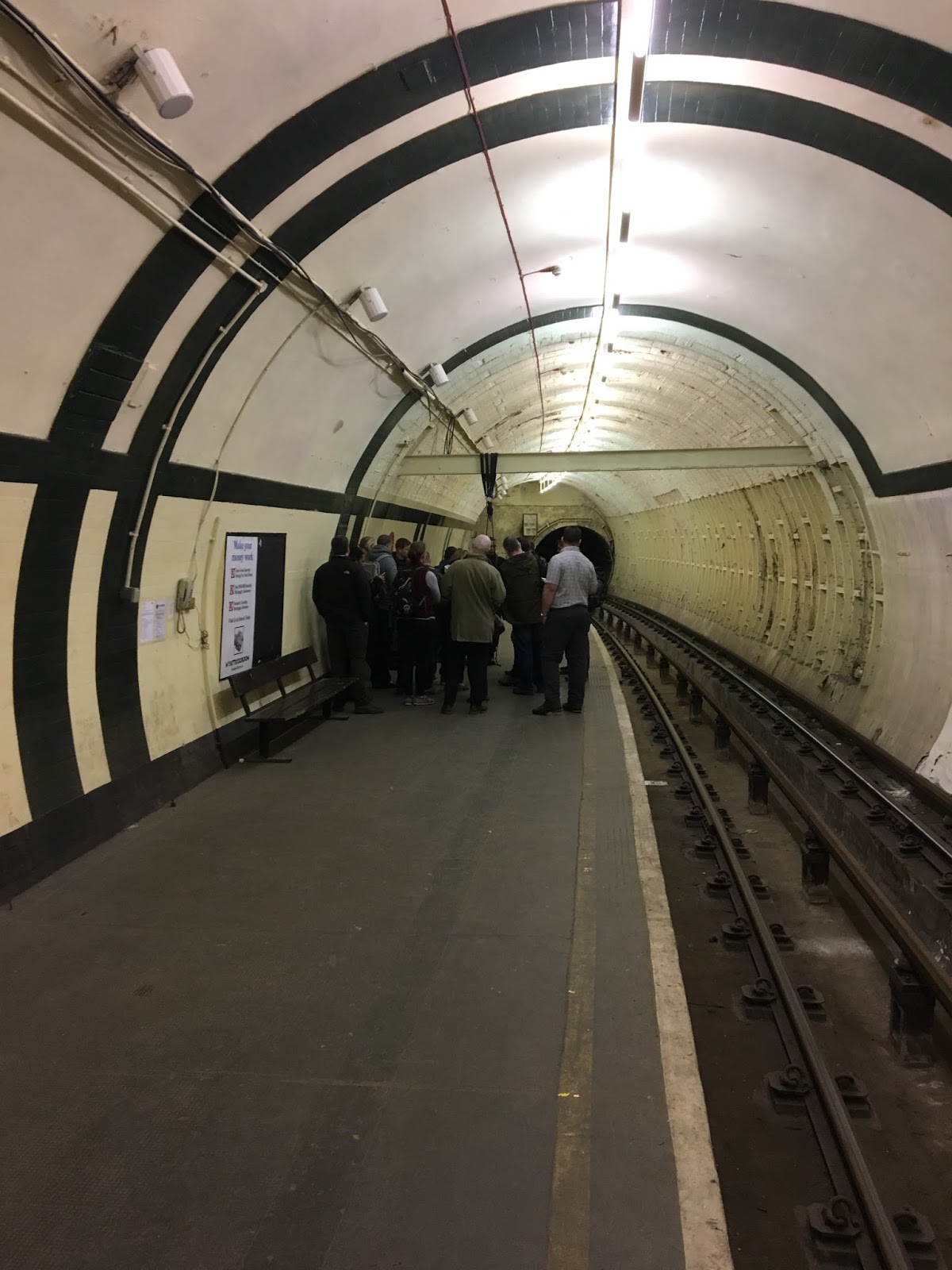
My entry into the station was through similar "collapsible steel gates", perhaps the very same that Negley Farson and his fellow shelterers had used nearly 78 years previously. I then walked through one of the original 1907 Otis lifts - both of which are now held statically by large steel beams beneath them - into the Booking Office area, part of which is original and the remainder an elaborate film set which has been retained in situ. Following a safety briefing, our group descended the spiral staircase towards platform level. It was whilst walking down the stairs that my memories of this station began to be rekindled; a somewhat musty, damp smell pervaded the staircase and the passageways leading to the platform. There was also a strange, unaccountable feeling of melancholy - as if the old station was trying to tell us that it was lonely and missed the sound of commuters footsteps.

The beginning of the 132 steps (author's photo)

Walking through the original 1907 Otis elevator (author's photo)

A now lonely passageway echoes to the sound of footsteps once again (author's photo)

Once on platform level, I explained a little of the station's wartime history as well as hearing a interesting briefing as to the history of tunnels and tunnellers in warfare through the ages, a fascination which continues to this day. Whilst listening to this talk, we were disturbed by various distant rumbling sounds and periodical bursts of cool breezes, all of which reminded us that not far away, up the line at Holborn, the Underground network was still operating. The area we had been visiting was Platform "A" which had been the working platform when the line closed to the public in 1994 and which, we had been warned at the Safety Briefing, still contained energised live rails and which was still frequently used for filming. The station has featured in numerous movies, ranging from Battle of Britain, Patriot Games, V for Vendetta and Atonement, to pop videos, perhaps most famously The Prodigy's "Firestarter" in 1996.

Looking south towards the buffers (author's photo)

Looking north towards Holborn (author's photo)

We then moved across to the other platform, disused since 1917, which although bricked off from the main running tunnels, still contained a stretch of the original one hundred year old track, which lay flat on ballast as with surface railway lines and did not contain the now familiar "Anti-Suicide Pit" which we see today at Tube stations. Unfortunately, the sensitive nature of some of the equipment being demonstrated in this area meant that it was not possible to take photographs here on this occasion but the platform presented a strange mixture of old and new, due to the fact that London Underground sometimes use this area to trial new systems of lighting, tunnel panels and other equipment.

The footbridge leading across to the 1917 platform (author's photo)

"Way Out" sign, together with the 'A N' from STRAND which was the station's original name (author's photo)

After about 90 minutes below ground, it was now time to return to the surface and it was at some point during the ascent of the 132 steps that I became painfully aware of how much we took lifts and escalators for granted. Some of my Army colleagues sprinted up the steps, leaving the oldest man in the group to bring up the rear somewhat wearily!

The Leslie Green designed Ticket Hall (author's photo)

Back at surface level, I made a brief inspection of the original Leslie Green designed Ticket Hall, with an elaborate "BOOK HERE" sign, as well as discovering an original 1930s direction sign pointing would-be interchange passengers in the direction of the nearby Temple Station.

1930s signage still extant (author's photo)

The way out to Surrey Street (author's photo)

As mentioned earlier, many proposals have been mooted to incorporate the Aldwych Branch into various other underground extensions and new lines but personally, I rather hope that the line remains preserved as a time capsule looking back into Underground history.

Blinking as we emerged back out into the bright spring sunshine, it was time for me to start earning my keep again as a guide but thanks are due to Major Christopher Garrard of 29 EOD & Search Group HQ for arranging the visit and for allowing me to add an unusual extra dimension to our Battlefield Study Tour.


Printed Source:

Bomber's Moon by Negley Farson, illustrated by Tom Purvis - Victor Gollanz Ltd, 1941


Sunday, 28 May 2017

A visit to Hamburg

The Hasselbrook shelter rises from the trees (author's photo)

As regular readers of this blog will know by now, I've been visiting the city of Hamburg on a fairly regular basis since the late 1980s and over that period of time have come to know and love the city as well as building a great liking and respect for the people of that great Hanseatic port on the River Elbe.

On my most recent visit to the city, I had a little more free time than usual and so took a day to seek out and photograph some of the surviving relics of the Second World War, mainly but not exclusively in the shape of air raid shelters.

I wrote about one of the surviving shelters in February 2013 when I was lucky enough to visit the Shelter Museum at Hamm and would highly recommend a visit to anyone who has the chance to do so. This type of shelter is the conventional (to the British at least) underground type and is known in German as a Rohrenbunker or literally Tube Bunker, consisting as it does of four parallel tubes, linked by a connecting passageway and each, in theory, capable of housing fifty people, although in practice, considerable more than this number were crammed in each night of the 'Gomorrah' raids of July and August 1943. 

A view along one of the tube shaped bunkers at the Hamm Shelter (author's photo)

Unlike the British, who began their Civil Defence preparations in 1938, albeit on an inadequate scale, Germany did not seriously start thinking about arrangements to protect civilians from air attack until after the Blitz on British cities in 1940-41, at which point it began to dawn on the authorities that German cities were highly vulnerable to air attack and that Reichsmarschal Goring's words, uttered in 1939, that "No enemy aircraft shall fly over Reich territory" rang somewhat hollow. Construction of the Rohrenbunker was achieved in 1940 and many of these structures were built across Hamburg and other German cities. Most of these are now derelict and in many cases have filled with water but the one in Hamm was restored by a dedicated team of volunteers and is well worth a visit.

Many of the German shelters took the form of above ground bunkers, extremely sturdy structures built of brick and concrete, of which large numbers still survive. These were known as Rundturm, literally Round Towers and were quite elegant looking buildings in their own way, built of concrete clad in brick with conical roofs designed to deflect incendiary bombs. These were typically built at or near public transport hubs, such as S-Bahn or U-Bahn stations and because of their stout construction, many survive to this day, sometimes derelict but more often than not, in use for more peaceful purposes.

Baumwall Shelter - now in use as a Portuguese Restaurant (author's photo)

The shelter pictured above is conveniently located adjacent to Baumwall U-Bahn Station as well as being withing easy walking (or running) distance of Landungsbrucken on the S-Bahn and today serves as a Portuguese restaurant, although I have yet to sample their wares. The building was built in 1940 and like all of the Rundturm, was built with a nominal capacity of 600, although during the great raids of 1943, would have undoubtedly held many more than this. It also has the remnants of a Nazi eagle or Reichsadler embossed above the main entrance, although as the Swastika understandably remains an illegal symbol in modern Germany, this has been removed and replaced by a blank panel.

The Nazi eagle above the Baumwall shelter - minus Swastika (author's photo)

I paid a visit to a few more of these shelters which remain dotted across the city and two of the more interesting examples can be seen below. The first, immediately adjacent to Sternschanze S-Bahn Station, has been attacked over the years by graffiti vandals. This does seem to be a serious problem in Hamburg and hasn't been tackled with as much vigour as in London but on this occasion and for this structure, the graffiti has softened the warlike appearance of the structure, although as it is still partially in use by a local football club, the occupants may take a different view!

Sternschanze shelter (author's photo)

There is no graffiti on the Hasselbrook shelter, which once again is located adjacent to the S-Bahn Station but like the Baumwall example mentioned earlier, this tower has a Nazi eagle above one of the entrances, albeit of a simpler, perhaps more stylized design. Of course, the swastika has been removed and in this instance, has been replaced by a simple panel showing the year of construction, in this case 1941. The other entrance is adorned by a representation of the City of Hamburg coat of arms.

The Nazi eagle and year of construction at Hasselbrook shelter (author's photo)
 
Hamburg coat of arms at Hasselbrook shelter (author's photo)

There are other similar examples of this type of shelter at Berliner Tor, Barmbek (which has a 1939 date embossed above the door) and Billhornerbrucke Strasse (dated 1940) all of which seem to be in varying uses today. There are other shelters surviving which I will try to visit and photograph on my next visit. 

The final type of shelter still very much extant in Hamburg, as well as other German cities, is the Flakturm or Flak Tower. These massive structures doubled up as shelters and defensive positions, armed (as the name suggests) with heavy anti-aircraft, or flak guns. There are two of these to be seen in Hamburg, one at Heiligengeistfeld, close to FC St Pauli's Millerntor Stadion, which is now in use as a nightclub and music school.

Heiligengeistfeld Flakturm (author's photo)

These vast structures had concrete walls in the region of 3.5 metres thickness and contained air raid shelters with accommodation for a staggering 10,000 persons, gas proof rooms (the fear of poison gas attack dominated thoughts on both sides), hospital facilities and were surmounted by gun emplacements for heavy 128mm anti-aircraft guns, as well as lighter 37mm and 20mm cannon, although these latter would have been next to useless against the high-flying British and American bombers. The second Flak Tower in Hamburg is located south of the River Elbe, at Wilhelmsburg and has been converted into a most interesting peacetime use, being today known as the Energiebunker, a renewable energy power station which supplies power to the local power grid as well as providing an exhibition space, cafe and spectacular views across the city.

The Energiebunker (iba-hamburg.de)

There are many more relics to be seen in Hamburg but alas, time ran out for me on this visit as I had to meet some friends for lunch before leaving for the airport for my return flight to London. My next visit won't be too far delayed and hopefully, I will get the chance to visit and photograph some more Hamburg history.

All photos used in this article are © Steve Hunnisett, with the exception of the Energiebunker photo which is duly credited.


Friday, 12 August 2016

A Little More from Lilliput

Reclining Figures sketched by Henry Moore at Liverpool Street (author's collection)

Regular readers will hopefully remember the March 2016 edition of this blog in which we looked at the wartime anthology of the pocket sized magazine, Lilliput and in particular a report on the work of 'Mickey the Midget', a shelter warden in East London. As there was an extremely positive reaction to this post and there are many more articles in the book to choose from, it seems a good idea to re-visit the magazine and the subject of life in wartime London.

Perhaps one of the most iconic images of life in the capital during the Blitz is that of shelterers in the London Underground, who at first endured conditions that were, to say the least, primative but who eventually, with the aid of some forceful individuals similar in outlook to Mickey Davis, managed to improve conditions out of all recognition and formed meaningful communities in their own right.

Despite the experiences of the First World War, when the public was permitted to use the London Underground as a means of sheltering from the Zeppelin and Gotha raids of 1915-18, by the time of the Munich Crisis of 1938, the British Government had decided not to allow the British public the use of the Tubes during any future conflict, for fear of encouraging a "Troglodyte" or "Deep Shelter Mentality." This was one of the many examples of pre-war Governments underestimating the common sense of the British people, who it was wrongly assumed, would take to the shelters at the first hint of an air raid and remain there, never to surface in order to perform their normal duties in wartime industry. In reality, the majority of people had no desire to remain underground indefinitely and merely wanted to do the sensible thing and take shelter until such time as the bombers had passed before getting with their lives as normally as possible.

This was still the official position when the bombing of London started on 'Black Saturday' 7th September 1940, although the new Prime Minister, Winston Churchill had already begun to press the Home Secretary, Sir John Anderson to open the Underground system to the public for sheltering purposes. At first Anderson resisted, supposedly fearful that large scale use of the Tubes would paralyse the system and he would only release the Aldwych-Holborn Branch for this use. For the remainder of the Underground system, posters with the following message were on prominent display across the network:

"THE TUBE STATIONS ARE REQUIRED FOR TRAFFIC PURPOSES AND THE TUBE STATIONS ARE NOT AVAILABLE AS AIR RAID SHELTERS."

Despite this seemingly unequivocal message, the lack of deep shelters in London and indeed across the country was a contentious issue and elements from the political Left continued to push for the Tubes to be opened up, at the very least pending the construction of purpose built deep level shelters. In the event, it wasn't the Communist Party, Labour Party or any other political faction that caused the Government into a change of heart, it was the sheer force of numbers of normal civilians who invaded the network on 'Black Saturday' who used the simple expedient of buying a ticket and then choosing not to travel. There was nothing in London Transport's regulations that said that passengers buying a ticket had to travel, so when people began to simply remain on the platforms, there was little the authorities could do but to acquiesce. People Power had won the day and the Government, to it's credit, did the sensible thing and began to hastily make improvements to make the system more habitable.

Shelterer at Aldwych Station sketched by Tom Purvis (author's collection)

However, these improvements took time to implement and when the American author Negley Farson visited Aldwych Station in early September 1940, he recorded a picture of somewhat primitive conditions where people were trying to make the best of things:

"One night, about six o'clock, I stood in the Strand with the long line of shelterers waiting to go down the famous Aldwych Tube. It was very much in the newspapers at the time. Nearly everyone (except those who were occupying it) believed it had just been opened as a public shelter. The Press, unwittingly, was giving the impression that great things were being done. As a matter of fact, when the authorities were complacently accepting all the ballyhoo about opening it as a shelter, it had been packed almost to capacity for over three weeks.

The first person in line was a girl, twenty years old, holding an eighteen month old baby in her arms. She told me later that she was expecting again in January. She had been standing there for an hour and a half. The next seventy people in line had of course, been standing there for slightly shorter periods. And there were more people piling up behind them while I was waiting to go down with them. She bared her gums and laughed, saying 'Maybe I'll faint. I did yesterday. Then there was an air raid and they had to let us down.'

The collapsible steel gates of the Tube were locked. They were not supposed to be opened until 6:15 but this evening an Underground worker came along and let the crowd down shortly before six. We descended 132 steps. The people scampered about the platform below to find their favourite places. This girl carried her baby to the far end and spread out a blanket. Then, from somewhere, she produced two sheets of corrugated cardboard - the thick packing case stuff. She placed her baby of top of it, 'So that he won't get damp' she said simply.

I asked her where she lived and she said in Vauxhall. She had to wait half an hour to get a bus here tonight 'And this morning I had to wait two hours before I could get one home.' 

'Bleedin bus conductors' blew out a heavy woman who was planting a family down beside us. 'Know what they said to us this morning? Ya, 'We'll take you' he says 'but we won't take your ------- bundles!'

Well it was quite a scene for a dark, damp, smelly tube - with an open 'Gent's' latrine staring you straight in the face. Lest I be accused of painting the picture, this was the Aldwych Tube; the position of the bucket latrine, used by the men, was some ten feet from the stone steps of the platform - and I'll take a chance and swear on it that there will be plenty of witnesses to come forward and swear that the only veil that covered it from public view at that date was two torn strips of burlap - with a jagged, unclosable gap between them of at least eighteen inches from top to bottom. As the light-weight woman put it, 'We has a free public view - stalls. Ha ha.'

Shelterers on Aldwych Station in the early days (author's collection)

Things did improve gradually; by December 1940 the tracks had been boarded over and rows of bunk beds installed. Chemical toilets were added as was a better ventilation system. Arrangements were made with Charing Cross Hospital for nurses to visit the shelter and later a proper First Aid Post was installed. Other stations followed suit and shelter life began to become more bearable.

Another part of the network used as a shelter was the as yet unopened extension to the Central Line east of Liverpool Street. Again, at first conditions were appalling and when the artist Henry Moore visited the shelter soon after its opening, he found hundreds of what were to become his trademark 'reclining figures' seemingly stretching for miles ahead. To him, the inhabitants had been "sleeping and suffering for hundreds of years."

As well as Henry Moore, the Lilliput wartime anthology, as you would expect, contains several other articles written about shelters and the experiences of shelterers, written by authors such as Ritchie Calder, Julian Huxley, Quentin Reynolds and Margery Sharp. The latter piece tells of how the Tubes were also a good place for a young lady (or gentleman for that matter) to meet someone of the opposite sex!

The articles also tell of how the Tube shelterers, despite being drawn from a multitude of social, racial and political groups, in other words, London in microcosm, formed enduring communities and how the various Shelter Committees even produced news sheets, such as the Subway Companion, The Swiss Cottager, The Holborn Shelter News, The Belsize Park Tube Magazine, The Goodge Street Siren and The Station Searchlight, which was the journal of the Oval Station shelterers. The first edition of the Swiss Cottager welcomed readers thus:

"Greetings to our nightly companions, our temporary cave dwellers (surely a gentle dig at the Government's initial 'Troglodtyes' injunction), our sleeping companions, somnambulists, snorers, chatterers and all who inhabit the Swiss Cottage Station of the Bakerloo Line nightly from dusk until dawn."

Children can sleep anywhere! (author's collection)

The purpose of these newsletters, apart from engendering a community spirit, was to assist in the self-governing nature of these shelters, to share information, to provide hints and appeals for cleanliness and hygiene and to provide some relief from the nightly drudgery of sheltering by providing humorous articles and cartoons.

In spite of the lull in the bombing from May 1941 until late 1943, the Tubes remained available and the onset of the 'Little Blitz' and the V-Weapons campaigns ensured another upsurge in the numbers using them as well as the new, purpose built, deep-level shelters and the continuation of the V-2 Rocket campaign on London (the last one fell on 27th March 1945) meant that the Tube Stations were in use almost right until the end of the War in Europe. The highest number of shelterers using the Tube had been recorded on 27th September 1940, when some 177,000 were recorded as having taken refuge from the bombs but even on VE Night, there were still over 12,000 people using the Tubes, although the majority of these were homeless who had been bombed out and would be given temporary accommodation, ironically some in the Deep Level Shelters until such time as more permanent arrangements could be made.

The Tube Stations themselves quickly reverted to a more peacetime guise, with the first bunks being removed on 12th April 1945 and the last (at South Wimbledon Station) on 31st May 1945.


Printed Sources:

Bomber's Moon - Negley Farson, Victor Gollanz Ltd 1941
Lilliput Goes to War - Edited by Kay Webb, Hutchinson 1985
London Transport at War - Almark Publishing, 1974
The Shelter of the Tubes - Capital Transport, 2001


Friday, 7 June 2013

Footprints of the Blitz (2)

Last time we looked at some of the surviving shelter signs in London that I have managed to capture on film for posterity. This week, I have unearthed some more photos of shelter signs along with one or two surviving shelters of various types. As before, all of the images shown are copyright to the author and may not be reproduced without permission.

Camberwell New Road (author's image)

The first image is of a sight that cannot now be seen in the form shown in the photograph, as it has now been partially obscured by a street name sign. The shelter in question that Londoners were being directed to was located on the platforms of Oval Underground Station, one of many then in use as deep level shelters. Oval Station saw out the war without incident, despite the surrounding area being heavily bombed but further down the Northern Line on 14th October 1940, the shelterers at Balham Station were not so lucky; a 1000kg high explosive bomb penetrated over forty feet and before exploding and the resulting explosion and flooding caused the northbound tunnel to partially collapse and fill with water from fractured water mains and sewers, which resulted in sixty eight shelterers being killed and many more injured.

Lee High Road

Our final shelter sign for now sees us remaining south of the Thames but moving south-eastwards to Lewisham. This is a slightly faded effort but one which is worth saving for posterity as with the passage of time, it may not be much longer before this sign fades away completely. This sign can be found in Lee High Road and it's junction with Brandram Road and the letters 'L-T-E-R' can still be seen reasonably clearly, whilst the remainder are somewhat more faded. There is the remnants of another sign in Brandram Road itself but this is so faded as to be now almost completely illegible.

We now move to the shelters themselves and for the first one, will stay south of the Thames but will move westwards to the grounds of the National Physical Laboratory in Teddington. 

NPL Teddington

There are at least two surviving shelters at this location and probably more than this but lack of time has so far precluded a more exhaustive search. The image shown is of the least overgrown shelter, which is located near to the cricket ground and would no doubt have been available for the use of employees of this important wartime facility. These brick and concrete shelters were basically surface shelters and would have provided protection from shrapnel and flying debris but would have been useless against a direct hit. Even the blast from a near miss would have probably caused the brick walls to collapse, bringing the concrete slab roof down on top of the unfortunate occupants. Londoners with their somewhat wry sense of humour, christened these type of shelters "Morrison Sandwiches" after Herbert Morrison, the Home Secretary of the time who was responsible for Civil Defence.

Another similar shelter, only on a much larger scale, survives in London's East End at Fawe Street in Poplar. Although the roof is somewhat overgrown, the shape of the shelter is still clearly visible and it is clear that this would have been capable of holding a considerable number of people.

Fawe Street, Poplar

Shelters could take all sorts of strange forms and often utilised the basements or cellars of existing buildings, expecially when there was nothing else available. Two such shelters are still visible in the Royal Borough of Greenwich - the first one in the grounds of Charlton House, which as the attached press cutting shows, was licensed to accomodate forty people. The shelter is actually located beneath a building formerly used as a public toilet, which rather primly was described as 'The House at Charlton House!' Charlton House itself was used as Wardens' Post 'Park 8' so the Air Raid Wardens presumably didn't want members of the public getting in their way!

Greenwich Shelters

Charlton House Grounds

The other shelter in Greenwich referred to in the list of 'Where to seek safety' was strangely described as a Trench Shelter but was actually located inside the underground reservoir located in Greenwich Park, although there is some doubt as to whether this shelter was ever actually used 'in anger' given the fact that there were plenty of other shelters available in the immediate locality. This would be shelter is included out of interest, especially for the fact that is was shown in the list as having been capable of holding three hundred people. Although I've never been inside this building, one can only imagine the claustrophobic conditions that would have prevailed inside.

Greenwich Park Reservoir Entrance

Before we leave the borough, there is another shelter in Charlton which is of interest, even though it is not immediately visible. This is located in the back garden of 88 Charlton Road, now a dentist's surgery but a house that during the wartime years was requisitioned by the Army as a billet for the crews of Anti-Aircraft guns that were located on the nearby Rectory Field. Whilst the guns would keep blazing away at most times, if the bombing became too adjacent, the crews would retire to their shelter, which incidentally was a good deal more substantial than the equivalent Anderson Shelters provided to the householders of the unrequisitioned houses nearby!

Shelter Entrance, 88 Charlton Road

Unfortunately, I have never been able to explore inside the shelter as it is full of old furniture, although maybe one day perhaps it will have been emptied and an exploration will be permitted.

There are plenty of shelters and other wartime structures that remain dotted around various parts of London, not all of which I have captured as yet. Our next edition will feature some more surviving shelters as well as other more random buildings and signage from the war.

Published Sources:

London Transport at War - Charles Graves, London Passenger Transport Board 1947