|
| Wartime memorabilia at the Royal Hospital (author's photo) |
I was recently lucky enough to guide a small family group from New York for a whole day exploring various aspects of London's wartime past and for part of this day, we took a walk around Chelsea, an area that perhaps does not at first thought appear synonymous with this most violent part of our capital city's recent history but is nevertheless an area which suffered heavily not just during the Blitz of 1940-41 but also suffered it's fair share of the later V-1 and V-2 weapons of 1944-45.
However, it was coincidental that we happened to take our walk on the 74th anniversary to the day of an air raid that became particularly engrained on the history of this historic borough - April 16th/17th 1941 - a raid so ferocious that it became known to Londoners of the time simply as 'The Wednesday' and one which recurs with a terrifying regularity in the history of wartime Chelsea.
We started our walk outside Sloane Square Underground Station. This station was originally opened to the public on 24th December 1868 by the Metropolitan District Railway as part of that company’s first section of line between South Kensington and Westminster. In 1872, the company connected with the erstwhile rival Metropolitan Railway’s tracks at South Kensington and the Inner Circle, predecessor of today’s Circle Line began to operate, although the full circuit was not completed until 1884. In 1939, the station began an extensive upgrade as part of London Transport’s ‘New Works Scheme’ which included the installation of escalators, the first of their kind on a sub-surface line. The works were completed on 27th March 1940 but to no avail, because on 12th November 1940, the station was struck by a HE Bomb causing the modernized station to be almost totally destroyed.
Tragically, 36 people were killed and a further 79 seriously injured, mostly aboard a train which had been leaving the station when the bomb struck and which caused large pieces of rubble to fall onto the train carriages. The station was rebuilt again after the war and today the only clue to the damage can be seen from the platforms where the stubs of the original cast iron supports to the old glazed station roof are still visible protruding from the retaining walls above the platforms.
From this location, we exited the station forecourt and proceeded across Sloane Square, turning into Lower Sloane Street, before taking the first turning on the right into Turks Row.
 |
| Self-explanatory plaque at Turk's Row (author's photo) |
During the Second World War, the large apartment blocks known as Sloane Court and Sloane Court East were in use as billets for American Army personnel stationed in London. At about 8 a.m. on Monday July 3rd 1944, a V-1 Flying Bomb fell in the street outside Sloane Court East which completely destroyed this building. The death toll was horrendous – 74 American service personnel – including several women were killed along with 3 British civilians and with many more injured.
An eye-witness to the immediate aftermath of this incident was Bill Figg, a young RAF serviceman on leave in his home area of Chelsea. After the war, Figg recalled what he saw and heard:
"I heard the unmistakeable sound of a V1, like a motorcycle without a silencer."
The missile struck, blowing Figg off his feet. He picked himself up and rushed around the corner into Turk's Row and was greeted by a scene of immense horror.
"I saw this Army truck with four bodies slumped over the back. In the middle of the road, there was a head. All down Sloane Court East, there were more bodies than you could shake a stick at. You just rolled over the bodies and felt the pulse. I must have rolled over twenty or thirty bodies but they were all glassy-eyed."
 |
| Reputedly the exact spot where the V1 fell (author's photo) |
The casualties incurred by the WACs, or Women’s Army Corps to give them their full title, were the first suffered by them whilst serving overseas. Today, a plaque on the wall of the replacement building commemorates those who died whilst on the opposite side of the road another small plaque set in the pavement reputedly marks the very spot where the missile fell.
Glenn Miller’s Army Air Force Band had been billeted at Sloane Court but had moved to RAF Twinwood near Bedford, the day before the V-1 struck. Concerned for the safety of his band, Miller had insisted on the move due to the number of V-1s falling in the vicinity at this time and faced with a lack of US Army transport – the local Motor Pool refused to work on a Sunday – he made a deal with the RAF to transport him and his band in return for performing a concert for the RAF personnel at the band’s new base. Thanks to his intuition, Miller undoubtedly saved his band from death or serious injury on the following day. As it was, Major Glenn Miller took off in foul weather from RAF Twinwood on December 15th 1944 in a Norseman light aircraft to play a concert in Paris for Allied servicemen but disappeared en route, never to be seen again.
We left this once melancholy scene which now echoes to the cheerful sound of children playing in the school which today partially occupies the site and continued along Turks Row, turning left at the junction with Franklin’s Row and then right at the junction with Royal Hospital Road.
The Royal Hospital, Chelsea was founded in 1682 by King Charles II and was intended ‘for the succour and relief of veterans broken by age and war’ and has fulfilled that role ever since, although today’s veterans are anything but broken by age and war being usually very sprightly ambassadors for the British Army.
 |
| Royal Hospital Roll of Honour (author's photo) |
Today, female as well as male pensioners are allowed – the qualification being that ‘in-pensioners’ as they are called, must be former Non Commissioned Officers or Soldiers of the British Army in receipt of an Army or War Service Pension who are normally over 65 years of age and who have no obligation to support a partner or family. Prior to the opening of the hospital, no specific provision had ever been made for old and retired soldiers.
Designed by Sir Christopher Wren, the buildings were completed in 1692 and the first pensioners were admitted in February of that year. Parts of the hospital were damaged by German bombs in 1918, rebuilt in 1923 and damaged again during the Second World War. The hospital and grounds suffered extensive damage during this conflict, being bombed over 20 times starting in the early days of the Blitz in September 1940, right through to almost the end when a V-2 rocket fell in the grounds on 3rd January 1945 with the loss of 4 lives and 28 injured.
The worst incident was on the night of 16th/17th April 1941, when the Infirmary was destroyed by a Parachute Mine with the loss of 15 lives and a further 50 serious injuries; the oldest of those in-pensioners killed was Henry Rattray, who was 101 years of age and a veteran of the Zulu Wars.
The Infirmary designed by Sir John Soane had been added in 1809 and is now the site of the National Army Museum. The idea of this museum was first conceived in the late 1950s by Field Marshal Sir Gerald Templar and was originally located at Sandhurst, home of the Royal Military Academy. The present location was chosen as a more central venue for the Museum and construction of the building was commenced in 1961 but took ten years to complete, with the present Museum opening to the public on November 11th 1971. Most of the fundraising for the construction of this building was undertaken personally by Sir Gerald Templar. This Museum, which is currently closed for an extensive refurbishment, is scheduled to re-open in 2016 and if it lives up to it's former incarnation, will continue to be well worth a visit.
We continued along Royal Hospital Road, walking towards the Thames Embankment, until we reached Cheyne Place, a terrace of houses and apartment blocks on the right hand side of the road. On the night of 16th/17th April 1941, a Parachute Mine detonated in the street, destroying or severely damaging numbers 25-43 and causing many casualties, including 3 AFS Firemen who were killed at the scene and whose names are commemorated on a plaque at Kings Road Fire Station, which we passed later in the walk. Like all London Fire Brigade and AFS Stations, Cheyne Place was given it's own unique alpha-numeric code and perhaps one of the AFS firefighters of the time had been a stonemason or sculptor in his civilian life, because the code letters '6W', the designated code for the Fire Station remains visible to this day, carved neatly into the stonework of one of the buildings concerned.
 |
| Station 6W of the AFS at 19/21 Cheyne Place (author's photo) |
We continued along Royal Hospital Road and turned right into Christchurch Street before embarking on a walk through some of the most peaceful side roads to be found in Central London, eventually finding ourselves at the junction with Cheyne Row, where we paused outside The Church of Our Most Holy Redeemer, which was the scene of another serious wartime incident.
In common with many other London churches during wartime, the crypt (the entrance to which was at 21 Upper Cheyne Row) was used as a Public Air Raid Shelter. On the night of September 14th 1940, between 80 and 100 people were sheltering inside when a HE Bomb crashed through the West Window and the floor, exploding in the crypt. Sadly, 23 of those sheltering including the Shelter Warden, Bert Thorpe, were killed in the explosion and the ensuing fire which was one of the worst incidents in the borough of Chelsea.
Josephine Oakman was a young Air Raid Warden who kept a diary, which is now in the possession of the Royal Borough of Kensington & Chelsea's Archives. Her entry for this date makes heart rending reading:
"18:27 - Bomb on Holy Redeemer. Got sent off by Bert Thorpe on bike patrol in Glebe Place and had hardly got away when HE sailed through church window, through crypt floor to cellar where it exploded against some strutting among 80 odd people. I got knocked off the bike. A second knocked me down again and a third sent a brick onto my tin hat. I went to Holy Redeemer and set to work on stirrup pumps. The cries and groans were awful. God help them all. We took 12 dead and put them in the garden by the church as it was getting dark. I think my heart broke this night over the sights I have seen today."
Despite this direct hit, the church which was consecrated in 1895, was not badly damaged and continued in use as a church and a shelter, with permanent repairs being completed by 1962.
After some reflection, we left this now peaceful backwater and proceeded along Cheyne Row until we reached the junction with Cheyne Walk where we turned right, following the River Thames upstream. After turning right into Cheyne Walk, we reached Chelsea Old Church, located appropriately on the corner of Old Church Street and set in its own small garden.
 |
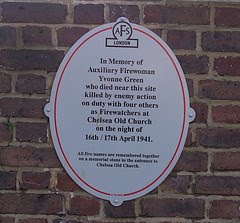
| Memorial to Yvonne Green (author's photo) |
 |
| Memorial at Roper's Garden (author's photo) |
Today, the Church Garden with its statue of Thomas More and Roper’s Garden opposite the Church form a peaceful oasis away from the incessant flow of traffic along Chelsea Embankment but as can be seen from the two plaques on the walls of Roper’s Gardens, it becomes clear that on the night of April 16th/17th 1941, this area was anything but an oasis of peace. The plaque located overlooking Chelsea Embankment tells us that Roper’s Garden is built on land formerly occupied by buildings destroyed during the raid on that night, whilst the plaque located in Old Church Street is erected by the charity ‘Firemen Remembered’ and commemorates the life of Yvonne Green, a 30 year old Canadian Auxiliary Fire Service (AFS) Fire Watcher killed on the same night along with four of her colleagues.
 |
| Memorial inside the rebuilt Chelsea Old Church (author's photo) |
We covered Yvonne's story in the April 2011 edition of this blog but suffice to say that Yvonne Green and four of her five Fire Watching colleagues were killed and Chelsea Old Church almost completely destroyed, when two Parachute Mines detonated in close proximity on this terrible night. Yvonne was another prolific writer - this time in the form of letters to her Mother, safely back home in Canada and what proved to be her last letter home, dated just two days before her death, makes poignant reading:
"The Blitz hasn't affected London now for some days now or nights. I should say now but I think it's a fair assumption to say that it is purely temporary and we'll be getting it again soon - maybe."
From this now tranquil scene, we proceeded north along Lawrence Street and eventually turned right into Kings Road.
Proceeding along this busy thoroughfare, we passed the recently closed Chelsea Fire Station at the junction with Dovehouse Street. Another of the commemorative plaques erected by ‘Firemen Remembered’ adorns this building and we paused here to remember the sacrifices made by these men over the years, not only in wartime but also as recently as 1968. We had already passed the site of those killed at Cheyne Place, whilst the location of those killed at Chelsea Square is somewhat to the rear of the Fire Station we were standing by, with Brompton Road and St Stephens Hospital to the north of our position. The present day Chelsea & Westminster Hospital is on the site of the old St Stephens Hospital which was seriously damaged in December 1944 by a V-2 rocket.
 |
| Chelsea Fire Station plaque (author's photo) |
From the Fire Station, we continued a short distance along Kings Road until we reached the pleasant open space known as Dovehouse Green. On the wall of the old Town Hall building, we saw two memorials, one to the Civilian War Dead of the people of Chelsea and the other, a small brass plaque that commemorates two members of the Heavy Rescue Service, Anthony Smith GC and Albert Littlejohn BEM.
The George Cross is the highest civilian award for bravery and therefore not given lightly, so the story of these two men is worth recounting. Anthony Smith was a chimney sweep by trade who had fought in the Royal Marines during The Great War and had lost three fingers of one hand on The Somme in 1917. He had tried to re-enlist on the outbreak of war in 1939 but his injury precluded this and so instead had joined the Heavy Rescue Service based at Chatham, Kent. On the night of 23rd February 1944, during the so-called 'Little Blitz', a lone raider dropped two bombs which were possibly aimed at Lots Road Power Station but which missed and instead fell on The Guinness Trust buildings on the corner of Edith Grove and Kings Road. Both blocks collapsed and Anthony Smith soon arrived with the Heavy Rescue Squad. Many people were trapped in the rubble and Smith heard the cries of one of them, a baker called Sam Mitchell who was trapped in the basement. Smith entered the basement through a gap in the rubble, which soon after he entered collapsed, trapping him also.
Tony Smith persevered and soon found Mitchell in the rubble, freed him and dragged him to the rear of the building where he broke through a wall to safety. Without thinking of his own safety, Smith then joined his colleague Albert Littlejohn and re-entered the basement, which by this time was flooding with water from a broken main and rescued a woman who they helped to safety.
Smith and his colleagues worked all night freeing victims and recovering bodies. In all, 76 people died that night but many others were rescued thanks to Anthony Smith and his colleagues from the Heavy Rescue Squad. He was awarded the George Cross in May 1944 and made a Freeman of the Borough of Chelsea in June of the same year. A fuller account of Tony Smith's story appeared in the February 2012 edition of this blog.
 |
| Dovehouse Green memorials (author's photo) |
From this modest but inspiring memorial, we returned to Kings Road and turned left at the traffic lights into Sydney Street and entered the delightful gardens adjoining Parish Church of St Luke’s. This church was damaged on 16th October 1940 by an incendiary bomb in the belfry which was brought under control before too much damage was caused and also by a HE Bomb on St Luke’s School (now the Church Hall) which severely damaged the eastern end of the church buildings generally. This end of the church still shows considerable signs of shrapnel damage and also some repaired areas of masonry. The churchyard had also been the scene of an unexploded bomb on 15th October 1940 which was rendered safe by the Bomb Disposal Squad. The church, which was designed by James Savage and consecrated on 18th October 1824, is the largest and tallest parish church in London. It is also the home to several interesting war memorials from both World Wars including the 3rd Gurkha Rifles, 140th Field Ambulance Royal Army Medical Corps, various units of The Royal Engineers and the 51st London Heavy A.A. Regiment. In more recent times, the church has been a frequent location for film makers and was perhaps most notably a location for ‘Four Weddings and a Funeral.’
Coming towards the end of our walk, we headed towards Draycott Avenue, at which point we continued ahead for a few metres, entering Cadogan Street with the Guinness Trust Buildings to our right hand side.
We took the time to peer into the pedestrian entrance into this estate. Underneath the covered walkway entrance, just off Cadogan Street, it was possible to see a delightful memorial to the men of Draycott Avenue who died during an earlier conflict, The Great War of 1914-18. It was hand written and simply titled ‘Our Roll of Honour’ and even after almost 100 years, our group still found it intensely moving to see this simple memorial to the men of an ordinary street in west London.
 |
| "Our Roll of Honour" - Draycott Avenue (author's photo) |
As always, there is much more to see on one of our walks and even a description of walk such as this, does not compare with actually "walking the ground", so come along one of these days - you will be surprised as to what can still be seen of our wartime history.
Published Sources:
London Transport at War – Charles Graves, LPTB 1947
The Story of London’s Underground – John R Day & John Reed, Capital Transport 2001
Blitz – MJ Gaskin, Faber & Faber 2005
Ordinary Heroes – David Walker & Roger Morgan, the Royal Borough of Kensington & Chelsea 2005
A Guide to St Luke’s Church Chelsea – Clare Johnston, privately published 1999
Unpublished Sources:
Metropolitan Borough of Chelsea ARP Incident Log 1940-45
Extracts from Josephine Oakman's Diary