Showing posts with label Firemen Remembered. Show all posts

Tuesday, 20 June 2023

Old Palace School - the largest Fire Service tragedy on British soil

The order of service for the ceremony (author's photograph)

Towards the end of last month, I was honoured to be invited to the dedication and unveiling of the latest commemorative plaque placed by the charity Firemen Remembered, at the Old Palace Primary School in Bow, in London's East End.

In many ways, this represents a full circle for the charity as the first commemorative plaque ever placed by the charity was at Old Palace School in 1997. Whilst this plaque is still in situ, it is no longer visible to the public and although the names were known at the time, they were not listed on original blue plaque and so it was right that the story was brought up to date.

The original plaque, now obscured from public view (author's photograph)

In common with many London schools, whose pupils had largely been evacuated out of the capital, Old Palace School, in St Leonard's Road was taken over by the Auxiliary Fire Service to serve as Sub-Station 24U, under the control of the erstwhile Brunswick Road Fire Station. It had served throughout the Blitz, including the dark days of "Black Saturday" on 7 September 1940, the great fire raid of 29 December 1940 and countless other raids affecting the East End of London. 

Old Palace School before the war (Firemen Remembered)

By April 1941, although Londoners didn't know it at the time, the Blitz was drawing to an end. Hitler was about to strike east at the Soviet Union and despite the misgivings of senior figures within the Luftwaffe such as Hugo Sperrle, the majority of the Luftwaffe's bomber forces were redeployed east. 

Despite the impending changes, bombing on London continued for the time being, with another particularly heavy raid being mounted on the night of 16/17 April 1941, a raid which became known to Londoners simply as "The Wednesday".

Three days later, on the night of 19/20 April came another heavy raid, said by some to coincide with Hitler's 53rd birthday and again, it was a sufficiently heavy and devastating raid to be given the simple label "The Saturday" by those that experienced it.

One of the purposes of the Auxiliary Fire Service was for the various units to act as a mobile reserve to be deployed wherever the need was greatest and on this night, as all of the local crews had been called out to fires in the local area, the call went out to Beckenham Fire Station for reinforcements. The twenty one Beckenham Firefighters arrived at 01.30 on Sunday 20th April and were mustering for orders alongside fellow crews from Homerton and Bow, when at 01:53 a high explosive bomb scored a direct hit on the school, demolishing a large part of it and setting the remainder on fire.

The results were catastrophic; all thirty two Firemen at the school as well as two Firewomen (1941 ranks used) were killed outright. It was - and remains - the largest loss of Fire Service personnel in a single incident in British history.

The grim task of recovery (Firemen Remembered)

The ceremony was presided over by Stephanie Maltman of the charity Firemen Remembered and the Rev'd Cathy Wyles; it was attended by Steve Dudeney, the former London Fire Brigade Borough Commander for the area when the original plaque was unveiled, as well as members of the present day Beckenham and Bow Fire Stations. As always, it was an extremely moving ceremony, especially as the names of the fallen were read.

Stephanie Maltman and the Rev'd Cathy Wyles (author's photo)

Fire Brigade guests, past and present (author's photo)

After the ceremony, we repaired to the school for tea and cakes but before we did, the School Caretaker invited us to the rear of the school buildings, where he showed us the splinter-strewn car park walls, the only part of the original school still standing, mute witnesses to an appalling horror. The walls had been slated for demolition a few years ago, he told us but the-then Head Teacher had mounted a campaign to save them, which ensured that they are now listed and saved for future generations to see.

Splinter strewn wall at Old Palace School (author's photo)

Splinter strewn walls (author's photo)

Thanks are due, as always to Stephanie Maltman and Bill Hickin of Firemen Remembered for organising the ceremony and for inviting yours truly to attend.

The new plaque in situ (author's photo)


Tuesday, 7 March 2023

Sidney Alfred Holder, The Wall and the Unknown Soldier

Firemen Remembered Plaque to Sidney Alfred Holder in Shoe Lane (author's photograph)

This post was originally written in August 2011 but since then, one or two discrepancies in the original story as recounted to me have come to light. These corrections have now been incorporated into the text, which is updated accordingly.

On Thursday 11 August 2011, I was lucky enough to be invited to the unveiling ceremony of one of the memorial plaques to be erected by the charity 'Firemen Remembered' which does so much excellent work in preserving and honouring the memory of the firefighters of the Second World War, who went from being described as "£3-a-week Army Dodgers" according to some of the more unscrupulous organs of the press, to receiving a ringing endorsement from Prime Minister Winston Churchill no less, who described them as "Heroes with grimy faces."

This particular plaque is located close to the scene of the incident at Shoe Lane, just off London's Fleet Street and commemorates a tragedy that was immortalised on canvas by the War Artist Leonard Rosoman R.A., who at that time was a member of the Auxilary Fire Service and who witnessed the event at first hand. Deeply troubled by what he had seen, Rosoman created a powerful image, which he found himself painting and re-painting, as if trying to exorcise what he had witnessed from his own consciousness. The artist subsequently stated that he was never entirely happy with the work and at first thought it was too raw for public consumption but it is today recognised as one of the iconic images of the Blitz. The image entitled 'The Falling Wall' by the artist but for some reason re-titled by the Imperial War Museum as 'A House Collapsing on two Firemen, Shoe Lane, London EC4' is reproduced below, courtesy of the IWM. The original is currently on display at the IWM North in Manchester, although perhaps would be better located in London, given that is where the incident occurred.

"The Falling Wall" by Leonard Rosoman (IWM collection)

On the night of 29th/30th December 1940, some 140 medium bombers of the Luftwaffe dropped some 24,000 incendiary bombs concentrated on the City of London in a raid that became known as "The Second Great Fire of London". The raid had been carefully planned to coincide with an exceptionally low tide on the River Thames, which once the water mains had been damaged by the high explosive bombs which were also dropped on the Square Mile, made it nigh on impossible for the beleaguered firefighters to obtain emergency supplies of water from the river. The spread of the fires was further compounded by the fact that many nightwatchmen and fire watchers employed by the various businesses in the City, had taken advantage of the Christmas and New Year holidays to sneak away for a long weekend, so leaving fires to spread unchecked. This failing was the subject of an official Government Enquiry after the event, the result of which was to compel companies to provide full-time fire watches on their premises.

As part of the ceremony, the redoubtable Stephanie Maltman, one of the leading figures behind the charity, explained what to the best of our knowledge today, had happened on this night in Shoe Lane and how Auxiliary Fireman Sidney Alfred Holder and a now unknown helper who had simply been passing by had come to perish beneath fifteen feet of white hot bricks and masonry.

The programme cover for the unveiling event (author's photograph)

Sidney Holder, Leonard Rosoman and the future travel writer and novelist William Sansom were part of an AFS squad from Station 13 at Belsize Park, detailed to fight a major fire in Shoe Lane, just off Fleet Street, adjacent to the Daily Express building. The three men were controlling a branch directing water onto the blazing building and although it looked a hopeless task, stuck bravely at their task. Amazingly, but not uncommonly during a major raid, there were still passers by going about their business and the firefighters were joined by an off duty soldier and an RAF airman, who offered to help. During the course of their toils, a more senior AFS Officer appeared on the scene and instructed Rosoman to leave the branch to the others and accompany him on a recce from an adjacent building to see if they could find another spot from which to direct their branches at the by now out of control fire. As they surveyed the scene, Rosoman heard the ominous crack of the wall crumbling under the heat and collapsing onto the men below, one of whom was Rosoman's close friend, William Sansom.

Incredibly, Sansom and the RAF man survived the incident by dint of good fortune; the wall had collapsed almost as a solid slab of masonry but they had had the luck to be standing more or less in line with a window aperture which framed them as the wall collapsed. The two men were showered with masonry but were not seriously injured and were quickly able to free themselves in order to clamber to where Holder and the soldier had been directing their branch. The two men tore at the red hot bricks with their bare hands, severely burning themselves at the same time. They were quickly relieved by a Rescue Squad and it was only when they were taken aside, that Sansom and his colleague realised the extent of the injuries to their hands.

Wreath laid at the unveiling ceremony (author's photograph)

The rescuers eventually reached the two buried men; the soldier was dead when they found him. His steel helmet had been crushed almost flat and he was burned beyond recognition. Although the details are sketchy, history tells us that Sidney Alfred Holder was alive when pulled from the rubble; the Commonwealth War Graves Commission tells us that he died 'near to St Bartholomew's Hospital' which suggests that he died in an ambulance whilst being taken to hospital.

Sidney Alfred Holder was born on 21 April 1907 and lived at 69 Denmark Road, Hendon, with his mother, Emily. His peacetime job as shown on the 1939 Register was a Temporary Railway Porter but he had obviously joined the Fire Service at some point after this. Despite fairly extensive research by Stephanie and her colleagues at Firemen Remembered, the identity of the soldier who heroically offered to help on that fateful night has never been established and he remains 'known unto God' but to us mere mortals, one of the many 'unknown soldiers.'


Dark City alleyways and passages,
curtained for a century by tall walls,
exchanged their twilight gloom for
a flood of yellow light in one
theatrical moment...

                         William Sansom                                                       


Published Sources:

Fireman Flower - William Sansom, Hogarth Press 1944

The London Blitz: A Fireman's Tale - Cyril Demarne OBE, After The Battle 1991


Unpublished Sources:

1939 Register - UK National Archives

Sunday, 21 November 2021

Honouring our wartime firefighters

The newly unveiled plaque at Lansbury Lawrence School (author's photo)

A few weeks back, I was lucky enough to be invited to the Lansbury Lawrence Primary School in Poplar to attend the dedication ceremony for the latest of the memorial plaques placed by the Firemen Remembered charity. This particular plaque had been unveiled back in 2006 at the school but due to an impending major refurbishment of the school buildings, a permanent site was not fixed at that time. More time passed and the pandemic then delayed matters even further and it was not until November this year that the plaque could finally be installed and properly dedicated.

The origins behind the plaque go back even further to July 2006, when Stephanie Maltman of the charity was contacted by an elderly lady, Cis Keefe who asked Stephanie whether she could arrange to get a plaque placed for her friend "Joanie" as she called her. Joanie turned out to be Auxiliary Firewoman Joan Ridd, who lost her life whilst serving at Ricardo Street School, as the school on the Lansbury Lawrence site was then called, on 1 November 1940.

Cis, Joan and another young lady named Hilda Dupree, were best friends from Poplar who decided to join the Auxiliary Fire Service in 1939. Hilda was to sadly lose her life at the Old Palace School in Poplar when this was bombed on the night of 19/20 April 1941 in what was to prove to be the largest single loss of Fire Service personnel in our history. Cis had seen this plaque and rightly wished for her other AFS friend to be duly honoured.

Old Palace School plaque (author's photo)

Once the connection became established, it was only a matter of time for the new plaque honouring Joan and her colleagues who perished with her on that November night, then almost eighty years ago. In July 2006, the plaque was unveiled at the school with Cis in attendance but as mentioned at the start of this piece, the plaque then went into storage until such time as it could be permanently displayed once the refurbishment of the school had been completed. Sadly, Cis was to pass away just two months after the original unveiling and so did not live to see her friend "Joanie" and her colleagues honoured but I'm sure that she would have been very pleased.

Cis Keefe (to right of plaque) at the original unveiling in July 2006 (Firemen Remembered)

Joan Ridd was a local Poplar girl, born in 1920 and worked at Hope Brothers in Ludgate Hill, a clothing shop that specialised in school uniforms but on joining the AFS, she was posted to Ricardo Street School, which like many such school premises in London, whose pupils had been evacuated to the relative safety of the countryside, had been requisitioned by the Auxiliary Fire Service. In this case, the school became known as Station 24Z and was under the control of Brunswick Road Fire Station, in "C" District of the London Fire Brigade.

Joan Ridd (Firemen Remembered)

Joan's duties would have been as a telephonist and as such, on the night of 1/2 November 1940, she was on duty at the station, together with many of her male colleagues. The school was devastated when it was struck by a high explosive bomb, which trapped many of those inside the building. Some were freed but sadly, Joan and four of her male colleagues were killed.

LCC Bomb Damage map for the Ricardo Street area (author's image)

As well as the damage to the school buildings, the entire area was to be ravaged by the Blitz and the subsequent V-Weapons campaign of 1944/45 and in the years immediately after the war, the entire area was cleared to make room for the Lansbury Estate, intended to be a showpiece built by the then London County Council to show what could be achieved when areas destroyed by the Blitz were redeveloped. The estate was built on the philosophy that it should comprise distinct neighbourhoods, rather than a bland "one size fits all" approach and contain everything within a neighbourhood that a community required - flats, housing, churches, schools, pubs, open spaces, shops and a covered market. The estate deliberately eschewed high-rise blocks and sought to retain the community feel of the old East End that it replaced, using many traditional materials such as the distinctive clay-coloured London Stock bricks and Welsh slate. Many of the new buildings were the work of architects such as Frederick Gibberd, who created the covered Chrisp Street Market and Adrian Gilbert Scott, whose St Mary and Joseph Roman Catholic Church is now listed Grade II by English Heritage.

FBU Plaque at Lansbury Lawrence School (author's image)

The informal but still very moving ceremony on 1 November was attended by pupils from the present day Lansbury Lawrence School, as well as member of the family of Fireman Arthur Wenborne, another of those who died here in 1940. Arthur lived close by in Brabazon Street and in peacetime worked for a furniture supply company. Also in attendance were re-enactors Neil Bloxham and Dave Porter, as well as modern firefighters from Bow Fire Station and representatives of the Fire Brigade Union, who had also placed a memorial plaque at the site. Another guest was historian Peter Quilter, whose grandfather Ernie Quilter had served in the London Fire Brigade from 1919 to 1948, initially at Bow and subsequently as a Divisional Officer at Brunswick Road Fire Station. Peter had researched the history of those who died here in 1940 and in addition to Joan and Arthur, told us about Walter Hart, born in Hackney in 1914, whose father had died during the Great War. Frank Wingfield was another local lad from Bow and Ernest Hyde had lived very close by in Ettrick Street. 

Neil Bloxham & Dave Porter in their 1940s uniforms (author's image)

Peter explained to the children present that these stories needed to be told and that be passing them on to the children, they were now their stories to tell and to likewise keep alive. Readings from the pupils then followed, as did some excellent questions from them. Our two re-enactors then explained something about the 1940s uniforms that they were wearing, which differ greatly from those worn by modern firefighters, many of whom took a great interest in the clothing that their counterparts from eighty years ago would have worn.

Members of Arthur Wenlock's family in front of the plaque together with Stephanie Maltman (second from right) and Peter Quilter (right) (author's image)

Firefighters old and new, together with FBU representatives (author's image)

The ceremony closed with some comments from Mr Owen O'Regan, the Head Teacher of Lansbury Lawrence School, who spoke of his genuine interest in this aspect of the school's history and who assured all those present that the memories of those who died here would be cherished and remembered so that future generations would continue to learn of them.

Please note that all of the colour images in this piece are the property of the author and they may not be reproduced under any circumstances without the express written permission of the author. 

Monday, 16 August 2021

Firemen Remembered: Harry Errington and the George Cross

The Invicta Road plaque remembrance ceremony in 2018 (author's photograph)

Since taking up guiding some twelve years ago, I have met some delightful people who have helped and encouraged me and frequently collaborated on various projects. One of my very earliest such contacts was Stephanie Maltman, the moving force behind the Firemen Remembered charity, an independent organisation that is dedicated to recording and remembering those firemen and women who served in the London Civil Defence Region during the Second World War and which commemorates those who died whilst serving.

Observant Londoners will have spotted the distinctive white, oval shaped plaques at various locations across the capital upon which the names of firemen and firewomen (the rank of "Firefighter" was not introduced until the late 1980s) are recorded, sometimes along with the names of other Civil Defence workers who died alongside them. Thanks to Stephanie, I have been fortunate enough to have been invited to a number of unveiling and dedication ceremonies of new plaques and on one occasion, worked with her to get a plaque installed at Invicta Road School, the scene of a tragic loss of fire service lives in November 1940.

The most recent plaque to be installed was of necessity, unveiled without ceremony due to Covid restrictions in 2020 but commemorates seven Auxiliary Fire Service members who died at the former Jackson & Allum's Garage at Rathbone Street, in the area of London's West End that we now know as Fitzrovia. The garage was then in use as an annexe of AFS sub-fire station 72Z but on 17 September 1940, received a direct hit from a high explosive bomb that killed the seven firemen, as well as nineteen civilians who were using the basement as a shelter. 

Firemen Remembered plaque at 7-9 Rathbone Street, London W1 (author's photograph)

However, as the plaque informs us, apart from the tragic loss of life, Jackson's Garage was the scene of an act of great bravery that saw the only George Cross awarded to Harry Errington, the only member of the London Fire Service to be so awarded during the Second World War.

Harry Errington was born on 20 August 1910 in a small, two roomed flat at 47 Poland Street, Westminster. He was one of four children born to Yiddish speaking, Jewish immigrants from Poland, Solomon and Bella Ehrengott, who were tailors originally from Lubartov, near Lublin. They had come to England in 1908 in order to flee the pogroms and had changed their name to Errington shortly before Harry's birth. He was educated at the Jewish Free School in Westminster and had vague memories of the Zeppelin raids of the First World War, when with his school friends, he remembered collecting pieces of shrapnel from the streets after each raid.

Upon leaving school, Harry initially trained as an engraver but the fumes from the nitric acid used in the process affected his chest and so instead, he went to trade school and became a tailor working for his uncle in Savile Row. His job at this time was to take finished articles of clothing to other Savile Row shops and bring back other work for his uncle. After completing his training as a cutter, he got his first job with a famous Dutch tailor called Sholti but as soon as he discovered that Harry was Jewish, sacked him in a move that would be illegal today but was typical of the widespread anti-Semitism of the time.

The site of Jackson's Garage in 2018 (author's photograph)

Harry eventually obtained another job in 1936 with the famous tailors Simpsons of Piccadilly but in August 1939, three weeks before the declaration of war, he volunteered to join the AFS full time, along with three friends at Shaftesbury Avenue Fire Station. Harry was highly motivated in his desire to help defend his local neighbourhood, as he had numerous relatives still living in Poland, all of whom he later learned were murdered in the Holocaust.

His first base was at his former school at Hanway Place, which was the main Station 72Z and as this was during the period known as the "Phoney War", they saw little action and were able to concentrate on training. Harry and his crew of four had the typical equipment of the time - a requisitioned taxi and a trailer pump. Harry recalled that morale was high and that as they had several chefs amongst their number from West End restaurants, the food was excellent.

In early 1940, he was transferred to Jackson & Allum's garage in Rathbone Street, which for Harry was a bonus as it meant that he could now walk to work from his home in Poland Street. This station had five crews and larger purpose built wagons for towing the trailer pumps. One of the main raisons d'etre of the AFS was to act as a mobile reserve to reinforce other areas and on the first night of the Blitz, 7 September 1940, Harry and his colleagues found themselves tackling fires a long way from their usual "manor" in places as far-flung as the Surrey Docks, Peckham, Camberwell and the Woolwich Arsenal.

On 17 September 1940, Harry and some twenty colleagues were awaiting their next "shout" in the basement of Jackson's Garage, along with around thirty members of the public who were sheltering there. At 00:14, the floors above crashed into the basement as the building received a direct hit from a high explosive bomb. The garage petrol store was also located above the basement and the burning fuel created a fireball that swept through the basement. Harry was blown across the floor and knocked unconscious but quickly awoke to find himself unhurt but stunned. The cellar was burning and smoke-filled and although the main exit was blocked, he was able to make his way to the emergency exit but on his way, heard screams for help; he saw his friend John Hollingshead laying face down in great pain with his legs trapped by masonry. Without hesitation, Harry found a blanket and placed it over his head to try and get a measure of protection from the flames and returned to help his friend.

Harry Errington GC (author's collection)

Harry was able to scrape away and lift the rubble with his bare hands, seriously burning and cutting them in the process. Freeing Hollingshead, he then carried him out into the street but on his way, noticed another friend, John Terry, trapped beneath a heavy radiator. Having taken Hollingshead to safety, Harry then returned into the burning basement, by then in danger of imminent collapse and freed Terr, dragging him out of the building.

Harry was by this time in serious pain from his cut and burned hands, which he must have surely known could end his peacetime livelihood. The injured men, including Harry were taken to the nearby Middlesex Hospital for treatment but later transferred to the relative safety of a hospital in Cheshunt, Hertfordshire. It was whilst recovering here that he recalled being given copious supplies of beer, courtesy of some Canadian soldiers who were also patients here. The Canadians didn't think much of English beer and so were happy to give it away to the English firemen!

Harry was eventually discharged by the AFS as his wounds failed to heal in the thirteen weeks allowed by the Civil Injuries Act and as his parents had moved to Bromsgrove, near Birmingham, he moved there and got a job working at Austin Aero, which manufactured Lancaster bombers. He also attempted to join the Army at this time but was refused as medically unfit due to his injured hands. Harry later re-joined the now-nationalised National Fire Service in Bromsgrove as a part-timer and remained with them until the end of the war.

Harry's George Cross was gazetted on 8 August 1941 based on the recommendation of Hollingshead and Terry, the two men he had rescued, who had reported his actions to a senior officer. Despite his injuries (he had third degree burns to his hands and arms), Harry had modestly not mentioned his act of rescue to his superiors. His GC was awarded to him in October 1942 by the King in a ceremony at Buckingham Palace.

After the war, Harry returned to Simpsons but eventually established his own tailoring business, Errington & Whyte in Sackville Street, which he ran until his retirement in 1992. In his youth, he had been a keen basketball player and after the war coached the Regent Street Polytechnic team and later still became Vice Chairman of the UK Amateur Basketball Association. He was heavily involved with the Great Britain basketball team at the 1948 London Olympics and travelled around the world with the British team. Harry was also an active member of AJEX - the Association of Jewish Ex-Servicemen, which have also placed a plaque in Harry's memory at Rathbone Street.

AJEX plaque honouring Harry at Rathbone Street (author's photograph)

Stephanie Maltman, who met Harry on several occasions, describes him as having been a "gentle and self-effacing" man. In his retirement, Harry was a welcome visitor to Soho Fire Station in Shaftesbury Avenue, who gave him a splendid 90th birthday party in 2000 and he was particularly honoured to have a road named after him at the Fire Services College at Morton-in-Marsh.

In 2002, Harry became a resident of the Nightingale Jewish Old Age Home in Wandsworth and died in 2004 at the age of 94, His medals are now on display at the Jewish Museum in Camden Town, having been gifted by his family.


Published Sources:

Jewish Participation in the Fire Service in the Second World War - Martin Sugarman - Valentine Mitchell, 2016
The London Gazette - 5th August 1941
The Salamander, Journal of the Worshipful Company of Firefighters, Issue 7, April 2006

Unpublished Sources:

Metropolitan Borough of St Marylebone Civil Defence Incident Log


Sunday, 15 November 2015

Remembering "The Heroes with Grimy Faces"

The newly unveiled plaque (author's photo)

On Thursday last, 12th November, I was fortunate enough to be invited to Euston Fire Station to attend the unveiling of the latest memorial plaque to London's fallen Second World War firefighters provided by the charity Firemen Remembered organized by the redoubtable Stephanie Maltman.

This plaque, the most recent in an ongoing project, commemorates two London Fire Brigade firefighters and one from the AFS or Auxiliary Fire Service, who lost their lives on the night of 16th/17th September 1940, whilst tackling a fire in Great Portland Street in the midst of an air raid.

The three men, Senior Fireman Thomas William Curson, Auxiliary Fireman Albert Evans and District Officer Joseph Leonard Tobias, inevitably known as 'Toby', were fighting fires that were started by German bombs falling on office buildings in Great Portland Street. The first incident was logged in the St Marylebone Civil Defence Incident Log at 22:15 as a fire above the air raid shelter, which was located in the basement of a five storey office building. At 22:35, a further bomb fell which set fire to a gas main, followed by what turned out to be a false alarm of a UXB. However, no chances could be taken and the nearby BBC studios at Broadcasting House and Western House were evacuated whilst a search for the unexploded device could be undertaken. In the meantime, the men from Station 73 as Euston Fire Station was known, were racing to the scene, under the command of District Officer Tobias. Upon arrival, they encountered a nightmarish scene but one which London's firefighters, both regulars and auxiliaries, had become accustomed to over the past ten days since the beginning of the London Blitz. The two upper floors of the building were already well alight and the fires were rapidly spreading to the other parts of the building. Quickly, Tobias deployed his men and lines of hose were laid and jets of water were soon at work both from inside the building and from the roof of an adjacent building. Euston's Turntable Ladder or 'TL' was put to work, with a lone fireman at the very top of the massive ladder, directing his jet onto the flames beneath him.

The scene of devastation in Great Portland Street (author's collection)

All this was going on whilst the raid was still progressing and with further bombs falling all around. Shortly after 23:00 disaster struck; a High Explosive bomb scored a direct hit on the TL, throwing it's main chassis through the front of 112 Great Portland Street and killing outright Thomas Curson and Albert Evans. District Officer Tobias was caught in the blast and mortally wounded. The frame and extensions of the Turntable Ladder were blasted upwards by the explosion and came to rest on the roof of the building, whilst the upper extension, the part being manned by the lone fireman came to rest hanging precariously down the front of the building. Of the fireman, there was not a sign and the survivors at first feared the worst and felt that he must have been thrown into the blazing building. Amazingly though, a faint cry for help was then heard coming from beneath a pile of debris in the street. The firemen frantically cleared the debris and discovered an Army officer who had just happened to passing when the bomb exploded but beneath him was the injured fireman from the top of the ladder - badly injured but still alive!

Close up view showing the chassis of the Turntable Ladder embedded in the shop front of 112 Great Portland Street (author's collection)

The blast from this bomb, apart from devastating the TL, severely damaged surrounding properties, fracturing both water and gas mains, as well as sending falling masonry tumbling into the street. Apart from those killed, two further firefighters, Fireman Arthur White and Auxiliary Fireman Tom Witherwick were badly injured . At this point, Station Officer Ted Morgan assumed command of the situation and under his calm leadership, the injured were rescued, an alternative water supply was located and the fires were successfully tackled. An extract from the subsequent official report states:

"Station Officer Morgan showed initiative and set an excellent example to the men under his command in taking charge of and extinguishing a fire in Great Portland Street on 16th September 1940, after renewed bombing of the fire had wrecked a turntable ladder and killed or injured a number of the crew and the officer in charge. Recommended for George Medal."

This recommendation was subsequently downgraded to the British Empire Medal, perhaps because Morgan had already been awarded a George Medal for rescuing a lady from a burning building on 29 December 1940. Edward Morgan was obviously a very gallant man because in addition to these two decorations, he went on to be awarded the King's Police & Fire Service Medal for Gallantry for the rescue of a family in March 1941.

A view of the crater in Great Portland Steet (author's collection)

As for 'Toby' Tobias, he died from his wounds the following day, on 17th September 1940.

Apart from Stephanie and other members of Firemen Remembered, last Thursday's ceremony was attended by Sir Keir Starmer, MP for Holborn & St Pancras as well as the Reverend Anne Stevens, vicar of St Pancras and the Reverend Mia Hilborn, Senior Brigade Chaplain for the London Fire Brigade. Also present were many of the members of White Watch from Euston Fire Station, paying tribute to their Wartime counterparts.

Members of White Watch, Euston Fire Station pay tribute to their wartime counterparts (author's photograph)

As might be expected of those who put their lives on the line to protect others, London's firefighters from the London Fire Brigade, Auxiliary Fire Service and from August 1941, the National Fire Service paid a heavy price and by the end of the war, some 327 had been killed in the line of their duties.

Therefore, the work of Firemen Remembered is far from complete and further plaques across London are planned for the future and will be reported on this blog as and when they appear.

The plaque unveiled last Thursday at Euston Fire Station will soon be mounted on the exterior of the Central Synagogue in Great Portland Street, which is close to the scene of the original incident.

Published Sources:

A Wander Through Wartime London - Clive Harris & Neil Bright, Pen & Sword, 2010
London Fire Region Deaths on Duty during the Second World War - WF Hickin, The Watchroom, 2005

Unpublished Sources:

Account of Great Portland Street incident - Mike Pinchen, Firemen Remembered
Metropolitan Borough of St. Marylebone Civil Defence Incident Log


Friday, 8 August 2014

A-Z of the Blitz (E)

Evacuation: Why & How? (author's photo)

After a holiday break, we resume our occasional series with a look at the letter 'E' and connections with the Battle of Britain and the Blitz.

Perhaps the most obvious 'E' is for Evacuees and when one thinks of this facet of the war in Britain, most people immediately and correctly think towards the mass exodus of children that was instigated two days before the official declaration of war, on September 1st 1939, under the title of 'Operation Pied Piper.'

In a superb piece of organisation, spread over four days, over half a million people were evacuated from London alone, largely using London Transport buses and the main line railways. Children were evacuated to all manner of places in the countryside, some as near to London as High Wycombe and some as far away as Torquay, Newton Abbot and South Wales but all out of the way of the dreaded and expected appearance of huge fleets of German bombers. Apart from children, others evacuated included expectant mothers, blind persons, the mentally ill and hospital patients, the latter so as to free up valuable bed space for the vast numbers of casualties expected to arise when the bombing began. 

"We are not going to win a war by running away." (author's photo)

As can be expected with this massed parting of children from their parents, there were more than a few tears shed both from children and from mothers and although some children came to enjoy the experience and found the country life a great adventure, it has to be said that some frankly hated every moment of it and were quickly brought back to London by mothers who could not bear to be parted from their children, especially when the bombers failed to materialize and Britain entered the period now known as the 'Phoney War.'

Schoolchildren from Woolwich awaiting evacuation at Victoria Station (Greenwich Heritage)

This was unfortunate; whilst the evacuation scheme for children was recommended, it was never mandatory and although the great majority of children stayed away from danger for the duration, the commencement of the Blitz on September 7th 1940, saw more children in London than had been the case exactly one year previously. Needless to say, the bombs falling on London did see a renewed exodus to the countryside.

One scheme that was stopped in it's tracks was the evacuation of children across the Atlantic to the absolute safety of Canada. Unfortunately to reach this safe haven, the vessels being used for the evacuation had to run the gauntlet of U-Boats and German raiders in order to reach safety. On September 27th 1940, the Ellerman liner City of Benares, carrying ninety children was torpedoed by U-48. Only thirteen children were rescued and six of those rescued had to endure a week in an open lifeboat before they were picked up by the destroyer HMS Anthony. One of the childrens' escorts on this voyage, Miss Mary Cornish, a 41 year old music teacher was awarded the George Cross for her efforts in evacuating children from the ship and subsequently caring for them whilst adrift in the lifeboat awaiting rescue.

Evacuees from Charlton Manor School, London at Torquay (Greenwich Heritage)

Another evacuation, strictly outside the scope of this article but worth mentioning nonetheless, was the evacuation that occurred during the onslaught of the so-called 'Terror Weapons', the V-1s and V-2s. Many people, thinking perhaps that the war was as good as won, decided that London was not the place to be in the summer of 1944 and the numbers of 'official' evacuees - i.e. those recorded by their local authorities soared from around 319,000 in March 1944 (which was the lowest number recorded) to an astonishing 1,012,200 by September of that year, which was almost on a par with the peak figures recorded in early 1941. On top of these official figures, it was estimated that a further half million made their own arrangements and left the capital by July 1944. It has to be said that the vast majority of these evacuees were people in the categories mentioned previously and those with war jobs or business in London remained at their posts.

The Daddy of all evacuations was that which occurred at Dunkirk in late May and early June 1944, together with other similar operations from the Channel ports which secured the escape of the bulk of the British Expeditionary Force as well as a sizeable French contingent from under the noses of the advancing German forces. Whilst this evacuation did not directly concern Londoners, it was once again a masterpiece of organisation, combined with not a little good fortune. The magnificent role of the Royal Navy and of the little ships has been well documented but perhaps lesser known is the effort in distributing the evacuated soldiers once they arrived back in England. This was again a stunning piece of logistics, this time on the part of the railway companies, mainly the Southern, who ran some 573 troop trains for evacuees, including ambulance trains for the wounded, many of which passed through London on their way to their various centres where the troops were able to rest and recuperate before returning to their proper units.

Another 'E' synonymous with the Blitz is the Emergency Water Supply, or EWS, with their distinctive signs, some of which still survive in London and other cities as fading reminders of our wartime past. Like many innovations brought about by the necessity of war, the idea of the EWS was a stunningly simple one. It was quickly realized, often through bitter experience that the regular supply of water to the fire services could easily be disrupted by bomb damage as the mains water supply was extremely vulnerable to even the smaller high explosive bombs in the Luftwaffe's arsenal. A simple expedient therefore, was to arrange a supply of emergency reservoirs at strategic points around any built up area. These originally took the form of steel dams which were kept filled and maintained by the local fire services and which could then be used in the event of a failure to the mains supply. They would be refilled by relays of hoses from the nearest source of water or by tanker lorries. Once the Blitz started in earnest, many bombed out buildings were cleared and their basements sealed with concrete or bitumen to create a watertight dam and these were then filled with water. Some of these conversions were official but some were done using local initiative, which sometimes incurred the wrath of the 'dead hand of the uninvolved', no doubt for not filling in the correct paperwork, or some such trifling matter. Bureaucrats and 'jobsworths' thrived even in wartime!

The plaque at the site of the Surrey Music Hall (author's photo)
 
One of these Emergency Water Supplies in London was the scene of one of the tragedies of the Blitz, when on the night of 10th/11th May 1941, the basement of the old Surrey Music Hall at St George's Circus, near the Elephant & Castle, received a direct hit from a High Explosive bomb, killing seventeen London firefighters who were engaged in keeping the water supplies to the already hard pressed firefighters tackling the huge fires burning in the area. Apart from the appalling loss of life, this one bomb cut off the water supply and until fresh water relays could be brought on line, in some cases from the Thames itself, the fires began to burn out of control. Eventually, after some heroic efforts, the water supply was restored using some nine miles of hoses from the Thames and the Surrey Canal and the vast fires began to be brought under control.

Today, a plaque erected by the Firemen Remembered charity marks the spot where these firefighters laid down their lives. 

As mentioned previously, some of these EWS signs survive in London and elsewhere to give a faded footprint into London's wartime past.

Next time, we shall look at the letter 'F' which could stand for Firefighters, First Aid Posts and Firestorms amongst other things.

Published Sources:

The Battle of The Atlantic - John Costello & Terry Hughes, Harper Collins 1977
The Doodlebugs - Norman Longmate, Arrow Books 1986
The London Blitz: A Fireman's Tale - Cyril Demarne OBE, After The Battle 1991
London Transport at War - Charles Graves, Almark Publishing 1974
Return from Dunkirk: Railways to the Rescue, Operation Dynamo 1940 - Peter Tatlow, The Oakwood Press 2010
War on The Line - Bernard Darwin, The Southern Railway Company 1946

Wednesday, 13 April 2011

The Wednesday, Chelsea Old Church and a heroine from Canada

This weekend marks the seventieth anniversary of one of the largest as well as one of the last raids of the London Blitz. So heavy and destructive was the raid of the night of the 16th/17th April 1941 that it became known to Londoners as 'The Wednesday'. Whilst most parts of London were affected by this raid, on this occasion it was the western side of the capital that suffered most and large swathes of Chelsea, the West End and St Marylebone were pounded with many lives lost and famous old buildings destroyed. It was also the night that the singer Al Bowlly was killed as he slept in his flat in Jermyn Street, having eschewed the offer of a hotel in High Wycombe after having played a concert there for the comfort of his own bed.

Although Londoners were not to know it at the time, the First Blitz was drawing to a close; Hitler was about to turn his attention eastwards and would require his Luftwaffe resources for Operation Barbarossa - the attack on the Soviet Union and the quest for lebensraum or living space for the German people. Despite this impending attack, a large proportion of the German air force would remain in the west but Hitler had decided against further attacks on London once his onslaught against the Russians had started and no amount of entreaties by the head of the Luftwaffe, Hermann Goring and his senior commanders, Sperrle and Kesselring could change his mind.

This was still in the future though and before the attack to the east, the Fuhrer's 53rd birthday on 20th April was approaching and needed to be celebrated in style. Goring decided on staging two huge raids on the capital, perhaps to flatter Hitler but also to demonstrate to him once and for all that given a free reign, his Luftwaffe could indeed flatten London.

So it was that the two raids on 16th/17th April and then on 19th/20th April were the two heaviest raids thus far of the Blitz and would only be surpassed by what proved to be the last raid on the night of May 10th/11th 1941. As mentioned briefly earlier, the west of London suffered the most in this raid; no area more than the Metropolitan Borough of Chelsea as it then was and inspecting the Civil Defence Incident Log today, one is struck by the number of times that 'The Wednesday' recurs when taking stock of the damage inflicted on the borough by enemy action and indeed, when walking the borough today, there are several memorial plaques located here and there for those in the know that confirm the record.
The Royal Hospital, home of the Chelsea Pensioners, was devastated this night when the Infirmary was destroyed by a Parachute Mine that detonated in the road outside and caused the deaths of fifteen pensioners and hospital staff. Amongst those killed was 101 year old Henry Rattray, a veteran of the 24th Regiment of Foot and survivor of many earlier campaigns.

The Infirmary itself had been an 1809 addition to Wren's original Royal Hospital buildings and had been designed by Sir John Soane. Although heavily damaged, there was arguably enough left of the building to warrant rebuilding but sadly the remains were demolished, with the site today being occupied by the National Army Museum.

Further along Royal Hospital Road was Station 6W of the Auxilary Fire Service or AFS, located in the garages of Cheyne Place. A clue to the location of this station can still be seen today in the form of a large '6W' carved in the stone wall in front of the apartments that now stand on the site. Another Parachute Mine detonated here, killing three Auxiliary Firemen, whose names are recorded on a memorial plaque, erected by the charity 'Firemen Remembered' at the present day Chelsea Fire Station in the King's Road. Another bomb, this time one of the conventional High Explosive variety caused the deaths of a further four AFS men at the Brompton Fire Station, located in Chelsea Square and these men too, are remembered on the plaque at King's Road.

Nor had the night finished with the men and women of the AFS, for when we reach the site of Chelsea Old Church in Cheyne Walk, we can discover perhaps the most poignant story of them all, which concerns a visitor from Canada whose story deserves to be told.

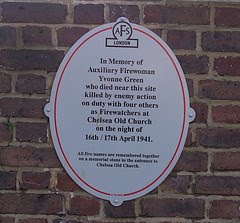
Yvonne Marie Green was a 30 year old thirteenth generation Canadian from Montreal who had recently been divorced from Tyrou Nichol, a British actor. She had re-married, this time to Leonard Green, an officer of the Canadian Army who had been posted on attachment to the Royal Tank Regiment shortly after the outbreak of war. The family home was at 24 Old Church Street, Chelsea but like all worried husbands who were in a position to do something about it, Leonard had tried to move Yvonne to the relative safety of the country and for a while, she dutifully lived with him near his barracks at Farnham in Surrey but being the fiercely independent and fiesty character she was, Yvonne was having none of this and soon moved back to London and later joined the AFS as a Firewatcher based at Chelsea Old Church.

Yvonne had left her baby daughter Penelope, in the safety of Canada with her mother and from her regular correspondence to 'Maman Cherie' which survive in the archives of the Imperial War Museum, we can see just how independent this remarkable lady was. Her letter dated 8th October 1940 demonstrates exactly what she thought of life in the country:

'Here I am back in London again, to your honor and my satisfaction. Honestly, Farnham was a simply dire place and I'd rather face Goering's worst than die from pernicious boredom. I take no chances, believe me, and when I'm not on duty I sleep downstairs very snugly in the basement. Don't alarm yourself when you don't hear from me because I have given instructions that if anything should happen to me you should be informed - so no news is good news - remember that.'

Yvonne's letters are all like that - newsy, common sense, matter of fact and with an unshakeable belief in the final victory of the British Empire and her Allies. By 23rd February 1941, she was writing home to report on her first night stationed at the top of the tower of Chelsea Old Church:

'I had quite an exciting experience on Wednesday night - my first night as a fire watcher. I was as high as one could get in Chelsea Old Church tower being shown around; where the buckets of sand, stirrup pumps and water were. And the bombs dropped! The first we'd seen in our district since September. I tell you, I have never descended a spiral staircase as fast in all my life! It was only a stick of three bombs in the next street which luckily did little damage and only one man hurt-a broken leg. So my experience was not disastrous luckily, but its going to take a lot to inveigle me up to the top of that tower again while a Blitz is in progress. I have never had a head for heights anyway.'

Chelsea Old Church dates from 1157 and includes Sir Thomas More's private chapel that was added in 1528, with the nave and the tower that Yvonne took a dislike to being added in 1670.

On the night of 16th/17th April 1941, Yvonne was not originally meant to have been on duty but had swapped shifts with one of her colleagues. At about 1.00 a.m., whilst the raid was at its height, she and five of her Fire Watching colleagues set off on a patrol along Chelsea Embankment. Whilst one of the team, a Mr Mallett was examining some shell fragments in the road, he became aware of something floating down behind him. He quickly realised that this was a Parachute Mine and shouted at the others to run. His colleagues were about twenty feet away from him and began to run towards Chelsea Old Church. Mr Mallett was running too quickly to turn the corner and follow them, so instead ducked for shelter behind a fire alarm cover. At about the same time, a second Parachute Mine descended between the still running group of five Fire Watchers and the Church. This mine exploded, also setting off the first and in the resulting blast, most of the Church was destroyed and five out of the six Fire Watchers were killed, the only survivor being Mr Mallett.

One of those killed was Yvonne Green, the visitor from overseas known as 'Canada' to her colleagues and 'Papoose' to her Mother. She had written what proved to be her last letter home barely two days previously, on 15th April 1941:

'The Blitz hasn't affected London for some days now or nights. I should say now but I think it is a fair assumption to say that it is purely temporary and we'll be getting it again soon - maybe. Adolf has a little too much on his hands now though to try and defeat civilian morale as well as coping with the armed forces of Greece, Yugoslavia, Australia and us (not forgetting the Free French).'

Yvonne's mother would no doubt have received this final letter after she learned of her daughter's death. Yvonne is remembered today, along with her four colleagues killed on that tragic night by a plaque inside the rebuilt Chelsea Old Church, whilst Yvonne as the only member of the AFS amongst the group, has another plaque dedicated to her outside the church and installed by the excellent 'Firemen Remembered' charity which does so much to keep alive the memory of the men and women of the wartime fire services.

Yvonne's daughter, Penelope Nichol along with her daughter and grandson came over from Canada to unveil the plaque in 2007, providing a wonderful family connection with a heroine from overseas. Yvonne herself is buried at West Hoathly in Sussex.

Published Sources:

Blitz - M J Gaskin, Faber & Faber 2005
London at War 1939-45 - Philip Ziegler, Sinclair Stevenson 1995

Unpublished Sources:

Imperial War Museum Archives
Royal Borough of Kensington & Chelsea Archives