Showing posts with label Chelsea. Show all posts

Friday, 24 April 2015

Discovering Wartime Chelsea

Wartime memorabilia at the Royal Hospital (author's photo)
 
I was recently lucky enough to guide a small family group from New York for a whole day exploring various aspects of London's wartime past and for part of this day, we took a walk around Chelsea, an area that perhaps does not at first thought appear synonymous with this most violent part of our capital city's recent history but is nevertheless an area which suffered heavily not just during the Blitz of 1940-41 but also suffered it's fair share of the later V-1 and V-2 weapons of 1944-45

However, it was coincidental that we happened to take our walk on the 74th anniversary to the day of an air raid that became particularly engrained on the history of this historic borough - April 16th/17th 1941 - a raid so ferocious that it became known to Londoners of the time simply as 'The Wednesday' and one which recurs with a terrifying regularity in the history of wartime Chelsea.

We started our walk outside Sloane Square Underground Station. This station was originally opened to the public on 24th December 1868 by the Metropolitan District Railway as part of that company’s first section of line between South Kensington and Westminster. In 1872, the company connected with the erstwhile rival Metropolitan Railway’s tracks at South Kensington and the Inner Circle, predecessor of today’s Circle Line began to operate, although the full circuit was not completed until 1884. In 1939, the station began an extensive upgrade as part of London Transport’s ‘New Works Scheme’ which included the installation of escalators, the first of their kind on a sub-surface line. The works were completed on 27th March 1940 but to no avail, because on 12th November 1940, the station was struck by a HE Bomb causing the modernized station to be almost totally destroyed. 

Tragically, 36 people were killed and a further 79 seriously injured, mostly aboard a train which had been leaving the station when the bomb struck and which caused large pieces of rubble to fall onto the train carriages. The station was rebuilt again after the war and today the only clue to the damage can be seen from the platforms where the stubs of the original cast iron supports to the old glazed station roof are still visible protruding from the retaining walls above the platforms. 

From this location, we exited the station forecourt and proceeded across Sloane Square, turning into Lower Sloane Street, before taking the first turning on the right into Turks Row. 

Self-explanatory plaque at Turk's Row (author's photo)
 
During the Second World War, the large apartment blocks known as Sloane Court and Sloane Court East were in use as billets for American Army personnel stationed in London. At about 8 a.m. on Monday July 3rd 1944, a V-1 Flying Bomb fell in the street outside Sloane Court East which completely destroyed this building. The death toll was horrendous – 74 American service personnel – including several women were killed along with 3 British civilians and with many more injured. 

An eye-witness to the immediate aftermath of this incident was Bill Figg, a young RAF serviceman on leave in his home area of Chelsea. After the war, Figg recalled what he saw and heard:

"I heard the unmistakeable sound of a V1, like a motorcycle without a silencer."

The missile struck, blowing Figg off his feet. He picked himself up and rushed around the corner into Turk's Row and was greeted by a scene of immense horror.

"I saw this Army truck with four bodies slumped over the back. In the middle of the road, there was a head. All down Sloane Court East, there were more bodies than you could shake a stick at. You just rolled over the bodies and felt the pulse. I must have rolled over twenty or thirty bodies but they were all glassy-eyed."

Reputedly the exact spot where the V1 fell (author's photo)

The casualties incurred by the WACs, or Women’s Army Corps to give them their full title, were the first suffered by them whilst serving overseas. Today, a plaque on the wall of the replacement building commemorates those who died whilst on the opposite side of the road another small plaque set in the pavement reputedly marks the very spot where the missile fell. 

Glenn Miller’s Army Air Force Band had been billeted at Sloane Court but had moved to RAF Twinwood near Bedford, the day before the V-1 struck. Concerned for the safety of his band, Miller had insisted on the move due to the number of V-1s falling in the vicinity at this time and faced with a lack of US Army transport – the local Motor Pool refused to work on a Sunday – he made a deal with the RAF to transport him and his band in return for performing a concert for the RAF personnel at the band’s new base. Thanks to his intuition, Miller undoubtedly saved his band from death or serious injury on the following day. As it was, Major Glenn Miller took off in foul weather from RAF Twinwood on December 15th 1944 in a Norseman light aircraft to play a concert in Paris for Allied servicemen but disappeared en route, never to be seen again. 

We left this once melancholy scene which now echoes to the cheerful sound of children playing in the school which today partially occupies the site and continued along Turks Row, turning left at the junction with Franklin’s Row and then right at the junction with Royal Hospital Road. 

The Royal Hospital, Chelsea was founded in 1682 by King Charles II and was intended ‘for the succour and relief of veterans broken by age and war’ and has fulfilled that role ever since, although today’s veterans are anything but broken by age and war being usually very sprightly ambassadors for the British Army. 

Royal Hospital Roll of Honour (author's photo)

Today, female as well as male pensioners are allowed – the qualification being that ‘in-pensioners’ as they are called, must be former Non Commissioned Officers or Soldiers of the British Army in receipt of an Army or War Service Pension who are normally over 65 years of age and who have no obligation to support a partner or family. Prior to the opening of the hospital, no specific provision had ever been made for old and retired soldiers. 

Designed by Sir Christopher Wren, the buildings were completed in 1692 and the first pensioners were admitted in February of that year. Parts of the hospital were damaged by German bombs in 1918, rebuilt in 1923 and damaged again during the Second World War. The hospital and grounds suffered extensive damage during this conflict, being bombed over 20 times starting in the early days of the Blitz in September 1940, right through to almost the end when a V-2 rocket fell in the grounds on 3rd January 1945 with the loss of 4 lives and 28 injured. 

The worst incident was on the night of 16th/17th April 1941, when the Infirmary was destroyed by a Parachute Mine with the loss of 15 lives and a further 50 serious injuries; the oldest of those in-pensioners killed was Henry Rattray, who was 101 years of age and a veteran of the Zulu Wars.

The Infirmary designed by Sir John Soane had been added in 1809 and is now the site of the National Army Museum. The idea of this museum was first conceived in the late 1950s by Field Marshal Sir Gerald Templar and was originally located at Sandhurst, home of the Royal Military Academy. The present location was chosen as a more central venue for the Museum and construction of the building was commenced in 1961 but took ten years to complete, with the present Museum opening to the public on November 11th 1971. Most of the fundraising for the construction of this building was undertaken personally by Sir Gerald Templar. This Museum, which is currently closed for an extensive refurbishment, is scheduled to re-open in 2016 and if it lives up to it's former incarnation, will continue to be well worth a visit.

We continued along Royal Hospital Road, walking towards the Thames Embankment, until we reached Cheyne Place, a terrace of houses and apartment blocks on the right hand side of the road. On the night of 16th/17th April 1941, a Parachute Mine detonated in the street, destroying or severely damaging numbers 25-43 and causing many casualties, including 3 AFS Firemen who were killed at the scene and whose names are commemorated on a plaque at Kings Road Fire Station, which we passed later in the walk. Like all London Fire Brigade and AFS Stations, Cheyne Place was given it's own unique alpha-numeric code and perhaps one of the AFS firefighters of the time had been a stonemason or sculptor in his civilian life, because the code letters '6W', the designated code for the Fire Station remains visible to this day, carved neatly into the stonework of one of the buildings concerned.

Station 6W of the AFS at 19/21 Cheyne Place (author's photo)

We continued along Royal Hospital Road and turned right into Christchurch Street before embarking on a walk through some of the most peaceful side roads to be found in Central London, eventually finding ourselves at the junction with Cheyne Row, where we paused outside The Church of Our Most Holy Redeemer, which was the scene of another serious wartime incident. 

In common with many other London churches during wartime, the crypt (the entrance to which was at 21 Upper Cheyne Row) was used as a Public Air Raid Shelter. On the night of  September 14th 1940, between 80 and 100 people were sheltering inside when a HE Bomb crashed through the West Window and the floor, exploding in the crypt. Sadly, 23 of those sheltering including the Shelter Warden, Bert Thorpe, were killed in the explosion and the ensuing fire which was one of the worst incidents in the borough of Chelsea. 

Josephine Oakman was a young Air Raid Warden who kept a diary, which is now in the possession of the Royal Borough of Kensington & Chelsea's Archives. Her entry for this date makes heart rending reading:

"18:27 - Bomb on Holy Redeemer. Got sent off by Bert Thorpe on bike patrol in Glebe Place and had hardly got away when HE sailed through church window, through crypt floor to cellar where it exploded against some strutting among 80 odd people. I got knocked off the bike. A second knocked me down again and a third sent a brick onto my tin hat. I went to Holy Redeemer and set to work on stirrup pumps. The cries and groans were awful. God help them all. We took 12 dead and put them in the garden by the church as it was getting dark. I think my heart broke this night over the sights I have seen today."

Despite this direct hit, the church which was consecrated in 1895, was not badly damaged and continued in use as a church and a shelter, with permanent repairs being completed by 1962. 

After some reflection, we left this now peaceful backwater and proceeded along Cheyne Row until we reached the junction with Cheyne Walk where we turned right, following the River Thames upstream. After turning right into Cheyne Walk, we reached Chelsea Old Church, located appropriately on the corner of Old Church Street and set in its own small garden. 

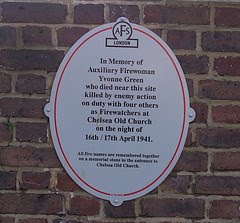
Memorial to Yvonne Green (author's photo)

 
Memorial at Roper's Garden (author's photo)

Today, the Church Garden with its statue of Thomas More and Roper’s Garden opposite the Church form a peaceful oasis away from the incessant flow of traffic along Chelsea Embankment but as can be seen from the two plaques on the walls of Roper’s Gardens, it becomes clear that on the night of  April 16th/17th 1941, this area was anything but an oasis of peace. The plaque located overlooking Chelsea Embankment tells us that Roper’s Garden is built on land formerly occupied by buildings destroyed during the raid on that night, whilst the plaque located in Old Church Street is erected by the charity ‘Firemen Remembered’ and commemorates the life of Yvonne Green, a 30 year old Canadian Auxiliary Fire Service (AFS) Fire Watcher killed on the same night along with four of her colleagues. 

Memorial inside the rebuilt Chelsea Old Church (author's photo)

We covered Yvonne's story in the April 2011 edition of this blog but suffice to say that Yvonne Green and four of her five Fire Watching colleagues were killed and Chelsea Old Church almost completely destroyed, when two Parachute Mines detonated in close proximity on this terrible night. Yvonne was another prolific writer - this time in the form of letters to her Mother, safely back home in Canada and what proved to be her last letter home, dated just two days before her death, makes poignant reading:

"The Blitz hasn't affected London now for some days now or nights. I should say now but I think it's a fair assumption to say that it is purely temporary and we'll be getting it again soon - maybe."

From this now tranquil scene, we proceeded north along Lawrence Street and eventually turned right into Kings Road. Proceeding along this busy thoroughfare, we passed the recently closed Chelsea Fire Station at the junction with Dovehouse Street. Another of the commemorative plaques erected by ‘Firemen Remembered’ adorns this building and we paused here to remember the sacrifices made by these men over the years, not only in wartime but also as recently as 1968. We had already passed the site of those killed at Cheyne Place, whilst the location of those killed at Chelsea Square is somewhat to the rear of the Fire Station we were standing by, with Brompton Road and St Stephens Hospital to the north of our position. The present day Chelsea & Westminster Hospital is on the site of the old St Stephens Hospital which was seriously damaged in December 1944 by a V-2 rocket. 

Chelsea Fire Station plaque (author's photo)
 
From the Fire Station, we continued a short distance along Kings Road until we reached the pleasant open space known as Dovehouse Green. On the wall of the old Town Hall building, we saw two memorials, one to the Civilian War Dead of the people of Chelsea and the other, a small brass plaque that commemorates two members of the Heavy Rescue Service, Anthony Smith GC and Albert Littlejohn BEM. 

The George Cross is the highest civilian award for bravery and therefore not given lightly, so the story of these two men is worth recounting. Anthony Smith was a chimney sweep by trade who had fought in the Royal Marines during The Great War and had lost three fingers of one hand on The Somme in 1917. He had tried to re-enlist on the outbreak of war in 1939 but his injury precluded this and so instead had joined the Heavy Rescue Service based at Chatham, Kent. On the night of 23rd February 1944, during the so-called 'Little Blitz', a lone raider dropped two bombs which were possibly aimed at Lots Road Power Station but which missed and instead fell on The Guinness Trust buildings on the corner of Edith Grove and Kings Road. Both blocks collapsed and Anthony Smith soon arrived with the Heavy Rescue Squad. Many people were trapped in the rubble and Smith heard the cries of one of them, a baker called Sam Mitchell who was trapped in the basement. Smith entered the basement through a gap in the rubble, which soon after he entered collapsed, trapping him also. 

Tony Smith persevered and soon found Mitchell in the rubble, freed him and dragged him to the rear of the building where he broke through a wall to safety. Without thinking of his own safety, Smith then joined his colleague Albert Littlejohn and re-entered the basement, which by this time was flooding with water from a broken main and rescued a woman who they helped to safety. 

Smith and his colleagues worked all night freeing victims and recovering bodies. In all, 76 people died that night but many others were rescued thanks to Anthony Smith and his colleagues from the Heavy Rescue Squad. He was awarded the George Cross in May 1944 and made a Freeman of the Borough of Chelsea in June of the same year. A fuller account of Tony Smith's story appeared in the February 2012 edition of this blog.

Dovehouse Green memorials (author's photo)

From this modest but inspiring memorial, we returned to Kings Road and turned left at the traffic lights into Sydney Street and entered the delightful gardens adjoining Parish Church of St Luke’s. This church was damaged on 16th October 1940 by an incendiary bomb in the belfry which was brought under control before too much damage was caused and also by a HE Bomb on St Luke’s School (now the Church Hall) which severely damaged the eastern end of the church buildings generally. This end of the church still shows considerable signs of shrapnel damage and also some repaired areas of masonry. The churchyard had also been the scene of an unexploded bomb on 15th October 1940 which was rendered safe by the Bomb Disposal Squad. The church, which was designed by James Savage and consecrated on 18th October 1824, is the largest and tallest parish church in London. It is also the home to several interesting war memorials from both World Wars including the 3rd Gurkha Rifles, 140th Field Ambulance Royal Army Medical Corps, various units of The Royal Engineers and the 51st London Heavy A.A. Regiment. In more recent times, the church has been a frequent location for film makers and was perhaps most notably a location for ‘Four Weddings and a Funeral.

Coming towards the end of our walk, we headed towards Draycott Avenue, at which point we continued ahead for a few metres, entering Cadogan Street with the Guinness Trust Buildings to our right hand side. We took the time to peer into the pedestrian entrance into this estate. Underneath the covered walkway entrance, just off Cadogan Street, it was possible to see a delightful memorial to the men of Draycott Avenue who died during an earlier conflict, The Great War of 1914-18. It was hand written and simply titled ‘Our Roll of Honour’ and even after almost 100 years, our group still found it intensely moving to see this simple memorial to the men of an ordinary street in west London. 

"Our Roll of Honour" - Draycott Avenue (author's photo)

As always, there is much more to see on one of our walks and even a description of walk such as this, does not compare with actually "walking the ground", so come along one of these days - you will be surprised as to what can still be seen of our wartime history.


Published Sources: 

London Transport at War – Charles Graves, LPTB 1947 
The Story of London’s Underground – John R Day & John Reed, Capital Transport 2001 
Blitz – MJ Gaskin, Faber & Faber 2005 
Ordinary Heroes – David Walker & Roger Morgan, the Royal Borough of Kensington & Chelsea 2005 
A Guide to St Luke’s Church Chelsea – Clare Johnston, privately published 1999 

Unpublished Sources: 

Metropolitan Borough of Chelsea ARP Incident Log 1940-45 
Extracts from Josephine Oakman's Diary
 

Friday, 17 May 2013

Logging the Blitz

The Blitz Hotel (Greenwich Heritage Centre)

Perhaps one of the lesser known aspects of the Civil Defence services during the Second World War but a vital one none the less was an administrative one, carried out as and when the bombs fell by a group of now anonymous senior air raid wardens or council officials, usually tucked away in the basement of a town hall at the end of a network of landline telephones and messengers. As each raid developed, every bomb that dropped, each incident as it developed, was logged and as the reports came in, the controllers would ensure that the correct response to each developing incident was despatched to the scene, whether this be the recognised emergency services such as the fire, police or ambulances, the seemingly mundane but equally essential  services such as the local gas board officials to switch off the supplies where gas mains had been severed by bombs, or the melancholy task of arranging mortuary vans to remove the unfortunate victims of war.

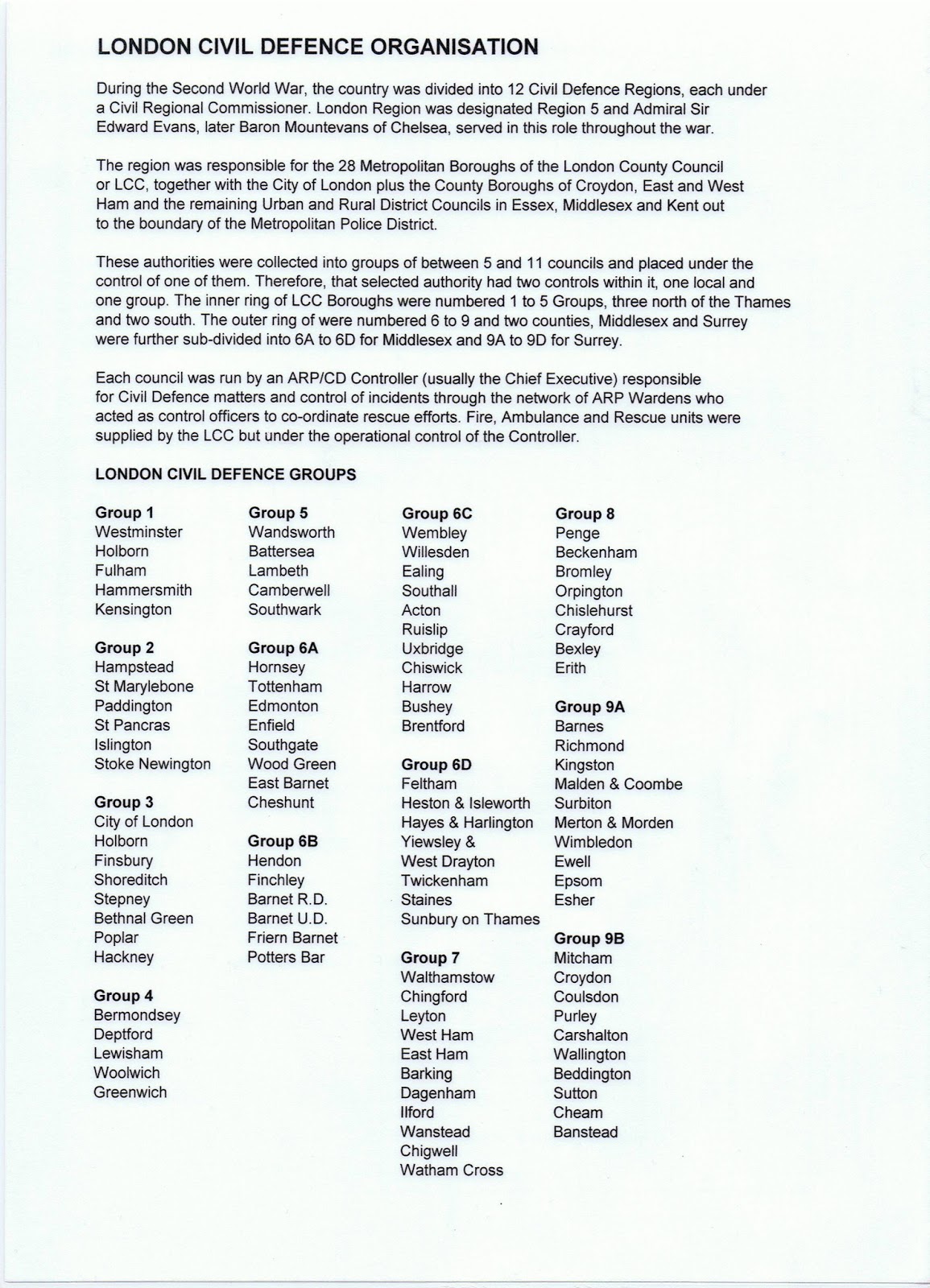
London Civil Defence organisation
The Civil Defence organisation had been established in 1938 as a response to the Munich Crisis and a brief explanation is required to give the reader a better understanding. The country was divided into twelve civil defence regions, each of which was placed under the control of a Civil Commissioner. London was designated Region 5 and was placed under the command of a veteran of Captain Scott's ill-fated Antarctic Expedition of 1912 and subsequently a First World War hero, Admiral Sir Edward Evans - "Evans of the Broke" as he had become known. Evans was to serve in his role as Civil Commissioner for the majority of the war and threw himself into the role with the energy and enthusiasm that had typified his Royal Naval service.

London Region was responsible for the 28 Metropolitan Boroughs of the erstwhile London County Council, or LCC as it was known, together with the City of London plus the County Boroughs of Croydon, East and West Ham and the remaining Urban and Rural District Councils in Essex, Middlesex, Kent and Surrey out to the boundary of the Metropolitan Police District. These authorities were collected into groups of between 5 and 11 councils and placed under the overall control of one of them. Therefore, that selected borough had two controls within it, one local and one group. The inner ring of LCC Boroughs were numbered Groups 1 to 5, three north of the Thames and two south. The outer ring were numbered 6 to 9 and two counties, Middlesex and Surrey, were further sub-divided into 6A to 6D for Middlesex and 9A to 9D for Surrey.

A typical 'chain of command' - this one is for Westminster

Each council was run by a Civil Defence Controller (usually the Town Clerk/Chief Executive) who was responsible for Civil Defence matters and the control of incidents through the network of ARP Wardens who acted essentially as incident officers, patrolling the streets often during the height of an air raid, pinpointing incidents and co-ordinating rescue efforts on the spot. Fire, ambulance and rescue services were supplied by the LCC but were under the operational control of the Controller. A copy of the organisation for London Region is shown for easy reference, as is a copy of a typical 'Chain of Command' for one London borough - on this occasion Westminster but which was echoed across the capital.

A typical incident report sheet (author's image)
Fortunately for today's historian, the majority of London boroughs kept their Incident Logs after the war, although some did dispose of them in the 1960s and 70s, in what today seems like a terrible piece of historical vandalism. Neil and I have spent many hours sitting in local authority archives transcribing these records and although we still have a few to go, between us we have so far gathered about half of the various London boroughs' records.

Reading these logs today, it is amazing to think that they were written at the moment that history was being made. The actual presentation of the logs varies from borough to borough; for example the Greenwich Log has been transcribed at the time into a series of A4 sized notebooks, whilst the neighbouring borough of Woolwich's log is still as it was written at the time with each individual development of an incident written on a separate report sheet. In this way, a major incident could require upwards of twenty such sheets, each updating the incident as it developed.

The other striking thing about reading these logs today is the matter of fact way that major incidents were noted. Whilst this professionalism cannot be faulted, one cannot help but wonder what feelings were going through the minds of the officials concerned whilst writing up and recording these reports, especially on those occasions when they were reporting on incidents in their own immediate neighbourhoods, or perhaps even seeing a report of their own homes being destroyed. Reproduced above is a typical report sheet from the Borough of Woolwich, which reports a fairly minor incident but which gives the reader the general idea of how an incident was written up.

Sometimes, these reports can today appear ridiculously terse; for example the terrible incident on 17th April 1941 that saw the destruction of Chelsea Old Church and the tragic loss of life of Canadian firewatcher Yvonne Green and four of her colleagues is reported simply "Para Mine - heavy damage, casualties, water and gas mains gone." Obviously, there would have been more detailed incident sheets written at the time but this precis still somehow captures the horror of the incident, which was recorded more fully in the April edition of this blog. In other boroughs, the reports go into more detail, some of which even seventy years on, are heartbreaking. For example, the Woolwich report of an incident in the 'Little Blitz' on 2nd March 1944, lists the four fatal casualties by name, including six week old baby Joyce Bowskill - a life cruelly ended before it had properly begun and which had even this fairly hardened researcher having to stop work for a while in order to reflect.

Devastation in Heavitree Road (Greenwich Heritage Centre)
The onset of the terror weapons in 1944 kept the recorders busy and in the south east London boroughs especially, the casualties started to mount again. A Woolwich report of an incident at Heavitree Road, Plumstead on 16th June 1944 lists seven fatal casualties and laconically describes "houses in Heavitree Road heavily damaged." A local photographer recorded the scene and it must be said that the writer of the report was a master of understatement.

Throughout all of the horrors of the London Blitz, a sense of humour prevailed, even amongst the Wardens and Civil Defence personnel who were very much in the front line and saw some terrible things in the course of their duties. When the Wardens' Post 'EE1' in Milward Street, Woolwich was rendered uninhabitable following a nearby V-1 strike in August 1944, the wardens, who must have endured a fearful shaking up when the flying bomb detonated, still saw fit to re-christen their devastated place of work 'The Blitz Hotel' as the accompanying photograph at the head of the page shows.

In August 1944, the British public may have been forgiven for thinking that despite the onset of the V-1s, the end of the war was in sight. Unfortunately, they had another seven months of V-2 rockets to endure, which brought yet more misery to the people of London but which were faithfully recorded by the London boroughs. The final incident shown in the Woolwich Incident Log is on 19th March 1945 was a rocket which fell on one of the piers servicing the Woolwich Arsenal, which itself had suffered terrible damage during the Blitz of 1940. This rocket exploded on the pier itself, causing 37 'slight' casualties, no doubt mainly cuts and shock but mercifully no fatalities. The last V-2 of all fell on Kynaston Road, Orpington on 27th March 1945, killing Mrs Ivy Millichamp in her home. With this one final fatal casualty, London at last had seen it's last attack from the German bombs which had started way back in August 1940.

Unpublished Sources:

Civil Defence Incident Logs for Metropolitan Boroughs of Chelsea, Greenwich & Woolwich and City of Westminster 


Friday, 6 April 2012

The Wednesday and The Saturday: Birthday Presents from Hell

The week following Easter 1941 saw London enjoying a short lull in the Blitz. The raids had died down from the intensity of nightly raids and though there had been raids throughout the early months of 1941, there had not been a serious raid on London since the 19th March. Londoners were not to know it but Hitler's thoughts were beginning to turn towards the invasion of the Soviet Union, for which task he would need to divert a considerable amount of his Luftwaffe resources from the Blitz on British towns and cities.

However, all this was in the future and before the worst was over London was to suffer three more heavy raids, culminating in the heaviest of them all on the night of 10th/11th May 1941, which we have examined previously in this blog.

In this short article, we shall examine what proved to be the penultimate two raids of the First Blitz, on the nights of 16th/17th April and 19th/20th April. These raids were so heavy that they became known in Londoners' folklore as 'The Wednesday' and 'The Saturday' respectively. Both of these raids were laid on as a strange sort of present to commemorate Hitler's birthday on 20th April, although 'The Wednesday' was also a revenge raid for damage caused to the Berlin State Opera House on the 9th April, in one of the RAF's early raids on the German capital. Indeed, a forewarning of the raid that would go down in history as 'The Wednesday' was given by William Joyce, aka 'Lord Haw Haw' in one of his 'Germany Calling' broadcasts from Hamburg, when he announced "There's going to be a bombing" although naturally, he did not give away the actual date of the planned raid.

These raids were savage in their intensity and affected parts of London that had hitherto only received light attention from the Luftwaffe, as well as re-visiting other areas that had already seen plenty of damage inflicted. So it was that as well as the East End and southeastern suburbs of London, areas such as Chelsea, the West End and St Marylebone were heavily hit in these two raids and though there is insufficient space in a blog of this nature to visit every target, we can at least examine some of the more notorious incidents across London on these two nights.

One famous London landmark destroyed on 'The Wednesday' was Chelsea Old Church, the home of Sir Thomas More's private chapel. Apart from the near total loss of a fine historic building, today happily restored, this tragic incident also saw the loss of five Fire Watchers, including the Canadian AFS volunteer, Yvonne Green, whose story has been told in a previous post in this series. Elsewhere in Chelsea, the famous Royal Hospital, home of the Chelsea Pensioners was also severely damaged on 'The Wednesday' when the Infirmary was destroyed by a Parachute Mine. These deadly blast weapons, converted from naval mines were used in large numbers during these later raids of the Blitz and it was one of these which cost the lives of fifteen in pensioners and Royal Hospital staff in this one incident. One of those killed was 101 year old Henry Augustus Rattray, a veteran of the Zulu Wars who had served with the 24th Regiment of Foot. The building itself had been designed by Sir John Soane and built in 1809 and had the damage been incurred today, then probably this fine historic building would have been restored. As it was, damaged buildings in wartime London, now matter how historic were invariably pulled down as unsafe. The site was cleared and is now the location of the excellent National Army Museum; a new infirmary was finally opened on a new site within the Hospital grounds in 2008.

Moving away from Chelsea, we move to the West End, which like Chelsea had suffered relatively little until now. The City of Westminster, then as now encompassed the bustling West End as well as the seat of government and it was in the former part of the borough that we examine our next incident, which resulted in the death of one of Britain's singing stars of the day. Al Bowlly was a major star of stage and screen, whose popularity had transcended national barriers which had made him popular on both sides of the Atlantic, which was quite an unusual achievement for a British star in those days. On 'The Wednesday', Bowlly had played a concert in High Wycombe and had been given the opportunity of staying overnight in the Buckinghamshire town but had eschewed this offer in order to catch the last train home to Marylebone in order to sleep at his own apartment in Duke Street, just off Jermyn Street. It was to prove a fatal decision as in the early hours of the morning another deadly Parachute Mine exploded outside. When rescuers found his body, it was unmarked and in a final touch of irony, it was discovered that he had died from a severe blow to the head, caused by the heavy bedroom door being blown off it's hinges and striking him a fatal blow.

We move now to 'The Saturday', the second of the raids to commemorate The Fuhrer's birthday and travel across London to the historic Borough of Greenwich, already heavily hit during the earlier raids of the Blitz. As now, this borough was the home of such historic buildings as the Royal Naval College, The Queen's House and National Maritime Museum, in 1941 it was also the home to a considerable amount of industry and another of these historic buildings was located in what was then a somewhat run down part of the town centre. The parish church of St Alfege has been located on the current site since the year 1012, where it reputedly marked the site of the martyrdom of Alfege, Archbishop of Canterbury who was murdered at that location by Danish Vikings on the 19th April 1012. The second church, dating from 1290 was the location of the future King Henry VIII's baptism in 1491. The present church, designed by Nicholas Hawksmoor, dates from 1718 and is the site of the tombs of amongst others, Thomas Tallis and General James Wolfe, victor of the Battle of Quebec in 1759 and whose statue looks down over Greenwich from the heights of Greenwich Park.

In a strange quirk of history, the interior of this fine church was to be largely destroyed on the 929th anniversary of Alfege's murder when incendiary bombs lodged in the roof timbers and brought the whole structure blazing into the main body of the building where it burned out of control. The aftermath can be seen in the photograph at the head of this page. Fortunately, the sturdy stone structure survived and the church was rebuilt after the war and rededicated in 1953. Today, the church stands proudly over the busy, rejuvenated town centre and is well worth a visit.

Following these two heavy raids, London again enjoyed a short lull before what was to prove the last and largest raid was unleashed on the night of 10th/11th May 1941.

Published Sources:

A Wander through Wartime London - Clive Harris & Neil Bright, Pen & Sword 2010
London at War 1939-1945 - Philip Ziegler, Pimlico 2002
Westminster in War - William Sansom, Faber & Faber 1947

Friday, 28 October 2011

The real heroes of football

Spotter at The Valley (Greenwich Heritage Centre)
As we have already discussed the nation's summer sport in an earlier post, it only seems fair to take a look at the winter game and how it fared during the dark days of the Second World War.

Firstly, it should be remembered that in many ways, football was a completely different game to the sport we know today. In the 1940s, it was truly the working mans' game and the players and spectators had far more in common with each other in those days than is the case today. For example, it is hard to imagine today's pampered Premiership stars travelling to the game by public transport; indeed, it is highly probable that most of them would get lost inside a tube station and would have no idea as to how to go about catching a bus!

Another thing that is hard to imagine is any of the players of today, giving up the game "for the duration" and donning the uniform of one of the fighting services, not for a cushy job on the sidelines but actually putting their lives on the line. Perhaps this writer is too much of a cynic but cannot help thinking that the agents who represent these players would be furiously trying to extricate their clients from any sort of involvement. We can only hope that such a situation never arises.

Upon the outbreak of war on 3rd September 1939, the 1939/40 football season was just three matches old and on the Saturday before the fateful Sunday which heard Prime Minister Neville Chamberlain broadcast to the nation that "consequently, this country is at war with Germany", the matches seem to have been played in a curiously subdued atmosphere. Indeed, across the country, attendances for these matches were greatly reduced. For example at The Valley, home of Charlton Athletic, which only a year previously had seen a crowd of 75,031 for a cup match against Aston Villa and where the average for the previous season had been over 25,000, a mere 8,608 had bothered to turn up to watch The Addicks play Manchester United. It seemed that minds were already drifting towards the inevitability of war.

On the outbreak of war, the Government immediately banned any form of public assembly, which meant that all forms of public entertainment ceased forthwith. The reasoning behind this was to avoid mass casualties in the air raids which were expected to begin the moment that war was declared. Fortunately, the raids and mass destruction did not materialise and the Government's somewhat panicky restrictions, which had also seen the closure of all theatres and cinemas, as well as sporting venues, were soon eased. Although the Football League programme had been abandoned, it was decided to commence a greatly reduced and regionalised league programme, so as to avoid causing problems for Britain's public transport system, which was also very much on a wartime footing. As it was, football matches had to cease immediately upon the sounding of the Air Raid Alert and our photograph shows a spotter posted at The Valley, home of Charlton Athletic, keeping a sharp look out for enemy raiders.

When football did resume, attendances were greatly reduced; after all the vast majority of football supporters were disappearing into the armed forces and those that did remain were too heavily involved with their wartime jobs to be able to spare the time to travel to away matches in any case. Despite this, it was recognised that football, along with other forms of entertainment, needed to continue in order to provide some form of diversion from the war. Once it was decided to resume playing, the problem for the clubs was one of raising teams.

With the termination of the league season in September 1939, players had been released from their contracts in order to make themselves available for war service and each club made different arrangements for their players. For example, in 1938 at the time of the Munich Crisis, West Ham's players were encouraged to join either the Territorial Army or the Reserve Police, whilst Arsenal's squad nearly all became ARP Wardens. Brentford, at that time a top division club, saw their players become War Reserve Policemen, whilst Liverpool's entire first team squad joined the Territorial Army. It was suggested in some quarters that this mass joining up at these and other clubs was a cynical ploy by club chairman in order to keep their playing squads together. Whilst there may have been some truth in this viewpoint, it quickly backfired when the league season was abandoned and the players had nowhere to play!

When the new regionalised league began in late October 1939, many of these players had already been called up with their new units and in many cases were posted far and wide across the country. With the cancellation of contracts, players were able to guest for clubs in the areas to which they found themselves posted. So it was that Charlton players such as Sam Bartram and 'Sailor' Brown guested for Southeast London arch-rivals Millwall, Stanley Matthews played for Crewe and Sunderland's Raich Carter regularly turned out for Derby County. If you were a supporter, you never quite knew who was going to turn out and if you could play a bit yourself, it was worth taking your boots as there was always a chance that you could end up getting a game yourself!

Just as the players themselves took up war work, many of the stadiums they had previously graced went onto a war footing, with some being immediately requisitioned for wartime purposes. For example, Arsenal's Highbury Stadium became an ARP Wardens' Post and Public Air Raid Shelter, with the adjacent training ground being taken over by the RAF for a barrage balloon unit. Supporters found themselves having to watch their beloved Gunners playing at the White Hart Lane home of their great rivals Tottenham - something that would be unthinkable today. Not surprisingly, Arsenal's ARP Wardens team, which boasted players such as England's Cliff Bastin, who was excused military service due to poor hearing, were usually the winners in matches against local rival ARP Wardens teams!

White Hart Lane, although it remained open for football, was also turned over to war work with part of the ground becoming a gas mask factory, whilst another part of the ground was set aside as a mortuary for air raid victims. Outside London, Preston's Deepdale ground became a Prisoner of War camp, as was part of Doncaster Rovers' ground at Belle Vue.

As well as being lost for war work, many grounds were damaged by bombing. In London, Arsenal's Highbury would have been rendered unusable for football even if they had been able to remain there. In October 1940, the famous old ground was damaged by incendiary bombs which destroyed the roof of the North Bank and in April 1941, a High Explosive bomb hit the training ground, killing two RAF men from the Barrage Balloon unit there and destroying a large part of the North Bank terracing. Millwall's Den ground was badly damaged, and elsewhere in London, Stamford Bridge, The Valley, Upton Park and Brentford's Griffin Park all suffered varying degrees of damage. When peace finally returned in 1945, many clubs found themselves returning to grounds that were in an extremely dilapidated state.

Grounds could always be repaired, so more importantly, let us look at what happened to those players who found themselves in the front line and in many cases made the supreme sacrifice. Raich Carter, who was mentioned earlier, was in the Fire Service and regularly put his life on the line during the Blitz on Sunderland. Two Queens Park Rangers players found themselves in German POW camps; Johnny Barr was captured in North Africa and found himself working in a German cement factory, whilst goalkeeper Reg Allen was captured in North Africa in 1942 whilst serving as a commando and after an unsuccessful escape spent the remainder of the war in an Austrian POW Camp. Charlton's Arthur Turner was the only survivor when his Coastal Command aircraft came down in the Bay of Biscay and he spent several hours in the sea prior to being picked up. Crystal Palace's Howard Girling recovered from wounds received in Germany whilst serving with the Army to play 27 times for Palace before being transferred to Brentford in 1947.

Bolton Wanderers' entire squad had joined the 53rd Field Regiment of the Royal Artillery and served at El Alamein and later in Italy, where their famous pre-war captain, Harry Goslin was killed in action. Goslin was only one of many well known players who made the ultimate sacrifice and whilst only a few can be mentioned here, all of those players who laid down their lives are remembered with honour.

Jackie Pritchard had been a promising goalkeeper with Cardiff City who was serving with the 77th Heavy Anti Aircraft Artillery and had been onboard a troopship heading for the Middle East when the Japanese invaded Malaya. His part of the convoy was diverted to Singapore and arrived two weeks before the colony surrendered in Britain's greatest military defeat of all time. Pritchard found himself as a POW in appalling conditions, as were all of those taken by the Japanese who showed a callous disregard for human life. He was then used as a slave labourer building airfields and was being moved on an unmarked ship when it was torpedoed by an American submarine north of Bali. Pritchard and his fellow prisoners had been worked almost to the point of death and in the eyes of their captors were expendable. Hundreds of these men were in the water but all hopes of rescue were dashed when the commander of a Japanese minesweeper, having picked up the Japanese survivors, then machine gunned the Allied survivors whilst they were floundering in the water. Jackie Pritchard had been the victim of a war crime.

Arsenal FC were worst affected by the war, losing no fewer than 11 players during the conflict; Cyril Tooze was killed by a sniper in Italy in 1944, Sid Pugh was killed in 1944 whilst serving with the RAF and Bill Dean, who admittedly had only appeared once for the club, was drowned when the cruiser HMS Naiad was torpedoed in the Mediterranean. Bobby Daniel was killed on Christmas Eve 1943 whilst serving with RAF Bomber Command on a raid to Prague and William Parr was also serving with the RAF, this time with Coastal Command, when he was shot down in 1942. Leslie Lack was also with the RAF, this time as a Spitfire pilot with 118 Squadron and lost his life over Holland in 1943. Hugh Glass, Albert Woolcock, Harry Cook, Herbie Roberts and Jack Lambert completed this sad list but nearly every club was affected in some way or another. As well as players, some clubs lost long serving officials; Lieutenant Colonel John Murray "Ivan" Cobbold, chairman of Ipswich Town, died whilst serving with the Welsh Guards. He died not on a foreign battlefield but whilst attending a church service in the Guards Chapel in Birdcage Walk, London, which was struck by a V-1 flying bomb on 18th June 1944. He was one of 122 fatalities in what was to prove the worst single V-1 incident of the war.

Overall, nearly 100 professional footballers lost their lives during the Second World War. Football was just one of the many aspects of British life that had been changed forever by the devastating experiences of wartime and we must sincerely hope that we never again have to see our sporting heroes donning their wartime uniforms.


Published Sources:

Gas Masks for Goal Posts - Anton Rippon, Sutton Publishing 2005

Home & Away with Charlton Athletic - Colin Cameron, Privately Published 1992

London at War 1939-45 - Philip Ziegler, Sinclair Stevenson 1995

Soccer at War - Jack Rollin, Willow Books 1985

Wednesday, 13 April 2011

The Wednesday, Chelsea Old Church and a heroine from Canada

This weekend marks the seventieth anniversary of one of the largest as well as one of the last raids of the London Blitz. So heavy and destructive was the raid of the night of the 16th/17th April 1941 that it became known to Londoners as 'The Wednesday'. Whilst most parts of London were affected by this raid, on this occasion it was the western side of the capital that suffered most and large swathes of Chelsea, the West End and St Marylebone were pounded with many lives lost and famous old buildings destroyed. It was also the night that the singer Al Bowlly was killed as he slept in his flat in Jermyn Street, having eschewed the offer of a hotel in High Wycombe after having played a concert there for the comfort of his own bed.

Although Londoners were not to know it at the time, the First Blitz was drawing to a close; Hitler was about to turn his attention eastwards and would require his Luftwaffe resources for Operation Barbarossa - the attack on the Soviet Union and the quest for lebensraum or living space for the German people. Despite this impending attack, a large proportion of the German air force would remain in the west but Hitler had decided against further attacks on London once his onslaught against the Russians had started and no amount of entreaties by the head of the Luftwaffe, Hermann Goring and his senior commanders, Sperrle and Kesselring could change his mind.

This was still in the future though and before the attack to the east, the Fuhrer's 53rd birthday on 20th April was approaching and needed to be celebrated in style. Goring decided on staging two huge raids on the capital, perhaps to flatter Hitler but also to demonstrate to him once and for all that given a free reign, his Luftwaffe could indeed flatten London.

So it was that the two raids on 16th/17th April and then on 19th/20th April were the two heaviest raids thus far of the Blitz and would only be surpassed by what proved to be the last raid on the night of May 10th/11th 1941. As mentioned briefly earlier, the west of London suffered the most in this raid; no area more than the Metropolitan Borough of Chelsea as it then was and inspecting the Civil Defence Incident Log today, one is struck by the number of times that 'The Wednesday' recurs when taking stock of the damage inflicted on the borough by enemy action and indeed, when walking the borough today, there are several memorial plaques located here and there for those in the know that confirm the record.

The Royal Hospital, home of the Chelsea Pensioners, was devastated this night when the Infirmary was destroyed by a Parachute Mine that detonated in the road outside and caused the deaths of fifteen pensioners and hospital staff. Amongst those killed was 101 year old Henry Rattray, a veteran of the 24th Regiment of Foot and survivor of many earlier campaigns.

The Infirmary itself had been an 1809 addition to Wren's original Royal Hospital buildings and had been designed by Sir John Soane. Although heavily damaged, there was arguably enough left of the building to warrant rebuilding but sadly the remains were demolished, with the site today being occupied by the National Army Museum.

Further along Royal Hospital Road was Station 6W of the Auxilary Fire Service or AFS, located in the garages of Cheyne Place. A clue to the location of this station can still be seen today in the form of a large '6W' carved in the stone wall in front of the apartments that now stand on the site. Another Parachute Mine detonated here, killing three Auxiliary Firemen, whose names are recorded on a memorial plaque, erected by the charity 'Firemen Remembered' at the present day Chelsea Fire Station in the King's Road. Another bomb, this time one of the conventional High Explosive variety caused the deaths of a further four AFS men at the Brompton Fire Station, located in Chelsea Square and these men too, are remembered on the plaque at King's Road.

Nor had the night finished with the men and women of the AFS, for when we reach the site of Chelsea Old Church in Cheyne Walk, we can discover perhaps the most poignant story of them all, which concerns a visitor from Canada whose story deserves to be told.

Yvonne Marie Green was a 30 year old thirteenth generation Canadian from Montreal who had recently been divorced from Tyrou Nichol, a British actor. She had re-married, this time to Leonard Green, an officer of the Canadian Army who had been posted on attachment to the Royal Tank Regiment shortly after the outbreak of war. The family home was at 24 Old Church Street, Chelsea but like all worried husbands who were in a position to do something about it, Leonard had tried to move Yvonne to the relative safety of the country and for a while, she dutifully lived with him near his barracks at Farnham in Surrey but being the fiercely independent and fiesty character she was, Yvonne was having none of this and soon moved back to London and later joined the AFS as a Firewatcher based at Chelsea Old Church.

Yvonne had left her baby daughter Penelope, in the safety of Canada with her mother and from her regular correspondence to 'Maman Cherie' which survive in the archives of the Imperial War Museum, we can see just how independent this remarkable lady was. Her letter dated 8th October 1940 demonstrates exactly what she thought of life in the country:

'Here I am back in London again, to your honor and my satisfaction. Honestly, Farnham was a simply dire place and I'd rather face Goering's worst than die from pernicious boredom. I take no chances, believe me, and when I'm not on duty I sleep downstairs very snugly in the basement. Don't alarm yourself when you don't hear from me because I have given instructions that if anything should happen to me you should be informed - so no news is good news - remember that.'

Yvonne's letters are all like that - newsy, common sense, matter of fact and with an unshakeable belief in the final victory of the British Empire and her Allies. By 23rd February 1941, she was writing home to report on her first night stationed at the top of the tower of Chelsea Old Church:

'I had quite an exciting experience on Wednesday night - my first night as a fire watcher. I was as high as one could get in Chelsea Old Church tower being shown around; where the buckets of sand, stirrup pumps and water were. And the bombs dropped! The first we'd seen in our district since September. I tell you, I have never descended a spiral staircase as fast in all my life! It was only a stick of three bombs in the next street which luckily did little damage and only one man hurt-a broken leg. So my experience was not disastrous luckily, but its going to take a lot to inveigle me up to the top of that tower again while a Blitz is in progress. I have never had a head for heights anyway.'

Chelsea Old Church dates from 1157 and includes Sir Thomas More's private chapel that was added in 1528, with the nave and the tower that Yvonne took a dislike to being added in 1670.

On the night of 16th/17th April 1941, Yvonne was not originally meant to have been on duty but had swapped shifts with one of her colleagues. At about 1.00 a.m., whilst the raid was at its height, she and five of her Fire Watching colleagues set off on a patrol along Chelsea Embankment. Whilst one of the team, a Mr Mallett was examining some shell fragments in the road, he became aware of something floating down behind him. He quickly realised that this was a Parachute Mine and shouted at the others to run. His colleagues were about twenty feet away from him and began to run towards Chelsea Old Church. Mr Mallett was running too quickly to turn the corner and follow them, so instead ducked for shelter behind a fire alarm cover. At about the same time, a second Parachute Mine descended between the still running group of five Fire Watchers and the Church. This mine exploded, also setting off the first and in the resulting blast, most of the Church was destroyed and five out of the six Fire Watchers were killed, the only survivor being Mr Mallett.

One of those killed was Yvonne Green, the visitor from overseas known as 'Canada' to her colleagues and 'Papoose' to her Mother. She had written what proved to be her last letter home barely two days previously, on 15th April 1941:

'The Blitz hasn't affected London for some days now or nights. I should say now but I think it is a fair assumption to say that it is purely temporary and we'll be getting it again soon - maybe. Adolf has a little too much on his hands now though to try and defeat civilian morale as well as coping with the armed forces of Greece, Yugoslavia, Australia and us (not forgetting the Free French).'

Yvonne's mother would no doubt have received this final letter after she learned of her daughter's death. Yvonne is remembered today, along with her four colleagues killed on that tragic night by a plaque inside the rebuilt Chelsea Old Church, whilst Yvonne as the only member of the AFS amongst the group, has another plaque dedicated to her outside the church and installed by the excellent 'Firemen Remembered' charity which does so much to keep alive the memory of the men and women of the wartime fire services.

Yvonne's daughter, Penelope Nichol along with her daughter and grandson came over from Canada to unveil the plaque in 2007, providing a wonderful family connection with a heroine from overseas. Yvonne herself is buried at West Hoathly in Sussex.

Published Sources:

Blitz - M J Gaskin, Faber & Faber 2005
London at War 1939-45 - Philip Ziegler, Sinclair Stevenson 1995

Unpublished Sources:

Imperial War Museum Archives
Royal Borough of Kensington & Chelsea Archives