 |
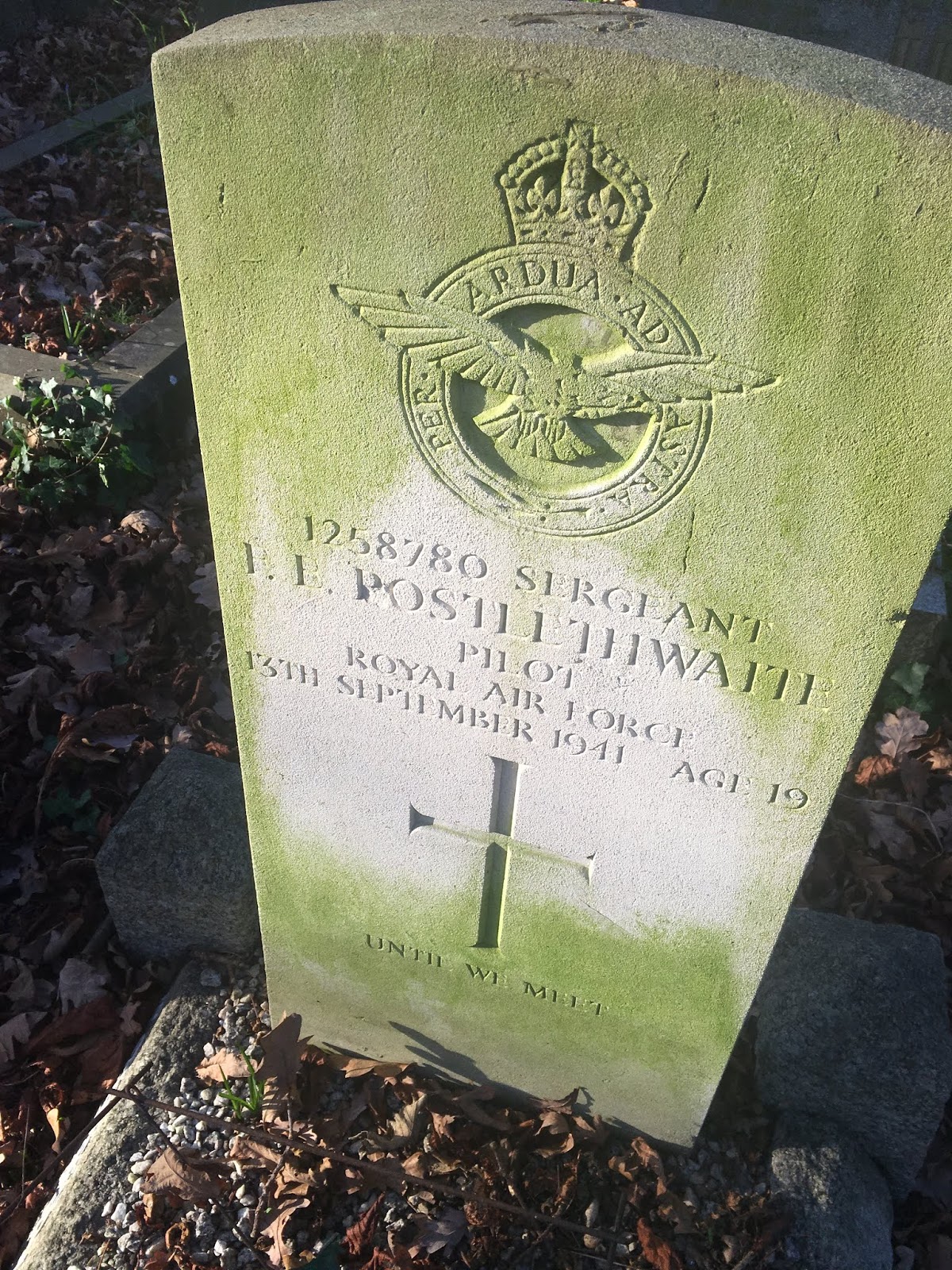
| The grave of Sgt. Frederick Postlethwaite at All Saints Churchyard, Carshalton (Sam Dorrington) |
One of the more satisfying aspects about my enthusiasm for history (or obsession depending on who you talk to) is how this tends to rub off on to my friends. This is partially because many of them have always shared this fascination in the subject but because we're never far from our wartime past in this country, they do all seem to notice points of interest much more easily these days!
Whatever the reasons, they all seem to have caught the history bug and are always quick to let me know about their finds. Sam Dorrington is one of my longest standing friends and has always shown a particular interest in the subject but in his case, this has perhaps been more a rekindling of a dormant fascination. Back in November 2016 I was proud to tell the story of his grandfather, Able Seaman Jack Dorrington and since then Sam, who is a talented professional photographer, has frequently accompanied me in searching out old wartime structures, visiting wartime airfields and often sends me photographs of various memorials and other wartime points of interest that he has discovered on his travels.
Whatever the reasons, they all seem to have caught the history bug and are always quick to let me know about their finds. Sam Dorrington is one of my longest standing friends and has always shown a particular interest in the subject but in his case, this has perhaps been more a rekindling of a dormant fascination. Back in November 2016 I was proud to tell the story of his grandfather, Able Seaman Jack Dorrington and since then Sam, who is a talented professional photographer, has frequently accompanied me in searching out old wartime structures, visiting wartime airfields and often sends me photographs of various memorials and other wartime points of interest that he has discovered on his travels.
One such photograph he sent to me recently recalled memories of my own 'accidental researching' in Charlton which I reported on in January 2017 and which incidentally, had a connection with Sam's own local neighbourhood of Carshalton in suburban Surrey. Whilst taking a shortcut to the shops through his local churchyard, he came across a Commonwealth War Graves Commission headstone and upon closer inspection, discovered many more located around All Saints' Churchyard.
Despite being familiar with the area, Sam doesn't often use the churchyard as a short cut and had thus never previously noticed the distinctive CWGC headstones and as a result, decided to send me a photograph of the RAF airman's grave that had caught his eye. As always, I needed to know more and so set about trying to find something of the story of Sergeant FE Postlethwaite and the circumstances of his death, at the tragically young age of 19.
Despite being familiar with the area, Sam doesn't often use the churchyard as a short cut and had thus never previously noticed the distinctive CWGC headstones and as a result, decided to send me a photograph of the RAF airman's grave that had caught his eye. As always, I needed to know more and so set about trying to find something of the story of Sergeant FE Postlethwaite and the circumstances of his death, at the tragically young age of 19.
 |
| Frederick Postlethwaite and a letter from the King (Kelvin Youngs, Aircrew Remembered/Michael Taylor) |
Frederick Edgar Postlethwaite was the son of Frederick William and Alice Marion Postlethwaite and had been born in Southwark in 1922. However, his mother and father both appear to have both died at a relatively young age in 1928 and 1932 respectively and so by the time of the 1939 Register being taken, the 17 year old Frederick had become the ward of one Elsie May Cogger of 2 Queen Mary's Avenue, Carshalton Beeches. In August 1941, having volunteered to serve as RAF aircrew and having qualified as a Sergeant Pilot, he was posted to the famous 92 Squadron, flying the Spitfire Mk. Vb based at Biggin Hill in Kent and on the 31st of that month, flew his first two operational patrols, a fighter sweep over the Channel, followed by a convoy patrol off the North Foreland. The beginning of September saw further fighter sweeps over France, interspersed with convoy patrols. On 8 September 1941, the Operations Record Book reports a "big party in the mess" to celebrate the anniversary of the squadron's arrival at Biggin Hill, which fortunately coincided with a day of non-flying due to bad weather!
 |
| The 92 Squadron Operations Record Book dispassionately records Sgt. Postlethwaite's death (author's photo) |
The bad weather continued to play a part in the squadron's fortunes, with only one day of suitable flying weather on 11 September, which saw 'Rhubarb' fighter sweeps over France. The 13th saw another day of poor weather over France, which precluded any operational flying but which did allow the squadron to take part in training exercises. At 19:00 hours, whilst taking part in formation flying exercises, Postlethwaite's Spitfire, serial number W3562 was seen to go into an uncontrolled dive from about 2,500 feet from which the pilot did not bale out. The aircraft plunged into a house near Biggin Hill airfield, killing Sgt. Postlethwaite instantly. No explanation was ever discovered as to the cause of the accident.
This tragic incident caused us both to reflect upon this accidental death and as a result, we chose five more RAF headstones at random in the churchyard to try and discover more about these War Graves that were almost on our doorsteps.
The first of these additional names we looked at concerned Sergeant Frederick Jones, who was aged 34 and at the time of his death, married to Violet Ellen Jones. Unfortunately, due to the sheer number of people bearing the name Jones, we have been so far unable to discover anything further regarding their family life, other than that they were living somewhere in North Cheam at the time of his death on 14 September 1943. Closer examination of the excellent CWGC website reveals that Frederick was serving in Bomber Command as a mid-upper gunner with 115 Squadron.
A look at the squadron's Operations Record Book for the date in question shows that as with our first casualty, he died as a result of a tragic accident.
At this stage of the war, 115 Squadron was one of the relatively few squadrons that flew the Avro Lancaster Mk II which was powered by four Bristol Hercules engines instead of the more usual Merlin power plant used for other marks of the iconic heavy bomber. The Bristol-powered variant was never as successful as the Merlin-powered Lancaster, being restricted to a smaller bomb load and having a lower ceiling, so when the expected shortage of the Rolls Royce and licence-built Packard Merlin engines failed to materialise, production of the Mk II was curtailed after just three hundred had been built. The Hercules engines were then used to power the Mk III version of the Halifax bomber, which ironically became a far more successful aircraft with this choice of engine than the original Merlin powered variants of this Handley Page aircraft!
On 14 September, the crew had been allocated a new aircraft, serial DS780 and at 10:53 took off from their base at RAF Little Snoring in Norfolk to carry out air tests on their new charge. In addition to the regular crew of seven, the Lancaster was carrying an additional crew member, Sgt. Harold Ashwin, a Flight Engineer who was on detachment from 1678 Conversion Flight but serving as a member of 115 Squadron. All seemed to have been going well until the operation of levelling and calibrating the bomb sight, at which point the Air Bomber, Sgt. M Read, requested the pilot, F/Sgt. Bradford RNZAF to maintain a height of 2,000 feet to ensure that the bomb sight would not jam but it soon became apparent that something was wrong and the pilot advised that he was unable to maintain height. F/Sgt. Bradford ordered the crew to their crash stations but shortly afterwards, the aircraft ploughed into a railway embankment at Magdalan, about four miles north of the RAF airfield at Downham Market. There were only two survivors, the Wireless Operator, Flight Sergeant Williamson and the Air Bomber, Sgt. Read. The investigation revealed that the two starboard engines had been feathered as part of the air test but could not be restarted due to the master fuel cock having been closed.
With the exception of Sgt. Ashwin, who was not a regular member, this was an experienced crew which had completed thirteen operational missions, with Flight Sergeant Bradford having logged a total of 743 flying hours, since he joined the squadron on 14 July 1943 from 1678 Conversion Flight. Of the survivors, the Wireless Operator, F/Sgt. Ivan Williamson RNZAF went on to complete two operational tours with 115 and 75 Squadrons, and left the service in 1946 as a Flying Officer. He died in his native New Zealand, aged 69 in 1981.
Incidentally, 115 Squadron was one of the 'original' Bomber Command squadrons, active at the outbreak of war and apart from a very short spell where they were attached to Coastal Command, served continuously with Bomber Command right through to the end of the war in Europe. They dropped the second greatest tonnage of bombs - approximately 23,000 tons - of any RAF Squadron during the war as well as participating in the third highest number of raids. As a counterpoint to these fine achievements and undoubtedly as a direct result of their almost continuous availability, 115 Squadron suffered the highest losses of any squadron within Bomber Command and were indeed, the only squadron to lose more than 200 aircraft in the war.
The next casualty that we selected at random was Sergeant Reginald James Sharp who died on 19 May 1942, aged just 22. Like the previous two individuals, he was a local boy and was an only child who lived with his parents George and Ethel Sharp at 196 Thornton Road, Carshalton.
After enlisting in the RAF and completing his aircrew training, Reginald was posted in November 1941 to Bomber Command as an Observer (the early-war phrase for Navigator) with 15 Squadron, based at RAF Wyton in Cambridgeshire, from where the squadron flew the Short Stirling, the RAF's first four engine heavy bomber. The Stirling was an unsatisfactory design which had had it's wingspan reduced whilst still on the drawing board for reasons of expediency concerning hangar accommodation. As a result, its operational ceiling suffered and it became the least popular and worst performing of the three types of heavy bomber ordered by Bomber Command, with most crews preferring the Lancaster or Halifax types. However, in the early stages of the war, squadrons had to make do with what was available and wait for the other types to become available in quantity.
Reginald does not appear to have been part of a regular crew but despite this, by May 1942 had flown sixteen missions with the usual mixture of night bombing over Germany and occupied Europe and 'gardening' or minelaying missions over the North Sea and Baltic. Closer inspection of the Operations Record Books reveals that four of these missions were aborted at various stages into the flight due to various technical issues typical of the Stirling.
On 19 May 1942, Reginald formed part of an expanded crew of nine, including Charles Evans Woodhouse, a USAAF civilian contractor electrician attached to Bomber Command and a member of RAF ground crew, Aircraftman 2nd Class Thomas Edwards of North Sheen. The reason for the latter's presence is not known but was perhaps a flight as a favour from his south west London neighbour, Reginald Sharp. Whatever the now unknown reasons, the crew took off shortly after midday from RAF Wyton in Stirling Mk I serial W7523 under the command of Sergeant Albert Douglass. The reason for the flight was an air test and the presence of the USAAF Electrician perhaps indicated that the aircraft had been suffering from some sort of electrical problem and was being tested following repairs. However, shortly after taking off, the bomber crashed into trees just north east of Gravely, with the Operations Record Book for RAF Wyton suggesting that the aircraft had caught fire whilst in the air. The aircraft rolled onto its back soon after hitting the ground and seven of the nine on board were killed outright, including Reginald Sharp.
There were two survivors from the initial crash, the Air Bomber, Pilot Officer Lionel Hack, who survived and the American Charles Woodhouse, who sadly succumbed to his injuries in hospital the following day.
Our next casualty was Sergeant Kenneth Snuggs, born on 12 May 1910 in Humberstone, Leicestershire but who by the time of the 1939 Register being taken was living in Carshalton, where his civilian occupation was described as a 'Master Hairdresser' who prior to joining the RAF, also had a wartime job as an Ambulance Driver with the Cheam & District Auxiliary Ambulance Service.
Following his enlistment into the RAF and on completion of his aircrew training, Kenneth served with Bomber Command, in his case as a Wireless Operator/Gunner in 44 (Rhodesia) Squadron based at RAF Waddington, another 'original' Bomber Command squadron which served without a break for the entire war and whose squadron badge carried the splendidly appropriate motto for a bomber squadron of "Fulmina Regis Iusta", which translates to "The King's Thunderbolts are Righteous".
Sergeant Snuggs appears not to have been part of a regular crew, as the 44 Squadron Operations Record Book shows him flying eight missions with three different crews during June and July 1941. However, on his second mission, a raid on the Marshalling Yards at Hamm on 12 June 1941, he was credited with having shot down a Bf110 night fighter over Enschede. On 6 July 1941, he flew on a mission to attack German cruisers at Brest under the command of a Flight Commander (and future Squadron Commander) of 44 Squadron, Squadron Leader Kenneth Smales DFC. Smales was a colourful character who had managed to escape from under the noses of the advancing Germans in 1940, when he and a colleague were able to reach the port of Brest by motorcycle (having previously been shot down and then having commandeered another aircraft) in time to catch one of the last ships to leave the port on 17 June 1940, just before the Fall of France. Smales had a very individual style of low flying when attacking such naval targets, often flying so low that his aircraft would return caked in mud and salt splashes. Despite this bold approach, Smales survived the war and served in the peacetime RAF during the 1950s.
Having survived this mission, Snuggs was then posted to the Central Gunnery School, located at RAF Castle Kennedy near Stranraer. On 27 July 1941, he took off in Hampden serial number P1162 piloted by Sergeant HG Turner as part of a crew of four Wireless Operator/Gunners for the purpose of Gun Camera trials but shortly after taking off, the aircraft stalled whilst turning and crashed at 10:32, about one mile southeast of the airfield, killing all five on board.
Horace James Cox was yet another local boy, the eldest of two sons of Horace Walter and Edith Cox who in the 1939 Register, were recorded as living at 100 Westmead Road, Carshalton. In 1942, Horace junior had married his wife Jose and lived at 217 Gander Green Lane, Sutton. Having volunteered to serve as aircrew with the RAF, Horace had completed his initial training and had been posted as an Air Bomber to 11 Operational Training Unit Bomber Command, based at RAF Westcott in Buckinghamshire and was a member of Course 69. Here, Horace would have been found himself as part of a bomber crew via the time honoured Bomber Command process known as 'Crewing Up' in which the men were placed inside a hangar or similar large space and left to sort themselves into the required number of crews. Once this was achieved, the newly formed crews would complete their training for night bombing operations on Wellington bombers which had been retired from front line service and which could often justifiably described as 'tired'. Just occasionally, the fledgling crews would be sent out on ops themselves but this became a less common occurrence as the war progressed and the front line Bomber Command squadrons became more numerous.
An important part of the training regime at an OTU was in the continual practice of night time bombing, as this formed the major part of Bomber Command's work. This meant replicating as far as possible the conditions in which crews would be expected to bomb a target and so in the early hours of 2 May 1943, the newly-formed crew took off from RAF Oakley, a satellite station of Westcott with the intention of dropping bombs on the range at Warpsgrove. Their charge was Vickers Wellington Ic serial Z8866, a twin engined medium bomber, once the mainstay of Bomber Command but now being increasingly relegated to training duties upon replacement by the four engined 'heavies' in the form of the Halifax and Lancaster. At 02:45, observers on the ground witnessed that the aircraft dropped two bombs but then flew away to the south west. Shortly afterwards, an aircraft was seen to be on fire and it was soon reported that a Wellington had crashed at Belcher's Farm, close to Stadhampton. The nearby base at RAF Mount Farm sent two crash tenders and an ambulance but on arrival reported that the crew had all been killed.
Our final casualty was the only officer in the group that we selected but whose story is perhaps the most heartbreaking of all those recounted previously. Flying Officer George Alexander Wigley was 22 years old when he died and like the others whose stories we have examined, was another local lad who lived with his parents and siblings at 41 St Albans Grove, Carshalton. As with many of his RAF colleagues buried at All Saints Churchyard, George was serving with Bomber Command, in his case as an Air Bomber with 97 Squadron of the Pathfinder Force based at RAF Bourn but unlike the others we chose, had received a commission as a Flying Officer.
George formed part of the seven-strong crew of Lancaster Mk III, JB219 under the command of Pilot Officer J Kirkwood DFC and at 16:50 on 16 December 1943, the aircraft lifted off from the Cambridgeshire airfield, heavily laden with five 2,000 lb 'High Capacity' or HC bombs, popularly known as 'Blockbusters' to be delivered to the "Big City" as Berlin was universally referred to in Bomber Command. These were bombs with a very thin casing, so as to maximise the blast effect and by 1943, formed a standard part of the RAF's armoury, along with the larger 4,000 lb HC bombs, known as 'Cookies'.
Kirkwood and his crew were highly experienced, having flown 23 missions with 207 Squadron since June 1943, before transferring to the Pathfinder Force (or PFF) on 29 November 1943. The PFF were viewed as something of an elite force within Bomber Command, being a specialist target finding and marking force. They were also viewed with some resentment amongst the senior echelons of the "Main Force" squadrons as the PFF tended to "cream off" the best crews to serve with them but the crews themselves were often keen to be selected. Partially, this was down to the professional pride at being seen to be part of an elite but was also due to more pragmatic reasons - a PFF tour of duty consisted of one single tour of 45 missions before being posted away from combat flying, whereas Main Force crews were expected to perform a first tour of 30 missions, then being rested as an O.T.U. Instructor for example, before undertaking a second tour of 20 missions.
Following their posting to 97 Squadron, this raid on Berlin was their first mission as part of the Pathfinder Force and according to the squadron's Operations Record Book, it went largely without incident, with only one aircraft from the squadron lost to enemy action over the target but this particular raid was to be tinged with tragedy upon the return to England.
On the morning of the raid, low cloud and poor visibility had been forecast, so much so that the Met. Officer at RAF Bourn had been convinced that ops for the day would be cancelled by Bomber Command HQ at High Wycombe. No such order was received and the mission went ahead as scheduled, with 483 Lancasters from across Bomber Command being dispatched. During the raid itself, some 25 Lancasters were lost to enemy action but upon the return, the promised low visibility had indeed materialised and particularly affected the airfields of 1, 6 and 8 Groups (the latter of which 97 Squadron was a part). As a result, a further seven aircraft from the squadron were lost when attempting to land at their home airfields. Two of these crews managed to bale out safely, abandoning their aircraft, whilst of the remainder who attempted to land, none survived unscathed, ranging from one or two survivors from an aircraft, to entire crews being killed. Across the whole of Bomber Command, a total of 29 Lancasters were lost on returning to England as a result of the bad weather.
Lancaster JB219, of which George Wigley formed part of the crew, was one of those lost when attempting to land at RAF Gransden Lodge, a satellite airfield of RAF Bourn, when at 00:10 the bomber crashed killing all on board at nearby Hayley Wood. The aircraft immediately caught fire but the wreckage containing the bodies of the crewmen was not discovered until the following morning. This raid saw the worst bad-weather crashes incurred during the entire war and escalated the attrition rate for this mission to an unacceptably high 12.2 percent. No small wonder that Bomber Command crews dubbed this raid as "Black Thursday."
It is a sobering thought indeed to consider that of the 55,573 killed in Bomber Command (out of an approximate aircrew strength of 125,000), some 8,195 of these lost their lives in flying or ground accidents such as we have examined above.
When all of the individuals whose cases we have examined joined the RAF, they must have had at least the occasional thought, quickly suppressed, that they may well be killed on active service and no doubt, the natural assumption would have been that it would always be someone else that would "buy it" but it somehow seems far worse that these men should have died by accidental causes, especially in the case of Flying Officer George Wigley, who with his crew-mates, had seemingly survived the worst dangers of a raid to Berlin, only to fall at the final hurdle when home and safety was so tantalisingly close at hand.
If any readers are in possession of any further photographs of those airmen mentioned above, or know members of their families who are prepared to share images, then please contact me using the 'comments' facility and I will be happy to add them to this article. My thanks are due to Sam Dorrington for alerting me to his latest find and for sharing his photos of the headstones with me.
In the meantime, the information garnered thus far will be shared to the excellent Aircrew Remembered website and linked to the relevant aircraft listed below, in order to ensure that these men and their crew mates are never forgotten.
This sort of history is on all of our doorsteps and the sort of research seen above is the type of service that we specialise in, so if you have a relative whose service you would like to explore further, then please contact us using the form on our main website.
As always, all of the photographs used in this article are copyright to me, or of the person credited in the caption and may not be used without my express written permission.
In Memoriam:
92 Squadron Spitfire Vb serial W3562
Sergeant FE Postlethwaite RAFVR (Pilot) of Carshalton Beeches
115 Squadron Lancaster II serial DS780
Flight Sergeant EAJ Bradford RNZAF (Pilot & Captain) of Hawke's Bay, New Zealand
Pilot Officer CR Morse RNZAF (Navigator) of Hanmer Springs, Canterbury, New Zealand
Sergeant F Jones RAF (A) (Mid Upper Gunner) of North Cheam
Sergeant M Fearn RAFVR (Flight Engineer) of Inverness
Flight Sergeant RV Griffiths RNZAF (Rear Gunner) of Penrose, Auckland, New Zealand
Sergeant HJB Ashwin RAFVR (Flight Engineer) of Kilburn
15 Squadron Stirling I serial W7523
Sergeant A Douglass RAFVF (Pilot & Captain) of Nottingham
Sergeant RJ Sharp RAF (Observer) of Carshalton
Sergeant DW Lewis RAF (Flight Engineer)
Flight Sergeant NF Payne RAFVR (Wireless Operator/Gunner) of Southampton
Sergeant HV Edmonds RAFVR (Air Gunner) of Exeter
Sergeant N Cash RAFVR (Air Gunner) of Broughton
Aircraftman 2nd Class TA Edwards RAFVR (Air Gunner) of North Sheen
EL2C CE Woodhouse USAAF (Electrician) of Oklahoma, USA
Central Gunnery School Hampden I serial P1162
Sergeant HG Turner RAFVR (Pilot)
Sergeant K Snuggs RAFVR (Wireless Operator/Gunner of 44 Squadron) of Carshalton
Flight Sergeant GE Appleton DFM RAF (Wireless Operator/Gunner of 49 Squadron) of Newcastle-upon-Tyne
Flight Sergeant AHD Batty DFM RAF (Wireless Operator/Gunner of 226 Squadron) of Walsall
Flying Officer A Paterson DFC RAFVR (Wireless Operator/Gunner of 49 Squadron) of Clapham Common
11 OTU Wellington Ic serial Z8866
Sergeant JR Richmond RAF (Pilot & Captain) of Epsom
Sergeant LR Crouch RAFVR (Navigator) of West Ealing
Sergeant HJ Cox RAFVR (Air Bomber) of Sutton
Sergeant ED Scott RAFVR (Wireless Operator/Gunner) of Beckenham
Sergeant JA Cheetham RAFVR (Air Gunner) of Liverpool
Sergeant TN Harker RAFVR (Air Gunner) of Darlington
97 Squadron Lancaster III serial JB219
Flying Officer J Kirkwood RAFVR (Pilot & Captain) of Kilwinning
Flight Sergeant EG Hubbard RAFVR (Flight Engineer) of Croxton
Sergeant RC Stewart RAFVR (Navigator) of Braemar
Flying Officer GA Wigley RAFVR (Air Bomber) of Carshalton
Sergeant RG Cleeve RAFVR (Wireless Operator) of Wyke Green
Sergeant L Madeley RAFVR (Mid Upper Gunner) of Manchester
Sergeant J Killen RAFVR (Rear Gunner) of Hollinfare
Published Sources:
The Berlin Raids - Martin Middlebrook, Viking 1988
Black Night for Bomber Command - Richard Knott, Pen & Sword 2014
The Bomber Command War Diaries: An Operational Reference Book 1939-1945 - Martin Middlebrook & Chris Everitt, Pen & Sword 2014
Internet Sources:
49 Squadron Association
Aircrew Remembered
Unpublished Sources:
92 Squadron Operations Record Books - National Archives Kew, AIR 27/744/8 - 10
115 Squadron Operations Record Books - National Archives Kew. AIR 27/892/4 - 18
15 Squadron Operations Record Books - National Archives Kew, AIR 27/203/20 - 34
RAF Wyton Operations Record Books - National Archives Kew, AIR 28/963
44 Squadron Operations Record Books - National Archives Kew, AIR 27/448/10 - 18
RAF Castle Kennedy Operations Record Book - National Archives Kew, AIR 28/125
Central Gunnery School Operations Record Book - National Archives Kew, AIR 29/605
11 O.T.U. Operations Record Book - National Archives Kew, AIR 29/942
11 O.T.U. Appendices - National Archives Kew, AIR 29/645
97 Squadron Operations Record Books - National Archives Kew, AIR 27/767/22 - 24
Casualty Information - Sgt K Snuggs - National Archives Kew, AIR 81/7957
 |
| Sgt. Frederick Jones at All Saints Churchyard, Carshalton (Sam Dorrington) |
The first of these additional names we looked at concerned Sergeant Frederick Jones, who was aged 34 and at the time of his death, married to Violet Ellen Jones. Unfortunately, due to the sheer number of people bearing the name Jones, we have been so far unable to discover anything further regarding their family life, other than that they were living somewhere in North Cheam at the time of his death on 14 September 1943. Closer examination of the excellent CWGC website reveals that Frederick was serving in Bomber Command as a mid-upper gunner with 115 Squadron.
A look at the squadron's Operations Record Book for the date in question shows that as with our first casualty, he died as a result of a tragic accident.
At this stage of the war, 115 Squadron was one of the relatively few squadrons that flew the Avro Lancaster Mk II which was powered by four Bristol Hercules engines instead of the more usual Merlin power plant used for other marks of the iconic heavy bomber. The Bristol-powered variant was never as successful as the Merlin-powered Lancaster, being restricted to a smaller bomb load and having a lower ceiling, so when the expected shortage of the Rolls Royce and licence-built Packard Merlin engines failed to materialise, production of the Mk II was curtailed after just three hundred had been built. The Hercules engines were then used to power the Mk III version of the Halifax bomber, which ironically became a far more successful aircraft with this choice of engine than the original Merlin powered variants of this Handley Page aircraft!
On 14 September, the crew had been allocated a new aircraft, serial DS780 and at 10:53 took off from their base at RAF Little Snoring in Norfolk to carry out air tests on their new charge. In addition to the regular crew of seven, the Lancaster was carrying an additional crew member, Sgt. Harold Ashwin, a Flight Engineer who was on detachment from 1678 Conversion Flight but serving as a member of 115 Squadron. All seemed to have been going well until the operation of levelling and calibrating the bomb sight, at which point the Air Bomber, Sgt. M Read, requested the pilot, F/Sgt. Bradford RNZAF to maintain a height of 2,000 feet to ensure that the bomb sight would not jam but it soon became apparent that something was wrong and the pilot advised that he was unable to maintain height. F/Sgt. Bradford ordered the crew to their crash stations but shortly afterwards, the aircraft ploughed into a railway embankment at Magdalan, about four miles north of the RAF airfield at Downham Market. There were only two survivors, the Wireless Operator, Flight Sergeant Williamson and the Air Bomber, Sgt. Read. The investigation revealed that the two starboard engines had been feathered as part of the air test but could not be restarted due to the master fuel cock having been closed.
 |
| The cold facts of the loss of DS780 in the 115 Squadron O.R.B. (author's photo) |
With the exception of Sgt. Ashwin, who was not a regular member, this was an experienced crew which had completed thirteen operational missions, with Flight Sergeant Bradford having logged a total of 743 flying hours, since he joined the squadron on 14 July 1943 from 1678 Conversion Flight. Of the survivors, the Wireless Operator, F/Sgt. Ivan Williamson RNZAF went on to complete two operational tours with 115 and 75 Squadrons, and left the service in 1946 as a Flying Officer. He died in his native New Zealand, aged 69 in 1981.
Incidentally, 115 Squadron was one of the 'original' Bomber Command squadrons, active at the outbreak of war and apart from a very short spell where they were attached to Coastal Command, served continuously with Bomber Command right through to the end of the war in Europe. They dropped the second greatest tonnage of bombs - approximately 23,000 tons - of any RAF Squadron during the war as well as participating in the third highest number of raids. As a counterpoint to these fine achievements and undoubtedly as a direct result of their almost continuous availability, 115 Squadron suffered the highest losses of any squadron within Bomber Command and were indeed, the only squadron to lose more than 200 aircraft in the war.
 |
| The grave of Sgt. Reginald Sharp at All Saints Churchyard, Carshalton (author's photo) |
The next casualty that we selected at random was Sergeant Reginald James Sharp who died on 19 May 1942, aged just 22. Like the previous two individuals, he was a local boy and was an only child who lived with his parents George and Ethel Sharp at 196 Thornton Road, Carshalton.
After enlisting in the RAF and completing his aircrew training, Reginald was posted in November 1941 to Bomber Command as an Observer (the early-war phrase for Navigator) with 15 Squadron, based at RAF Wyton in Cambridgeshire, from where the squadron flew the Short Stirling, the RAF's first four engine heavy bomber. The Stirling was an unsatisfactory design which had had it's wingspan reduced whilst still on the drawing board for reasons of expediency concerning hangar accommodation. As a result, its operational ceiling suffered and it became the least popular and worst performing of the three types of heavy bomber ordered by Bomber Command, with most crews preferring the Lancaster or Halifax types. However, in the early stages of the war, squadrons had to make do with what was available and wait for the other types to become available in quantity.
Reginald does not appear to have been part of a regular crew but despite this, by May 1942 had flown sixteen missions with the usual mixture of night bombing over Germany and occupied Europe and 'gardening' or minelaying missions over the North Sea and Baltic. Closer inspection of the Operations Record Books reveals that four of these missions were aborted at various stages into the flight due to various technical issues typical of the Stirling.
On 19 May 1942, Reginald formed part of an expanded crew of nine, including Charles Evans Woodhouse, a USAAF civilian contractor electrician attached to Bomber Command and a member of RAF ground crew, Aircraftman 2nd Class Thomas Edwards of North Sheen. The reason for the latter's presence is not known but was perhaps a flight as a favour from his south west London neighbour, Reginald Sharp. Whatever the now unknown reasons, the crew took off shortly after midday from RAF Wyton in Stirling Mk I serial W7523 under the command of Sergeant Albert Douglass. The reason for the flight was an air test and the presence of the USAAF Electrician perhaps indicated that the aircraft had been suffering from some sort of electrical problem and was being tested following repairs. However, shortly after taking off, the bomber crashed into trees just north east of Gravely, with the Operations Record Book for RAF Wyton suggesting that the aircraft had caught fire whilst in the air. The aircraft rolled onto its back soon after hitting the ground and seven of the nine on board were killed outright, including Reginald Sharp.
There were two survivors from the initial crash, the Air Bomber, Pilot Officer Lionel Hack, who survived and the American Charles Woodhouse, who sadly succumbed to his injuries in hospital the following day.
 |
| The grave of Kenneth Snuggs at All Saints Churchyard, Carshalton (author's photo) |
Our next casualty was Sergeant Kenneth Snuggs, born on 12 May 1910 in Humberstone, Leicestershire but who by the time of the 1939 Register being taken was living in Carshalton, where his civilian occupation was described as a 'Master Hairdresser' who prior to joining the RAF, also had a wartime job as an Ambulance Driver with the Cheam & District Auxiliary Ambulance Service.
Following his enlistment into the RAF and on completion of his aircrew training, Kenneth served with Bomber Command, in his case as a Wireless Operator/Gunner in 44 (Rhodesia) Squadron based at RAF Waddington, another 'original' Bomber Command squadron which served without a break for the entire war and whose squadron badge carried the splendidly appropriate motto for a bomber squadron of "Fulmina Regis Iusta", which translates to "The King's Thunderbolts are Righteous".
Sergeant Snuggs appears not to have been part of a regular crew, as the 44 Squadron Operations Record Book shows him flying eight missions with three different crews during June and July 1941. However, on his second mission, a raid on the Marshalling Yards at Hamm on 12 June 1941, he was credited with having shot down a Bf110 night fighter over Enschede. On 6 July 1941, he flew on a mission to attack German cruisers at Brest under the command of a Flight Commander (and future Squadron Commander) of 44 Squadron, Squadron Leader Kenneth Smales DFC. Smales was a colourful character who had managed to escape from under the noses of the advancing Germans in 1940, when he and a colleague were able to reach the port of Brest by motorcycle (having previously been shot down and then having commandeered another aircraft) in time to catch one of the last ships to leave the port on 17 June 1940, just before the Fall of France. Smales had a very individual style of low flying when attacking such naval targets, often flying so low that his aircraft would return caked in mud and salt splashes. Despite this bold approach, Smales survived the war and served in the peacetime RAF during the 1950s.
Having survived this mission, Snuggs was then posted to the Central Gunnery School, located at RAF Castle Kennedy near Stranraer. On 27 July 1941, he took off in Hampden serial number P1162 piloted by Sergeant HG Turner as part of a crew of four Wireless Operator/Gunners for the purpose of Gun Camera trials but shortly after taking off, the aircraft stalled whilst turning and crashed at 10:32, about one mile southeast of the airfield, killing all five on board.
 |
| The grave of Sgt. Horace James Cox at All Saints Churchyard, Carshalton (Sam Dorrington) |
Horace James Cox was yet another local boy, the eldest of two sons of Horace Walter and Edith Cox who in the 1939 Register, were recorded as living at 100 Westmead Road, Carshalton. In 1942, Horace junior had married his wife Jose and lived at 217 Gander Green Lane, Sutton. Having volunteered to serve as aircrew with the RAF, Horace had completed his initial training and had been posted as an Air Bomber to 11 Operational Training Unit Bomber Command, based at RAF Westcott in Buckinghamshire and was a member of Course 69. Here, Horace would have been found himself as part of a bomber crew via the time honoured Bomber Command process known as 'Crewing Up' in which the men were placed inside a hangar or similar large space and left to sort themselves into the required number of crews. Once this was achieved, the newly formed crews would complete their training for night bombing operations on Wellington bombers which had been retired from front line service and which could often justifiably described as 'tired'. Just occasionally, the fledgling crews would be sent out on ops themselves but this became a less common occurrence as the war progressed and the front line Bomber Command squadrons became more numerous.
 |
| Course 69 at 11 OTU - infuriatingly, the photographed is not captioned, so the names remain unknown (Author's collection) |
An important part of the training regime at an OTU was in the continual practice of night time bombing, as this formed the major part of Bomber Command's work. This meant replicating as far as possible the conditions in which crews would be expected to bomb a target and so in the early hours of 2 May 1943, the newly-formed crew took off from RAF Oakley, a satellite station of Westcott with the intention of dropping bombs on the range at Warpsgrove. Their charge was Vickers Wellington Ic serial Z8866, a twin engined medium bomber, once the mainstay of Bomber Command but now being increasingly relegated to training duties upon replacement by the four engined 'heavies' in the form of the Halifax and Lancaster. At 02:45, observers on the ground witnessed that the aircraft dropped two bombs but then flew away to the south west. Shortly afterwards, an aircraft was seen to be on fire and it was soon reported that a Wellington had crashed at Belcher's Farm, close to Stadhampton. The nearby base at RAF Mount Farm sent two crash tenders and an ambulance but on arrival reported that the crew had all been killed.
 |
| The grave of F/O George Wigley at All Saints Churchyard, Carshalton (Sam Dorrington) |
Our final casualty was the only officer in the group that we selected but whose story is perhaps the most heartbreaking of all those recounted previously. Flying Officer George Alexander Wigley was 22 years old when he died and like the others whose stories we have examined, was another local lad who lived with his parents and siblings at 41 St Albans Grove, Carshalton. As with many of his RAF colleagues buried at All Saints Churchyard, George was serving with Bomber Command, in his case as an Air Bomber with 97 Squadron of the Pathfinder Force based at RAF Bourn but unlike the others we chose, had received a commission as a Flying Officer.
George formed part of the seven-strong crew of Lancaster Mk III, JB219 under the command of Pilot Officer J Kirkwood DFC and at 16:50 on 16 December 1943, the aircraft lifted off from the Cambridgeshire airfield, heavily laden with five 2,000 lb 'High Capacity' or HC bombs, popularly known as 'Blockbusters' to be delivered to the "Big City" as Berlin was universally referred to in Bomber Command. These were bombs with a very thin casing, so as to maximise the blast effect and by 1943, formed a standard part of the RAF's armoury, along with the larger 4,000 lb HC bombs, known as 'Cookies'.
Kirkwood and his crew were highly experienced, having flown 23 missions with 207 Squadron since June 1943, before transferring to the Pathfinder Force (or PFF) on 29 November 1943. The PFF were viewed as something of an elite force within Bomber Command, being a specialist target finding and marking force. They were also viewed with some resentment amongst the senior echelons of the "Main Force" squadrons as the PFF tended to "cream off" the best crews to serve with them but the crews themselves were often keen to be selected. Partially, this was down to the professional pride at being seen to be part of an elite but was also due to more pragmatic reasons - a PFF tour of duty consisted of one single tour of 45 missions before being posted away from combat flying, whereas Main Force crews were expected to perform a first tour of 30 missions, then being rested as an O.T.U. Instructor for example, before undertaking a second tour of 20 missions.
Following their posting to 97 Squadron, this raid on Berlin was their first mission as part of the Pathfinder Force and according to the squadron's Operations Record Book, it went largely without incident, with only one aircraft from the squadron lost to enemy action over the target but this particular raid was to be tinged with tragedy upon the return to England.
 |
| George Alexander Wigley (Kelvin Youngs, Aircrew Remembered) |
On the morning of the raid, low cloud and poor visibility had been forecast, so much so that the Met. Officer at RAF Bourn had been convinced that ops for the day would be cancelled by Bomber Command HQ at High Wycombe. No such order was received and the mission went ahead as scheduled, with 483 Lancasters from across Bomber Command being dispatched. During the raid itself, some 25 Lancasters were lost to enemy action but upon the return, the promised low visibility had indeed materialised and particularly affected the airfields of 1, 6 and 8 Groups (the latter of which 97 Squadron was a part). As a result, a further seven aircraft from the squadron were lost when attempting to land at their home airfields. Two of these crews managed to bale out safely, abandoning their aircraft, whilst of the remainder who attempted to land, none survived unscathed, ranging from one or two survivors from an aircraft, to entire crews being killed. Across the whole of Bomber Command, a total of 29 Lancasters were lost on returning to England as a result of the bad weather.
Lancaster JB219, of which George Wigley formed part of the crew, was one of those lost when attempting to land at RAF Gransden Lodge, a satellite airfield of RAF Bourn, when at 00:10 the bomber crashed killing all on board at nearby Hayley Wood. The aircraft immediately caught fire but the wreckage containing the bodies of the crewmen was not discovered until the following morning. This raid saw the worst bad-weather crashes incurred during the entire war and escalated the attrition rate for this mission to an unacceptably high 12.2 percent. No small wonder that Bomber Command crews dubbed this raid as "Black Thursday."
 |
| The 97 Squadron O.R.B. tells the sad story of JB219's end (author's photo) |
It is a sobering thought indeed to consider that of the 55,573 killed in Bomber Command (out of an approximate aircrew strength of 125,000), some 8,195 of these lost their lives in flying or ground accidents such as we have examined above.
When all of the individuals whose cases we have examined joined the RAF, they must have had at least the occasional thought, quickly suppressed, that they may well be killed on active service and no doubt, the natural assumption would have been that it would always be someone else that would "buy it" but it somehow seems far worse that these men should have died by accidental causes, especially in the case of Flying Officer George Wigley, who with his crew-mates, had seemingly survived the worst dangers of a raid to Berlin, only to fall at the final hurdle when home and safety was so tantalisingly close at hand.
If any readers are in possession of any further photographs of those airmen mentioned above, or know members of their families who are prepared to share images, then please contact me using the 'comments' facility and I will be happy to add them to this article. My thanks are due to Sam Dorrington for alerting me to his latest find and for sharing his photos of the headstones with me.
In the meantime, the information garnered thus far will be shared to the excellent Aircrew Remembered website and linked to the relevant aircraft listed below, in order to ensure that these men and their crew mates are never forgotten.
This sort of history is on all of our doorsteps and the sort of research seen above is the type of service that we specialise in, so if you have a relative whose service you would like to explore further, then please contact us using the form on our main website.
As always, all of the photographs used in this article are copyright to me, or of the person credited in the caption and may not be used without my express written permission.
In Memoriam:
92 Squadron Spitfire Vb serial W3562
Sergeant FE Postlethwaite RAFVR (Pilot) of Carshalton Beeches
115 Squadron Lancaster II serial DS780
Flight Sergeant EAJ Bradford RNZAF (Pilot & Captain) of Hawke's Bay, New Zealand
Pilot Officer CR Morse RNZAF (Navigator) of Hanmer Springs, Canterbury, New Zealand
Sergeant F Jones RAF (A) (Mid Upper Gunner) of North Cheam
Sergeant M Fearn RAFVR (Flight Engineer) of Inverness
Flight Sergeant RV Griffiths RNZAF (Rear Gunner) of Penrose, Auckland, New Zealand
Sergeant HJB Ashwin RAFVR (Flight Engineer) of Kilburn
15 Squadron Stirling I serial W7523
Sergeant A Douglass RAFVF (Pilot & Captain) of Nottingham
Sergeant RJ Sharp RAF (Observer) of Carshalton
Sergeant DW Lewis RAF (Flight Engineer)
Flight Sergeant NF Payne RAFVR (Wireless Operator/Gunner) of Southampton
Sergeant HV Edmonds RAFVR (Air Gunner) of Exeter
Sergeant N Cash RAFVR (Air Gunner) of Broughton
Aircraftman 2nd Class TA Edwards RAFVR (Air Gunner) of North Sheen
EL2C CE Woodhouse USAAF (Electrician) of Oklahoma, USA
Sergeant HG Turner RAFVR (Pilot)
Sergeant K Snuggs RAFVR (Wireless Operator/Gunner of 44 Squadron) of Carshalton
Flight Sergeant GE Appleton DFM RAF (Wireless Operator/Gunner of 49 Squadron) of Newcastle-upon-Tyne
Flight Sergeant AHD Batty DFM RAF (Wireless Operator/Gunner of 226 Squadron) of Walsall
Flying Officer A Paterson DFC RAFVR (Wireless Operator/Gunner of 49 Squadron) of Clapham Common
11 OTU Wellington Ic serial Z8866
Sergeant JR Richmond RAF (Pilot & Captain) of Epsom
Sergeant LR Crouch RAFVR (Navigator) of West Ealing
Sergeant HJ Cox RAFVR (Air Bomber) of Sutton
Sergeant ED Scott RAFVR (Wireless Operator/Gunner) of Beckenham
Sergeant JA Cheetham RAFVR (Air Gunner) of Liverpool
Sergeant TN Harker RAFVR (Air Gunner) of Darlington
97 Squadron Lancaster III serial JB219
Flying Officer J Kirkwood RAFVR (Pilot & Captain) of Kilwinning
Flight Sergeant EG Hubbard RAFVR (Flight Engineer) of Croxton
Sergeant RC Stewart RAFVR (Navigator) of Braemar
Flying Officer GA Wigley RAFVR (Air Bomber) of Carshalton
Sergeant RG Cleeve RAFVR (Wireless Operator) of Wyke Green
Sergeant L Madeley RAFVR (Mid Upper Gunner) of Manchester
Sergeant J Killen RAFVR (Rear Gunner) of Hollinfare
Published Sources:
The Berlin Raids - Martin Middlebrook, Viking 1988
Black Night for Bomber Command - Richard Knott, Pen & Sword 2014
The Bomber Command War Diaries: An Operational Reference Book 1939-1945 - Martin Middlebrook & Chris Everitt, Pen & Sword 2014
Internet Sources:
49 Squadron Association
Aircrew Remembered
Unpublished Sources:
92 Squadron Operations Record Books - National Archives Kew, AIR 27/744/8 - 10
115 Squadron Operations Record Books - National Archives Kew. AIR 27/892/4 - 18
15 Squadron Operations Record Books - National Archives Kew, AIR 27/203/20 - 34
RAF Wyton Operations Record Books - National Archives Kew, AIR 28/963
44 Squadron Operations Record Books - National Archives Kew, AIR 27/448/10 - 18
RAF Castle Kennedy Operations Record Book - National Archives Kew, AIR 28/125
Central Gunnery School Operations Record Book - National Archives Kew, AIR 29/605
11 O.T.U. Operations Record Book - National Archives Kew, AIR 29/942
11 O.T.U. Appendices - National Archives Kew, AIR 29/645
97 Squadron Operations Record Books - National Archives Kew, AIR 27/767/22 - 24
Casualty Information - Sgt K Snuggs - National Archives Kew, AIR 81/7957