Showing posts with label Croydon. Show all posts

Thursday, 15 February 2024

From Doodlebugs to Devon - by Sarah Shaw

From Doodlebugs to Devon cover (author's photo)

Sarah Shaw's latest book "From Doodlebugs to Devon" is subtitled "one war...one woman...one year..." and is very much a personal journey for the author, for the "one woman" mentioned in the title happens to be Sarah's mother, Yvonne Shaw, whose letters to her husband form the basis of this book.

I have to declare an interest in this book now because during the various Covid lockdowns and the periods in between, I assisted Sarah in a very small way by checking and verifying the various BC4 Bomb Census reports for some of the V-1 and V-2 incidents that are referred to in this book, both in Yvonne's letters and in the narrative that the author skilfully weaves around them, which help provide context to the letters and help the reader get a real idea of what was happening in the wider world of the British "Home Front" at this later stage of the Second World War.

Yvonne Shaw and her four-year-old son, Oliver begin the period covered in this book living in Foxley Lodge, a Victorian detached house in the outer London suburb of Purley, to the south of Croydon and at that time, still in the county of Surrey. Yvonne is almost 33 and her husband Clem, is an army officer stationed in Scotland. His work is something of a mystery to Yvonne but we soon learn in the author's narrative that he is actually working with the Home Guard in Scotland.

The first letter to him we read is dated 1st April 1944 and apart from mention of an air raid late in the preceding month (one of the last such raids by manned Luftwaffe aircraft), most of these early letters cover the relatively mundane life of a young wife with a husband serving in the armed forces, somewhat struggling to make ends meet and finding life in wartime London fairly boring.

It is when the Doodlebugs mentioned in the book title start falling that the tone of the letters suddenly change. As most people know, "Doodlebug" was one of the nicknames given by the British people to the V-1, the first of Hitler's so-called "Vengeance Weapons", a pilotless aircraft as they were somewhat quaintly called initially by the British Civil Defence service, before they were given the name of "FLY" for "Flying Bomb", which is essentially what these weapons were - an early form of cruise missile.

Croydon was to become the most "Doodlebugged" borough in London. This was not due to any particular singling out of the citizens of the south London suburbs but more due to subterfuge on the part of the British, who had double agents on the ground whom the Germans were convinced were providing them with accurate information regarding the fall of shot of the V-1s. Whereas in fact most of them were initially falling as intended on the central area of the capital, false information fed to them by one agent in particular, Juan Pujol Garcia, better known as Agent Garbo, persuaded the Germans to adjust the targeting of these devices downwards, so that they would fall on what in 1944, were the much more lightly populated areas of outer suburban London, rather than the densely packed inner London.

It was a terrible decision by the authorities to have to take, for whichever option ensured that people would die. In the end, it was just about numbers and sadly, Croydon became the recipient of 141 these weapons. 

Yvonne's growing anxiety is reflected in her letters to Clem and she reports some very close calls nearby which although they do not directly impact the family home, happen to be far too close for comfort and it is clear from the tone of her writing that the mental strain is growing, as well as concern for the well-being of young Oliver.

As a result of this and a phone call from her uncle in Exmouth, Yvonne and Oliver decamp to Devon, at first staying with her Uncle Dudley and family but later moving to Budleigh Salterton and enduring something of an odyssey of moves and re-locations to various parts of that delightful seaside town, although doubtless in 1944, it was somewhat different to the Budleigh Salterton that I am quite familiar with today.

The letters home, which sometimes cover seemingly quite mundane matters, actually provide an interesting window of this important period of British history and the author's accompanying commentary and explanations, provide a fascinating context.

The book ends with a chapter which tells us about the family from 1945-1973, which sadly doesn't provide us with a particularly happy ending to the story - but there will be no further spoilers from this reviewer!

Sarah Shaw has produced a delightful social history of wartime Britain which I would thoroughly recommend to you.

Available from www.amazon.co.uk

RRP: £11.99

softback, pp 227 (also available as an e-book)


Monday, 8 January 2018

History on our doorsteps

One is never too far from history in London and reminders of the capital's wartime past are certainly still out there in abundance if one knows where to look. Over the years, I've shared photographs of wartime remnants that I encounter on my travels and in the weeks before Christmas, I set out to take some photographs of other reminders of our wartime history.

My first foray took me just across the Thames from my own home to photograph something that I had seen previously but had never thought to photograph before. A short journey on the Docklands Light Railway found me at Stratford and walking along the Greenway - a footpath and cycleway that runs along the top of the Northern Outfall sewer pipe and which also passes the Olympic Stadium. 


Tank Traps and Pillbox on the Greenway (author's photographs)

Following the fall of France in June 1940, a Nazi invasion of this country was thought to be a serious proposition and urgent arrangements were put in hand to counter the threat. Under the direction of General Sir Edmund Ironside, Commander in Chief Home Forces, a series of fixed defences known as the "GHQ Line" and a further series of "Stop Lines" were put in place around London and across the southeast of England. Perhaps it was felt that German tanks could proceed easily along the Greenway as in addition to pillboxes at the Thames end of the Outfall pipe, anti-tank obstructions and a further pillbox was installed at Stratford as part of the London Stop Line Outer, or "Line A" as it was also known. General Ironside's plans for fixed defences were controversial and those commanders who had seen recent action during the British Expeditionary Force's withdrawal from France were vehement in their condemnation of this proliferation of concrete, which in France, the German Army had simply manoeuvered around, or obliterated from the air. Indeed, the then Major General Bernard Montgomery simply stated that he was in "complete disagreement with the general approach to the defence of Britain" and refused to apply it!

He was supported by General Alan Brooke, who had conducted a brilliant fighting withdrawal of his II Corps to Dunkirk, who also appreciated the realities of modern, mobile warfare and who proposed to create mobile reserves close to probable German landing sites. These views in particular, coincided with those of Winston Churchill and following a conversation between the Prime Minister and Brooke during a visit to the latter's Southern Command, Ironside was sacked after only two months in the role. His replacement was Brooke and as a consequence, the "pill box madness" subsided in favour of more mobile forces. History tells us that the invasion never came and fortunately, the Olympic Park defences were never called upon to fire a shot in anger.

For my next stop, I wanted to check out a ghost sign in nearby Bethnal Green that I had been tipped off about and a short bus journey later, I found myself walking along Hereford Street searching for evidence of another facet of wartime London.

Ghost Sign in Hereford Street, Bow (author's photo)

Hereford Street is quite close to Brick Lane in the heart of the old East End of London and the faded sign on the wall of St Matthew's Church Gardens reads "FAP GAS CASES - WOMEN" - FAP stands for First Aid Post and this particular example would have been for treatment of women victims of a poison gas attack on the area. Since the Great War of 1914-18 when poison gas had been used by both sides on the Western Front, there was a great fear that any future conflict would see the civilian populations of British cities and towns subjected to the same horrors. As a consequence, gas masks had been issued to every citizen beginning in 1938 at the time of the Munich Crisis and gas decontamination had been one of the mainstays of the Civil Defence, or Air Raid Precautions arrangements established in the run-up to war in 1939. Mercifully, when war did come, neither side resorted to the use of poison gas and like the anti-invasion measures in nearby Stratford, the Bethnal Green Gas Decontamination Centre was never needed, although the First Aid Post would undoubtedly have seen a heavy workload during the Blitz.

Another short bus journey saw me at Hackney Town Hall, where at the rear of the building is the entrance to an underground bunker. This structure was one of the entrances to the Civil Defence Control Centre for the Metropolitan Borough of Hackney and as such, would have seen extensive service during the Blitz of 1940-41 and the subsequent V-Weapons campaigns of 1944-45. 

Hackney Borough ARP Control Centre (author's photo)

Another short bus journey took me to outside no. 322 Kingsland Road, Dalston where the unmistakeable shape of an air raid shelter entrance can still be seen. It is unclear as to why this house did not have the more familiar shape of an Anderson Shelter in the back garden but it is possible that the premises saw industrial use during the war, or perhaps the owner of the time could afford to pay for a privately built and what he would have hoped was a sturdier structure built deeper into the ground than the garden structure. Interestingly, the shelter now has a door with a letter box, although there was a note to the postman instructing him not to deliver any letters here!

Shelter entrance outside 322 Kingsland Road (author's photo)

On my way home - and much closer to Blitzwalker Towers - I then discovered something entirely by chance and which despite being less than ten minutes walk from my own front door, I had never spotted previously. Walking home from the bus stop via a slightly different route to normal, I was astonished to discover a set of "stretcher fences" in Marlborough Lane, Charlton. Before the outbreak of war, the British Government had assumed that civilian casualties in any future war would be on a Biblical scale with hundreds of thousands killed and injured within a few weeks of the onset of any bombing campaign. As such, suitable numbers of the tubular steel and wire mesh "ARP" Stretchers were manufactured and stockpiled to await the inevitable apocalypse. Fortunately, although the Blitz did claim some 30,000 killed and many more injured in London alone, the mass casualties never materialised and consequently, most of these stretchers remained unused, in storage. Post-war, a quick way needed to be found to replace the wrought iron railings sacrificed for the war effort and also to provide boundary fencing for the many new council estates that appeared to replace bomb damaged and destroyed housing. A quick and what proved to be lasting solution was found in the unused stretchers and today, over seventy years since the end of the war, many of these fences can still be seen at many locations across London.

Stretcher Fencing in Marlborough Lane, Charlton (author's photo)

A few weeks later saw me make another foray, this time with my good friend and designer of our main website, Sam Dorrington, who had tipped me off about some shelters and similar structures in his own locality of Carshalton and Wallington. One of these structures I was aware of but had never photographed, whilst the others were not known to me. After an intial exploration of Kenley Aerodrome (which will feature in a future blog post), Sam drove me to what he described as a "mystery location" which was actually on the Roundshaw Estate, which during the wartime years was part of the former Croydon Airport, at that time in use as a Fighter Station for the RAF. After a short walk through some woodland, we came across the unmistakeable shape of an air raid shelter, now daubed with graffiti but sustantially intact. Sam soon set to work in uncovering the outline of where the blast walls had been located.

Air Raid Shelter at Roundshaw (author's photo)

Sam hard at work uncovering the blast wall (author's photo)

Jumping back into the car, Sam soon took us to the site of another public shelter, this time in nearby Carshalton. Located on the Wrythe Recreation Ground, adjacent to Carshalton Athletic Football Club, I was aware of this shelter but had never examined it previously. This was a substantial concrete structure set into the grass. Most, if not all of the surrounding housing would have had sufficient space for an Anderson Shelter in the garden but during the war, there was a large gas works quite close to this location as well as other industry, so it is quite possible that this shelter was constructed with the workers at these facilities in mind.


The shelter at Wrythe Recreation Ground (author's photos)

Our next port of call was close to Sam's home and took the form of an Air Raid Wardens' Post, located at Mellows Park in Wallington. Made famous by Bill Pertwee's portrayal of Chief Warden Hodges in the classic comedy Dad's Army, the real-life Wardens were an extremely brave and dedicated group of men and women, who not only enforced the black-out but performed many other vital duties during the Blitz, such as supervising air raid shelters, rescue work and acting as 'First Responders' at bomb incidents. They were controlled at a municipal level, with a senior warden on duty at the local borough control, as we saw above at Hackney but operating through a network of Wardens' Posts. Sometimes, these posts were improvised affairs in the basements of existing buildings but more often than not, they were located in small, purpose-built concrete structures that looked like miniature air raid shelters. This was the case at Mellows Park and despite the sadly inevitable grafitti, the structure remains substantially intact and is locally listed.

ARP Wardens' Post at Mellows Park, Wallington (author's photo)

Our final visit for the day was just a short drive away and in the fading light, we arrived at nearby Woodcote Green in Wallington, where another similar looking but slightly wider structure to the Mellows Park Wardens' Post was located. A large mound in the grass adjacent to the brick structure suggested that a shelter was also present and that this small building was a shelter entrance, perhaps also doubling up as a Wardens' Post. A visit to the London Borough of Sutton archives will be required at some point to ascertain what exactly the arrangements were here.

Woodcote Green Shelter Entrance (author's photo)

All in all, combined with the visit to Kenley, it was a fascinating day of exploration only about an hour from my own home and thanks were due to Sam for giving up his time to show me his local wartime history.

Despite London being a vast city, there is still plenty of history, if not quite on one's doorstep, then certainly within a short distance of it. I shall be out and about again quite soon in my search for some more examples of our wartime past.


Friday, 17 May 2013

Logging the Blitz

The Blitz Hotel (Greenwich Heritage Centre)

Perhaps one of the lesser known aspects of the Civil Defence services during the Second World War but a vital one none the less was an administrative one, carried out as and when the bombs fell by a group of now anonymous senior air raid wardens or council officials, usually tucked away in the basement of a town hall at the end of a network of landline telephones and messengers. As each raid developed, every bomb that dropped, each incident as it developed, was logged and as the reports came in, the controllers would ensure that the correct response to each developing incident was despatched to the scene, whether this be the recognised emergency services such as the fire, police or ambulances, the seemingly mundane but equally essential  services such as the local gas board officials to switch off the supplies where gas mains had been severed by bombs, or the melancholy task of arranging mortuary vans to remove the unfortunate victims of war.

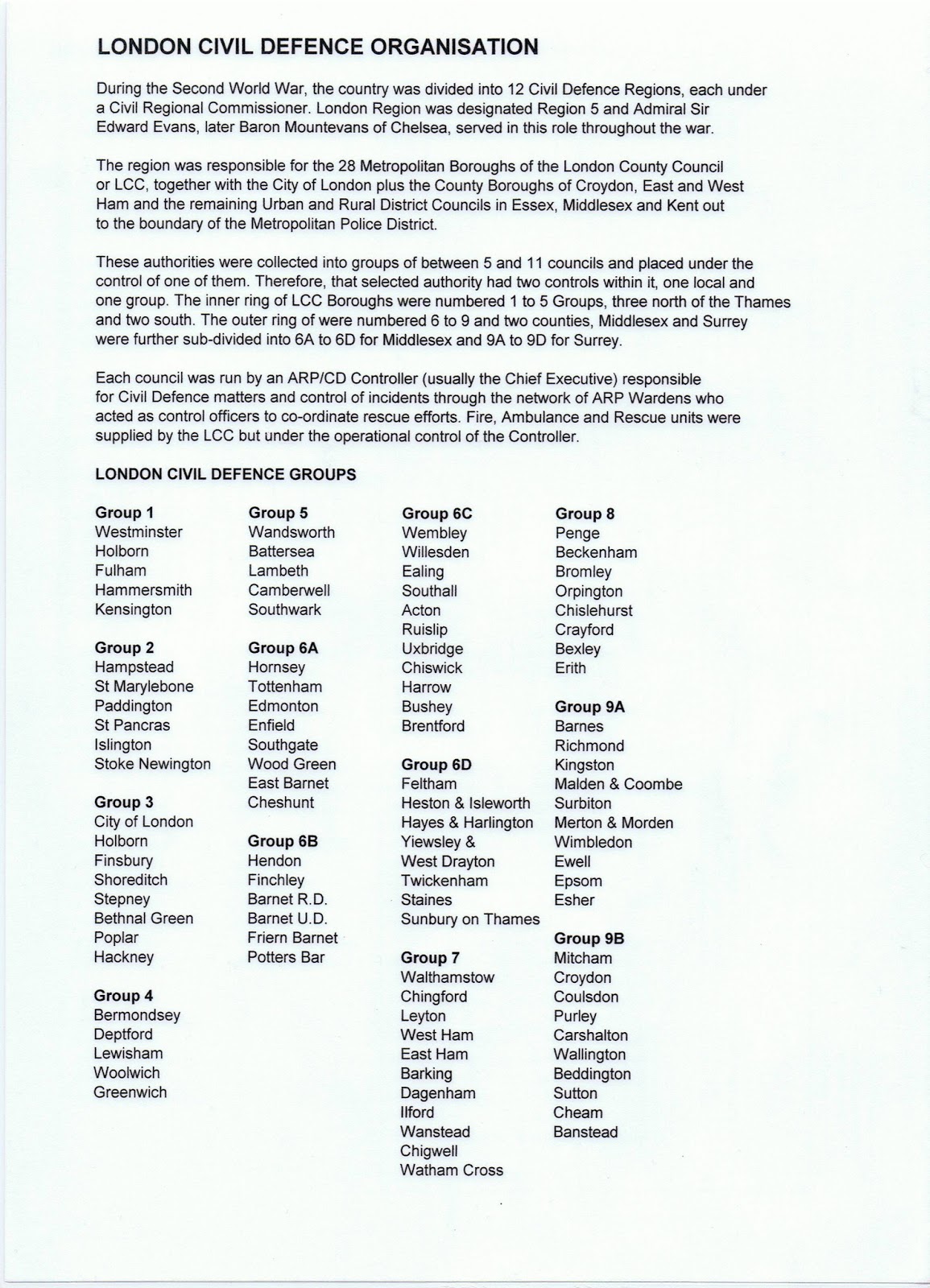
London Civil Defence organisation
The Civil Defence organisation had been established in 1938 as a response to the Munich Crisis and a brief explanation is required to give the reader a better understanding. The country was divided into twelve civil defence regions, each of which was placed under the control of a Civil Commissioner. London was designated Region 5 and was placed under the command of a veteran of Captain Scott's ill-fated Antarctic Expedition of 1912 and subsequently a First World War hero, Admiral Sir Edward Evans - "Evans of the Broke" as he had become known. Evans was to serve in his role as Civil Commissioner for the majority of the war and threw himself into the role with the energy and enthusiasm that had typified his Royal Naval service.

London Region was responsible for the 28 Metropolitan Boroughs of the erstwhile London County Council, or LCC as it was known, together with the City of London plus the County Boroughs of Croydon, East and West Ham and the remaining Urban and Rural District Councils in Essex, Middlesex, Kent and Surrey out to the boundary of the Metropolitan Police District. These authorities were collected into groups of between 5 and 11 councils and placed under the overall control of one of them. Therefore, that selected borough had two controls within it, one local and one group. The inner ring of LCC Boroughs were numbered Groups 1 to 5, three north of the Thames and two south. The outer ring were numbered 6 to 9 and two counties, Middlesex and Surrey, were further sub-divided into 6A to 6D for Middlesex and 9A to 9D for Surrey.

A typical 'chain of command' - this one is for Westminster

Each council was run by a Civil Defence Controller (usually the Town Clerk/Chief Executive) who was responsible for Civil Defence matters and the control of incidents through the network of ARP Wardens who acted essentially as incident officers, patrolling the streets often during the height of an air raid, pinpointing incidents and co-ordinating rescue efforts on the spot. Fire, ambulance and rescue services were supplied by the LCC but were under the operational control of the Controller. A copy of the organisation for London Region is shown for easy reference, as is a copy of a typical 'Chain of Command' for one London borough - on this occasion Westminster but which was echoed across the capital.

A typical incident report sheet (author's image)
Fortunately for today's historian, the majority of London boroughs kept their Incident Logs after the war, although some did dispose of them in the 1960s and 70s, in what today seems like a terrible piece of historical vandalism. Neil and I have spent many hours sitting in local authority archives transcribing these records and although we still have a few to go, between us we have so far gathered about half of the various London boroughs' records.

Reading these logs today, it is amazing to think that they were written at the moment that history was being made. The actual presentation of the logs varies from borough to borough; for example the Greenwich Log has been transcribed at the time into a series of A4 sized notebooks, whilst the neighbouring borough of Woolwich's log is still as it was written at the time with each individual development of an incident written on a separate report sheet. In this way, a major incident could require upwards of twenty such sheets, each updating the incident as it developed.

The other striking thing about reading these logs today is the matter of fact way that major incidents were noted. Whilst this professionalism cannot be faulted, one cannot help but wonder what feelings were going through the minds of the officials concerned whilst writing up and recording these reports, especially on those occasions when they were reporting on incidents in their own immediate neighbourhoods, or perhaps even seeing a report of their own homes being destroyed. Reproduced above is a typical report sheet from the Borough of Woolwich, which reports a fairly minor incident but which gives the reader the general idea of how an incident was written up.

Sometimes, these reports can today appear ridiculously terse; for example the terrible incident on 17th April 1941 that saw the destruction of Chelsea Old Church and the tragic loss of life of Canadian firewatcher Yvonne Green and four of her colleagues is reported simply "Para Mine - heavy damage, casualties, water and gas mains gone." Obviously, there would have been more detailed incident sheets written at the time but this precis still somehow captures the horror of the incident, which was recorded more fully in the April edition of this blog. In other boroughs, the reports go into more detail, some of which even seventy years on, are heartbreaking. For example, the Woolwich report of an incident in the 'Little Blitz' on 2nd March 1944, lists the four fatal casualties by name, including six week old baby Joyce Bowskill - a life cruelly ended before it had properly begun and which had even this fairly hardened researcher having to stop work for a while in order to reflect.

Devastation in Heavitree Road (Greenwich Heritage Centre)
The onset of the terror weapons in 1944 kept the recorders busy and in the south east London boroughs especially, the casualties started to mount again. A Woolwich report of an incident at Heavitree Road, Plumstead on 16th June 1944 lists seven fatal casualties and laconically describes "houses in Heavitree Road heavily damaged." A local photographer recorded the scene and it must be said that the writer of the report was a master of understatement.

Throughout all of the horrors of the London Blitz, a sense of humour prevailed, even amongst the Wardens and Civil Defence personnel who were very much in the front line and saw some terrible things in the course of their duties. When the Wardens' Post 'EE1' in Milward Street, Woolwich was rendered uninhabitable following a nearby V-1 strike in August 1944, the wardens, who must have endured a fearful shaking up when the flying bomb detonated, still saw fit to re-christen their devastated place of work 'The Blitz Hotel' as the accompanying photograph at the head of the page shows.

In August 1944, the British public may have been forgiven for thinking that despite the onset of the V-1s, the end of the war was in sight. Unfortunately, they had another seven months of V-2 rockets to endure, which brought yet more misery to the people of London but which were faithfully recorded by the London boroughs. The final incident shown in the Woolwich Incident Log is on 19th March 1945 was a rocket which fell on one of the piers servicing the Woolwich Arsenal, which itself had suffered terrible damage during the Blitz of 1940. This rocket exploded on the pier itself, causing 37 'slight' casualties, no doubt mainly cuts and shock but mercifully no fatalities. The last V-2 of all fell on Kynaston Road, Orpington on 27th March 1945, killing Mrs Ivy Millichamp in her home. With this one final fatal casualty, London at last had seen it's last attack from the German bombs which had started way back in August 1940.

Unpublished Sources:

Civil Defence Incident Logs for Metropolitan Boroughs of Chelsea, Greenwich & Woolwich and City of Westminster 


Wednesday, 18 August 2010

On this day - 18th August 1940


Sunday August 18th 1940 dawned a typical late summer's day - fine and hazy with the haze burning off as the morning went on. The Battle of Britain was at it's height with the Luftwaffe attempting to destroy the RAF as a prelude to a land invasion of Great Britain that was tentatively planned for the middle of September. The RAF's airfields had been the main targets, along with the radar stations along the south coast and attacks on convoys in the English Channel. There were also raids on the oil refineries in the Thames Estuary and on Bristol, Portsmouth, Liverpool and South Wales but these were not the main focus of the Luftwaffe's attentions - the RAFs airfields and the disablement of Fighter Command was the main prize.

On this beautiful Sunday morning as the haze cleared, the radar plots picked up massed formations of German aircraft heading for England. Sixty Heinkels attacked RAF Biggin Hill and a further 48 Dorniers and Ju88s attacked Kenley. This was just the beginning - the fighter stations at Croydon, Hawkinge and West Malling were also attacked. All of these airfields were defended stoutly - 64, 111 and 615 Squadrons from Kenley defended their own airfield as well as Hawkinge. Whilst they were engaging the enemy, over 100 bombs fell on Kenley, temporarily putting it out of action so that some of the defenders were diverted to land at Croydon whilst repairs were carried out, although 64 Squadron managed to get down at their home airfield due to an improvised landing strip being marked out between the bomb craters. Croydon Airport had itself received some attention, with 19 bombs damaging hangars and outbuildings.

The attack on Biggin Hill was also stubbornly defended but here 32 and 610 Squadrons were scrambled on the initiative of the Station Commander, Group Captain Grice. This was due to the radar plots being overwhelmed with the sheer numbers of attackers but although the defending squadrons were ordered into the air at relatively short notice, they destroyed ten of the attacking German bombers which on this occasion merely added further craters to the airfield without destroying any aircraft on the ground.

The next assault on this day came in the early afternoon when the RAF airfields at Thorney Island and Gosport were attacked by Stuka dive bombers as was the Fleet Air Arm station at Ford, in Sussex and the radar installation at Poling, near Arundel in Sussex. This time the cumbersome Ju87 Stukas were routed by the defending RAF fighters of 43, 152 and 234 Squadrons, which destroyed seventeen out of the twenty five attacking aircraft. This was the final time that the Stukas took any meaningful part in the Battle of Britain - they had been suffering alarming levels of losses and had become a liability for the Luftwaffe, as well as a death trap for their crews.

The final attacks of the day came in the late afternoon when Croydon was attacked once again and twelve Me1o9s attacked RAF Manston from beneath the radar and destroyed two Spitfires on the ground as well as killing an airman and injuring fifteen others. The night saw bombing raids on Bristol and minelaying operations in the Thames Estuary and Bristol Channel.

So ended Sunday 18th August 1940; the Luftwaffe had lost a total of sixty nine aircraft against the RAF's thirty four plus another twenty nine on the ground. Whilst this meant the losses were about equal, when it came to air combat the losses were about 2:1 in the RAF's favour. Destroyed aircraft could be replaced quickly but pilots and aircrew could not and this was where the advantage remained with the British - the RAF's pilots who were not killed could bale out and be rescued over home territory whilst those from the Luftwaffe were either killed outright or taken prisoner.

This was a battle of attrition which the RAF was winning but the sheer numbers of the attackers meant that it would be a near run thing and it would take a blunder by Hitler when he ordered the switching of attacks from the RAF's airfields to London, to make the outcome certain.

On the 18th August 1940, this was all still in the future but this date will be remembered as the day when both sides in the Battle of Britain suffered the most material damage. As Alfred Price called his excellent book on the subject, this was The Hardest Day.

Published Sources:

The Most Dangerous Enemy, Stephen Bungay - Aurum Press, 2000
The Hardest Day, Alfred Price - Arms & Armour Press, 1979
The Narrow Margin, Derek Wood with Derek Dempster - Hutchinson 1961