|
| The Invicta Road plaque in situ overlooking the school playground (author's photo) |
On Thursday last, 16 March 2017, I was fortunate enough to attend the unveiling ceremony of the latest memorial plaque erected by the charity Firemen Remembered which took place at Invicta Primary School, Blackheath and which commemorated events at the school some seventy seven years ago when the then vacated school premises were in use as London Auxiliary Fire Service Sub-Station 54X.
The day of the ceremony was a beautifully bright and sunny early spring day, which made it hard to imagine that this now happy place which today once again resonates to the cheerful sound of children playing, was once the scene of one of the worst tragedies in wartime Southeast London, when twelve London Auxiliary Firemen and three civilians were killed when the school received a direct hit from a Luftwaffe parachute mine.
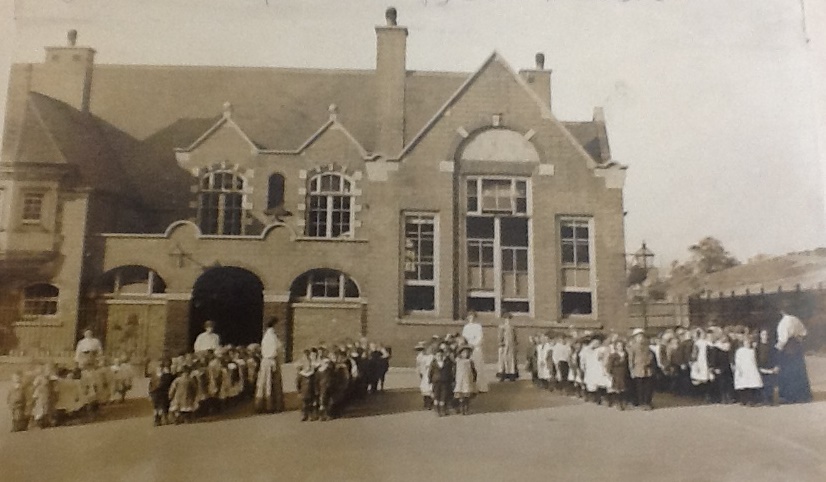 |
| Invicta Road School shortly after opening in 1900 (Invicta Primary) |
On 3 September 1939, Prime Minister Neville Chamberlain made his now famous radio broadcast in which he informed the British people that they were "now at war with Germany" but two days prior to this, schoolchildren from across London were being evacuated, in the case of those from Invicta Road School, to the relative safety of the Kent countryside. The school buildings dating from 1900, in common with many across the capital were taken over by the London Fire Brigade as a wartime fire station, being given the somewhat functional title of Sub-Station 54X. It then became home to members of the Auxiliary Fire Service, men and women who had volunteered to serve in the fire brigade should war come. These men and women have often been the subject of writings on this blog, most recently in November 2016 when we reviewed a book that concentrated on participation by the Jewish community in the Fire Services. Those who served were paid the princely sum of £3 per week and were exempt from the call-up to the Armed Forces for the duration of their service with the AFS and before the coming of the Blitz, met with hostility from some quarters, being dismissed as "£3 a week Army dodgers" from certain members of the public. They also met initial resistance and prejudice from some members of the regular Fire Services and it wasn't until after the Blitz started that Churchill's tribute to the "Heroes with Grimy Faces" gathered currency.
When the Blitz did begin on 7 September 1940, the men based at Invicta Road School would have seen plenty of action, since the school was located very close to the River Thames, adjacent to which were situated many factories, wharves and associated industries, all of which were by now undertaking vital war work. At 23:05 on 13 September, the school itself suffered its first damage of the war when a small bomb - probably of the 50 kg variety - fell through the roof of the School Assembly Hall. Fortunately for all concerned, the bomb failed to explode and it was carried out of the building by Fireman Arthur Grant into the Playground, where he then proceeded to bury it beneath a large pile of sandbags. The bomb did subsequently explode but because of being shielded by the sandbags, did little further damage to the school buildings. For this act of extreme bravery, Arthur Grant was recommended for a George Medal, the award of which was confirmed on 12 November 1940.
 |
| The ruined school following the bombing (Author's collection) |
London suffered nightly bombing from 7 September 1940 for fifty seven consecutive nights but the evening of 14 November proved to be a quieter one than usual for the nation's capital, because on this night the attention of the Luftwaffe switched to Coventry, where one of the worst raids of the war took place. So bad was the destruction resulting from this raid that a new word entered the language, to "Coventrate" which came from a word that had similarly entered the German language at this time "coventrieren", meaning to raze a city to rubble from the air. The death toll from this raid was 568 people killed, with a further 863 who suffered severe injuries. Some 500 tonnes of high explosive bombs were dropped on the industrial city and around 3,600 incendiaries, which started so many fires that firemen were sent from as far away as London to help extinguish them. The industrial output of the city was disrupted but factories were quickly repaired or relocated to new "shadow" factories elsewhere and production recovered within a few months.
Whilst this raid was occurring in the Midlands, the situation in London remained quiet but at 19:30 the air raid sirens sounded and the men at Sub-Station 54X settled down waiting for their first "shout" of the evening. The first bomb in the Borough of Greenwich was reported just ten minutes later at 19:40 when a High Explosive bomb fell on the premises of J Stone & Company, a ship propeller manufacturer in Anchor & Hope Lane, Charlton but on this occasion the men of Invicta Road were not required to attend and they continued to wait patiently, little realising that they would in fact become the subject of the next incident to be reported. At 21:20, a one tonne parachute mine floated silently down and became entangled in the trees that lined Invicta Road and then exploded with the terrific air-burst effect that these weapons, converted naval mines, were capable of. These mines could flatten large areas from their blast and so the adjacent school buildings did not stand a chance.
 |
| Parachute Mine at the IWM London (author's photo) |
The school buildings collapsed like a house of cards and left many firemen trapped and seriously injured beneath the rubble. These men, usually the rescuers, now found themselves in need of rescue themselves and help quickly came from their colleagues in surrounding fire stations. The work to free them went on well into the next day but sadly, when everyone had been accounted for, twelve firemen were dead, along with a further three civilians who had been in the school premises when the mine exploded. Amongst the firemen killed was Firemen Arthur Grant, whose award of the George Medal had been announced just two days previously and who had not yet received his decoration. One of the civilians killed was Mr White, the School Caretaker who died in his house on the school site. We shall probably never know the reasons as to why the other two visitors were at the school. One of them, Cecil Smith lived at 2 Invicta Road, so perhaps was visiting a newly found acquaintance amongst the firemen or perhaps was a friend of the caretaker. The reason behind the other civilian casualty, 21 year old tailoress Rosetta Florence Johnson, being at the school will remain an even bigger mystery, as being a resident of Islington, she was far away from home on this bleak November evening.
Ironically, despite the unfolding tragedy at Invicta Road, it was to be a relatively quiet night in Greenwich, with just three reported incidents.

 |
| Rescue and recovery work goes on (Invicta Primary/LFB) |
The idea to place a memorial plaque at the present-day Invicta Primary School was first mooted as far back as 2010 but was delayed for various reasons, not least of which was the rebuilding of the school's temporary premises, first erected in the early 1950s, with a more permanent structure. The modern school is a splendid facility and they are rightly proud of their reputation of having a friendly and stimulating environment for the pupils and are also very conscious of their heritage and local history.
Therefore, the ceremony, whilst under the overall auspices and guidance of Stephanie Maltman from Firemen Remembered, was very much driven by the school and for this initiative, Mrs Marie Corbett, the Executive Head Teacher and Emily Perfect, Creative Arts Leader, as well as the children themselves, deserve much credit. The ceremony started with Mrs Corbett welcoming everyone to the school and explaining to the pupils what was about to take place. There had been much excitement and anticipation amongst the children, not all of whom were in on the secret!
 |
| The Museum curators read the Roll of Honour under the watchful eye of Mrs Corbett (author's photo) |
The Year 2 choir opened the ceremony with a delightful rendition of the popular wartime song "We'll Meet Again" before some of the curators of the School's own museum showed photographs of the aftermath of the bombing. A certain local historian and Blitz guide (who shall remain nameless) gave those present a brief description of the events of the night of 14 November 1940 before four pupils from Year 6 read poems that they had written about the war. We then heard the Roll of Honour read to us by fifteen of the School Museum's curators before Mrs Corbett, assisted by two hand-picked pupils from the assembly unveiled the plaque. A minute's silence followed after which the entire school sang "Tipperary", a song perhaps better known as a First World War number but which was sung with great enthusiasm and which seemed very fitting as it was undoubtedly a song with which all of the firemen would have been familar. The indoor part of the ceremony was then repeated with the older pupils coming to join in - this was because the Assembly Hall was too small to accomodate the entire school, such was the interest shown in the proceedings.
 |
| The plaque is unveiled as Stephanie looks on (Ken Sinyard) |
Amongst the guests present were Ken and Graham Sinyard, whose Grandfather Frank Smart had been a member of the AFS based at Invicta Road, although fortunately not present on the fateful night. Fellow guide and official historian of Charlton Athletic FC, Clive Harris was also present, as was Darryl Chamberlain co-author of the Charlton Champion blog and an old boy of Invicta School from the 1980s (from the "old" school, not the "old old" school as the wartime premises are now known!)
After the indoor ceremony was complete, we then repaired outside to the school playground, where the plaque was installed in it's new permanent home, fittingly located onto the last surviving retaining wall of the original Victorian school, which now overlooks the present school's playground.
 |
| Lest we forget - and the reason we were there (author's photo) |
We left the school just as the children were emerging into the playground for their lunch break and the final photograph taken of a group of them inspecting the newly unveiled plaque spoke volumes.
Thanks are due to Stephanie Maltman and Bill Hickin of Firemen Remembered for continuing to raise awareness of the work done and sacrifices made by the men and women of our wartime Fire Services and also to Marie Corbett, Emily Perfect as well as all of the staff and pupils of Invicta Primary for making us all so welcome and for arranging such a wonderful ceremony, of which the fallen of 14 November 1940 would surely have been proud.
 |
| The unveiled plaque (Ken Sinyard) |
Invicta Road School - Roll of Honour - 14/15 November 1940
David (or Davis) Appleby - Fireman AFS - 432 Bancroft Road, Mile End
John Arthur Axcell - Fireman AFS - 10 Archbishop's Place, Brixton
Charles William Barrow - Leading Fireman AFS - 18 Hassendean Road, Blackheath
Henry Arthur Charles Dixon - Fireman AFS - 35 Alberta Cottages, Kennington
Edmund Francis Emmett - Fireman AFS - 1 Lewis House, Greenhundred Road, Peckham
Edward James Fox - Fireman AFS - 12 High Street, Pinner
Arthur Hugh Grant - Fireman AFS - 107 Footscray Road, Eltham
Ronald Francis King - Fireman AFS - 71 Evan Road, Catford
Reginald Francis William Knight - Fireman AFS - 196 Croydon Road, Hayes
John Phelan - Fireman AFS - 151 Grove Lane, Camberwell
Stanley Sargent - Fireman AFS - 21 Havelock Road, Bromley
Frederick Charles Sutherland - Sub Officer LFB - 203 Kidbrooke Park Road, Blackheath
Rosetta Florence Johnson - 117 Southgate Road, Islington
Cecil Critoph Smith - 2 Invicta Road, Blackheath
Charles White - School Caretaker - School House, Invicta Road, Blackheath