Showing posts with label rescue. Show all posts

Sunday, 19 March 2017

Firemen Remembered at Invicta Road

The Invicta Road plaque in situ overlooking the school playground (author's photo)

On Thursday last, 16 March 2017, I was fortunate enough to attend the unveiling ceremony of the latest memorial plaque erected by the charity Firemen Remembered which took place at Invicta Primary School, Blackheath and which commemorated events at the school some seventy seven years ago when the then vacated school premises were in use as London Auxiliary Fire Service Sub-Station 54X.

The day of the ceremony was a beautifully bright and sunny early spring day, which made it hard to imagine that this now happy place which today once again resonates to the cheerful sound of children playing, was once the scene of one of the worst tragedies in wartime Southeast London, when twelve London Auxiliary Firemen and three civilians were killed when the school received a direct hit from a Luftwaffe parachute mine.
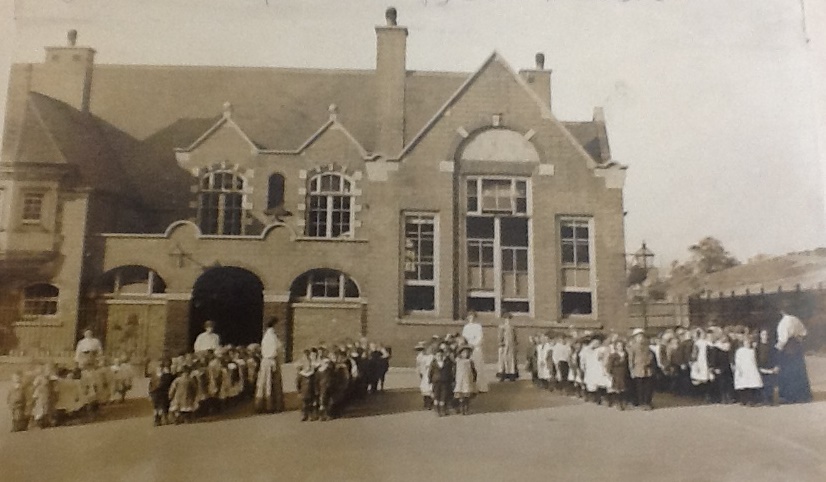
Invicta Road School shortly after opening in 1900 (Invicta Primary)

On 3 September 1939, Prime Minister Neville Chamberlain made his now famous radio broadcast in which he informed the British people that they were "now at war with Germany" but two days prior to this, schoolchildren from across London were being evacuated, in the case of those from Invicta Road School, to the relative safety of the Kent countryside. The school buildings dating from 1900, in common with many across the capital were taken over by the London Fire Brigade as a wartime fire station, being given the somewhat functional title of Sub-Station 54X. It then became home to members of the Auxiliary Fire Service, men and women who had volunteered to serve in the fire brigade should war come. These men and women have often been the subject of writings on this blog, most recently in November 2016 when we reviewed a book that concentrated on participation by the Jewish community in the Fire Services. Those who served were paid the princely sum of £3 per week and were exempt from the call-up to the Armed Forces for the duration of their service with the AFS and before the coming of the Blitz, met with hostility from some quarters, being dismissed as "£3 a week Army dodgers" from certain members of the public. They also met initial resistance and prejudice from some members of the regular Fire Services and it wasn't until after the Blitz started that Churchill's tribute to the "Heroes with Grimy Faces" gathered currency.

When the Blitz did begin on 7 September 1940, the men based at Invicta Road School would have seen plenty of action, since the school was located very close to the River Thames, adjacent to which were situated many factories, wharves and associated industries, all of which were by now undertaking vital war work. At 23:05 on 13 September, the school itself suffered its first damage of the war when a small bomb - probably of the 50 kg variety - fell through the roof of the School Assembly Hall. Fortunately for all concerned, the bomb failed to explode and it was carried out of the building by Fireman Arthur Grant into the Playground, where he then proceeded to bury it beneath a large pile of sandbags. The bomb did subsequently explode but because of being shielded by the sandbags, did little further damage to the school buildings. For this act of extreme bravery, Arthur Grant was recommended for a George Medal, the award of which was confirmed on 12 November 1940.

The ruined school following the bombing (Author's collection)

London suffered nightly bombing from 7 September 1940 for fifty seven consecutive nights but the evening of 14 November proved to be a quieter one than usual for the nation's capital, because on this night the attention of the Luftwaffe switched to Coventry, where one of the worst raids of the war took place. So bad was the destruction resulting from this raid that a new word entered the language, to "Coventrate" which came from a word that had similarly entered the German language at this time "coventrieren", meaning to raze a city to rubble from the air. The death toll from this raid was 568 people killed, with a further 863 who suffered severe injuries. Some 500 tonnes of high explosive bombs were dropped on the industrial city and around 3,600 incendiaries, which started so many fires that firemen were sent from as far away as London to help extinguish them. The industrial output of the city was disrupted but factories were quickly repaired or relocated to new "shadow" factories elsewhere and production recovered within a few months.

Whilst this raid was occurring in the Midlands, the situation in London remained quiet but at 19:30 the air raid sirens sounded and the men at Sub-Station 54X settled down waiting for their first "shout" of the evening. The first bomb in the Borough of Greenwich was reported just ten minutes later at 19:40 when a High Explosive bomb fell on the premises of J Stone & Company, a ship propeller manufacturer in Anchor & Hope Lane, Charlton but on this occasion the men of Invicta Road were not required to attend and they continued to wait patiently, little realising that they would in fact become the subject of the next incident to be reported. At 21:20, a one tonne parachute mine floated silently down and became entangled in the trees that lined Invicta Road and then exploded with the terrific air-burst effect that these weapons, converted naval mines, were capable of. These mines could flatten large areas from their blast and so the adjacent school buildings did not stand a chance.

Parachute Mine at the IWM London (author's photo)

The school buildings collapsed like a house of cards and left many firemen trapped and seriously injured beneath the rubble. These men, usually the rescuers, now found themselves in need of rescue themselves and help quickly came from their colleagues in surrounding fire stations. The work to free them went on well into the next day but sadly, when everyone had been accounted for, twelve firemen were dead, along with a further three civilians who had been in the school premises when the mine exploded. Amongst the firemen killed was Firemen Arthur Grant, whose award of the George Medal had been announced just two days previously and who had not yet received his decoration. One of the civilians killed was Mr White, the School Caretaker who died in his house on the school site. We shall probably never know the reasons as to why the other two visitors were at the school. One of them, Cecil Smith lived at 2 Invicta Road, so perhaps was visiting a newly found acquaintance amongst the firemen or perhaps was a friend of the caretaker. The reason behind the other civilian casualty, 21 year old tailoress Rosetta Florence Johnson, being at the school will remain an even bigger mystery, as being a resident of Islington, she was far away from home on this bleak November evening.

Ironically, despite the unfolding tragedy at Invicta Road, it was to be a relatively quiet night in Greenwich, with just three reported incidents.


Rescue and recovery work goes on (Invicta Primary/LFB)

The idea to place a memorial plaque at the present-day Invicta Primary School was first mooted as far back as 2010 but was delayed for various reasons, not least of which was the rebuilding of the school's temporary premises, first erected in the early 1950s, with a more permanent structure. The modern school is a splendid facility and they are rightly proud of their reputation of having a friendly and stimulating environment for the pupils and are also very conscious of their heritage and local history. 

Therefore, the ceremony, whilst under the overall auspices and guidance of Stephanie Maltman from Firemen Remembered, was very much driven by the school and for this initiative, Mrs Marie Corbett, the Executive Head Teacher and Emily Perfect, Creative Arts Leader, as well as the children themselves, deserve much credit. The ceremony started with Mrs Corbett welcoming everyone to the school and explaining to the pupils what was about to take place. There had been much excitement and anticipation amongst the children, not all of whom were in on the secret!

The Museum curators read the Roll of Honour under the watchful eye of Mrs Corbett (author's photo)

The Year 2 choir opened the ceremony with a delightful rendition of the popular wartime song "We'll Meet Again" before some of the curators of the School's own museum showed photographs of the aftermath of the bombing. A certain local historian and Blitz guide (who shall remain nameless) gave those present a brief description of the events of the night of 14 November 1940 before four pupils from Year 6 read poems that they had written about the war. We then heard the Roll of Honour read to us by fifteen of the School Museum's curators before Mrs Corbett, assisted by two hand-picked pupils from the assembly unveiled the plaque. A minute's silence followed after which the entire school sang "Tipperary", a song perhaps better known as a First World War number but which was sung with great enthusiasm and which seemed very fitting as it was undoubtedly a song with which all of the firemen would have been familar. The indoor part of the ceremony was then repeated with the older pupils coming to join in - this was because the Assembly Hall was too small to accomodate the entire school, such was the interest shown in the proceedings.

The plaque is unveiled as Stephanie looks on (Ken Sinyard)

Amongst the guests present were Ken and Graham Sinyard, whose Grandfather Frank Smart had been a member of the AFS based at Invicta Road, although fortunately not present on the fateful night. Fellow guide and official historian of Charlton Athletic FC, Clive Harris was also present, as was Darryl Chamberlain co-author of the Charlton Champion blog and an old boy of Invicta School from the 1980s (from the "old" school, not the "old old" school as the wartime premises are now known!) 

After the indoor ceremony was complete, we then repaired outside to the school playground, where the plaque was installed in it's new permanent home, fittingly located onto the last surviving retaining wall of the original Victorian school, which now overlooks the present school's playground.

Lest we forget - and the reason we were there (author's photo)

We left the school just as the children were emerging into the playground for their lunch break and the final photograph taken of a group of them inspecting the newly unveiled plaque spoke volumes.

Thanks are due to Stephanie Maltman and Bill Hickin of Firemen Remembered for continuing to raise awareness of the work done and sacrifices made by the men and women of our wartime Fire Services and also to Marie Corbett, Emily Perfect as well as all of the staff and pupils of Invicta Primary for making us all so welcome and for arranging such a wonderful ceremony, of which the fallen of 14 November 1940 would surely have been proud.

The unveiled plaque (Ken Sinyard)

Invicta Road School - Roll of Honour - 14/15 November 1940

David (or Davis) Appleby - Fireman AFS - 432 Bancroft Road, Mile End
John Arthur Axcell - Fireman AFS - 10 Archbishop's Place, Brixton
Charles William Barrow - Leading Fireman AFS - 18 Hassendean Road, Blackheath
Henry Arthur Charles Dixon - Fireman AFS - 35 Alberta Cottages, Kennington
Edmund Francis Emmett - Fireman AFS - 1 Lewis House, Greenhundred Road, Peckham
Edward James Fox - Fireman AFS - 12 High Street, Pinner
Arthur Hugh Grant - Fireman AFS - 107 Footscray Road, Eltham
Ronald Francis King - Fireman AFS - 71 Evan Road, Catford
Reginald Francis William Knight - Fireman AFS - 196 Croydon Road, Hayes
John Phelan - Fireman AFS - 151 Grove Lane, Camberwell
Stanley Sargent - Fireman AFS - 21 Havelock Road, Bromley
Frederick Charles Sutherland - Sub Officer LFB - 203 Kidbrooke Park Road, Blackheath

Rosetta Florence Johnson - 117 Southgate Road, Islington
Cecil Critoph Smith - 2 Invicta Road, Blackheath
Charles White - School Caretaker - School House, Invicta Road, Blackheath


Saturday, 8 November 2014

Remembering them all

The Charlton Athletic FC memorial (author's photo)

Last weekend, this writer was lucky enough to be present at The Valley, home of Charlton Athletic Football Club, at the unveiling of our Club's war memorial to the fallen of this famous old football club.

Fittingly, whilst this memorial was unveiled during the year marking the centenary of the outbreak to "The War to end all wars", Clive Harris, the military historian and Charlton fan who has been the driving force behind this project, was quick to point out in his brief but moving speech during the ceremony, that this memorial was for everyone associated with the club, whether they be players, officials or supporters and whatever conflict, or facet of the war they were involved in, whether military or civilian, as Charlton with it's close proximity to the Thames, was at the heart of the Blitz in 1940-41.

So perhaps with this in mind and at this remembrance weekend, perhaps now is a good time to remember those civilians and civil defence workers who lost their lives, either as innocent victims of bombing, or in the case of Civil Defence workers, trying to protect the citizens of their localities, whether in London, Coventry, Liverpool, Plymouth, or wherever in the UK that Hitler's bombs fell.

The statistics tell us that overall, some 30,000 civilians died in London during the Second World War due to enemy air attacks and the 'Vengeance' Weapons campaign of 1944-45. What mere statistics do not necessarily convey is the sheer awfulness of the reality of these figures; a glance at a typical incident log will impart some more detail - entire families wiped out, children and babies killed (the youngest this writer has seen mentioned was 9 hours old), groups of people in pubs and church congregations alive one moment and gone the next - nobody was immune. Even Armistice Day itself brought terror in wartime; on November 11th 1944, the Brook Hotel, a public house on suburban Shooter's Hill was obliterated by a V-2 rocket, the toll of 29 dead, including some on a passing bus, warranted 'major incident' status but probably had to be seen to realize the true horror of the aftermath.

Woolworth's V-2 memorial (author's photo)
The worst V-2 incident in London came just a few short miles along the A2 from Shooter's Hill, in New Cross, at a busy Woolworth's store. This time, everything that could go wrong, did - the 25th November 1944 was a busy pre-Christmas Saturday - the rumour had gone around that the Woolworth's store had received a consignment of saucepans, which had become something of a rarity in the austere conditions prevailing in the sixth year of the war and the store was busy with shoppers literally from all across London in search of one of these rare finds. In addition, the store was busy, as usual, with children eager to spend their pocket money (and 'personal points' under the rationing scheme) on sweets. At 12:25, the missile struck and what had been a bustling and busy high street was instantly turned into a scene of utter devastation and carnage as the Woolworth's store and the next door Co-op were destroyed. As with the Shooter's Hill incident, passengers on a passing bus were also victims and when, two days later, the final victims were retrieved by the rescue services, the final death toll was an appalling 168, with almost as many seriously injured, many of whom required amputations. There were few people indeed in south-east London who did not know a victim of this terrible incident.

So much for the civilians, but we should also not forget the work done by the Fire and Ambulance Services, Police, Rescue Squads, ARP Wardens and all of the other Civil Defence services, male and female, including the WVS, whose members, mainly ladies of a 'certain age' provided refreshments for those working during the Blitz, often placing themselves in as much danger as those doing the rescuing!

Wartime Civil Defence badges, from left WVS, ARP Wardens, AFS (author's photo)

The Firefighters' Memorial, appropriately sited opposite St Paul's Cathedral records the names of 1.027 men and women of the Fire Services who lost their lives during the Second World War, the London Ambulance Service lost 36 members of staff during the Blitz and the Metropolitan Police lost over 100 killed both on and off duty during the Blitz.

Apart from the casualty figures, a good indication of the bravery involved amongst the Civil Defence services, is the number of bravery awards made for services above and beyond the call of duty. We have already looked at the story of Anthony Smith GC in a February 2012 post on this blog but another example of a George Medal award is typical of those made during the Blitz.

Join the AFS (author's collection)
On the night of 19th/20th October 1940, the Red Lion public house just off Shooter's Hill was hit by a High Explosive bomb; there were thirteen fatal casualties both in the pub and in adjoining houses which had collapsed but there were also survivors trapped in the ruins. Without a thought for her own safety, Nurse Mary Thomas, whose job was to tend to the injured after they had been extracted, decided to crawl into the rubble to reach two trapped survivors and tended to their injuries whilst they were awaiting rescue. The survivors were eventually rescued and went on to make a full recovery. As a result of her bravery Nurse Thomas was awarded the George Medal.

Apart from their work with Blitz victims, the Ambulance services were often required to assist with transporting wounded soldiers who had been repatriated from the front line en route to hospitals back in the UK. The ambulance staff would always put on a brave and cheerful face for the soldiers, some of whom were suffering from appalling injuries. In Angela Raby's excellent book, 'The Forgotten Service', Babette Loraine recounted being sent to Paddington Station to collect wounded being returned from North Africa. Even her normal composure was rattled at the sight of a soldier, who had neither arms or legs and was also blind. Not surprisingly, she was temporarily taken aback but recovered sufficiently to ask the soldier the standard fall back question, if he would like a cup of tea. The soldier cheerfully replied "Can a duck swim?" Babette got the soldier his tea and gladly assisted him to drink it.

Perhaps the final word should go to an anonymous Firewoman, ostensibly operating the switchboard at Redcross Street Fire Station on the night of 29th/30 December 1940, the great City Blitz. The appliances had all been ordered out early in the raid and in the meantime, the fires were gradually creeping ever closer to the Fire Station. Senior Officers were debating whether to evacuate when an ARP Warden burst in, yelling "Hey! Your bloody roof is on fire!"

"Whoopee!" cried a Firewoman and grabbed a stirrup pump before making for the stairs followed by her colleagues armed with buckets of water. At last they had a chance to prove themselves equal to the men and made an expert job of extinguishing the fires. The Fire Station, along with the Whitbread Brewery, was one of the few buildings to survive in an area which was devastated by fires.

Such was the spirit of both civilians and Civil Defence workers.

Whatever you are doing this Remembrance Day, remember them all.

Published Sources:

Hitler's Rockets: The Story of the V2s - Norman Longmate - Frontline Books, 2009
The Forgotten Service: Auxiliary Ambulance Station 39 - Angela Raby - After The Battle 1999
The London Blitz: A Fireman's Tale - Cyril Demarne OBE - After The Battle 1991

Friday, 3 October 2014

One night in Greenwich & Woolwich

When looking back at the London Blitz, it is sometime difficult for the average person to always understand the extent of the damage caused to London (and to other towns and cities in the UK) and that interspersed with the major incidents that grabbed the headlines, there were many more mundane happenings during an average night, that occurred night in and night out but which had to be dealt with all the same and which had an impact to a greater or lesser extent on those who happened to be there at the time. The actual purpose of today's offering is to take a snapshot of a typical night during the Blitz and to show readers the number of incidents on such a night, the nature of them and how they were reported and acted upon by the Civil Defence services.

Anyone who reads this blog on a regular basis will know that this writer hails from Greenwich and so for the sake of example, we will look at the Incident Logs for this borough and for neighbouring Woolwich, which are absolutely typical of those across the capital and indeed across the whole of Great Britain.

Civil Defence Organization for Greenwich

Let us start with a brief description as to how incidents were reported and at the Civil Defence organization across the country. The United Kingdom was divided into regions for Civil Defence, under the overall control of the Minister of Home Security, who for the majority of the War, was Mr Herbert Morrison. Each region was under the control of a Civil Commissioner, responsible for the Civil Defence arrangements of the region. London was designated Region 5 and for the bulk of the War, the Civil Commissioner was Admiral Sir Edward Evans. The accompanying 'chain of command' chart gives an idea of the awesome responsibility held by the Civil Commissioner and of the huge number of services under his control.

London Civil Defence Organization
London was further sub-divided into Civil Defence Groups, each under the control of (usually) the Chief Executive of the relevant local authority; the inner London Boroughs formed Groups 1-5, whilst the outer London Boroughs and Urban/Rural Districts formed Groups 6-9, again as shown in the accompanying chart. The Chief Executive was the Civil Defence Controller for his or her borough including the control of incidents through the network of ARP Wardens, who acted as control officers to coordinate the efforts of the rescue services. In London, the Fire, Ambulance and Rescue services were all supplied by the London County Council, or LCC but were under the direct operational control of the Civil Defence Controller. Despite the seeming complexity of the system, it was basically a sound system that ran efficiently and smoothly.

Having established how London's Civil Defence was organized, let us now look at how the system worked in practice.


Typical incident report for Woolwich (author's collection)

As mentioned above, the Air Raid Precautions (ARP) Wardens were the essential link between events happening 'on the ground' and how they were dealt with. The Wardens were on patrol at all times during an 'alert' when the sirens had sounded. The wardens wore a basic uniform of a blue boiler suit, with the ubiquitous 'tin helmet' to provide their only protection against flying debris and shrapnel. Their 'badge of office' was a small silver 'ARP' badge worn proudly on the lapel which along with the 'W' on their steel helmets signified that these brave men and women, largely volunteers and many of whom were of 'a certain age' were the vital cog in the Civil Defence machinery. The wardens usually patrolled in pairs and when they came upon an incident, which on busy nights were only too commonplace, the younger and fitter of the pair was detailed to report back to the nearby Wardens' Post, where the Chief Warden for the Post would arrange for the required services and then phone details of the incident back to the Borough Control, usually located in the basement of the local Town Hall. There, the Duty Controller would record the incident on a sheet of paper as shown, which would then either be transcribed into a ledger for future reference, or filed as loose sheets. Each incident would be updated until deemed 'closed.'

Let us now look at a typical night in Greenwich and Woolwich and the sequence of events on the night of 5th/6th October 1940. During the day, the Luftwaffe had attacked targets in Kent and also Southampton, no doubt the Supermarine works, where the all-important Spitfires were being produced. By night, the targets switched to airfields in East Anglia and to London, which had been the focus of attention since September 7th. The weather had been bright during the day but with increasingly frequent showers in most areas.

The first incident recorded in Greenwich was at 00:25 on the 6th October, which was a report of Incendiary Bombs dropped in the grounds of Trinity Hospital, Greenwich which were extinguished by wardens without the need for the Fire Brigade to get involved. Incidents 2 & 3 are recorded at 01:45 and 01:50 at Siemens' Works and at 19 Heringham Road and again involved incendiaries, which were dealt with by the AFS (Auxiliary Fire Service) and by a Stirrup Pump Party respectively. Incident 4 was recorded at 02:15 as a High Explosive (HE) Bomb that fell harmlessly on open ground in Charlton Park Lane opposite Siemens Sports Ground. This must have been a relatively quiet night in Greenwich as the next incident is not recorded until 03:00 and demonstrates amply that not all incidents were of the Luftwaffe's making. The log records that 51 Haddo House in Claremont Street was struck by an Anti-Aircraft shell, proving the theory that "What goes up, must come down." Fortunately, on this occasion, no casualties were reported, although these 'friendly fire' incidents as they would be called nowadays, could sometimes have tragic consequences. There is then a long gap before the next incident is reported, almost certainly after the 'All Clear' had sounded and when people went out in the light of day to discover what had happened. This is recorded at 08:30 by the Cricket Pavilion in Charlton Park, which had been damaged by a HE Bomb - could this be the consequences of Incident 4, first reported at 02:15? Sadly, we shall never know. The next incidents follow the same pattern, being an unexploded AA shell at 08:37 in a field at the rear of 260 Wricklemarsh Road, then at 10:04, a UXB was reported at the RAF Depot in Kidbrooke Park Road, before finishing with the last incident reported at 10.24 at Angerstein's Wharf with the discovery of no fewer than 3 HE bombs and an incendiary for good measure. So ended a quiet-ish day in Greenwich.

Nearest ARP Warden (Author's collection)

Across the borough boundary in Woolwich, things were slightly busier. The first incident was reported at 20:35 on the evening of the 5th October with a HE Bomb in Queenscroft Road, Eltham which blocked the road between Eltham Hill and Queenscroft Road. This was quickly followed at 20:37 by an Oil Bomb at 99 Montbelle Road, which was soon extinguished. Incident 3, reported at the same time saw 3 x HE Bombs fall upon numbers 68 and 70 Eltham Hill. Not surprisingly, both houses were demolished, with others nearby being heavily damaged as well as Eltham Hill itself being blocked. Fortunately, in all of these incidents, no casualties were recorded. The next incident is missing from the log, so we shall never know what this refers to, whilst number 5 saw a HE Bomb fall harmlessly into a field on the western side of Crouch Croft. Another Oil Bomb, this time at 305 Green Lane, Eltham saw minor damage to a fence before it was dealt with by the Fire Brigade. A short lull then ensued before the action switched to Woolwich proper. A flurry of incidents starting at 23:49 saw clusters of incendiary bombs falling in Ferry Approach, Woolwich Dockyard, Warspite Road, Woolwich Church Street, Sunbury Street, Chapel Street and the Commonwealth Buildings. Fires were reported at all of these incidents but were eventually brought under control without casualties. A grimmer entry then ensues at 04:37 on the 6th October, when a HE Bomb is reported at 121 Crescent Road. The ominous words 'Mortuary Van required - 2 fatal casualties' appears and brings home to the casual reader the true meaning of the Blitz and of the bombing of civilians in general. Further HE bombs are reported at 40 St Margaret's Terrace, Old Mill Road and Woolwich Arsenal Station, which caused both lines to be blocked and repair gangs called out. Fortunately, as the 6th October was a Sunday, not too much inconvenience would have been caused to the travelling public, who presumably would have had better things to worry about in any case. The final Woolwich incident of the night's activities is number 14 and records another HE Bomb, this time at 193 Burrage Road and reminds us of another facet of the Civil Defence service; the occupant of the house was unharmed, though not surprisingly suffering from shock, but having lost her home and many of her possessions, the log notes that 'storage for furniture required.' Wherever property could be salvaged and made safe from looters, then it would be kept in storage until the bombed-out residents could be rehoused.

Repairing the damage in Woolwich Road (Author's collection)

So ended a moderate night's Blitz in Greenwich and Woolwich. Compared with September 7th 1940 and other nights still to come, the events of October 5th/6th were small beer indeed to the people of southeast London.

If you'd like to find out more about the Blitz, the V-Weapons and the effects of the war in general on Greenwich, I will be guiding a walk around Blackheath and Greenwich on Sunday October 12th, starting at 11:00am outside All Saints' Church Blackheath - for further details and how to book, visit our main website at http://www.blitzwalkers.co.uk/dates.html


Published Sources:

The Narrow Margin - Derek Wood with Derek Dempster, Tri-Service Press 1990

Unpublished Sources:

Metropolitan Borough of Greenwich Civil Defence Incident Log
Metropolitan Borough of Woolwich Civil Defence Incident Log

Original documents held in Greenwich Heritage Centre - transcribed by the author