Showing posts with label USAAF. Show all posts

Monday, 3 January 2022

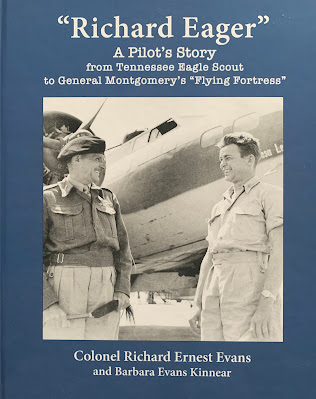
Book Review: "Richard Eager" - A Pilot's Story from Tennessee Eagle Scout to General Montgomery's Flying Fortress


Richard Eager cover (author's photograph)

Regular readers of this blog will be aware that starting back in 2014, we began to tell the story of Captain Richard E Evans who became the pilot of Bernard Law Montgomery's personal B-17 Flying Fortress, that Monty had "won" in a bet with General Eisenhower's Chief of Staff, General Walter Bedell Smith concerning the capture of of the Tunisian city of Sfax.

I was already aware of this bet and how by claiming his winnings, Monty had managed to upset pretty much everyone from Bedell Smith (who had wrongly assumed that Monty was joking) to the British Chief of the Imperial General Staff, Sir Alan Brooke, one of the few who could normally keep Monty under some sort of control. It was left to Ike to smooth things over and despite his annoyance at having to kow-tow to Monty, he recognised the importance of keeping him happy and so authorised the use of a Boeing B-17, complete with American crew to satisfy the British general's ego.

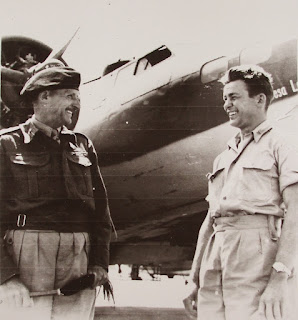
However, in December 2014, I had the honour of guiding Barbara (Bobbie) Kinnear and her husband John on a wartime walk around Westminster but before we had met, Bobbie had mentioned that her late father had been Monty's pilot. Bobbie expressed a certain amount of surprise that I was aware of this particular wartime oddity and when we did finally meet before our walk, I was delighted that she had brought along some copies of photos of her dad, proudly standing alongside a genial looking Monty. This photo, Bobbie explained, was one that her dad had unofficially entitled "Friends at Last" after a series of mishaps, mostly born of bad luck and the occasional misunderstanding, had threatened to sour the relationship between the two men.

"Friends at Last" (courtesy of Bobbie Kinnear)


Following our walk, we parted as friends and promised to keep in touch. Bobbie and John were as good as their word and apart from continuing in email contact, we have managed to meet up on their every subsequent visit to London in those pre-Covid days, with the friendship extending to John and Bobbie's wider family.

Before he passed away aged 87 in 2006, Colonel Richard E Evans (as he had become) began writing the story of his very full life but sadly, the work was not completed by the time of his death. Fortunately for us, Bobbie decided to complete the work but writing and editing isn't always an easy process, especially when one is trying to juggle it around work, family matters and life in general!

It is difficult to review a book of this nature without giving away too many spoilers but suffice to say, this is a well-researched and well written story that alternates between stories of Richard's childhood and growing up in the Tennessee Valley and Great Smokey Mountains and of his service in the USAAF and in particular, of his time as Monty's personal pilot, as well as his post-war service with Strategic Air Command.

The book is well illustrated with photographs both from the family collection as well as from the Imperial War Museum and other archives. There are also copies of some remarkable - and very sincere - personal correspondence between Monty and the then Captain Evans, which form part of an irreplaceable family archive.

From my own point of view as a military historian, the chapters covering Richard's service during the Second World War are of the most interest but those dealing with his young life in Tennessee are fascinating and give an insight to a life that this "Limey" can only imagine but which in some ways echo my own father's young life growing up in rural England before the war.

I commend this book to anyone with an interest in family or in military history, or for anyone interested in the often overlooked "human" side of Field Marshal Bernard Montgomery. 

And why is the book called Richard Eager? Well, you'll have to buy it to find out!

I should point out that I did have a very small role in assisting with some of the research for this book but the writing and the editing is the work of Colonel Richard Evans and Barbara Evans Kinnear and theirs alone.


All profits from the sale of this book are being donated by the family to the Air Force Aid Society and copies can be purchased online from www.richardeagerbook.com 


Monday, 27 February 2017

His Majesty's Stationery Office at War

One of the many bonuses of my job as a guide, speaker and researcher is being able to indulge myself in one of my old hobbies of collecting old books, although this is something of a double-edged sword, as my home is rapid becoming submerged in an ever growing tide of books both old and new. Indeed, one item firmly on the agenda for 2017 is to build some new bookshelves.

One of the publications I have found myself collecting over the years are the excellent and numerous series of wartime booklets published by HMSO, or His Majesty's Stationery Office to give this organisation it's correct title.

It would be easy to dismiss these works as mere propaganda but this would be to do them a great disservice; of course they tell the stories from a staunchly pro-Allied point of view but there is a great difference between these works and the blunt nature of the works put out by the HMSO's Nazi counterparts. For one thing, the British works do tend to tell things pretty much as they were and some of the photographs pull no punches. For example, in the first of these booklets I acquired, Front Line 1940-41, which tells the story of Britain's Civil Defence Services during this time, the images of destroyed buildings, injured civilians and people being rescued are all real enough and are in no way "manufactured" shots for the benefit of the book. The narrative, although understandably of its time, is thoughtful and well-written and leaves nobody in any doubt that the country has suffered grievously. The underlying message of course, is a positive one - that although times are hard, everything will eventually come right. The books themselves are a masterpiece of good design - the covers are innovative and the standard of some of the photography is first class. The price of these little booklets varied depending on the size of them but were generally between 6d and 2 shillings (between 2 1/2 and 10 pence in today's money) and were an invaluable way for the British public to keep up with events during the wartime years.

Not strictly an HMSO publication but one in which they doubtless had an input is Fire Over London, which tells the story of the London Fire Service during the Night Blitz of 1940-41. Published by the London County Council, who were about to relinquish control of the capital's Fire Brigade into the nationalised National Fire Service, it is a slimmer volume at 34 pages in comparison to most of the HMSO publications, which were generally around the 100 page mark but follows a similar format. It starts with a brief summary of the wartime Fire Service and of the preparations that had been made for war, before going into an account of events of some of the various great raids on London up to that point - 'Black Saturday' 7th September 1940, 'The Second Great Fire of London' 29th December 1940 and the heaviest raid of them all on the night of 10th/11th May 1941. It also tells us of the different types of bomb dropped by the Luftwaffe and gives an insight as to how various types of fires were tackled and as with the HMSO booklets, it is well illustrated with some fascinating photographs. Once again, this is not by any means a piece of blunt propaganda.

Another non-HMSO publication but one with which they undoubtedly were involved is It Can Now Be Revealed published in 1945 on behalf of the four major railway companies - GWR, LMS, LNER and Southern Railways, together with London Transport - by the British Railways Press Office. This is an early use of the phrase 'British Railways' as the railways were not to be nationalised until 1948 but had been effectively under state control during the wartime years under the Railway Executive Committee. Interestingly, each of the railway companies, plus London Transport were to publish their own wartime stories in the early years of peacetime but this is another well written piece, which apart from telling us of the railways' work during the recent war, also tells us something of the plans for peace. The booklet starts by telling us not of railway operations but of the war work undertaken by the railway companies - of building tanks, Halifax bombers and Horsa gliders, anti-aircraft guns and even motor boats. This section reminds us that the railway companies contained superb in-house heavy engineering and manufacturing capabilities, all of which were put to good use to aid the war effort. We then turn to the railways themselves and the arrangements put in place for handling child evacuees, war workers, troop movements and war production. We then look at the preparations and arrangement for D-Day, which as well as being the largest sea-borne invasion of all time, was probably the greatest logistical achievement ever likely to be undertaken. The booklet then closes by telling us the work undertaken to maintain services during the V-Weapons campaigns of 1944-45 as well as something of rebuilding for the future.

Staying with the Civilian Services for now, we turn to Merchantmen at War, an HMSO publication that tells the story of Britain's Merchant Navy and the great convoy battles of the war. The booklet starts by telling us of the men of the sea, the Masters, Chief Engineers, officers and men and also tells us of the diversity amongst the crews of the British Merchant Fleet and reminds us that many of the seamen came from places as widespread as Sierra Leone, Bombay and Mombasa. We learn of the convoys themselves, the pre-sailing conferences and of the cargoes themselves, which could be anything from foodstuffs to vital wartime supplies of raw materials and finished products such as tanks, aircraft and ammunition. Like the other booklets, it pulls no punches and there are some pretty graphic photographs of ships being torpedoed and men being rescued who were clearly at the limits of their endurance. We learn of the Arctic Convoys, which were arguably the most arduous of all and finally we see the 'turn of the tide' the preparations for the various landings at Sicily and Normandy. As someone who served in the Merchant Navy in a small way during the 1970s and 80s, this is a fascinating account of a subject close to my own heart.

The fighting services are not ignored either and there is comprehensive coverage of various aspects of the 'sharp end' of the war. A recent acquisition courtesy of the excellent David JB Smith aka @NavalAuthor on Twitter (with whom some swapping of doubles was done), is The Mediterranean Fleet, which is the Admiralty's account of Naval operations in that theatre from April 1941 to Janaury 1943. Like all of the others, this is well written with a copious amount of illustrations and covers some of the hardest moments such as the evacuations from Crete and Greece and the losses of such ships as HMSs Ark Royal, Barham and York, as well as the Malta Convoys, to the more triumphant moments such as the victories at Cape Matapan and Sirte. Once again, the standard of photography is outstanding and leaves the reader in no doubt that before the final victories, there were many moments of tragedy along the way. Some of the photographs of the sinking of HMS Manchester are particularly hair raising and it is hard to imagine anything nearly so candid being published in Nazi Germany at any stage of the war.

Neither are our various Allies forgotten in these booklets either and another recent acquisition  focuses on the exploits of Queen Wilhelmina's Navy or the Royal Netherlands Navy to use the correct title. At twenty five pages, this is a slimmer volume but like the others described earlier, is still well-written and contains a large number of excellent photographs. In common with the other booklets in the series, the narrative doesn't just provide the reader with mindless propaganda but also speaks candidly of the defeat and losses suffered when the Netherlands were invaded and how the Dutch Navy fought a brave delaying action. Despite the loss of their homeland to the German invaders, the Navy fought on and suffered further heavy losses when the Japanese entered the war and attacked Dutch colonies in the East Indies and the booklet tells of the heroic defeat of Admiral Doorman's combined Dutch, American and British force at the Battle of Sunda Straits. Like the other booklets reviewed above, this one also ends on a hopeful note and tells of the Dutch Navy's ongoing fight against both Germany and Japan and looks forward to the day when they will be able to return to a liberated country.

Staying with the Allied theme, Target: Germany examines the work done by the United States 'Mighty Eighth' Air Force in it's first year of operations over Europe. The booklet in my possession is marked "British Edition" so this was clearly something produced for consumption on both sides of the Atlantic. The narrative here starts with the description of two  daylight raids (all American raids were in daylight) on a synthetic rubber factory at Huls as well as the General Motors' factory in Antwerp and tells of how important it was for the American bombers to stick in a close defensive formation. As before, the narrative is quite candid in it's descriptions of massed attacks by German fighters, of bombers exploding and of others coming down in the Channel and the crews awaiting rescue by the British Air-Sea Rescue services. The chapter closes with the post-mission interrogation of the surviving crews and the questions asked of them. Next, we read about the comparisons between the two main American heavy bombers used, the B-17 Flying Fortress and the B-24 Liberator, such as relative bomb loads, speeds, defensive armaments etc. The next chapter steps back in time and gives us the background of the raison d'etre of the Eighth Air Force and the early developments in it's formation and deployment to Britain. All in all, this is another quality piece of work and whilst the narrative is perhaps the most 'gung-ho' of all those reviewed thus far, it is also fairly candid in it's descriptions and like the other books, the standard of the photography is first class.

Staying with the theme of air power, our next booklet RAF Middle East concentrates on the work of the Desert Air Force and air operations in the Middle Eastern Theatre of War from February 1942 to January 1943. This volume tells of operations primarily in the North African desert but also covers the defence of Malta. We hear descriptions of the unique conditions encountered in the desert that made flying so difficult and the maintenance of aircraft challenging in the extreme. Like most of the other volumes, we read descriptions of the early reverses and the back and forth struggles across the desert during this most fluctuating of wartime theatres. The siege of Tobruk is covered as is the later fall of this supposed fortress-port. Air operations in support of the British Eighth Army at Alamein are covered in some detail, when probably for the first time there was really close and effective co-operation between the British Army and Royal Air Forces. This was one of Montgomery's finest achievements and was something of which all those involved could be justly proud. The booklet closes with the pursuit of the Afrika Korps across the Western Desert until their final surrender in Tunisia. Once again, the narrative is truthful and speaks of the reverses as well as the triumphs and the standard of photography is excellent.

We stay in the desert for our next HMSO publication for The Eighth Army which covers this Army from it's official formation in September 1941 through to the brink of final victory in that theatre during January 1943. When the Eighth Army was formed, British fortunes in North Africa were at a low ebb following the earlier brilliant successes achieved by General Wavell's Western Desert Force against the Italians early in the war. Wavell was replaced by General Auchinleck and the book really opens by describing The Auk's (as he was nicknamed) first offensive in November 1941. The book makes a point of describing the cosmopolitan nature of Eighth Army, as besides men from all of the home nations of the British Isles, there were soldiers from Australia, India, New Zealand and South Africa. We again hear of the siege of Tobruk, this time obviously from the point of view of the men on the ground. The book tells us of the great advances and retreats that symbolised this campaign before the Army settled on it's defensive line at El Alamein. It was at this point that Churchill decided on another change of command and Auchineck was relieved both as Commander in Chief, Middle East and as General Officer in Command of Eighth Army. He was replaced by Alexander in the former position and the then little-known (outside the Army) Bernard Law Montgomery as Eighth Army Commander. After halting the Afrika Korps at Alam Halfa inSeptember 1942, Montgomery's thoughts turned to the offensive and the booklet covers the ensuing Battle of El Alamein in some details but perhaps understandably considering when the book was written, does not cover any of the later controversies with regard to Monty's perceived over-cautious approach to battle. Seemingly after years of defeats on land, the British at last had a winning General and would not allow dissent in an official publication!

We close by looking at a regiment which formed an integral part of Eighth Army and in The Royal Armoured Corps published in 1945, the narrative gives a brief account of the formation of the regiment during the First World War following the invention of the tank and tells us of how Germany embraced the tank under Hitler and of the early British defeats in France during 1940, during which campaign the Royal Armoured Corps was one of the relatively few parts of the British Army to come out with credit, although they were to lose the majority of their equipment during the hurried retreat and subsequent evacuations. We then learn of the regiment during the Western Desert campaign and the rapid expansion caused by the massive influx of wartime conscripts. There follows a detailed account of the recruiting and training process. The book closes with accounts of the victorious battles in the desert as well as the return to France in 1944 and the future advance into Nazi Germany. Although published in 1945, the book was clearly written in mid 1944 before final victory was achieved but like the other HMSO publications described above, this is a candidly written and well illustrated account.

There is a seemingly endless list of these HMSO booklets and I have yet to see the publications covering the Battle of Britain, RAF Bomber Command, The Fleet Air Arm, His Majesty's Submarines, His Majesty's Minesweepers, The Royal Marines, Australian Forces, Coastal Command and Combined Operations amongst many others that are out there. So far, my acquisitions have come from junk shops, internet auction sites, swaps and the odd gift from friends who know what a sad character they have befriended. They are a fascinating view of the war as written at the time.


HMSO Publications:

The Eighth Army: September 1941 to January 1943 - published 1944 
Fire Over London: The Story of the London Fire Service 1940-41 - published by the London County Council, August 1941
Front Line 1940-41 - published 1942
It can now be revealed: More about British Railways in peace and war - published 1945
The Mediterranean Fleet: Greece to Tripoli - published 1944
Merchantmen at War - published 1944
Queen Wilhelmina's Navy - published 1944
RAF Middle East - published 1945
The Royal Armoured Corps - Through mud & blood to the green fields beyond - published 1945
Target: Germany - The US Army Air Forces' official story of the VIII Bomber Command's first year over Europe - published 1944


Wednesday, 10 June 2015

Captain Evans, Monty and the Flying Fortress - an update


Monty with the crew of Theresa Leta (Bobbie Kinnear collection)

Regular readers may remember that in February 2014, I recounted some of the exploits of Captain (later Colonel) Richard E Evans USAAF and his crew when they were flying the Theresa Leta, B17 Flying Fortress which General Bernard Law Montgomery had 'won' in what was thought by General Eisenhower to be a light-hearted wager but which the deadly serious British general had insisted be 'paid out' to him.


Monty 'Learning the Ropes' (Bobbie Kinnear collection)

At the time of writing the second part of the story, I had a feeling that my crew list was incomplete but following a further meeting in London with Bobbie, her husband John and daughter Kate, I was alerted to a book called "Victory Mail of World War II; V-Mail, The Funny Mail" by Captain James W Hudson, who was heavily involved in the setting up of this vital morale boosting method of communicating with home for the boys posted overseas.

Monty at the controls (Bobbie Kinnear collection)

Although Hudson was based in Egypt running the V-Mail system, his official title was 'Senior Photographic Officer in the US Army Forces, Middle East' and thus in November 1943, he was appointed to be Photographic Censor for the Cairo Conference between Winston Churchill and President Franklin D Roosevelt  and ended up taking many of the photos of this event himself. Later still, he was at the 'Big Three' conference in Tehran, when Prime Minister and President were joined by Soviet Leader, Josef Stalin and it was during this period that Hudson got to fly in the Theresa Leta along with some illustrious passengers.

Bobbie has subsequently most kindly sent me a copy of the book, as well as some of the original photos that form part of her collection and which also appear in the book - perhaps originally taken by James Hudson.

As a result of reading Hudson's chapter on the Theresa Leta and her crew, as well as Captain Evans' as yet unpublished memoir, we can now show the complete crew list, their rank and position aboard Theresa Leta and where known, their hometown in the USA.

The Crew of the Theresa Leta:

Captain Richard E Evans (Pilot) (Tennessee)
Lieutenant Fred I Johnson (Co-Pilot) (Logansport, Indiana)
2nd Lieutenant Albert L Beringsmith (Bombardier) (Chicago, Illinois)
2nd Lieutenant Thomas Carver (Navigator) (Alameda, California)
Tech. Sergeant Dale Owens (Flight Engineer)
Staff Sergeant Francis (Frank) R Morris (Radio Operator) (Soodenow, Illinois)
Staff Sergeant Victor Kennedy (Waist Gunner) (Tylertown, Mississippi)
Tech. Sergeant Lewis (Top Turret)
Staff Sergeant Austin (Ball Turret)
Staff Sergeant Charles (Chuck) W Ward (Tail Gunner) (Albuquerque, New Mexico)

Also after writing the first series of articles, I received an email from Lee Beringsmith, the son of the Bombardier, Albert L Beringsmith. Lee spoke very highly of Captain Evans and recalled that his father felt that he was the best pilot in the squadron and gladly swapped places with another bombardier who suffered from nervous problems and wanted off Captain Evans' crew. Lee also kindly recounted an amusing story but one in which we see Monty's sometimes well hidden 'human' side which showed his insistence at nothing but the best for the men under his command:

"My Dad told me that when they reached Cairo, Monty had them check into the Cairo Hilton as part of his personal staff. As Monty left the B17, he told Captain Evans to call him if there were any problems. When they got to the front desk at the hotel, the rather rude clerk informed them that there were no rooms available. Captain Evans asked to use the phone and reached Monty. He passed the phone to the clerk and said 'General Montgomery would like to speak to you.' The desk clerk rolled his eyes, picked up the receiver and suddenly snapped to attention, saying ' Yes sir, yes sir, right away sir.' Needless to say, rooms were somehow magically found and the crew got a well deserved rest from their combat missions."

I am indebted to Bobbie Kinnear as always for her generous sharing of her family photographs and to Lee Beringsmith for his email and shared anecdotes.


Published Sources:

Victory Mail of World War II: V-Mail, the Funny Mail - Captain James W Hudson, Xlibris Corporation 2007

Unpublished Sources:

Unpublished memoir of Colonel Richard E Evans USAF


Captain Evans, Monty and the Flying Fortress - Part Two

Richard Evans (left) and some of his crew with Monty (Bobbie Kinnear)

Having duly met King George VI and having found him to be, as Monty had predicted "A very nice chap", the time soon came for Captain Evans and his crew to start the work for which they had been selected.

This was on a flight from Tripoli to Cairo and as well as Montgomery, the B-17 carried a full party of VIPs, amongst them General Henry Maitland Wilson, known as ‘Jumbo’ due to his large size as well as the ever present ‘Freddie’ de Guingand. The atmosphere was relaxed as the crew of the bomber gave their British guests an impromptu tour of the aircraft, even allowing the British Generals the opportunity to squeeze into some of the gun positions. Whilst all this was going on, Monty was settled into his small office area that had been set up in the converted bomb bay and carried on with his paperwork. Monty seemed – and was – an austere type but ‘Freddie’ had earlier spoken to Captain Evans and reassured him that Monty’s “disinclination to smile” as he put it, was nothing to worry about and that Monty could be “a most pleasant fellow” in the right circumstances.

Gen. Sir Henry 'Jumbo' Wilson (IWM)
During the course of the flight, Evans noticed that the oil pressure indicator on the B-17’s number 3 engine was showing a very slight drop in pressure. There was nothing particularly untoward in this; the desert environment was extremely tough on aircraft engines with sand constantly being ingested into the cylinders and gradually wearing the pistons, thus allowing oil to leak slowly into the space and escape into the airstream. Although this was a slow process at first, for an older aircraft like Theresa Leta unless the engines were replaced at regular intervals, these leaks would steadily get worse.

Even so, it was nothing to worry about, the B-17 could quite easily fly on three engines if required and as a precaution Evans decided to shut down or ‘feather’ no. 3 engine to save wear and tear and then re-start it on approach to Cairo so as to have full power available for landing. Whilst this was a slightly unusual procedure, for an experienced pilot like Richard Evans it was not an issue to cause concern. Even so, when Lieut. Johnson, the co-pilot enquired whether he should inform the passengers of the developments, Evans wisely decided against it, so as not to cause them undue alarm. Despite the wisdom of this decision, it was one which was to have repercussions for Evans – and for Monty. Leaving Theresa Leta on autopilot, Evans decided to go back and speak to his passengers and passing Monty in his office, he casually invited him up to the flight deck, having completely forgotten that his bomber was flying on three engines!

Lieut. Johnson was despatched to stretch his legs and to free up the co-pilot’s seat for Monty, who settled in gingerly. Evans felt that he was making real progress with his British master, who for the first time began to relax and speak with some freedom. It was clear that he was enjoying the flight as he spoke to Evans about his time in the British Army and his exploits against Rommel.

During this conversation, the British General suddenly noticed something and rasped in a very un-Monty like voice “It’s stopped, it’s stopped! The engine’s stopped – it’s not running!” Evans had been so engrossed in his conversation with Monty that he had completely forgotten that he had feathered the engine and now Monty had embarrassed himself in front of an American officer. Captain Evans tried his hardest to reassure Monty that there was no cause for alarm and even tried a little humour in telling the great man that Boeing had deliberately given the B-17 an excess of power just so that one engine could be switched off so as to rest it!

It was all to no avail and Monty stormed from the flight deck, clearly upset and embarrassed that his legendary calm demeanour should have cracked in front of an American officer and a fairly junior one at that. Evans cursed his forgetfulness and vowed never to let this happen again.

General George S Patton Jnr (US Army)

As well as incurring Monty’s displeasure, Evans also managed to upset the volatile American General George S Patton. This incident came when he was flying Monty and a B-17 full of distinguished British VIPs to Palermo for a conference with Patton regarding the ongoing campaign in Sicily. Apart from Montgomery himself, the passengers once again included ‘Freddie’ de Guingand and General ‘Jumbo’ Wilson, Eisenhower’s Deputy Commander.

Prior to the flight, General Patton had advised Monty that the airfield at Palermo “was satisfactory for all types of aircraft”, information that had been passed on to Evans. However, upon arrival over the airfield, it quickly became clear that Patton's aviation knowledge did not match his expertise in tank warfare. The runway looked alarmingly short for a large aircraft such as the B-17 and Evans growing apprehension could not have been helped by his then witnessing a C-47 transport aircraft, better known to the British as a Dakota and a much smaller aircraft than the B-17, run the full length of the runway before crashing in flames into the trees at one end of the airfield.

Perhaps fortunately for his passengers, they remained blissfully ignorant of affairs on the ground whilst Evans circled the field trying to assess the situation. The only positive that could be drawn was that the smoke billowing from the crashed C-47 provided an excellent indication of the wind speed and direction!

The question now for Evans was whether to attempt a landing and risk quite possible disaster, or to incur the possible displeasure of Montgomery and the certain wrath of Patton by aborting the whole operation as unsafe and returning to Gela. To add to the pressure on Captain Evans, he could already see General Patton on the ground, his polished steel helmet glistening in the Sicilian sunlight, impatiently awaiting the arrival of his British counterpart, for whom he was already developing an implacable loathing, something that would grow into an obsession by the time of the Normandy campaign a year or so later.

Against his better judgement, Evans decided to attempt a landing, confident in his own ability as a pilot to pull off a diagonal landing across the field, thus maximising the available limited space. Touching down into the brisk headwind all seemed well at first but an initial touch of the brakes revealed that the brakes on Theresa Leta had failed and that an already perilous landing on a short field was now being turned into something altogether more hazardous.

Thinking quickly, Evans decided to try to ‘ground loop’ the big bomber in an attempt to avoid meeting the same fate as the C-47 that he had seen crash earlier and indeed to avoid ploughing into it’s wreckage. This was achieved by using the engine throttles on the port wing of the aircraft to make a fast, powered turn to effectively reverse course on the ground.

Through superb skill and a little luck, Evans managed to turn a potential disaster into a very rough landing, almost a controlled crash and taxied the B-17 up to about fifty feet from where General Patton was waiting to greet his British guests. No sound could be heard from the on-board VIPs and certainly no sound was coming from General Montgomery’s makeshift office created in the bomb bay of the B-17. Outside the bomber, it quickly became clear from General Patton’s expression that he was not impressed!

Patton in fact, had a face like thunder. Notwithstanding his intense dislike of Monty and all things British, even he considered that it was bad form for an American officer and a mere Captain at that, to go endangering the life of a British general!

Patton’s ‘greeting’ to Captain Evans was brief, to the point and typical of the man – “What kind of a landing do you call that?” he asked. Evans managed to stay surprisingly calm and replied that he had executed a deliberate ground loop to avoid crashing into the burning C-47. He also added that on reflection, he should not have attempted a landing and should have returned to Gela. Captain Evans repeated his apology directly to Monty but it was quickly apparent from the British General’s expression that he too was not best pleased with his American pilot. As for Patton, his face was now crimson and for a brief moment, Captain Evans felt that the apoplectic General might actually physically strike him.

However, without any further words spoken, both of the senior officers along with their entourages piled quickly into their transport and headed for their conferences. On their next meeting, after the conference, Monty gave Evans a “slight smile” as he probably realised that the American had in fact, saved his life.

Some books, notably ‘Patton, A Genius for War’ state that the B-17 was destroyed in this incident. This was not true and after some repairs, the bomber was quickly made airworthy once more.

Despite these early setbacks in their relationship, Monty soon became genuinely attached to ‘his’ crew, holding a sincere concern for their well being and mentioned this in a letter written later that summer, which was transcribed in full in Part One of this article, the original of which is now a proud possession of Richard Evans’ daughter, Bobbie Kinnear.   

"The crew of my Fortress are a fine body of officers and men and their comfort and well being is one of my first considerations. It is a very great honour for a British general to be flown about by an American crew in an American aircraft and I am very conscious of this fact."

The relationship between Monty and Evan’s and his crew quickly became one of mutual respect and friendship and another proud possession of Bobbie Kinnear today is a photograph that Richard Evans subtitled ‘Friends at last’ which shows a smiling Monty along with Captain Evans standing in front of the Theresa Leta.

Friends at Last - Monty & Captain Evans (Bobbie Kinnear)

Richard Evans continued to fly on combat missions out of Sicily, whilst still being on call to Montgomery and actually flew Monty back to the UK for the British General to begin work on planning the invasion of Europe.It was at this time that Monty requested that Evans should stay on as his personal pilot for the Normandy campaign and beyond. Evans declined as he wished to return to full time combat duties and although Monty was disappointed, he greatly respected this decision and wrote Captain Evans a generous and sincere letter of thanks, which must surely have been a useful item to have had in one’s Army Air Force Curriculum Vitae!

The letter is reproduced below and is written in the typical no nonsense style beloved of Monty but is obviously sincere as well as being to the point:

"On the occasion of the departure of you and your crew I would like to thank you all, each one of you, for the good work you have done whilst with me.

It has been a great pleasure to have had you serving with me, and with the Eighth Army.

Good-bye and the best of luck to you all, always."

Evans and his crew may have departed but true to his word, General Eisenhower provided Montgomery with an aircraft and crew right through to the end of the war in Europe, although given the way Monty later strained their relationship, there must have been times when Ike was sorely tempted to abandon the arrangement and make his British subordinate walk!

Monty's 'thank you' letter to Richard Evans and his crew (Bobbie Kinnear)

Richard Evans and his crew returned to combat duties, flying out of Italy on raids to Venice, Rome, Pisa, Austria and targets in Southern Germany before completing fifty missions in 1944 and returning home to the USA. He then trained to fly the B-29 Superfortress for combat missions in the Pacific and actually flew three raids on Japan out of Tinian before being ordered to return to the USA in order to bring another wing of B-29s out to Tinian. The war ended before he could achieve this and instead he was ordered to fly a B-29 to Delhi and then return to Okinawa.

Evans left the USAAF in 1946 to become a financial planner in Pasadena, although he continued as a reservist. In 1952, he re-entered the Air Force as a Colonel and was made head of operations for the development of the new B-47 bomber at MacDill AFB, Florida. He did all of the flying scenes in the movie ‘Strategic Air Command’, starring James Stewart (himself an Air Corps veteran) and flew B-47s out of Thule, Greenland and bases in England.

Evans left the Air Force in 1959 and became a consultant for Northrop Grumman in the B-1 Bomber competition as well as working as a consultant for Douglas on the C-5A transport aircraft.

Richard Evans died on June 13th 2006 and was buried with full military honours having loyally served his country and the Allied cause as well as achieving much for Anglo-American relations in the process.

I am indebted to Bobbie Kinnear for making her late father’s papers and unpublished memoirs available to me. It is to be hoped that these can be published in the future as the exploits of the unsung heroes of World War Two such as Richard E Evans and his crew deserve to be read by a wider audience.

The Crew of the Theresa Leta:

Captain Richard E Evans
Lieutenant Fred I Johnson (Co-Pilot)
2nd Lieutenant Albert L Beringsmith (Bombardier)
2nd Lieutenant Thomas Carver (Navigator)
Tech. Sergeant Dale Owens (Flight Engineer)
Staff Sergeant Francis (Frank) R Morris (Radio Operator)
Staff Sergeant Victor Kennedy (Waist Gunner)
Tech. Sergeant Lewis (Top Turret)
Staff Sergeant Austin (Ball Turret)
Staff Sergeant Charles (Chuck) W Ward (Tail Gunner)

Published Sources:

The Memoirs of Field Marshal The Viscount Montgomery of Alamein - Collins 1958

Unpublished Sources:

Unpublished Memoirs of Colonel Richard E Evans, USAF
Monday, 26 May 2014

A - Z of the Blitz (C)

After a short break, we resume our occasional series with a look at the letter 'C' which amongst other things, stands for Cabs.

At this point, readers might be wondering, not for the first time whether this writer has lost his marbles and what relevance cabs had to the Blitz, apart from providing a means of transport to those with a little more money to spare and one, which like every other mode of transport in London 'carried on' despite the worst that the Luftwaffe could throw at them.

AFS firemen with taxi at Gordonbrock Road (Blitzwalkers)
A glance at our main website helps to provide the answer but for ease of reference, the photo is reproduced here, showing some of the lads of the AFS at Gordonbrock Road School, Brockley proudly standing in front of their 'new' fire engine, which is a requisitioned London cab, complete with roof rack carrying a ladder and also towing a trailer pump. It is not clear from the photograph whether one of the three fire fighters is in fact a taxi driver taking his vehicle to war, but this is quite possible. 

In his excellent book 'London Taxis at War', Bill Eales explains that on many occasions, the cabs arrived at the scene of a fire long before the large fire engines simply because the drivers knew all of the short cuts, which become known to London cab drivers over years of experience and through passing 'The Knowledge', that tough examination that every licensed London cab driver has to pass before he is allowed out on the streets to ply his trade.

Whilst some cabs removed their meter and substituted a small bell in it's place, thus becoming full time 'fire engines', others doubled up and continued their usual duties during the daytime but during a raid, in addition to the ladder and trailer pump, the cabs would carry buckets of sand (for smothering incendiaries) as well as stirrup pumps that could deal with small fires. The drivers would wear a tin hat and except when the bombs were falling from directly overhead, would usually remain with his cab through thick and thin. Other cabs were converted into ambulances, whilst further vehicles were used by the Army as personnel carriers in the event of an invasion.

For those cab drivers still working 'For Hire' the pickings could be rich indeed, for when raids were at their height, they were quite often the only form of public transport still moving. Later in the war, when the American servicemen arrived, they were often accused of hogging the available cabs as they were the only ones who could afford them! 

A slightly apocryphal story perhaps but Americans on leave in London, were very prone to using cabs, although in 1944-45 when the Vengeance Weapons were falling on London, it could be a dangerous form of transport. One group of American airmen were in a cab passing Smithfield Market when a V-2 rocket exploded very adjacently to the taxi. Although all survived unscathed, including the cab, when they eventually arrived back at Liverpool Street Station to catch their train back to their airbase in East Anglia, one of the flyers was heard to comment "Gee, it's much safer up there in the plane! 

One final story relating to flyers, this time RAF boys during the Battle of Britain is worthy of note. One evening in Park Lane, two RAF flyers hailed a cab and asked whether more were available as there were many of the colleagues needing to get back to Biggin Hill after a function at one of the big hotels. Soon, some thirty cabs were lined up waiting and transported the flyers back to Biggin free of charge. The drivers thought that this would be the last they heard of it but a week or so later, some of the same lads who had been driven back to base managed to seek out the drivers and informed them that no less an RAF personage than 'Sailor' Malan had arranged for two RAF trucks to take the cabmen down to Biggin Hill for a 'thank you' celebration at the mess and after a convivial evening, the same trucks brought the drivers back to central London. After that, the boys of Fighter Command could do no wrong!

Cross of Nails from Coventry Cathedral now at the Mahnmal St Nikolai in Hamburg (author's photo)

'C' also stands for Coventry and a new word that was introduced into the vocabulary at this time - 'Koventrieren' was originally used by the Germans but soon entered the English language as to Coventrate, i.e. to devastate a target through the means of heavy bombing.

Although towns and cities other than London had been severely bombed in the Blitz, notably Portsmouth, Plymouth and Liverpool, the bombing of Coventry on November 14th 1940, marked a change in the Luftwaffe's tactics, beginning a concerted effort to attack targets in the industrial Midlands. The raid was carried out by 515 bombers and in it's own way, was a precursor to the RAF attacks on German cities later in the war. An initial small wave of target marking bombers, guided by the Knickebein radio beams, accurately dropped marker flares for the follow up wave of aircraft to drop their high explosive bombs. These rendered many roads temporarily impassible and also ruptured water mains, thus making it nigh on impossible for the fire services to reach the fires and then effectively fight them once they did arrive. A third wave of bombers carried a mix of high explosive and incendiary bombs and started many fires which burned uncontrollably.

The resulting devastation destroyed or seriously damaged twenty one important factories, twelve of them involved in the aircraft industry. Hundreds of shops were destroyed and approximately one third of it's houses were destroyed or rendered uninhabitable. More importantly, 554 people were killed. Today, the most tangible sign of the Coventry Blitz is the ruined cathedral, gutted by incendiary bombs and never rebuilt, which still stands as a memorial to those killed and as a mark of reconciliation. 

The damage to Coventry was serious but not terminal. Many of the industries whose factories were devastated that night had already partially relocated to 'shadow' factories carefully located away from the city centre into the relative safety of the suburbs or the countryside unknown to German intelligence. It was one thing to destroy an ancient monument such as Coventry Cathedral and to wreck the shopping centre but the aircraft industry was harder to pin down.

The target marking techniques employed by the Luftwaffe that night were carefully studied by RAF Bomber Command, and in particular by Sir Arthur Harris, at that point commanding No. 5 Group, who had been practicing the concept of target marking for some years. The tactic was tried on a small scale on 16th December 1940 when Mannheim was bombed in retaliation and it could be said that the attack on Coventry precipitated the change in the RAF's tactics from precision attacks on military targets (which had failed dismally) to area bombing of entire cities, a tactic which under Harris's direction, using radio beams to reach their targets and employing target marking techniques, was to reap spectacular, if horrifying, results on almost every major German town and city for the remainder of the war. Our photo shows a cross of nails taken from the gutted Coventry Cathedral, now on display at another devastated place of worship, the St Nikolai Kirche in Hamburg, now like Coventry Cathedral a place of reconciliation and remembrance of the horrors of area bombing.

Sir Winston Churchill (Library of Congress)

Our final 'C' is one who visited Coventry in the immediate aftermath of the raid and is Winston Churchill. From the moment that the first bombs fell on London on 7th September, Britain's Prime Minister was everywhere. Whenever a major incident occurred, the odds were that Churchill would want to inspect the damage, to be seen by the population, partially because he did not want to be thought of as taking refuge safely in a shelter whilst others suffered and partially because he genuinely did care about what was happening. On one occasion whilst visiting the East End of London after a bad raid, Churchill was visibly moved to tears at the plight of the people, having seen the aftermath of a direct hit on a shelter. Seeing Churchill's reaction, one elderly lady was heard to say "You see, he really cares, he's crying." The Prime Minister quickly pulled himself together and continued his breakneck tour of the damage but his reaction was far from untypical of the man.

Churchill was utterly fearless to the point of recklessness. He would frequently sit on the roof of 10 Downing Street during a raid so he could watch what was happening and on another occasion when he did this was informed that the building below was rapidly filling with smoke; it turned out that the Prime Minister had perched himself comfortably sitting on a chimney!

At a time when invasion of this country was a serious proposition, Churchill refused to countenance any possibility that he might be evacuated away from danger - "If at last this long story is to end, let it end only when each one of us lies choking in his own blood" - was his response to any suggestions of surrender or evacuation.

Of course, underground accommodation did exist for Churchill in the form of the Cabinet War Rooms, which from 21st October 1940, was the Prime Minister's main base. Referred to as the 'No. 10 Annexe', many Cabinet and Chiefs of Staff meetings were held here, although Churchill continued to hold meetings and to sleep at the 'real' No. 10 whenever possible. A more secure location was also constructed at the disused Tube Station at Down Street, near Piccadilly but this was only used on a handful of occasions.

Despite all of these secure locations from which to sit out the Blitz, Churchill was rarely, if ever, content to do this. On 15th September, the day we now commemorate as Battle of Britain Day, he was at the Uxbridge Headquarters of 11 Group, RAF Fighter Command, watching the battle unfold as Keith Park deployed his forces. Deeply moved after watching this drama, it was in the car returning to Chequers that Churchill began to compose his "Never in the field of human conflict" speech, which still resonates to this day.

Winston Churchill was at this time, at the very beginning of his wartime Premiership and victory could not be assured but fortunately for the British people and for civilisation, an inspirational figure had come to the fore at precisely the right moment.

Printed Sources:

Churchill - Roy Jenkins, Pan 2001
London Taxis at War 1939-1945 - Bill Eales, Privately Published 1985
The Myth of the Blitz - Angus Calder, Pimlico 1992


Friday, 29 November 2013

The All American

The crippled All American in flight (Warbirds News)

Earlier this month, I had the great pleasure of guiding Barbara and John Kinnear from Santa Barbara, USA on a Blitz walk around Westminster and during the course of our walk, I discovered that Barbara's late father, the then Captain Richard E Evans had served in North Africa with the 346th Bomb Squadron, 99th Bombardment Group, 12th Air Force and had indeed served as the personal pilot of General Bernard Montgomery's B-17 Flying Fortress for some time during that campaign. That, as they say, is another story which will be covered in a forthcoming edition of this blog but as a result of the mutual interest that we both have in World War 2 history, Barbara recently sent me another story of a B-17 and how due to the skill of it's crew, the soundness of the aircraft's construction and no little measure of good fortune, this particular aircraft survived terrible damage and brought it's crew safely back to base. 

Sadly, the story that was emailed to Barbara had become something of an urban myth perhaps due to constant retelling but the essence of the story is true and this Thanksgiving Weekend seems an appropriate time to tell the accurate version of the story of the 'All American.'

The Boeing B-17 was a four engined heavy bomber originally designed in the mid 1930s and entering service with the US Army Air Corps in 1938. Entry into service was slow however, and by the time of the Japanese attack on Pearl Harbour, fewer than two hundred machines had been delivered, although much larger orders were pending. Despite it's name as the Flying Fortress, the early marks were not really adequately defended against determined fighter attack and it was not until the entry into service of the B-17E in early 1942 that introduced a new tail gun position, together with ventral and dorsal turrets that the B-17 began to positively bristle with armaments and could go onto the offensive in the European Theatre of Operations. 

The later B-17F introduced the 'chin' turret  and although these marks of the Fortress boasted no fewer than thirteen gun positions, the B-17 was no more capable of flying unescorted missions over German occupied Europe than the early British attempts in 1939. However, with fighter protection - at first provided by RAF Spitfires on shorter range missions and later by the superb P51 Mustang which had the range to fly to Berlin and back to Britain - the tight formations of B-17s enabled the Allies to bomb Germany around the clock, the RAF mainly by night and the USAAF by day. The B-17 could never carry as heavy a bomb load as it's British equivalent, the Lancaster but it had a higher altitude for bombing and operating by day enabled it's attacks to be carried out with greater accuracy, at least in theory.

The particular B-17 we are looking at today though, did not operate in the European Theatre but rather in North Africa, to be precise the bomber named 'All American' by it's crew was part of 414th Bomb Squadron, 97th Bombardment Group of the 12th Air Force based at Biskra, Algeria and on February 1st 1943 was part of a raid on Tunis, which at that time was still in German hands, being used for the supply of Rommel's beleaguered Afrika Korps which was gradually being squeezed out of North Africa by the Allies.

Inspecting the damage after landing (Warbirds News)

The All American, under the command of Lieutenant Kendrick R Bragg Jnr. along with her squadron colleagues had already braved German fighters and flak before making a successful bombing run. Turning for base, the formation again came under attack, this time from two Bf109s, one of which attacked the lead aircraft, whilst the other concentrated it's attentions upon the All American. The first fighter was shot down by the bomber leader, whilst the second made a head on attack upon Bragg's aircraft. The German fighter was met with a withering barrage from the All American's guns and began to roll away from her intended prey. The gunfire from the B-17 must have killed the Messerschmitt's pilot and instead of rolling away from the bombers, the fighter collided with the Fortress with a sickening crunch, tearing a huge gash in the B-17's tail section and ripping off the port stabiliser before the fighter plummeted to the ground. Amazingly, nobody aboard the B-17 was hurt and after what must have seemed an eternity, the crew discovered that their bomber, though seriously wounded, was still flying and that the tail section had not fallen off.

The tail section was visibly moving and the crew, fearing that their aircraft could break up at any moment, donned their parachutes ready to escape. However, the wounded bomber managed to keep flying, at first closely escorted by her squadron colleagues and then, safely out of range of further German attack, limped on alone before managing to reach base at Biskra and landed safely, although perhaps not surprisingly without a tail wheel which had been disabled in the collision.

Apart from the skill and bravery displayed by the pilot and crew in nursing their crippled bomber back home, this story is also a testament to the strength and soundness of the design as well as to those who built the B-17 at Boeing in Seattle. 

I am indebted to Barbara Kinnear for making me aware of this story and also to the excellent Warbirds News website for helping to set the record straight.

Next month, I hope to tell the story of Monty's B-17, how he came to 'win' it and to tell something of the men who flew for him.