Friday, 20 May 2011

Escape to Victory (1)


The title of this week's blog doesn't refer to the cheesy 1981 movie starring Michael Caine, Sylvester Stallone, Pele and sundry Ipswich Town footballers of the day, which quite possibly ranks as one of the worst war films of all time. Neither does it relate to those brave men who escaped Nazi Prisoner of War camps to return to Great Britain, but covers the great evacuations of May and June 1940, which enabled the British Army to escape home from France and thus become the nucleus of those forces which would return in 1944 to liberate Europe from Nazi tyranny.

Even those with only a passing interest in the history of the Second World War are probably aware of Dunkirk, the French Channel port through which nearly 200,000 British and 110,000 French troops were evacuated between May 27th and June 4th 1940 but what is not so well known is that although Dunkirk saw by far the largest number of Allied troops evacuated from the clutches of the advancing Germans, it was by no means the only evacuation from the French coast and was just one of a series that saw over half a million mainly British and French servicemen evacuated to Britain, as well as significant numbers of Poles and Czechs who had made their way to France in order to continue the war.


The first of these remarkable mass withdrawals came at the channel port of Boulogne. This port did not originally contain a British garrison but was one of the primary ports used to maintain supplies to the British Expeditionary Force or BEF as it was known, which had been sent to France on the outbreak of war in 1939 to stand alongside the French Army, in what was widely seen as being a repeat of the static warfare seen during 1914-18. By the spring of 1940, this force was some 300,000 strong but although numerically strong, many of the units were still woefully undertrained and poorly equipped despite the best efforts of rising stars of the British Army such as Generals Alan Brooke, Bernard Montgomery and Harold Alexander.

On May 10th, the long awaited German offensive against the Low Countries and France began and despite the early success of the BEF in holding the Germans in their sector, it soon became apparent that the French Army was a shadow of it's former self during the Great War and the British were soon hard pressed to stem the relentless German advance. The French Army was in disarray and coupled with the imminent collapse of the Belgians, the BEF was dangerously exposed and a withdrawal to the coast soon became the only option open to the British if they were going to stand any chance of not losing their Army.

To return to Boulogne, by May 21st the Germans had reached the French coast near Abbeville and became clear that the British were in a race against time to reach and hold their section of the Channel coast before the Germans could complete an encircling operation and cut off the BEF from any chance of escape. It was originally intended to evacuate the BEF from all of the northern Channel ports of Boulogne, Calais and Dunkirk but the speed of events would ensure that Dunkirk and it's adjacent beaches would be the centre of the withdrawal.

Although Boulogne did not contain a British garrison, it did contain a 1,500 strong contingent of No. 5 Group Auxiliary Pioneer Corps, who had been engaged on dock labour work unloading the various cargo ships supplying the BEF. These men were largely unarmed and not trained in combat but were commanded by Lieutenant Colonel Donald Dean VC, who had won this highest award for bravery with the Royal West Kent Regiment in the Great War. Dean was a determined commander and although many of the Pioneers in Boulogne were later reported to have been ill-disciplined and disorderly, the men under Dean's command were made of different stuff. Despite having no anti-tank guns, they improvised road blocks with abandoned lorries and petrol bombs and thus managed to hold off the German tanks long enough to enable them to withdraw to the inner harbour to join up with the Brigade of Guards who had been sent across the Channel to stiffen the port's defences whilst the port was evacuated. The 20th Guards Brigade, comprising the 2nd Irish Guards and 2nd Welsh Guards had originally been sent in the hope of not only holding the town but also of linking up with the British garrison at the neighbouring port of Calais

This idea very quickly proved to be wishful thinking in the extreme and shortly after first light on the 23rd May, the Germans completed their encirclement of the port when they captured the Fort de la Creche. The Germans then mounted an attack on the main defences of Boulogne but although heavily pressed, the Irish and Welsh Guards held firm, supported by makeshift platoons of the Pioneers who had been armed with rifles taken from the wounded and from those who had already managed to embark for England.

The evacuation was now in full swing and as always, it was the Royal Navy that came to the rescue with a succession of destroyers entering the port whilst under heavy fire from the German armour, which was now well within firing range of the harbour. During the late afternoon, whilst HM Ships Keith and Vimy were alongside the Gare Maritime embarking a mass of troops and evacuees, they also came under air attack from Stuka dive bombers. By a miracle and also the intervention of the RAF, no hits were registered on the British destroyers but another hazard was about to manifest itself. Due to the state of the tide, the bridges of the British vessels were exposed above the level of the quayside and as the air raid was clearing, Captain David Simson of the Keith fell dead, hit by a German sniper located in an adjacent hotel that overlooked the harbour. The enemy was moving ever closer and shortly afterwards, Lieutenant Commander Donald, commanding officer of the Vimy was also hit, as were several others - both officers and men of the destroyers and also their passengers. The destroyers then left port under the command of their First Lieutenants and on their passage back to Dover performed the melancholy task of burying their dead at sea.

The Navy was undeterred and as these destroyers left, their place was taken by HMS Whitshed (pictured) and HMS Vimiera which began the task of embarking the Irish Guards and Brigade HQ whilst at the same time disembarking a demolition party from the Royal Engineers tasked with the destruction of the port's facilities so as to deny their use to the Germans. Following the embarkation of these men, it was the turn of the Welsh Guards to leave and two further destroyers, Venomous and Wild Swan moved into the port to fulfil this task. A third destroyer, the Venetia was also ordered in but as she entered the harbour was struck hard by German artillery. It was clear that the Germans wanted to sink her in the harbour entrance, thus blocking the port and bottling up the remaining destroyers inside. By skilled ship handling though, she was able to manouvre full astern out of the harbour and on fire aft, managed to escape back to England.

The Germans were now getting ever closer and as enemy columns were seen moving through the town, the destroyers deployed their 4.7 inch (120mm) main armament against the Panzers with absolutely devastating effect. It was probably the first effective anti-tank fire that the Germans had encountered; at least one tank was seen to somersault through the air following a near miss from a 4.7 inch shell and two tanks were obliterated by direct hits from HMS Whitshed. According to one eye witness who saw the destruction of the tanks:

"The shout of triumph that went up from the embarked troops was more suitable for the football ground than the field of battle and order had to be restored by megaphone, also at point blank range!"

Soon after 2100, Venomous and Wild Swan slipped their moorings and left the harbour. Even so, British troops still remained within Boulogne - many Welsh Guardsmen including almost three companies who had become separated from the main body of the Guards Brigade during the fighting and about 800 Pioneers remained along with the Sappers of the Demolition Parties as well as some wounded men being cared for by the Padre and Medical Officer of the Pioneers. So, at about 2230 the destroyer HMS Windsor entered the harbour and took off 600 men including most of the Pioneers and Demolition Parties and at 0140 the following morning, HMS Vimiera, making her second trip entered the port and embarked an incredible 1,400 men in just over an hour - the last to embark was the redoubtable Lieutenant Colonel Dean, who only just made it; he had been knocked out by a nearby explosion but had recovered just in time to make it onboard. He had wanted to return to the port to bring more men who were taking cover underneath railway wagons but had been dissuaded from doing so by Lieutenant Commander Roger Hicks in command of Vimiera, whose ship was jammed full and who understandably wanted to sail before daybreak.

Vimiera then returned to England in a dangerously overloaded condition. Sadly, the three companies of Welsh Guards - just over 300 men - began to arrive just after Vimiera sailed but even then could still have been saved had a further destroyer, HMS Wessex not been diverted to Calais at the last moment. No further vessels were sent to Boulogne and these fine soldiers mostly all became prisoners of war for five long years. Despite this, some 4,300 men had been evacuated from Boulogne, although the garrison along the coast at Calais was to be largely sacrificed to the Prisoner of War camps in an attempt to buy time for the main evacuation at Dunkirk.

As mentioned earlier, Operation 'Dynamo' as the embarkation at Dunkirk was officially titled, is well known but in the next part of this article, we shall take a look at the post-Dunkirk evacuations which brought a further 140,000 British and 46,500 Allied servicemen back to these shores but which also brought Britain's worst disaster at sea.

Published Sources:

B.E.F. Ships before, at and after Dunkirk - John de S Winser, World Ship Society 1999
Dunkirk: Fight to the Last Man - Hugh Sebag-Montefiore, Viking 2006
Dunkirk: Retreat to Victory - Major General Julian Thompson, Sidgwick & Jackson 2008

V and W Class Destroyers 1917-45 - Anthony Preston, Macdonald & Son 1971

With Ensigns Flying - David A Thomas - William Kimber 1958

Sunday, 8 May 2011

When the lights came on again; VE Day, London 1945


‘When the lights go on again’ was one of the many evocative wartime songs by Vera Lynn and although released in 1943 when the end of the war seemed a long way off, by May 1945 the lights really were coming on again. The wartime blackout had been relaxed slightly in the autumn of 1944 and had become known as a ‘dim-out’ but this was nowhere near the full level of lighting that older Londoners were accustomed to. In May 1945 though, Britain had been at war for getting on for six years and some children had never known anything but dark nights and the fear of German bombs penetrating the darkness.

By early 1945 it was plain that the Germans were finished and despite the onslaught of V-2 rockets that fell on London until the end of March, it was only a matter of time before the war would be over and to paraphrase the words of the song, the boys would be home again.

However, as with all things connected to war, the end of the European War was shrouded in chaos and uncertainty. On 7th May, everyone knew that Hitler and Goebbels were both dead and that a group of high ranking Germans had surrendered to Field Marshal Montgomery on Luneburg Heath. It was common knowledge that Berlin had fallen to the Russians and that at some point the unconditional surrender demanded by the Allies was about to be signed at General Eisenhower’s headquarters in Rheims but despite all of this, there was no formal announcement as to what was happening for the simple reason that the situation in Europe was ever changing.

In the meantime, the crowds began to converge on London in preparation for the end of the war and the extra paid holiday that had been promised by the Government to mark the end of the war with Germany. The pubs were doing a roaring trade and seemed to have suddenly found extra supplies of booze from somewhere. Everywhere, there was the anticipation of a mass celebration but the British, being then as now a basically reserved nation of people, were reluctant to start partying prematurely.

On the 8th May, it was officially over. Winston Churchill had broadcast to that effect and by that afternoon vast crowds – Londoners and Foreign servicemen and women alike – were flowing into Whitehall, where it had been announced that Churchill would speak at 3 o’clock. Right on time, he appeared on the balcony of the Ministry of Works and told the crowds that hostilities would cease at midnight that night. This naturally was greeted by cheers and when he spoke the words “The German war is therefore at an end” the crowd erupted. His voice cracking with emotion, Churchill ended his speech with the words “Advance Britannia! Long live the cause of freedom! God save the King!” The buglers of the Scots Guards the sounded the ceremonial ‘Cease Fire’ and then the band struck up the National Anthem, which was sung with great reverence by everyone present, young and old, civilians and soldiers alike, many of whom would have been doubtless thinking of absent friends who had not lived to see this day of final victory.

After this moment of reflection, there were of course wild celebrations to be seen, not only in London but in New York, Paris, Brussels and every major city and town in the Free World. Despite these celebrations, there were many who chose not to be with the crowds and preferred to be on their own or just with their families. Many of these people had lost loved ones during the Blitz or on service overseas with the services and whilst they were still glad to see the end of hostilities, they were naturally in a more sombre mood on this special day. It must also be remembered that many thousands of servicemen were still serving overseas, not only in Europe but also fighting the Japanese and the relatives of these men were also not inclined to go overboard with their celebrations.

For the children though, there were the street parties as in the example shown above in Woolwich. Hurriedly organised affairs, they were widespread across the country and as in the case of the pubs, food still strictly rationed seemed to suddenly appear as if by magic and ensured that these street parties were memorable affairs for all concerned.

For those adults still celebrating, London was ablaze with floodlighting, switched on to illuminate buildings rather than German bombers and for those in the suburbs where there was no floodlighting, some huge bonfires were lit on the many bomb sites and these bonfires gave the National Fire Service one of their busiest nights since the Blitz. Many of the large fires got out of hand and as senior fire officer Cyril Demarne recalled, the Fire Brigade soon discovered (or re-discovered) that the public could be very fickle. Only a few weeks ago, the firemen were being cheered as heroes for fighting the fires lit by the German bombs and rockets; now they were being booed as party poopers for dousing the bonfires that were threatening to get out of hand.

Peace had returned to London and although the Japanese war was to continue until August 1945, the people of the capital could at last begin to think about rebuilding their city and their lives.

Published Sources:

Backs to the Wall - Leonard Mosley, Weidenfeld & Nicolson 1974
London at War 1939-45 - Philip Ziegler, Sinclair Stevenson 1995
The London Blitz: A Fireman's Tale - Cyril Demarne OBE, After The Battle 1991

Wednesday, 13 April 2011

The Wednesday, Chelsea Old Church and a heroine from Canada

This weekend marks the seventieth anniversary of one of the largest as well as one of the last raids of the London Blitz. So heavy and destructive was the raid of the night of the 16th/17th April 1941 that it became known to Londoners as 'The Wednesday'. Whilst most parts of London were affected by this raid, on this occasion it was the western side of the capital that suffered most and large swathes of Chelsea, the West End and St Marylebone were pounded with many lives lost and famous old buildings destroyed. It was also the night that the singer Al Bowlly was killed as he slept in his flat in Jermyn Street, having eschewed the offer of a hotel in High Wycombe after having played a concert there for the comfort of his own bed.

Although Londoners were not to know it at the time, the First Blitz was drawing to a close; Hitler was about to turn his attention eastwards and would require his Luftwaffe resources for Operation Barbarossa - the attack on the Soviet Union and the quest for lebensraum or living space for the German people. Despite this impending attack, a large proportion of the German air force would remain in the west but Hitler had decided against further attacks on London once his onslaught against the Russians had started and no amount of entreaties by the head of the Luftwaffe, Hermann Goring and his senior commanders, Sperrle and Kesselring could change his mind.

This was still in the future though and before the attack to the east, the Fuhrer's 53rd birthday on 20th April was approaching and needed to be celebrated in style. Goring decided on staging two huge raids on the capital, perhaps to flatter Hitler but also to demonstrate to him once and for all that given a free reign, his Luftwaffe could indeed flatten London.

So it was that the two raids on 16th/17th April and then on 19th/20th April were the two heaviest raids thus far of the Blitz and would only be surpassed by what proved to be the last raid on the night of May 10th/11th 1941. As mentioned briefly earlier, the west of London suffered the most in this raid; no area more than the Metropolitan Borough of Chelsea as it then was and inspecting the Civil Defence Incident Log today, one is struck by the number of times that 'The Wednesday' recurs when taking stock of the damage inflicted on the borough by enemy action and indeed, when walking the borough today, there are several memorial plaques located here and there for those in the know that confirm the record.

The Royal Hospital, home of the Chelsea Pensioners, was devastated this night when the Infirmary was destroyed by a Parachute Mine that detonated in the road outside and caused the deaths of fifteen pensioners and hospital staff. Amongst those killed was 101 year old Henry Rattray, a veteran of the 24th Regiment of Foot and survivor of many earlier campaigns.

The Infirmary itself had been an 1809 addition to Wren's original Royal Hospital buildings and had been designed by Sir John Soane. Although heavily damaged, there was arguably enough left of the building to warrant rebuilding but sadly the remains were demolished, with the site today being occupied by the National Army Museum.

Further along Royal Hospital Road was Station 6W of the Auxilary Fire Service or AFS, located in the garages of Cheyne Place. A clue to the location of this station can still be seen today in the form of a large '6W' carved in the stone wall in front of the apartments that now stand on the site. Another Parachute Mine detonated here, killing three Auxiliary Firemen, whose names are recorded on a memorial plaque, erected by the charity 'Firemen Remembered' at the present day Chelsea Fire Station in the King's Road. Another bomb, this time one of the conventional High Explosive variety caused the deaths of a further four AFS men at the Brompton Fire Station, located in Chelsea Square and these men too, are remembered on the plaque at King's Road.

Nor had the night finished with the men and women of the AFS, for when we reach the site of Chelsea Old Church in Cheyne Walk, we can discover perhaps the most poignant story of them all, which concerns a visitor from Canada whose story deserves to be told.

Yvonne Marie Green was a 30 year old thirteenth generation Canadian from Montreal who had recently been divorced from Tyrou Nichol, a British actor. She had re-married, this time to Leonard Green, an officer of the Canadian Army who had been posted on attachment to the Royal Tank Regiment shortly after the outbreak of war. The family home was at 24 Old Church Street, Chelsea but like all worried husbands who were in a position to do something about it, Leonard had tried to move Yvonne to the relative safety of the country and for a while, she dutifully lived with him near his barracks at Farnham in Surrey but being the fiercely independent and fiesty character she was, Yvonne was having none of this and soon moved back to London and later joined the AFS as a Firewatcher based at Chelsea Old Church.

Yvonne had left her baby daughter Penelope, in the safety of Canada with her mother and from her regular correspondence to 'Maman Cherie' which survive in the archives of the Imperial War Museum, we can see just how independent this remarkable lady was. Her letter dated 8th October 1940 demonstrates exactly what she thought of life in the country:

'Here I am back in London again, to your honor and my satisfaction. Honestly, Farnham was a simply dire place and I'd rather face Goering's worst than die from pernicious boredom. I take no chances, believe me, and when I'm not on duty I sleep downstairs very snugly in the basement. Don't alarm yourself when you don't hear from me because I have given instructions that if anything should happen to me you should be informed - so no news is good news - remember that.'

Yvonne's letters are all like that - newsy, common sense, matter of fact and with an unshakeable belief in the final victory of the British Empire and her Allies. By 23rd February 1941, she was writing home to report on her first night stationed at the top of the tower of Chelsea Old Church:

'I had quite an exciting experience on Wednesday night - my first night as a fire watcher. I was as high as one could get in Chelsea Old Church tower being shown around; where the buckets of sand, stirrup pumps and water were. And the bombs dropped! The first we'd seen in our district since September. I tell you, I have never descended a spiral staircase as fast in all my life! It was only a stick of three bombs in the next street which luckily did little damage and only one man hurt-a broken leg. So my experience was not disastrous luckily, but its going to take a lot to inveigle me up to the top of that tower again while a Blitz is in progress. I have never had a head for heights anyway.'

Chelsea Old Church dates from 1157 and includes Sir Thomas More's private chapel that was added in 1528, with the nave and the tower that Yvonne took a dislike to being added in 1670.

On the night of 16th/17th April 1941, Yvonne was not originally meant to have been on duty but had swapped shifts with one of her colleagues. At about 1.00 a.m., whilst the raid was at its height, she and five of her Fire Watching colleagues set off on a patrol along Chelsea Embankment. Whilst one of the team, a Mr Mallett was examining some shell fragments in the road, he became aware of something floating down behind him. He quickly realised that this was a Parachute Mine and shouted at the others to run. His colleagues were about twenty feet away from him and began to run towards Chelsea Old Church. Mr Mallett was running too quickly to turn the corner and follow them, so instead ducked for shelter behind a fire alarm cover. At about the same time, a second Parachute Mine descended between the still running group of five Fire Watchers and the Church. This mine exploded, also setting off the first and in the resulting blast, most of the Church was destroyed and five out of the six Fire Watchers were killed, the only survivor being Mr Mallett.

One of those killed was Yvonne Green, the visitor from overseas known as 'Canada' to her colleagues and 'Papoose' to her Mother. She had written what proved to be her last letter home barely two days previously, on 15th April 1941:

'The Blitz hasn't affected London for some days now or nights. I should say now but I think it is a fair assumption to say that it is purely temporary and we'll be getting it again soon - maybe. Adolf has a little too much on his hands now though to try and defeat civilian morale as well as coping with the armed forces of Greece, Yugoslavia, Australia and us (not forgetting the Free French).'

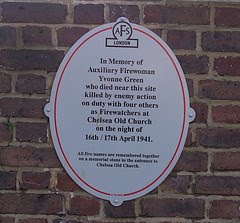
Yvonne's mother would no doubt have received this final letter after she learned of her daughter's death. Yvonne is remembered today, along with her four colleagues killed on that tragic night by a plaque inside the rebuilt Chelsea Old Church, whilst Yvonne as the only member of the AFS amongst the group, has another plaque dedicated to her outside the church and installed by the excellent 'Firemen Remembered' charity which does so much to keep alive the memory of the men and women of the wartime fire services.

Yvonne's daughter, Penelope Nichol along with her daughter and grandson came over from Canada to unveil the plaque in 2007, providing a wonderful family connection with a heroine from overseas. Yvonne herself is buried at West Hoathly in Sussex.

Published Sources:

Blitz - M J Gaskin, Faber & Faber 2005
London at War 1939-45 - Philip Ziegler, Sinclair Stevenson 1995

Unpublished Sources:

Imperial War Museum Archives
Royal Borough of Kensington & Chelsea Archives

Tuesday, 5 April 2011

I am the Boiler Man

Last week's Blog closed on a note of classic British 'stiff upper lip' and an absolute determination to remain calm in the face of adversity, so perhaps now is a good time to take this facet of the British personality a step further and examine how we managed to keep our sense of humour during the dark days of the Blitz and wartime in general.

Whilst everyone surely agrees that war is a grim experience for everyone, it is also a fact that wartime conditions can bring out the absolute best in people as well as the absolute worst. Among the better aspects of human nature is a sense of humour and even during the darkest days of the Second World War, there are examples of humour - sometimes from a senior officer in the face of adversity to demonstrate to his men that things aren't actually that bad, sometimes what we now call 'gallows humour' and more often than not, simply because the person concerned was a naturally cheerful person and war wasn't going to change anything.

Some of the best examples of the former seem to come from the Royal and Merchant Navies, such as this splendid example from Admiral Sir James Somerville (pictured), newly appointed in command of the Eastern Fleet in 1942 and flying his flag in HMS Warspite. His fleet was largely an ageing and obsolescent one and they were steaming towards very possible destruction at the hands of the Japanese but he still found time to send the following memo to his Executive Officer, Commander Sir Charles Madden, who was a Baronet, which read:

'Dear Charles, I am well aware that as a Baronet you are indifferent to the suffering of mere Admirals, but would you mind having my lavatory unblocked?'

Somerville knew that this message would do the rounds of the messdecks and whilst it made him the butt of his own joke, it demonstrated to the men of his fleet that if he could be unconcerned about the Japanese threat to them, then why should they worry?

Strangely, some of the best examples of gallows humour came from the German side, especially towards the end of the war, when defeat was inevitable. Wehrmacht soldiers in the Western Front were becoming used to the overwhelming Allied air supremacy, with all the discomfort that this brought and soon the saying was doing the rounds:

'If planes show up painted in camouflage markings, then its the RAF. If they show up painted silver, then its the Americans. And if they don't show up at all, then its the Luftwaffe!'

A great example of the third type of humour, that of the genuinely cheerful and cheeky person comes from Angela Raby's excellent book about the London Auxiliary Ambulance Service, 'The Forgotten Service' and concerns Eileen Lamb, a shift leader at Station 39 in Weymouth Mews:

'Eileen was a glamourous society girl with her own flat. Her father was in the Royal Navy and her mother was on the Queen's Working Party at the Palace. While going on leave, Eileen was travelling in a railway carriage alongside an airman who asked to use her lighter. As she lit his cigarette, she accidentally set fire to his magnificent handlebar moustache. She apologised profusely and he was gracious enough to reply that everything was "O.K." However, she made the mistake of lending him her mirror. On seeing with horror the remains of his moustache, he rounded on her: "That's all your fault," to which Eileen replied, "Not so. You're the one who should know about wind direction."'

Winston Churchill, despite the enormous pressures of leading the country in wartime, with all of the trials and tribulations never lost his sense of humour, which could surface at the most unexpected times. After a particularly fraught conference with General De Gaulle, who was never the easiest of allies to get along with, Churchill suddenly turned to General Alan Brooke, the Chief of the Imperial General Staff and said to him "How can one do business with a man who looks like a female llama who has just been surprised in the bath?" Brooke, who was well used to the darker side of Churchill's moods struggled to control his laughter.

If some of the humour seems a little strained by today's standards, we shouldn't forget that the British public were trying to put a brave face on very trying times but the Londoner would always try and have the last word, such as these hecklers at Speakers' Corner, where the speakers in question must have known they were on to a loser from the start:

'What are we fighting for?' cried a speaker.
'Spam!' replied someone in the crowd.

'Who are the two greatest men in the World?' asked another orator.
'Flanagan and Allen' said the voice in the crowd.

Some of the very best humour was unintentional and perhaps we should close with this farcical situation being reported in Westminster during the height of the Blitz.

'Mr Kimmett, Chief Warden's Liaison Officer was conducting a reconnaissance at the Art Metal Company during the Hugh Street incident and asked a man at the door if there was anybody in the building when the bomb fell. The man replied "Only the Boiler Man." Mr Kimmett found out from him where the Boiler Room was and set off to make a search. The building was flooded at the time and though he searched diligently, waist deep in water, he could find no sign of a floating corpse. So he returned to the man at the door and enquired as to the whereabouts of the Boiler Man. The reply he received was "I am the Boiler Man!"'

The reply of Mr Kimmett, or indeed what he thought of the Boiler Man in question probably couldn't be printed here!

Published Sources:

Backs to the Wall - Leonard Mosley, Weidenfeld & Nicolson 1971
The Fighting Admirals - Martin Stephen, Leo Cooper 1991
The Forgotten Service - Angela Raby, After The Battle 1999

The London Blitz: A Fireman's Tale - Cyril Demarne OBE, After The Battle 1991

Make a Signal - Capt Jack Broome DSC, RN, Putnam 1955

War Diaries 1939-45 - Field Marshall Lord Alanbrooke, editors Alex Danchev & Daniel Todman, Weidenfeld & Nicolson 2001

Unpublished Sources:

City of Westminster Archives


Thursday, 31 March 2011

They never closed (well not for long anyway)

'We never closed' was the motto of the Windmill Theatre situated in London's Soho. Famous for it's scantily clad and often nude tableaux, some Londoners changed this motto to 'We never clothed' but the truth is although The Windmill remained open throughout the worst of the Blitz, it did in common with the remainder of the nation's theatres, close for twelve days from 4th-12th September 1939 following a Government decree that affected all places of entertainment.

This decision, which seemed almost guaranteed to undermine the morale of the public and which was described at the time by George Bernard Shaw as "a masterstroke of unimaginative stupidity" was introduced by a nervous government seemingly in order to close down anything that could not be deemed essential to national life. Although churches were exempted, from this ruling, cinemas and theatres were closed immediately across the land. As with many things British, this edict was in fact, only a guideline issued by the government to local authorities and although they mostly fell into line, the town of Aberystwyth ignored it and allowed their cinemas to remain open. The real reason behind the ruling was that the government wanted to ban anything that could cause large gatherings of people with the potential consequences of bombs falling on such a gathering. When seen from this point of view, perhaps the decision of the government is easier to understand, although it still seems a panicky move which always seemed guaranteed to fail.

It wasn't just cinema and theatre that suffered either; professional sport suffered too. The 1939 cricket season had almost finished in any case and the touring West Indies side had hurriedly sailed for home on Saturday 26th August as the war clouds gathered. The remaining county matches were cancelled and it was to be the summer of 1946 before Test Cricket returned. The 1939-40 football season had only just started and this was cancelled by the Football League on 6th September after only a handful of matches had been played. Friendly matches were later allowed and later still, a league of sorts was introduced in which clubs were allowed to field 'guest players' from other clubs who were serving in the Armed Forces and stationed locally. There was also a 'War Cup' competition complete with a Wembley final which always attracted large crowds. Other sports which required floodlighting such as speedway and greyhound racing were doomed to fall prey to the Blackout and the phrase 'cancelled for the duration' soon crept into the vocabulary of the public. London Zoo and Kew Gardens were also victims of the policy, although both were soon open again, with the Zoo in particular being very popular with visitors - 1.6 million in 1943 alone.

The public soon became restless with this policy and as a result, one of the few British institutions to flourish during the war were the pubs. It would have been a foolish government indeed that tried to close down these generally cheerful places of escape for the public. The general ban on entertainment couldn't last and the cinemas and theatres re-opened from 12th September, in the outer suburbs of London at first and then grudgingly for the inner London venues three days later on 15th September.

Concerts had also fallen foul of the ban but these too resumed, although many of the orchestras suffered through losing members to the call-up. The Queens Hall in Langham Place, itself later to become a victim of the Blitz, re-opened by hosting the London Symphony Orchestra on 24th September 1939, with pianist Myra Hess (pictured) as soloist and it was Hess who was soon to provide some of the cultural highlights of wartime London.

The National Gallery in Trafalgar Square had lost it's collection of paintings to the safety of a disused slate quarry in North Wales and had thus become a largely vacant space. Myra Hess made a proposal to the Director of the Gallery, Kenneth Clark that she play a lunchtime concert there. His reply was to insist that she should play every day and although this was clearly not practical, she agreed to organise a series of concerts in which she would play whenever possible. The first concert was barely publicised but despite this, the queues to enter soon stretched all the way along the north side of Trafalgar Square. These lunchtime concerts became a wartime institution for Londoners and visitors to the capital, with Myra Hess performing in over 250 of the 1,698 concerts that she arranged during six years of the war. Neither were these concerts exclusively for the 'high brow'; soldiers and ARP Wardens rubbed shoulders with intellectuals and Cabinet Ministers and despite being initially limited to an audience of 200, this was frequently overlooked and often crowds of 1,000 plus managed to squeeze into the Gallery. For this contribution to maintaining the morale of the British public, Myra Hess was created a Dame of the British Empire by King George VI in 1941.

Apart from these pursuits, the overwhelming desire of many Londoners was to head for the dance halls. Venues like the Streatham Locarno, Hammersmith Palais and the Paramount Tottenham Court Road reported crowds well above the pre-war averages. There were more dance bands playing than ever before and even the smallest restaurants felt it necessary to employ musicians.

It was inevitable that with these gatherings and the coming of the Blitz in 1940/41, tragedies would ensue and sure enough on the 8th March 1941, the Cafe de Paris in Coventry Street was struck by two bombs which killed eighty people. In a stroke of irony this restaurant, which was located twenty feet below ground, had billed itself as 'London's safest restaurant' but this shield of concrete was not enough to save it from the direct hits of the German bombs and when the rescue workers arrived they found a scene of utter carnage. The bandleader, Ken 'Snakehips' Johnson had been decapitated and diners were still sitting dead at their tables. To make matters worse, looters were mingling with the rescue workers and reportedly cutting the fingers off the dead in order to steal the expensive rings that some were wearing.

Attendances fell away for a while during the height of the Blitz and again during the Terror Weapons campaign of 1944-45 but always quickly picked up again. Civilians needed diversions from the routine of wartime life and service personnel on leave needed reminders of what civilian life was like and indeed a reminder of what they were fighting for.

Life continued and even during air raid warnings, the cinemas and theatres carried on regardless. Perhaps we should close with this message that was displayed to customers entering London's Adelphi Theatre. The gist of the message was repeated in cinemas and theatres across the country but for sheer 'stiff upper lip' this takes some beating:

'When an Air Raid Warning is received, you will be informed from the stage. Those wishing to leave will have seven minutes to find shelter. For those desiring to remain, the show will go on. Walk, not run to the exits. Do not panic. REMEMBER YOU ARE BRITISH.'

As they say in showbusiness - 'follow that!'

Published Sources: Backs to the Wall - Leonard Mosley, Wiedenfeld & Nicolson 1971
London at War - Philip Ziegler, Sinclair Stevenson 1995

The Lost Seasons; Cricket in Wartime 1939-45 - Eric Midwinter, Methuen 1987

Friday, 18 March 2011

Saving an Icon: The St Paul's Watch and a Flawed Hero


Probably everyone today is aware of Herbert Mason's iconic photograph of St Paul's Cathedral standing proudly and seemingly untouched amid a sea of smoke and flame on the 29th/30th December 1940, the night that became known as the Second Great Fire of London. This photograph was circulated around the World and became a symbol of the British people's defiance against the Nazi hordes waiting across the Channel.

The truth is that far from being undamaged, the famous old cathedral did in fact sustain quite serious damage on a number of occasions during the War and on the night that Mason's photograph was taken, came within a whisker of joining the ten Wren churches destroyed within the Square Mile on that fateful night. Let us therefore tell the story of St Paul's Cathedral during the War and of those individuals who ensured the survival of Sir Christopher Wren's masterpiece.

During The Great War, the Dean and Chapter of St Paul's had formed the St Paul's Watch in order to guard the Cathedral against German air attacks, which in those days came from the giant airships colloquially known as Zeppelins and the Gotha biplane bombers. In that conflict, the Cathedral had survived unscathed and the Watch had been disbanded in 1918. In 1939, the Watch was reformed as a dedicated team of three hundred fire watchers and fire fighters formed mainly from the Cathedral's own staff but augmented by members of RIBA - the Royal Institute of British Architects - including the future Poet Laureate, Sir John Betjeman. About forty of the Watch were on duty at any one time, with more being drafted in during air raids. On the night of the 29th/30th December, it was estimated that some eight hundred incendiaries fell on and around the Cathedral, all of which were successfully dealt with by the Watch - all except for one rogue bomb which lodged in the lead covering of the Dome. This bomb was too high for those stationed on the Stone Gallery to reach and too far down for the members stationed on the Ball high above street level. As the incendiary fizzled and burst into life, the onlookers could only watch helplessly and pray that somehow the bomb would not fall into the Dome and ignite the timber framework that supported the whole structure, for if this were to happen then the Cathedral was certain to burn like the rest of the City, leaving just a shell. Just as things were looking desperate, either a miracle or a result of gravity occurred, depending on one's point of view and the bomb fell outward, bounced down the side of the Dome and landed on the Stone Gallery where it was pounced upon by members of the St Paul's Watch and quickly extinguished.

The St Paul's Watch was disbanded once again after the war but was reformed once again in 1952 when it was renamed The Friends of St Pauls who today sell guidebooks and assist visitors to the Cathedral.

Even at this relatively early stage of The Blitz, this wasn't the first time that St Paul's had come close to destruction; this had happened just five days into The Blitz, on September 12th 1940 when a tale of bravery and heroism unfolded that ensured the Cathedral's survival but which would ultimately end in disgrace for one of the participants. During this particular raid, a 1,000 kg Delayed Action Bomb fell in the Dean's Yard and buried itself into the cloying London clay. At this time, the Bomb Disposal Squads did not have the means to defuse this type of bomb and the usual tactic was to evacuate the area and let the bomb explode, which usually happened within 72 hours. With St Paul's however, this was not an option; Winston Churchill had decreed that certain buildings were to be saved at all costs and St Paul's was one of them. So it was that Lieutenant Robert Davies and his team of three 'sappers' from the Royal Engineers arrived at the scene and began digging down to reach the bomb. It wasn't a simple matter though - the London clay was wet and the more the men dug, the deeper the bomb seemed to settle in the clay; so much so that by the time the team reached the bomb, it was thirty feet beneath the surface and to compound matters, fumes from a leaking gas main had overcome two of Davies's men and then to make matters even worse, the gas then ignited and the men had to retreat whilst the Gas Board turned off the supply. All of this wasted precious time but work was eventually able to resume and after the painstaking digging, Davies and his remaining assistant Sapper George Wylie, attached a steel hawser around the bomb and attached it to the winch on their truck and began hauling the monster to the surface. A short way into the process, the hawser snapped and the bomb slid slowly back into the clay. A second attempt ended the same way but with the third lift, the men succeeded in bringing the deadly bomb to the surface and it was at this point that Lieutenant Davies personified the phrase 'above and beyond the call of duty' by insisting that his men had faced enough danger and once the bomb was loaded onto the truck, he drove it alone to Hackney Marshes, where it was detonated, leaving a crater one hundred feet across. For their actions in clearing this bomb and undoubtedly saving St Pauls, Lieutenant Davies was awarded the George Cross, as was Sapper Wylie. The other members of the team Sergeant James Wilson and Corporal Herbert Leigh were awarded the British Empire Medal.

Lieutenant Davies's story was an interesting one, which after the award of his George Cross ended in ignominy and disgrace. Born in 1899 in Cornwall, he had emigrated to Canada at a young age and had served in the Canadian Army during the Great War. He had returned to this country shortly before the outbreak of war and had enlisted in the Royal Engineers, becoming a Bomb Disposal expert. Despite his undoubted bravery, Davies's fall from grace was rapid. In 1942, he was charged with and found guilty on multiple counts of Fraudulent Behaviour and Improper Use of Government Materials and Manpower for Personal Enrichment. He was sentenced to two years imprisonment but was released after serving six months and cashiered from the Army. In 1950, he emigrated to Australia, presumably to try and make a fresh start but cut a sad figure wearing medals for campaigns he could not possibly have served in due to his serving his prison sentence and subsequent dismissal from the Army. Davies died in Australia in 1975, aged 74.

The Cathedral was struck again on the night of 16th/17th April 1941, this time by a bomb that exploded, when a 250 kg High Explosive device pierced the roof and exploded on the High Altar, which was destroyed but mercifully without loss of life. This damage although serious, was not irrepairable but without the actions of the St Pauls Watch and of Lieutenant Robert Davies and his team coping with the earlier incidents, it could all have been so much worse.

Published Sources:

Blitz - MJ Gaskin - Faber & Faber, 2005
The City Ablaze - David Johnson - William Kimber, 1980
The Times - London, September 15th 2010


Sunday, 13 February 2011

Liquid History, HMS Arethusa, and the London Fire Brigade at Dunkirk

The River Thames has always been one of the main arteries of London. In 1940, the Thames was home to far more commercial traffic than we can see today, with five great expanses of enclosed docks on the north side of the river, the Surrey Commercial Docks to the south and all manner of wharves, power stations and the vast Woolwich Arsenal site strung out along either side of the tideway.

The Thames has always held a special place in the hearts of Londoners, who have used it for leisure, for work, for travel and have seen pageantry and tragedy unfold upon it in equal measure. It was described by the trade unionist and Labour MP John Burns as ‘Liquid History’ which is probably the most eloquent description of the river that has ever been penned.

Before the outbreak of war in 1939, the Germans had already begun aerial reconnaissance of likely targets along the river and today, we can still see these photographs which have been published under the somewhat distastefully named series Adolf Hitler’s Home Counties Holiday Snaps. Despite the trivialisation implied by this title, reconnaissance photography was a serious business which pre-war was often undertaken by concealed cameras aboard German civilian aircraft en route to or from London’s embryonic airports such as Heston and Croydon. In these photos, sites such as the Woolwich Arsenal, power stations, railways, docks and other potential targets were identified well before war was declared.

In those days before airborne radar sets and guidance beams, the best way for aircraft to find a target was to follow easily identifiable landmarks such as rivers and railway lines. London of course, has no shortage of the latter and the River Thames was and is an un-disguisable pathway to the centre of the capital and all a potential enemy had to do was to follow the course of the river from the Estuary to the centre of London. Today’s flyers call this Visual Flight Rules or 'VFR' and by using this method, it was inevitable that the Luftwaffe would be able to find their target when the time came.

When, at 4.30 p.m. on Saturday September 7th 1940, the sirens sounded to mark what proved to be the beginning of the Blitz, it was the course of the Thames that the bombers followed before unloading their bombs on the Woolwich Arsenal, Silvertown, West Ham Power Station and the Surrey Docks, lighting huge conflagrations that acted as beacons for the second wave of bombers that came that night. This was to be that start of fifty seven consecutive nights bombing and even after a brief lull in early December the bombers would continue to return right the way through until the night of May 10th/11th 1941. The docks and industries along the Thames were invariably part of the targets being attacked and with an un-knowing nod as to what was to happen some three years hence, the Luftwaffe gave the London dock system the code name ‘Hamburg’ and one can only wonder whether the irony of this was not lost on the Germans when the Allied air forces unleashed havoc on the German port city some three years later.

In 1940, the British anti-aircraft defences, although enthusiastically manned and well led by General Sir Frederick Pile – who incidentally would remain in this role throughout the war – were proving fairly ineffective against the German onslaught. The guns at this time were sighted in London’s open spaces such as Hyde Park, Blackheath, Southwark Park, Wanstead Flats and many similar places but being without the advantage of radar guidance, the chance of hitting a relatively fast moving bomber at night with only the assistance of searchlights to pick out the target, was fairly remote. As the war progressed, their performance and equipment was to improve drastically but in 1940 the anti aircraft or 'Ack Ack' guns’ crews needed all the help they could get. So it was that in November 1940, the cruiser HMS Arethusa (pictured), that had been refitting at Sheerness following arduous service in the Norwegian Campaign and covering the evacuations from France was moved to the Lower Pool of London, close to Tower Bridge to augment London’s defences. Her impressive anti-aircraft armament of eight four inch guns plus smaller calibre two pounder ‘pom poms’ joined in the nightly barrage against the Luftwaffe and although it was questionable whether they actually hit anything, they did have the advantage of forcing the bombers to fly higher and also of boosting the morale of the civilian population, who always liked to hear the sound of the guns firing back, despite the fact that on the principle of 'what goes up must come down’ the shrapnel caused by the shells fired were just as likely to cause death and damage to Londoners and their property as the German bombs.

Her brief stay in London ended in early 1941 and HMS Arethusa went on to enjoy further distinguished wartime service in the Mediterranean Fleet, on the Malta Convoys and at Normandy on D-Day before being eventually scrapped in 1950.

The sterling work of the London Fire Brigade, the Auxiliary Fire Service and later the National Fire Service in fighting the fires of the Blitz is well known and whilst everyone is familiar with the land-based fire engines and fire fighters, perhaps less well known was the small armada of fire boats, or what were effectively floating fire engines. Many of these fire boats were converted tugs and barges, hastily pressed into service on the outbreak of war but amongst their number was the purpose built fire float (as the London Fire Brigade called her) Massey Shaw (pictured) which was named after Sir Eyre Massey Shaw, first head of the Metropolitan Fire Brigade, predecessor of the London Fire Brigade. Built in 1935 by J Samuel White’s Yard at Cowes on the Isle of Wight, Massey Shaw was designed to fight fires in peacetime along the vast expanses of London’s industrial riverside and was capable of pumping three thousand gallons of water per minute from each of her two Merryweather pumps. Now in 1940, she was fighting different kinds of fires – huge out of control timber fires in the Surrey Docks, exploding rum barrels that sent sheets of blazing spirits flying through the air, pepper fires, rubber fires, paint fires, the list was endless and the possibilities were unfortunately horrendous.

Perhaps the best personal account of events on the Thames on the night of 7th September 1940 was given by Sir Alan Herbert, in command of the Thames Auxiliary Patrol’s vessel Water Gypsy, which was coming downriver: “Half a mile or more of the Surrey shore was burning. The wind was westerly and the accumulated smoke and sparks of all the fires swept in a high wall across the river.” He pressed on into the clouds of smoke: “The scene was like a lake in Hell. Burning barges were drifting everywhere. We could hear the hiss and roar of the conflagrations, a formidable noise but we could not see it so dense was the smoke. Nor could we see the eastern shore.”

Not only did the Massey Shaw fight fires during the Blitz. She had already earned herself a battle honour in May 1940 when she joined in the evacuation of the British Expeditionary Force from Dunkirk. Originally sent across with a volunteer crew to fight the fires in the port of Dunkirk, she had a scare on the voyage across the English Channel, when in poor visibility her large water monitor on the foredeck was mistaken for the gun of a German fast patrol boat by a British destroyer which almost opened fire on her before realising her true identity. Fire fighting in Dunkirk proved to be a non-starter as the inner harbour area was so blocked with sunken ships and rubble as to be impassable but instead of returning to England, the crew decided to assist with the evacuation. The bulk of her service came off the beaches at Bray Dunes and La Panne, where she ferried some five hundred men from the beaches out to the destroyers and larger vessels waiting in deeper water but when the time came for her to return to England, she brought twenty eight British soldiers back to Ramsgate on 2nd June before heading back up the Thames to resume her London Fire Brigade duties.

Not retired until 1971, the Massey Shaw is still in existence and is currently being restored to her former glory, ironically at the old South Dock of the Surrey Docks where she fought fires seventy years ago. When restored, she will be a living memorial to the Blitz and the Dunkirk Evacuation and will hopefully be able to once again attend the Dunkirk ‘Little Ships’ return to the French port.

Published Sources:

Backs to the Wall – Leonard Mosley, Weidenfeld & Nicolson 1971
B.E.F. Ships before, at and after Dunkirk – John de S Winser, World Ship Society 1999

Cruisers of The Royal & Commonwealth Navies – Douglas Morris, Maritime Books 1987
London’s Docks – John Pudney, Thames & Hudson 1975
The Thames on Fire – LM Bates, Terence Dalton 1985

Pillar of Fire, Dunkirk 1940 – Ronald Atkin, Sidgwick & Jackson 1990